
Choosing IT Asset Disposition Companies A Strategic Guide
When your company's technology hits the end of the road, what happens next? An IT asset disposition company is the specialized partner that manages the secure retirement of your corporate hardware. Don't think of them as just recyclers. They are a strategic team focused on mitigating risk, ensuring compliance, and recovering value from your used servers, laptops, and networking gear.
Their entire job is to handle that end-of-life process securely and responsibly, so you don't have to.
What an IT Asset Disposition Company Actually Does
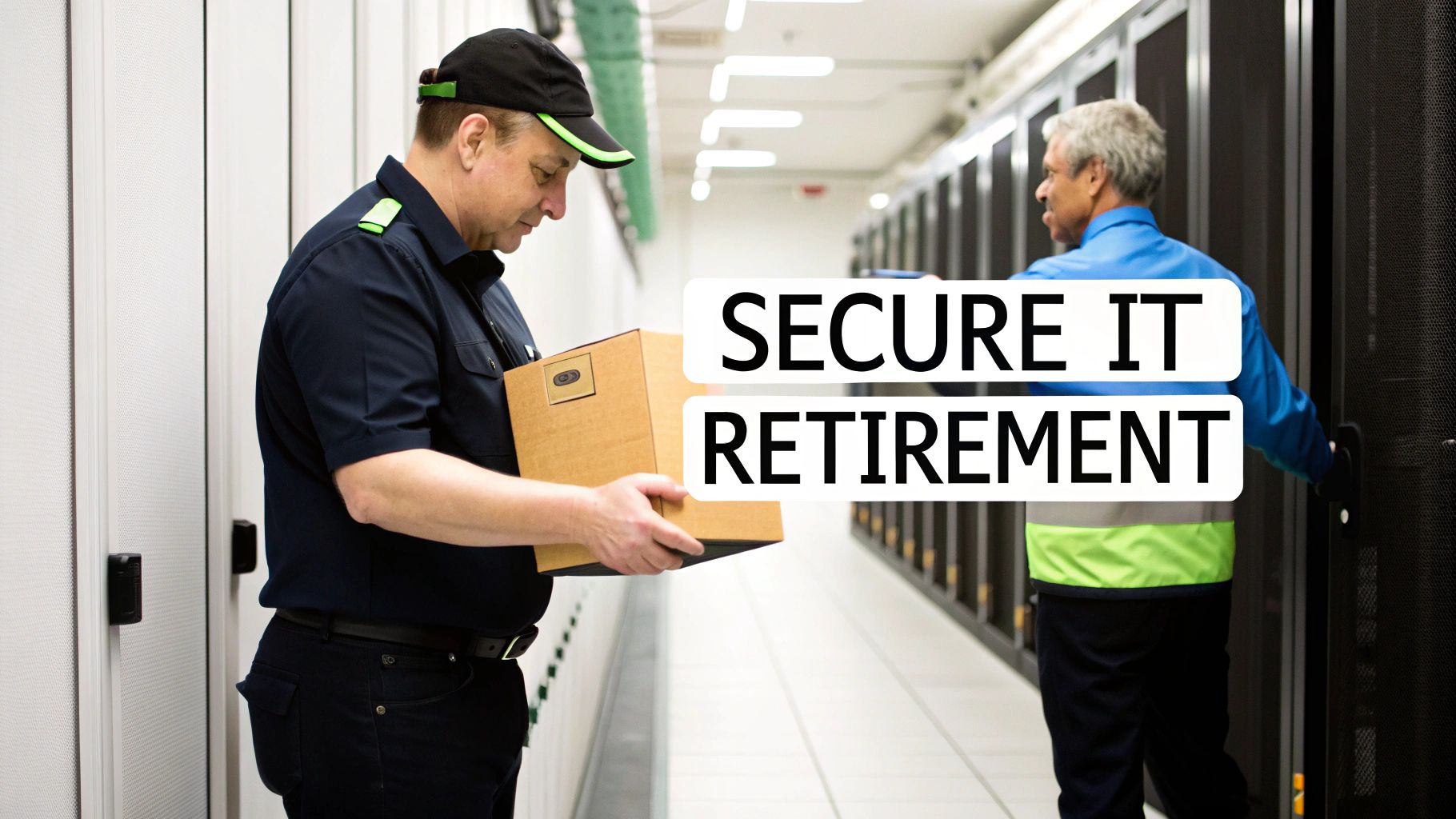
Once a piece of technology reaches the end of its useful life, you can't just unplug it and stick it in a closet. Every single server, hard drive, and laptop holds sensitive company data. Many also contain hazardous materials. Simply tossing this equipment in a dumpster creates massive security holes and environmental headaches.
This is exactly the problem that IT asset disposition (ITAD) companies were created to solve.
An ITAD partner is an expert in managing the entire lifecycle of retired tech assets. Their role is so much more than basic e-waste collection. They deliver a structured, auditable process that shields your organization from the huge risks that come with getting rid of old equipment. For any IT leader or procurement team, this isn't just a service—it's essential for keeping the business safe.
Moving Beyond Simple Recycling
While responsible recycling is part of the job, it’s just one piece of a much bigger puzzle. A true ITAD strategy is built on a foundation of security and maximizing any leftover value. The primary goal isn't just about being green; it’s about protecting your company’s most critical information.
A top-tier ITAD partner handles several key functions:
- Secure Data Destruction: They ensure every bit of data on your old devices is permanently and verifiably destroyed, using strict industry standards to prevent a breach.
- Regulatory Compliance: They expertly navigate the complicated web of environmental and data privacy laws (like HIPAA or FACTA), giving you the paperwork to prove your company did everything by the book.
- Value Recovery: They evaluate equipment for any resale potential, then refurbish and remarket those assets to put money back into your IT budget.
- Secure Logistics: They manage the physical process of decommissioning and transporting assets from your facility with a secure chain of custody, preventing anything from getting lost or stolen along the way.
A Rapidly Growing Necessity
The demand for professional ITAD services is exploding. The global IT asset disposition market is projected to be worth as much as USD 28.32 billion in 2025, with that number expected to climb to USD 40.1 billion by 2035. This huge growth is fueled by faster technology refresh cycles and stricter cybersecurity rules, making professional disposition a critical business function.
In short, an ITAD company acts as your organization's risk manager for retired technology. They turn a complex, hazardous process into a secure, compliant, and potentially profitable one. You get auditable proof that every single asset was handled correctly from the moment it left your hands.
Understanding these fundamentals is the first step toward building a solid asset retirement plan. To see how these services fit into a broader corporate strategy, you can learn more about our comprehensive corporate e-waste solutions.
The Core Services That Define a Premier ITAD Partner
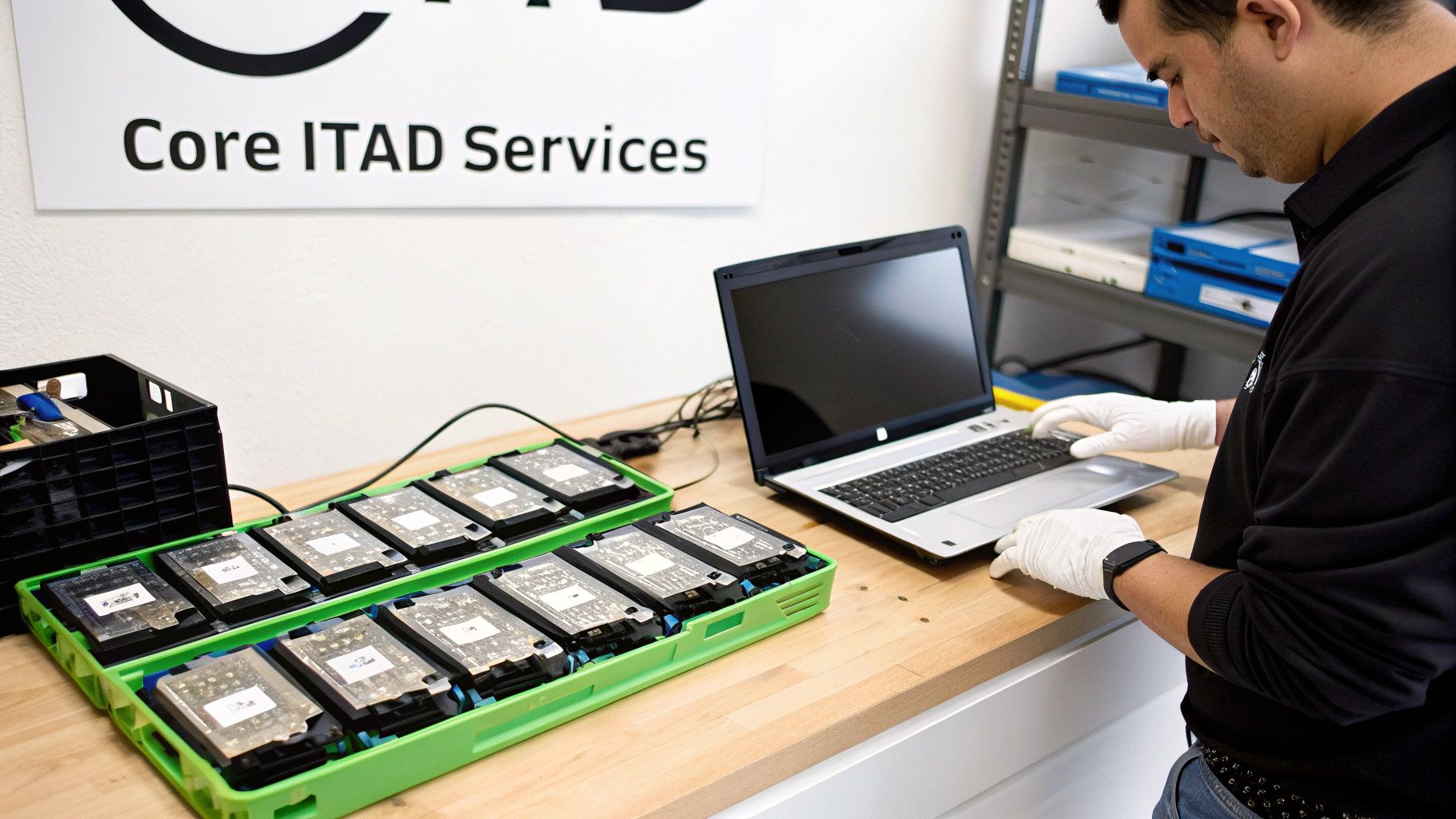
A genuine ITAD company does a lot more than just pick up old equipment. They deliver a complete suite of services built to protect your business from every angle—security, financial, and regulatory. These core functions are what separate a basic recycler from a true strategic partner.
When you work with a professional ITAD provider, they orchestrate a seamless workflow that covers everything from data security to environmental compliance, all documented with painstaking detail. This turns the chore of asset retirement into a managed, value-driven business process.
Before we dive into the specific services, here's a quick overview of what a premier ITAD partner brings to the table and why it matters for your business.
Key ITAD Services and Their Business Impact
| ITAD Service | Description | Primary Business Benefit |
|---|---|---|
| Certified Data Destruction | Irreversibly sanitizing or destroying data on all storage devices using methods compliant with standards like NIST 800-88. | Prevents catastrophic data breaches, ensures regulatory compliance (HIPAA, GLBA), and protects brand reputation. |
| Asset Reuse & Remarketing | Testing, refurbishing, and reselling functional IT assets to recover their remaining market value. | Generates a financial return that offsets ITAD costs, supports circular economy goals, and reduces total cost of ownership. |
| Responsible E-Recycling | De-manufacturing end-of-life electronics to separate commodities and responsibly manage hazardous materials. | Ensures environmental compliance, avoids landfill liabilities, and supports corporate sustainability (ESG) initiatives. |
| Secure Logistics & Decommissioning | Providing on-site de-installation, secure packaging, and GPS-tracked transport from your facility to theirs. | Maintains an unbroken chain of custody, prevents asset theft or loss in transit, and minimizes disruption to your operations. |
| Comprehensive Reporting | Delivering detailed, serialized reports and certificates for data destruction and recycling for every asset. | Provides auditable proof of compliance for regulators and stakeholders, closing the loop on asset lifecycle management. |
Each of these services plays a critical role in creating a secure, compliant, and financially smart IT asset retirement strategy. Let's look at each one more closely.
Certified Data Destruction
This is the absolute, non-negotiable foundation of professional ITAD. Before any device is considered for recycling or resale, the data it holds must be wiped out for good. A retired hard drive with sensitive information still on it is a ticking time bomb for a data breach.
Top-tier it asset disposition companies use methods that meet strict government standards, mainly the NIST 800-88 Guidelines for Media Sanitization, to make sure data is gone forever.
- Data Wiping (Purge): This involves using specialized software to overwrite a drive with random data, often multiple times. It’s perfect for newer, working drives that can be resold.
- Physical Destruction (Destroy): For failed drives or devices holding extremely sensitive information, nothing beats a shredder. Industrial shredders grind hard drives, SSDs, and tapes into tiny, useless fragments.
There's a reason data destruction is such a huge part of the ITAD market. It was valued at USD 5 billion globally in 2025, holding a massive 28.9% market share because the cost of a single data breach is infinitely higher than the cost of doing this right.
Asset Reuse and Remarketing
Not all of your old tech is junk. Many devices, from laptops to data center servers, still have plenty of life—and value—left in them. A smart ITAD partner can identify these valuable assets, refurbish them, and sell them through established channels.
This creates a win-win scenario. Your organization gets back some of its original investment, which can help pay for the ITAD service or even fund new equipment. At the same time, giving electronics a second life is the best form of recycling, as it cuts down on the environmental toll of manufacturing new gear.
The goal of remarketing is to transform a retired asset from a liability into a source of revenue. A skilled ITAD partner has the technical expertise to test and grade equipment accurately, ensuring you receive the maximum possible return.
Responsible Electronics Recycling
For assets that are too old, broken, or have no resale value, responsible recycling is the final stop. This is a far cry from just tossing them in a scrap bin. E-waste is full of hazardous materials like lead, mercury, and cadmium that can poison soil and groundwater if they end up in a landfill.
A certified ITAD partner guarantees that every piece of material is processed in an environmentally safe way. They break down the equipment, separating plastics, metals, and circuit boards. These commodities are then sent to certified downstream partners to be refined and put back into the manufacturing supply chain.
Secure Logistics and Decommissioning
The security of your assets starts the second they’re unplugged. A premier ITAD partner provides secure, end-to-end logistics to protect your equipment from the moment it leaves your control, which is essential for maintaining an unbroken chain of custody.
This service typically includes:
- On-site Services: Trained technicians can come to your office or data center to de-install servers, pack assets, and scan serial numbers before anything leaves the building. This is invaluable for big projects, like a data center cleanout. You can prepare for this with a detailed server decommissioning checklist.
- Secure Transport: Assets are moved in locked, GPS-tracked vehicles driven by vetted and insured personnel.
- Secured Facilities: Once at the ITAD facility, your assets are brought into a secure, access-controlled warehouse with 24/7 video surveillance to prevent any unauthorized access.
Comprehensive Reporting and Certification
Finally, a professional ITAD partner gives you the paperwork to prove everything was handled by the book. This is your auditable proof of compliance. When the project is finished, you should receive a full reporting package that verifies every step.
This package should always include a Certificate of Data Destruction and a Certificate of Recycling. These documents list the make, model, and serial number of every single asset, confirming its secure and compliant retirement. This documentation is your key to passing internal audits and satisfying regulators.
Navigating Critical Compliance and Certifications
When you're handling sensitive information, compliance isn't just a box to check—it's your frontline defense against crippling fines and a damaged reputation. That responsibility doesn't vanish when you retire old IT assets. It simply transfers to your disposition process, making your choice of an IT asset disposition company a direct statement about your commitment to security and governance.
Think of a certified vendor as an expert guide through a ridiculously complex legal landscape. They don't just haul away old equipment; they create an auditable, compliant path that shields you from the severe penalties tied to data privacy and environmental laws. This is non-negotiable for anyone in a regulated industry.
- Healthcare (HIPAA): Patient health information (PHI) must be protected, even on devices collecting dust in a storage closet.
- Finance (FACTA/GLBA): Financial institutions are required to ensure customer data is gone for good—irreversibly destroyed.
- Government (NIST/FedRAMP): Public sector organizations have to follow strict federal data security protocols, no exceptions.
Going with a non-certified vendor is a gamble. You're potentially turning a routine equipment refresh into a costly legal nightmare.
Understanding Key Industry Certifications
Those acronyms you see on an ITAD provider’s website aren't just for show. Certifications are your proof that a vendor operates under strict, third-party audited standards for both data security and environmental responsibility. They're the universal quality control system for the entire industry, and the two most important ones to look for are R2v3 and e-Stewards.
While both are focused on responsible recycling, they have slightly different angles. R2v3 (Responsible Recycling) is a broad standard that covers environmental, health, and safety practices, as well as data security. On the other hand, e-Stewards, which was started by the Basel Action Network, is famous for its zero-tolerance policy on exporting hazardous e-waste to developing countries.
A vendor holding these certifications has poured significant resources into their processes, security, and facility to meet globally recognized best practices. That investment is your assurance that your assets will be handled the right way—ethically and securely—from the moment they leave your building.
Choosing a certified partner means you're working with a provider who has already proven they know how to manage risk.
How Certifications Safeguard Your Organization
Working with a certified ITAD partner takes compliance from a headache to a documented, managed process. Their strict adherence to standards like R2v3 and e-Stewards delivers real, tangible benefits that directly protect your business. For starters, they are required to maintain a secure, unbroken chain of custody for every single asset they touch.
This meticulous documentation is your best friend during an audit. If a regulator ever questions your disposal process, you can hand over a complete, serialized report proving every device was handled by the book. The cornerstone of this proof is the final documentation detailing what happened to each asset. For a closer look at this crucial step, our guide on the importance of a certificate of destruction for hard drives breaks it all down.
Ultimately, these certifications ensure your ITAD partner is equipped to help you navigate complex data privacy laws like GDPR or CCPA. They guarantee every hard drive and server is wiped or destroyed in a way that respects data sovereignty and privacy rights, closing a common—but often overlooked—security gap in the asset lifecycle. This transforms asset disposition from a potential liability into a verified part of your overall risk management strategy.
The Unbreakable Chain of Custody in ITAD Security
The moment you unplug a computer, its security becomes a moving target. That journey from your office to its final destination is filled with potential risks—theft, loss, and unauthorized data access. This is where the chain of custody becomes the single most important part of a secure ITAD process.
Think of it like evidence handling in a high-stakes legal case. Every person who touches the evidence, every place it's stored, and every action taken is meticulously documented. There are no gaps and no moments of uncertainty. A professional ITAD partner applies this same forensic rigor to your retired technology, creating an unbreakable, auditable trail that proves your assets were secure every step of the way.
This documented journey is your peace of mind. It’s the verifiable proof that sensitive data and valuable hardware never fell into the wrong hands.
The Anatomy of a Secure Workflow
A robust chain of custody isn’t just a promise; it's a structured process built on physical security, digital tracking, and strict protocols. Leading it asset disposition companies invest heavily in their infrastructure and people to ensure this chain remains intact.
Here’s what that secure workflow typically looks like in action:
- On-Site Asset Verification: The process starts at your location. Before anything is moved, technicians scan and record the serial number of every single asset designated for pickup, creating an initial inventory list on the spot.
- Secure Logistics: Your assets are then transported in locked, GPS-tracked vehicles operated by vetted and insured personnel. This real-time tracking means you always know where your equipment is.
- Controlled Facility Access: Upon arrival at the ITAD facility, assets are received in a secure, access-controlled area. Only authorized, background-checked employees can handle your equipment.
- Serialized Auditing: As your assets are processed for data destruction or remarketing, each device's serial number is scanned again. This reconciles the shipment against the original inventory list created at your site.
The core principle is simple: every touchpoint is a checkpoint. From your data center to the shredder, each step is logged, timed, and verified, leaving no room for error or ambiguity. This systematic approach is the only way to guarantee end-to-end security.
Why Every Link in the Chain Matters
A single broken link can undermine the entire process. An unvetted driver, an unlocked truck, or a poorly monitored warehouse can create the perfect opportunity for a devastating data breach. That's why premier ITAD vendors enforce strict security measures that go far beyond simple logistics.
This level of discipline is especially vital in North America, which is expected to dominate the ITAD market with a 42.5% global share in 2025, valued at USD 8.37 billion. With the U.S. market projected to grow at an 11.4% CAGR to 2030—driven by state e-waste laws and cybersecurity concerns—the need for secure, scalable logistics is more pressing than ever. You can dig deeper into these market trends and their implications in this in-depth industry analysis.
Ultimately, the chain of custody transforms asset disposition from a logistical task into a core security function. It’s the mechanism that ensures promises of data security are backed by auditable actions. When it's time to retire equipment, you need more than a pickup service; you need a partner who can provide an ironclad, documented journey from start to finish. For more details on that crucial first step, check out our guide on how to properly wipe a hard drive.
How To Choose The Right IT Asset Disposition Company
Picking an ITAD partner isn't just another vendor contract. It's a strategic decision that puts your organization's security, finances, and reputation in someone else's hands. Think of it less like hiring a mover and more like entrusting a firm with the keys to your most sensitive data and valuable hardware. The right partner is a shield; the wrong one is a massive liability waiting to happen.
Making a smart choice means looking far beyond a low-ball price quote. A proper evaluation digs deep into a vendor's processes, certifications, and security culture. This ensures you find a partner who not only handles the logistics but actively reinforces your security and compliance posture.
Assess Their Data Destruction Methodologies
The first place to look—and the most critical—is how a potential partner handles data destruction. This is the absolute foundation of a credible ITAD service. A vague promise to "wipe drives" simply doesn't cut it. You need to see concrete proof of their methods and their commitment to recognized industry standards.
Ask them directly about their process. Do they follow the NIST 800-88 Guidelines for Media Sanitization? This isn't just a nice-to-have; it's the gold standard for making sure data is gone for good. You'll also want to confirm they offer both software-based wiping (for assets you want to reuse) and physical shredding (for older or failed drives). How do they decide which method is appropriate?
A reputable vendor will have no problem providing you with sample Certificates of Data Destruction. These documents should list every single drive by its serial number, giving you an irrefutable audit trail. Anything less is a non-starter.
Verify Security Protocols and Chain of Custody
The second an asset leaves your building, its security becomes the top priority. A vendor’s chain of custody is the documented, auditable trail that proves your equipment was secure every step of the way. You need complete confidence that their security is airtight from pickup to final disposition.
This process flow shows the essential stages of a secure ITAD chain of custody, from initial pickup and tracking to final, certified destruction.
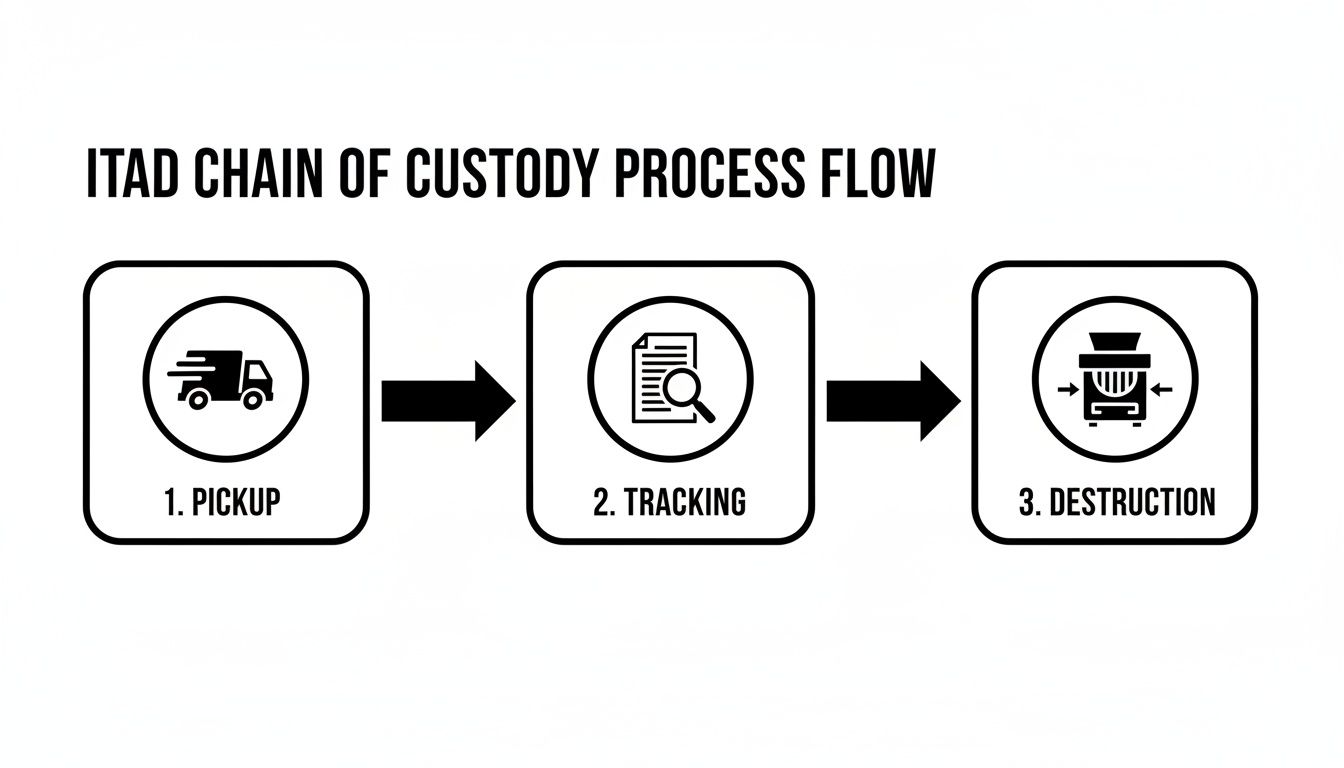
As you can see, a secure process isn't a single event but a continuous, verifiable system that ensures no asset ever falls through the cracks.
Key security elements to demand from IT asset disposition companies include:
- Secure Logistics: Are they using locked, GPS-tracked vehicles? Are the drivers background-checked, insured, and properly vetted?
- Facility Security: Is their processing facility under 24/7 surveillance with strict access controls? Do they undergo regular security audits?
- Serialized Tracking: Can they give you a real-time, serialized inventory of your assets from the moment they leave your dock?
A vendor who stumbles on these questions is waving a giant red flag. An inability to demonstrate a bulletproof chain of custody is a direct measure of the risk you’d be taking on.
Confirm Environmental Certifications and Compliance
Responsible electronics recycling is a core part of any ITAD program. It protects the environment, sure, but it also protects your company from the legal and financial fallout of improper e-waste disposal. Checking a vendor's environmental credentials is just as crucial as verifying their security.
The two most respected certifications in the industry are R2v3 (Responsible Recycling) and e-Stewards. These aren't just logos they can slap on a website. They represent a serious commitment to rigorous, third-party audited standards for environmental safety, worker protection, and data security. A certified partner gives you a guarantee they won't illegally export hazardous materials and that everything will be processed responsibly.
Ask to see their current certificates. A transparent partner will provide them without hesitation. This is your proof that your retired assets won’t become someone else’s toxic problem—or your next compliance nightmare. For any organization vetting partners, it's wise to compare the certified practices of various computer recycling companies.
Evaluate Value Recovery and Reporting Transparency
While security and compliance always come first, a good ITAD partner can also find significant value in your retired assets. Through remarketing, a disposition project can shift from being a line-item expense to a revenue source that helps offset your costs.
Transparency is everything here. The vendor needs to provide a crystal-clear explanation of their value recovery model. How do they test and grade equipment? What is their fee structure? How is the final resale value determined? Look for a partner who offers an open-book profit-sharing model and provides financial reports that cleanly break down the revenue from your assets.
Finally, insist on world-class reporting. A top-tier partner should give you access to a secure online portal where all your project documentation lives. This should include everything from the initial pickup manifests to the final Certificates of Destruction and detailed financial settlements, giving you a complete, auditable record for every single asset.
Choosing the right ITAD partner requires due diligence, but the peace of mind is invaluable. To help streamline your evaluation, we've created a practical checklist outlining what to look for—and what to avoid.
Vendor Selection Checklist for ITAD Partners
| Evaluation Criteria | What to Look For (Best Practice) | Red Flags to Avoid |
|---|---|---|
| Data Destruction | Adherence to NIST 800-88. Offers both certified wiping and physical shredding. Provides serialized Certificates of Destruction. | Vague promises to "wipe drives." No clear standard or process. Incomplete or non-serialized reporting. |
| Security & Chain of Custody | GPS-tracked vehicles, vetted drivers, secure facilities with 24/7 surveillance, and end-to-end serialized asset tracking. | Unsecured transport, lack of facility audits, or gaps in the tracking process where assets are "unaccounted for." |
| Environmental Compliance | Current R2v3 or e-Stewards certification. Can provide copies of their certificates and audit reports. | No third-party certifications. Unwillingness to share compliance documentation. Vague downstream recycling process. |
| Value Recovery & Remarketing | Transparent, documented process for testing, grading, and pricing assets. Clear profit-sharing model and detailed financial reporting. | Hidden fees, complex commission structures, or an inability to explain how resale values are determined. |
| Reporting & Documentation | Secure online portal with on-demand access to all project documents, including inventories, certificates, and financial settlements. | Manual, inconsistent reporting. Lack of a central portal for documentation. Reports that are difficult to audit or understand. |
This checklist serves as a solid starting point. A truly reliable partner will not only meet these criteria but will welcome your questions and be eager to demonstrate their commitment to protecting your organization.
Frequently Asked Questions About ITAD Services
When you're dealing with retiring company hardware, a lot of questions come up. It's completely normal, especially if you're facing tough compliance demands for the first time or just trying to understand the process better.
Getting a handle on the differences between services and what they actually mean for your business is crucial. Here are the most common questions we hear from IT managers and operations leaders when they start looking for it asset disposition companies.
What Is The Difference Between E-Waste Recycling And ITAD?
Think of it this way: e-waste recycling is just one piece of the much larger ITAD puzzle. A standard e-waste recycler is focused on one thing—breaking down old electronics into basic commodities like plastic, copper, and aluminum. Their job is all about material recovery and meeting environmental disposal rules.
An ITAD company, on the other hand, provides a complete, security-focused service from start to finish. ITAD covers everything from secure logistics and certified data destruction to detailed asset tracking and remarketing equipment to recover its value. The whole process puts your data security and financial return first, long before recycling is even on the table.
Recycling is simply the last resort for assets with no useful life left. ITAD is the entire strategic process that gets them to that point safely and securely.
How Can We Verify Our Data Is Completely Destroyed?
A professional ITAD partner will provide a Certificate of Data Destruction, which is your official, auditable proof that your information has been permanently wiped out. This isn't just a simple receipt; it's a formal legal document that lists the unique serial number of every single hard drive or storage device that was sanitized or physically destroyed.
The actual destruction process follows strict government and industry standards, most notably NIST 800-88. This framework outlines the correct methods for both software-based wiping (for drives that can be reused) and physical shredding (for older or failed hardware).
The combination of a certified process and serialized reporting gives you an ironclad guarantee that the data is gone for good. This is the documentation you'll need to prove to auditors, stakeholders, and regulators that you've met your legal obligations.
This verifiable proof is absolutely essential for protecting your organization from the massive financial and reputational fallout of a data breach.
What Is The Real Cost Of Using An ITAD Company?
It’s a common mistake to see ITAD as just another line-item expense. A better way to look at it is as an investment in risk management. The potential cost of a single data breach—which can easily climb into the millions—or a fine for improper disposal is far greater than the fees for a professional disposition service.
Of course, service costs depend on a few things:
- Logistics: How many locations you have, the amount of equipment, and if you need on-site services.
- Asset Type: The mix of gear, like servers, laptops, or specialized medical devices.
- Data Destruction Method: The level of data wiping or physical shredding required.
But here’s the key part many people miss: value recovery. For your newer or more valuable equipment, your ITAD partner can test, refurbish, and resell it, returning a good portion of the revenue back to you. In many projects, this recovered value can significantly offset—or even completely cover—the service costs, turning what you thought was an expense into a net positive for your IT budget.
Can One ITAD Partner Handle Our Nationwide Locations?
Absolutely. Leading ITAD providers offer nationwide logistics to ensure you get consistent, secure service across all your business locations. This is a critical factor for any enterprise-level company with a distributed workforce or multiple data centers.
Using a single partner for all your sites has huge advantages. It creates one uniform standard for data security, environmental compliance, and reporting, no matter where an office is. This makes vendor management simple, streamlines audits, and guarantees that every location—from headquarters to the smallest remote branch—is following the exact same secure, documented procedures.
A partner with a national reach can manage complex, multi-site pickups, making sure every single asset is handled under the same strict chain of custody. You eliminate the risk of sloppy or inconsistent security practices that can creep in when you're juggling multiple local vendors.
When your organization needs a reliable, nationwide partner for secure and compliant technology retirement, Dallas Fortworth Computer Recycling delivers. With over a decade of experience, we provide end-to-end ITAD services, from certified data destruction to responsible recycling, all backed by a documented chain of custody. Learn more about our secure IT asset disposition solutions.