
IT equipment recycling McKinney: Secure IT Asset Disposal & Compliance
For businesses in McKinney, IT equipment recycling is a critical process for securely and compliantly disposing of outdated technology. This involves far more than just discarding old computers; it requires a formal strategy to protect sensitive data, comply with environmental laws, and manage potential liabilities.
Why Your McKinney Business Needs a Formal ITAD Strategy
Moving past the simple idea of "getting rid of old computers" is essential for any modern McKinney business. A formal IT Asset Disposition (ITAD) plan isn't a luxury—it's a strategic necessity for organizations operating within the dynamic North Texas tech corridor. Without one, you're exposing your company to significant, and often underestimated, risks.
Improperly discarded hard drives, for instance, can lead to devastating data breaches long after the equipment has left your building. At the same time, incorrect e-waste disposal can result in heavy fines under Texas environmental laws and cause lasting damage to your brand's reputation.
The Real-World Risks of Improper Disposal
Let's walk through a common scenario. A growing McKinney-based firm upgrades its employee laptops. The old devices get stacked in a storage closet, seemingly out of sight and out of mind. The reality is that each one still contains sensitive company data, from financial records to client information. Without a proper ITAD process, these assets are a ticking time bomb.
An informal "recycling" run could easily lead to these devices ending up in the wrong hands, creating a direct path to a data breach. This is where a structured approach becomes invaluable. A professional partner specializing in IT equipment recycling in McKinney transforms this potential liability into a secure, documented, and compliant activity. You can learn more about this structured approach by exploring what IT Asset Disposition is and how it safeguards businesses.
A formal ITAD process is about more than just disposal; it's a fundamental component of risk management. It protects your data, upholds your environmental responsibility, and safeguards your bottom line.
The Growing Global E-Waste Challenge
The need for responsible recycling isn't just a local concern; it's a global one. The e-waste crisis is intensifying at an alarming rate, with electronic waste rising five times faster than documented recycling efforts. Small IT equipment alone contributed 4.6 million tonnes to this problem, with a dismal recycling rate of just 22%.
This global context underscores why partnering with a certified ITAD provider is so important. These professionals ensure your assets don't contribute to this growing problem.
A formal ITAD plan delivers tangible benefits:
- Data Security Assurance: Through certified data destruction methods like shredding or wiping to NIST 800-88 standards.
- Regulatory Compliance: Adherence to environmental regulations such as those set by the Texas Commission on Environmental Quality (TCEQ).
- Brand Protection: Demonstrating a commitment to corporate social responsibility and protecting your company’s public image.
- Value Recovery: Potentially generating revenue from remarketing viable equipment, which can offset recycling costs.
Building Your Internal Asset Retirement Framework
Before you can partner with a service for IT equipment recycling in McKinney, you need to get your own house in order. A solid internal asset retirement framework is your first and best defense against data breaches and compliance failures. This process ensures every retired device is accounted for, sanitized, and ready for its final disposition, making the handoff to a recycling partner much smoother and more secure.
It all starts with a comprehensive inventory. You simply can’t protect what you don’t know you have. That means creating a detailed log of every single asset slated for retirement.
This initial inventory becomes the foundation of your chain of custody—an unbroken, auditable trail that documents an asset's entire journey, from the moment it's taken offline to its final destruction or resale.
Establishing Your Asset Inventory and Chain of Custody
A proper asset log is more than a simple list of old computers. To ensure full accountability, your IT team must document specific, critical details for each device.
Your inventory should include:
- Asset Tag or Serial Number: The unique identifier for tracking.
- Asset Type: E.g., laptop, server, switch, mobile phone.
- Manufacturer and Model: This is important for assessing any potential resale value.
- Data-Bearing Status: A simple "Yes" or "No" to flag which devices require sanitization.
- Assigned User or Department: Helps trace the asset's history and potential data sensitivity.
- Retirement Date: When the asset was officially removed from service.
This level of detail is non-negotiable. If an auditor ever questions the disposal of a specific server, you'll have a complete record to demonstrate responsible handling. It also helps your recycling partner provide an accurate quote and plan logistics more efficiently. For a deeper look at this process, you can read our in-depth article on IT asset management best practices.
Failing to establish this framework introduces serious risks.
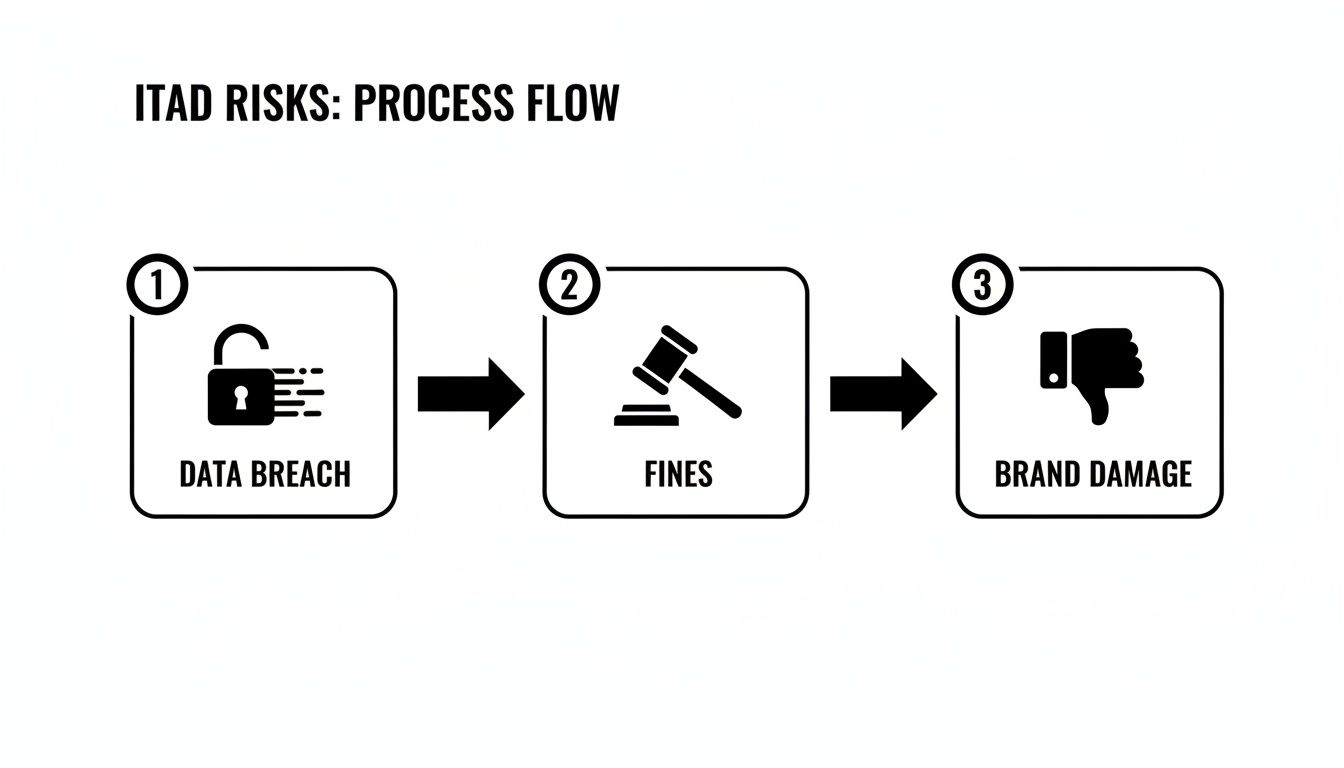
As the flow shows, a data breach can lead directly to heavy financial penalties and lasting damage to your company's reputation.
Choosing the Right Data Destruction Method
With your inventory in place, the next critical step is data sanitization. Just deleting files isn't enough; that data is often still recoverable. You have to choose a destruction method that aligns with your security policies and the types of data you handle.
The goal is to render all data completely irretrievable. There are three primary ways to do this, and each has its place depending on the asset and your organization's risk tolerance.
Making the right choice isn't just a technical decision—it's a business one. Choosing a method that’s insufficient for your data's sensitivity is a compliance failure waiting to happen. To help you decide what's right for your McKinney business, let's compare the main options.
Data Destruction Methods Explained
| Method | Description | Best For | Key Consideration |
|---|---|---|---|
| Software Wiping | Uses specialized software to overwrite existing data on a hard drive with random characters. | Laptops, desktops, and servers that may be resold or redeployed. | Must be verified to meet standards like NIST 800-88 to be considered compliant. |
| Degaussing | Exposes magnetic media (like HDDs and tapes) to a powerful magnetic field, scrambling the data. | Older magnetic tapes and hard drives that will not be reused. | Renders the drive completely inoperable and is not effective on Solid-State Drives (SSDs). |
| Physical Shredding | The media is physically destroyed by an industrial shredder, breaking it into small, irrecoverable pieces. | All media types, especially SSDs and high-security hard drives. | This is the most secure method, providing visual proof of destruction. It eliminates any possibility of reuse. |
For many organizations, a hybrid approach works best. You might wipe less sensitive devices for potential resale while physically shredding any devices that contained PII or proprietary IP. This strategy effectively balances security with the opportunity for value recovery.
By building out this internal framework—from inventory to data destruction—you prepare your organization for a seamless and secure handoff to your IT equipment recycling McKinney partner. This internal diligence is the key to mitigating risk and turning IT retirement from a liability into a well-managed business process.
How to Choose the Right IT Recycling Partner in McKinney
Picking the right vendor for your IT equipment recycling in McKinney is the single most important decision you'll make in the entire asset disposition process. This isn't just about finding someone to haul away old electronics. It’s about entrusting a partner with your company's sensitive data, your legal compliance, and your brand reputation.
The right partner becomes a seamless extension of your IT and compliance teams. The wrong one? They can expose your business to staggering data breach fines, environmental penalties, and public relations nightmares. You have to look past the slick marketing and dig into how they actually operate.
Look for Certifications That Protect Your Business
In the electronics recycling industry, certifications are your first line of defense. They are the clearest indicator of a vendor's commitment to security and responsible processing, but not all are created equal. For any business in McKinney or the greater Dallas-Fort Worth area, two standards matter most: R2v3 and e-Stewards.
A vendor holding these certifications isn't just making promises. They are subject to continuous, rigorous third-party audits that verify their processes from start to finish.
R2v3 (Responsible Recycling): This is the leading global standard for our industry. An R2v3-certified recycler must follow strict protocols for data security (including standards like NIST 800-88), environmental protection, and worker safety. It guarantees a clear, auditable chain of custody for every asset.
e-Stewards: Developed by the Basel Action Network, this certification is known for its absolute prohibition against exporting hazardous e-waste to developing nations. It's your guarantee that your equipment won’t end up harming vulnerable communities or polluting the environment overseas.
When a potential vendor says they're "certified," your immediate follow-up should be, "Certified in what, and can I see a copy of your current certificate?" A legitimate partner will have this ready for you without hesitation.
Choosing a certified partner is more critical than ever. The global computer recycling market is projected to grow to an incredible $22,981.53 million by 2033. This boom, fueled by new regulations and corporate sustainability goals, means the market is crowded. Certification helps you cut through the noise. You can learn more about this growing market's trends and see why professional risk management is key.
The Non-Negotiable Site Visit
Reading about security protocols is one thing. Seeing them in action is another. Before you sign any contract for IT equipment recycling in McKinney, you must conduct a site visit or, at the very least, a detailed virtual tour of their facility. This is your chance to verify their claims with your own eyes.
Pay close attention to these key areas during your tour:
Secure Access Control: Is the facility properly secured with gates, cameras, and controlled entry points? Critically, is there a clear, enforced separation between public access areas and the secure processing zones where your assets will be?
Chain of Custody Procedures: Ask for a walkthrough of their process from receiving to final disposition. You should see organized, segregated areas for incoming assets, equipment waiting for data destruction, and processed materials. Chaos is a major red flag.
Data Destruction Area: Is the hard drive shredding or wiping area physically secure and monitored by cameras? A disorganized or unsecured destruction area tells you everything you need to know about their commitment to data security.
If a vendor refuses to allow a site tour, walk away. It's a dealbreaker. Reputable recyclers are proud of their facilities and are transparent about their operations.
Key Questions for Your RFP
Your Request for Proposal (RFP) is the tool you use to formally compare potential partners. It's time to move beyond generic questions about price and ask pointed questions that reveal a vendor’s real capabilities. For a starting point, you can review our list of top-rated IT asset disposition companies.
Make sure your RFP includes these critical questions to properly vet your candidates:
- Downstream Vendor Transparency: "Can you provide a complete downstream vendor map showing where all non-reusable materials, like hazardous waste and circuit boards, are sent for final processing?"
- Data Destruction Verification: "What specific methods do you use for data destruction, and how do you verify and document the successful sanitization of each individual drive or device?"
- Insurance and Liability: "What are the liability limits of your pollution liability and data breach insurance policies? Please provide a current certificate of insurance."
- Employee Screening: "What are your procedures for background checks and security training for all employees who will handle client assets?"
The answers you get will quickly separate the professional ITAD partners from the simple scrap haulers, ensuring you choose a company that truly protects your interests.
Mastering Pickup Logistics and On-Site Services
Once you’ve vetted and selected an ITAD partner, the real work begins. This is where the plan meets the pavement—literally. The logistics of getting retired IT assets out of your McKinney facility require careful coordination to ensure the handoff is secure, efficient, and fully documented.
This isn't just about calling for a truck. Proper preparation on your end makes a world of difference. Before the pickup crew arrives, take the time to segregate your assets. Grouping data-bearing devices like servers and laptops separately from non-sensitive items like monitors and keyboards allows the team to work faster and prioritize the most critical equipment.
Preparing Your Equipment for Transport
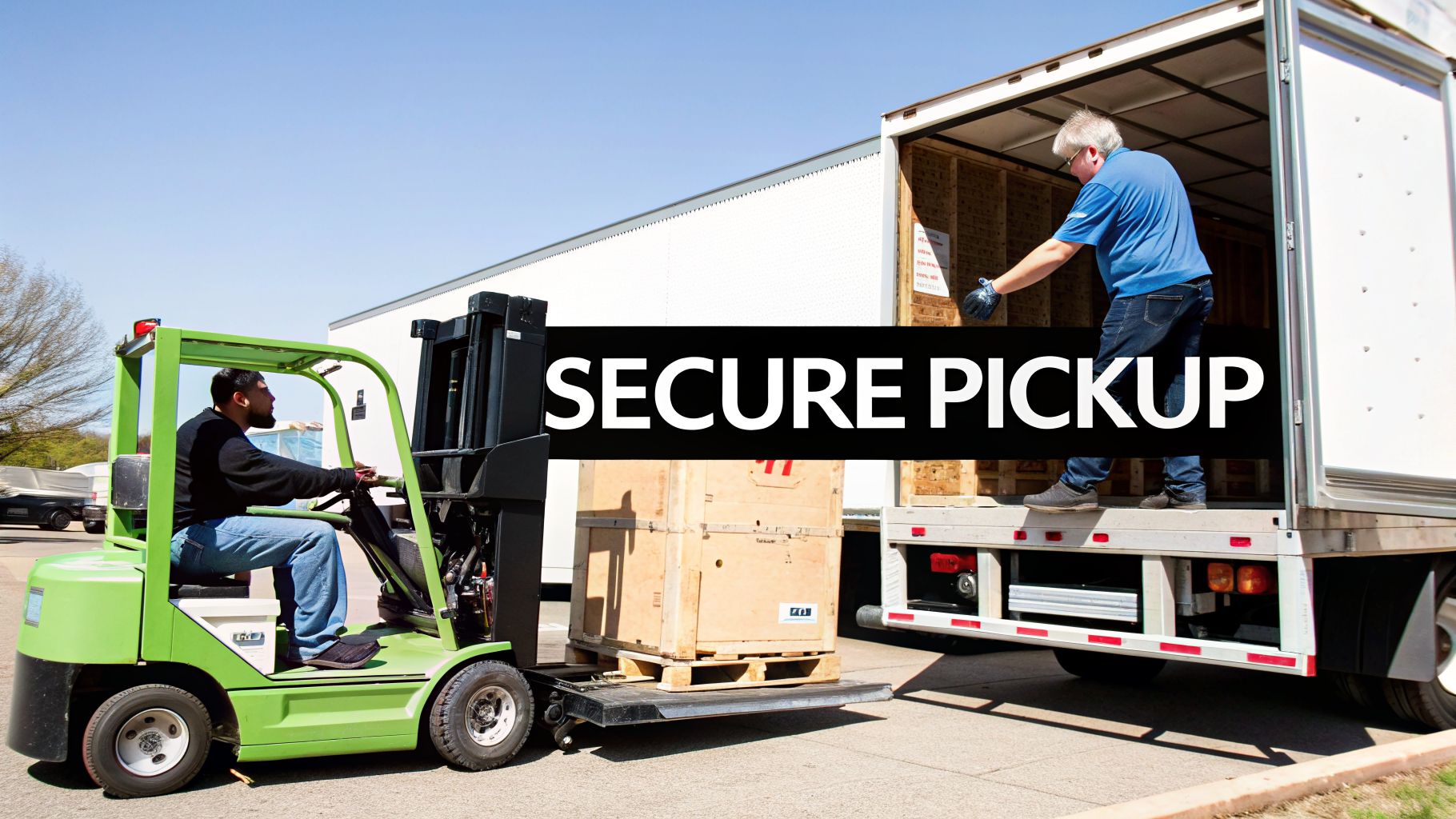
How you stage your equipment directly impacts the speed and security of the removal. For any significant volume, proper palletizing is a must. This means securely shrink-wrapping stacked devices onto pallets to prevent them from shifting or getting damaged in transit. A good partner can provide clear instructions on this, or even handle the palletizing for you.
Think about a McKinney financial services firm retiring 300 workstations. Leaving them scattered across a floor would be a logistical nightmare. Instead, the IT team stacks the desktops on pallets and secures all the associated hard drives in a locked cage. This simple organizational step can turn a chaotic, hours-long job into a quick and professional removal.
The goal is to maintain the chain of custody you worked so hard to establish. Clear segregation and proper staging eliminate confusion and security gaps from the moment the equipment leaves your control.
The Decisive Advantage of On-Site Services
For many IT leaders, the only way to achieve absolute peace of mind is to witness data destruction firsthand. This is where on-site services, especially mobile hard drive shredding, are invaluable. Instead of your sensitive data traveling across town, the shredder comes directly to your office.
This completely erases the risk of data being compromised in transit—often the most vulnerable point in the ITAD process. A specialized truck with an industrial-grade shredder parks at your facility, and your team can physically watch as every hard drive, SSD, or backup tape is turned into tiny, irrecoverable pieces.
The assurance offered by on-site services is often worth the investment, particularly for organizations handling highly sensitive information. If you're exploring this route, you can learn more about on-site shredding services near you and see how it fits your security protocol.
Streamlining the Entire Process
A true partner in IT equipment recycling in McKinney manages all the complexities of the removal, whether it's from a tidy corporate office or a sprawling data center.
A professional pickup process should always include:
- Flexible Scheduling: They work around your business hours to minimize any disruption to your operations.
- Professional Crew: The technicians who arrive should be trained, background-checked, and know how to handle sensitive electronics.
- The Right Tools: They’ll show up prepared with dollies, pallet jacks, rolling bins, and secure cages for a smooth removal.
- On-Site Asset Verification: Before anything leaves your building, they should scan asset tags to reconcile the physical gear with your inventory list. This ensures every single device is accounted for.
This seamless execution is what separates the pros from the amateurs. They handle the heavy lifting and logistical headaches, freeing up your team to focus on their core duties. This coordinated approach ensures the final, physical step of your ITAD plan is just as secure and compliant as everything that came before it.
Finalizing Your Disposition and Maximizing Value Recovery
The job of IT equipment recycling in McKinney isn’t over when the truck leaves your loading dock. The process is only complete once you have final, auditable documentation in hand. This last phase is your proof of compliance, safeguarding your business and unlocking residual value from retired assets.
Your recycling partner's work should conclude with two critical deliverables. The first is a Certificate of Destruction (CoD), a legal document confirming that all data-bearing devices were sanitized or physically destroyed according to standards like NIST 800-88.
The second is a detailed, serialized asset disposition report. This isn’t a simple packing slip; it’s a comprehensive spreadsheet that officially closes the loop on the chain of custody established at pickup.

What to Look for in a Final Disposition Report
A compliant report must reconcile perfectly against the initial inventory you created. It provides a definitive, line-item-by-line-item account of each asset's journey and final outcome.
A truly auditable disposition report will always include:
- Original Asset Identifiers: Your internal asset tags or the serial numbers you provided.
- Device Details: Manufacturer, model, and equipment type (e.g., Dell Latitude 7420 Laptop).
- Data Destruction Method: Explicit confirmation of how data was handled for that specific device (e.g., "NIST 800-88 Wipe" or "Shredded").
- Final Disposition Status: The final outcome for each piece of hardware, such as "Recycled," "Remarketed," or "Donated."
This level of detail is non-negotiable. When an auditor asks what happened to a specific server that once held sensitive customer data, this report gives you a clear, documented, and defensible answer.
Uncovering Hidden Value in Your Retired Assets
With compliance confirmed, the focus can shift to a major benefit of professional ITAD: value recovery. Not all retired technology is e-waste. In fact, many devices, especially those less than five years old, retain significant resale value.
This process, known as IT asset remarketing, involves your partner testing, refurbishing, and reselling viable equipment on your behalf. The revenue generated is then shared back with you, turning a potential cost center into a source of income that can offset the expense of your disposition project.
What Equipment Holds the Most Value?
- Enterprise Servers and Networking Gear: Switches, routers, and servers from brands like Cisco, Dell, and HPE often command high prices on the secondary market.
- Business-Class Laptops: Recent-generation models from Lenovo, Dell, and HP are always in demand.
- Specialized Workstations: High-performance machines used for engineering or graphic design are excellent candidates for resale.
For more guidance on this, our team has put together a helpful resource on where you can sell used computer parts to get the best return.
Enhancing Your CSR Through Strategic Donations
Beyond direct revenue, there's another way to extract value. For equipment that is still functional but has minimal resale value, donation is an excellent alternative.
Partnering with a recycler who can facilitate donations to local McKinney-area schools or nonprofits does more than just clear out storage space. It strengthens your company’s corporate social responsibility (CSR) profile and makes a real impact in the community.
This demonstrates a commitment to sustainability and community support, turning retired hardware into a powerful tool for organizations that need it most. By finalizing your documentation, exploring remarketing, and considering donations, you complete the ITAD lifecycle in a way that is secure, compliant, and strategically beneficial.
Common Questions About IT Equipment Recycling in McKinney
As IT leaders in McKinney plan for equipment retirement, plenty of questions come up. We hear them every day. Here are direct answers to the most common queries we get from businesses, giving you the clarity needed to manage your IT asset disposition with confidence.
What Types of IT Equipment Can We Recycle?
A professional IT equipment recycling in McKinney partner should be able to handle just about any electronic asset your business uses—not just the obvious things like desktops and laptops.
Your ITAD provider needs the capability to process a wide range of equipment, including:
- Servers, storage arrays, and complete data center hardware
- Networking gear like switches, routers, and firewalls
- Desktop PCs, laptops, and tablets
- Monitors, printers, copiers, and peripherals
- Company smartphones and other mobile devices
The key is to confirm they provide serialized tracking for every single data-bearing device. This isn't just for high-value items; it's essential for creating a complete, auditable trail that satisfies any compliance check.
Is Our Data Really Secure During the Process?
This is usually the biggest concern we hear, and the answer is a firm "yes"—but only if you choose a certified partner. For a professional ITAD service, data security isn't just one step in the process; it's the entire foundation of what we do.
Your confidence should come from their certifications and documented procedures. Look for vendors holding R2v3 or e-Stewards certifications. These aren't just plaques on a wall; they mandate strict chain-of-custody protocols and data destruction methods that align with standards like NIST 800-88.
For absolute peace of mind, nothing beats on-site hard drive shredding. This service brings the destruction equipment right to your McKinney office, so you can witness your data being physically destroyed before the assets ever leave your control.
What Do the R2v3 and e-Stewards Certifications Mean?
Think of these certifications as the industry's seal of approval. They prove a vendor is committed to secure, responsible recycling and require tough, ongoing third-party audits to maintain.
- R2v3 (Responsible Recycling): This is the leading global standard. It validates a recycler’s processes for data security, environmental protection, and worker health and safety, ensuring accountability from start to finish.
- e-Stewards: This standard is famous for its zero-tolerance policy against exporting hazardous e-waste to developing nations. An e-Stewards partner guarantees your company's name will never be tied to irresponsible disposal practices overseas.
When a partner holds both, you know they are fully committed to doing things the right way.
Can We Get Money Back for Our Old Equipment?
Absolutely. This is called value recovery or IT asset remarketing, and it can turn a disposal cost into a budget-positive project. If your retired equipment still has a useful life (typically devices under 3-5 years old), it can be resold.
A good partner will test and refurbish this equipment to sell through established secondary markets. That revenue can then be returned directly to your organization or applied as a credit to offset the costs of recycling your older, non-functional assets.
When it comes to protecting your organization's data and reputation, choosing the right partner is paramount. Dallas Fortworth Computer Recycling offers certified, secure, and compliant ITAD solutions tailored for businesses nationwide. Get a quote and ensure your asset disposition is handled with the highest level of professionalism and security.