
ITAD services Plano: Secure Data Destruction, Recycling, and Value Recovery
Staring at a server room full of outdated hardware? Proper ITAD services in Plano aren’t just about disposal—they’re a secure, compliant, and often profitable solution for managing retired technology. For modern businesses, ITAD has become an absolutely critical function.
Why ITAD Is Now a Mission-Critical Function in Plano
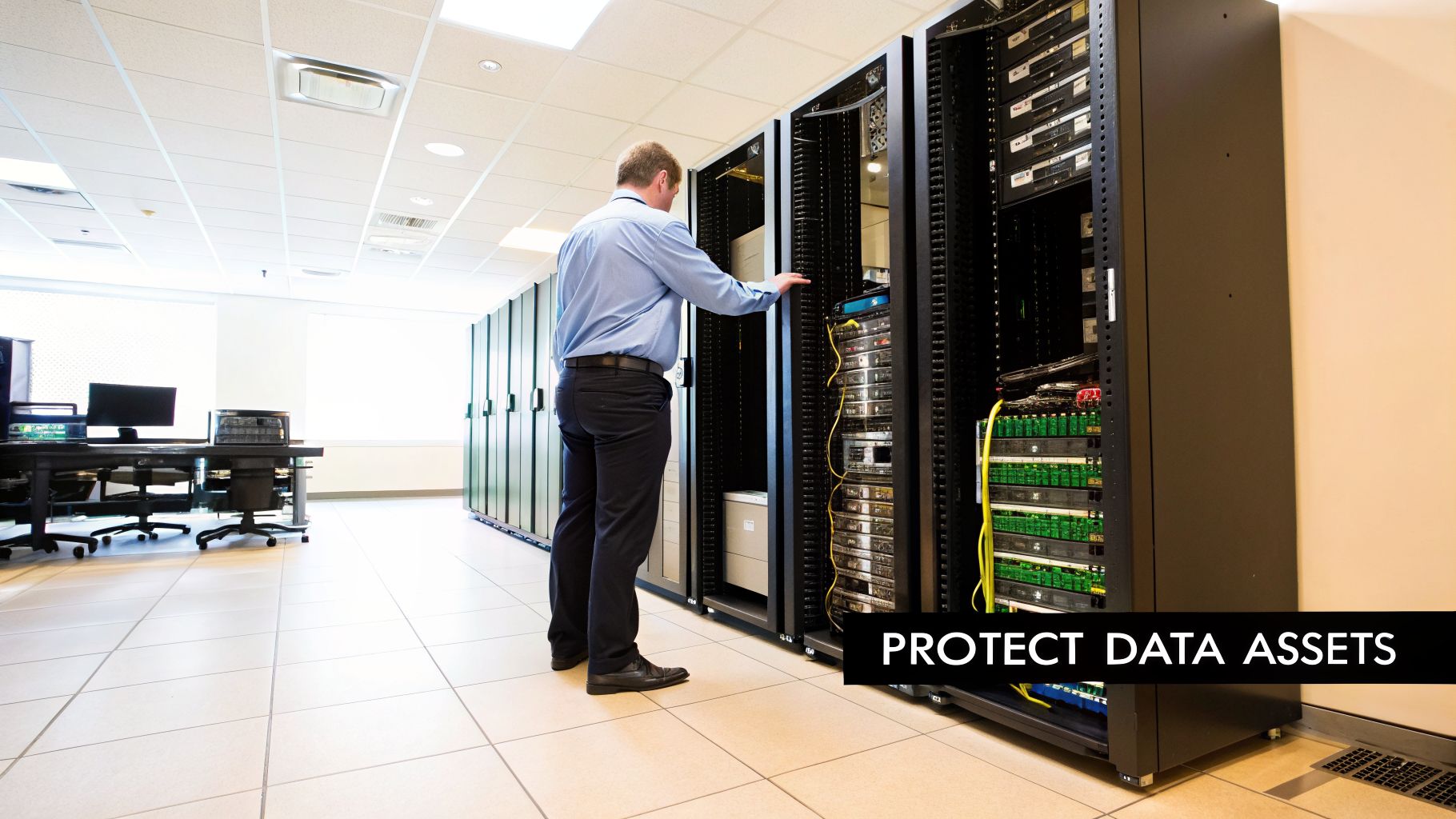
Think about it from the perspective of an IT director at a growing Plano financial services firm. After a major data center refresh, you're left with dozens of servers, storage arrays, and network switches. These devices don’t just take up valuable space; they’re packed with years of sensitive client data.
Simply shoving them into a storage closet or calling a generic junk hauler creates an enormous risk. A single lost hard drive could easily trigger a data breach, leading to devastating regulatory fines and a complete loss of customer trust. This isn't a hypothetical anymore—it’s a real-world pressure facing DFW businesses every single day.
This is exactly where a strategic IT Asset Disposition (ITAD) plan becomes non-negotiable. It’s no longer a 'nice-to-have' but a core part of modern risk management and financial strategy. The days of treating old electronics as simple trash are long gone.
The New Reality of Asset Retirement
The rapid pace of tech upgrades means equipment lifecycles are shorter than ever. This constant refresh cycle, combined with tightening data privacy laws like HIPAA for healthcare and GLBA for finance, has created a perfect storm. Companies can no longer afford to be casual about how they retire old assets.
Here’s what’s driving the need for professional ITAD services:
- Data Breach Prevention: A single device that’s improperly disposed of can expose your entire organization. Certified data destruction is your only real line of defense.
- Regulatory Compliance: Failing to meet legal requirements for data privacy and e-waste can result in severe penalties and lasting reputational damage.
- Environmental Responsibility: With e-waste becoming a major concern, demonstrating a commitment to sustainability is vital. A partner that understands responsible recycling helps you meet those goals. You can learn more about the specifics of Plano electronics recycling.
- Value Recovery: Don't forget, many retired assets still have residual value. A skilled ITAD partner can refurbish and resell equipment, turning a potential cost center into a revenue stream.
This shift is backed by serious market growth. The global ITAD market, valued at USD 21.98 billion in 2025, is projected to reach an incredible USD 53.49 billion by 2035.
More Than Just Disposal
This booming market is a direct response to these heightened risks and new opportunities. The U.S. market alone is forecasted to grow from USD 7.03 billion in 2025 to over USD 18.45 billion by 2035, driven heavily by compliance mandates like NIST 800-88. You can read the full research about these market trends and their drivers.
A professional ITAD provider in Plano doesn't just haul away old gear. They deliver an end-to-end, auditable service that includes secure logistics, serialized asset tracking, certified data destruction, and detailed reporting that proves your compliance. Choosing the right partner means turning a complex liability into a secure, managed, and even profitable process.
Decoding ITAD Certifications and Compliance
When you're trying to choose an ITAD partner, the long list of certifications can feel like an alphabet soup. Standards like R2v3, RIOS, and e-Stewards are more than just logos on a website—they are your first line of defense against data breaches, steep fines, and environmental trouble.
For any business in Plano, understanding what these credentials actually mean is the key to finding a professional partner, not just a scrap hauler. These certifications prove a vendor follows strict, audited procedures for everything from secure data destruction to responsible recycling.
The High Stakes of Non-Compliance
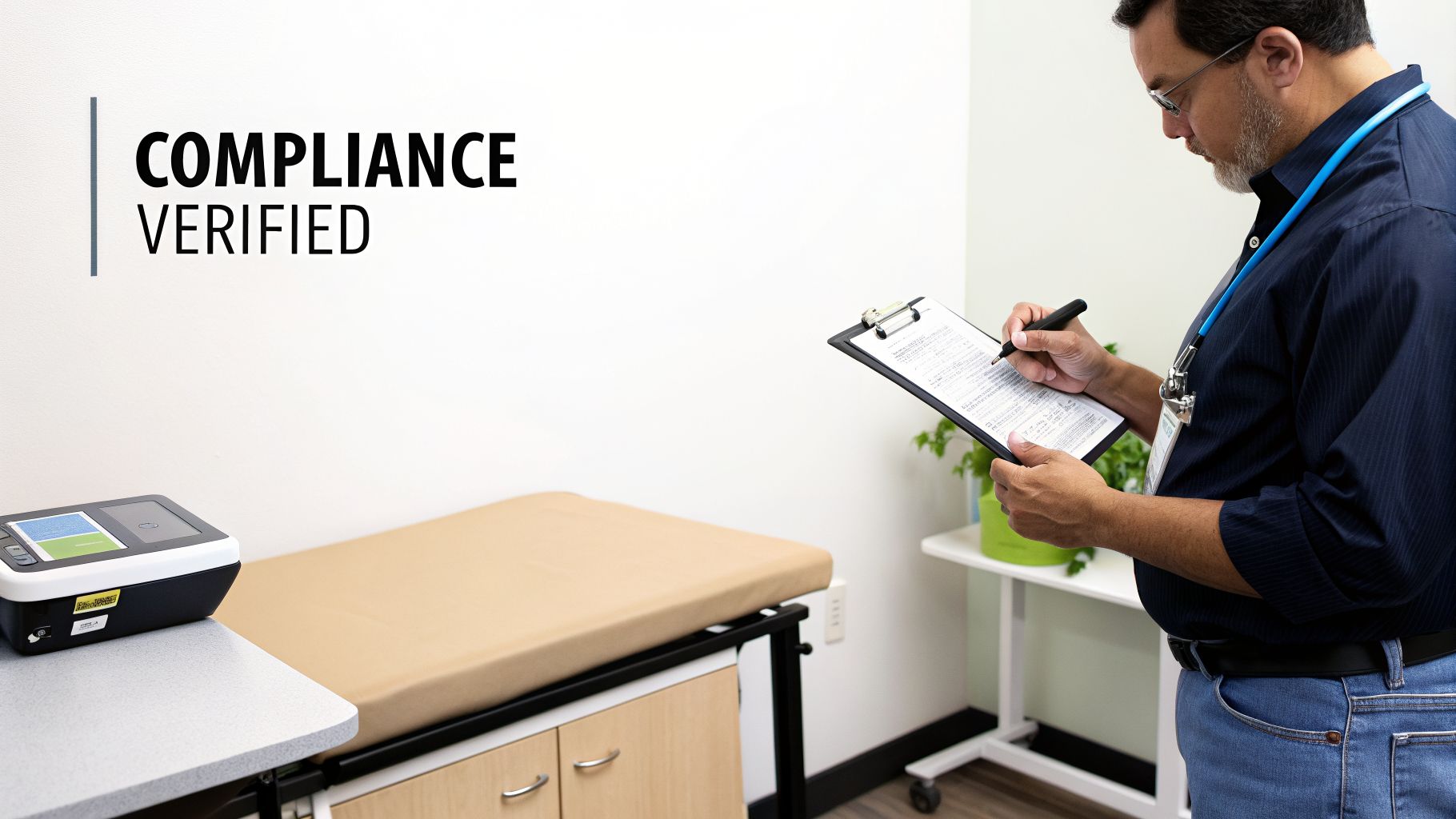
Think about a healthcare clinic right here in Plano upgrading its patient check-in kiosks. Those old devices are loaded with protected health information (PHI), governed by the tough rules of the Health Insurance Portability and Accountability Act (HIPAA).
If those assets fall into the hands of a non-certified vendor who cuts corners, the risk is massive. A single hard drive that isn’t properly wiped could end up in a landfill or on a secondary market, leading to a major data breach.
For healthcare providers, the fallout is serious. HIPAA violations from improper electronics disposal cost an average of $1.5 million in fines last year. This risk has driven a 25% year-over-year increase in demand for specialized ITAD services that truly understand healthcare compliance.
This isn't just about ticking a box. It's about protecting your patients, your reputation, and your budget. Choosing the right certified partner for ITAD services in Plano is a critical business decision.
Key Certifications to Look For
To simplify your vetting process, we've broken down the most important certifications and regulations. This table summarizes what you need to know at a glance.
Key ITAD Certifications and Regulations at a Glance
| Standard/Regulation | Primary Focus | Why It Matters for Your Business |
|---|---|---|
| R2v3 | Secure data destruction, environmental safety, and tracking recycled materials through the entire downstream chain. | Ensures your old equipment doesn't cause a data breach or environmental issue down the line. It's the global gold standard. |
| RIOS | Quality, environmental, health, and safety (QEHS) management for the recycling facility itself. | The operational backbone that proves a recycler runs a safe, consistent, and professional facility. Often paired with R2. |
| e-Stewards | A strict, no-compromise standard that forbids exporting hazardous e-waste to developing nations. | Offers the highest level of assurance against illegal dumping and environmental harm, with a strong focus on data security. |
| HIPAA/HITECH | Protecting patient health information (PHI). | Mandatory for any healthcare provider or business associate. A breach can lead to massive fines and reputational ruin. |
| GLBA | Protecting consumer financial data. | Essential for banks, credit unions, investment firms, and other financial institutions in the DFW area. |
When you're evaluating a potential ITAD partner in the Dallas-Fort Worth area, their certifications tell you a lot about their commitment to security and responsibility. They prove a vendor has invested in building a trustworthy and accountable operation.
Industry data shows that using R2v3-certified partners helps businesses reduce compliance audit failures by an incredible 85% because of their complete chain-of-custody reports. You can discover more insights about ITAD compliance and market trends.
Turning Compliance into Your Vetting Tool
Don't just take a vendor's word for it. Use their certifications as a way to dig deeper and see if their processes truly match your company's needs.
Start by asking some direct questions:
- Can you show me your current R2v3 or e-Stewards certificate? Always verify that it's active and not expired.
- How do you audit your downstream vendors? A certified partner must have a documented process for vetting anyone else who handles your materials.
- What information is on your Certificate of Data Destruction? It should list the device serial numbers, the destruction method, and the date it was completed.
A professional partner will have clear, detailed answers ready. How fluently they speak about their certified processes is a strong sign of their expertise. To dig deeper into what makes a recycler a safe choice, you can learn more about what it means to be an R2-certified electronics recycler and how it protects your business.
Choosing the Right Data Destruction Method
When you hand over your old tech to an ITAD provider, you're trusting them with your company's most sensitive information. But not all data destruction is the same. The method used to erase your data is one of the most critical decisions in the entire process, directly impacting your security and compliance standing.
Simply hitting "delete" on a file is never enough. The right approach depends entirely on the type of media and your end goal for the asset. A method that works perfectly for an old spinning hard drive (HDD) might be completely ineffective on a modern solid-state drive (SSD), leaving recoverable data wide open for the taking.
Understanding the three primary methods—data wiping, degaussing, and physical shredding—allows you to make informed demands of your provider. This is a core component of professional ITAD services in Plano, and getting it right protects your company from future liability.
Data Wiping and Sanitization
Data wiping, often called sanitization, is a software-based process that overwrites an entire drive with random 1s and 0s. This effectively erases the original data, making it unrecoverable by any standard means. The professional benchmark for this is the NIST 800-88 standard, which provides clear guidelines for media sanitization.
Wiping is the ideal method for any assets you intend to reuse or resell. It preserves the hardware's functionality and value while ensuring complete data removal. The big advantage here is value recovery, which can turn old equipment into a revenue source instead of just a cost.
When you use this service, you need to demand a process that follows NIST 800-88 guidelines. Your provider must supply a serialized report proving that each specific drive was successfully wiped clean.
Degaussing for Magnetic Media
Degaussing is a powerful but highly specific method. It uses an intense magnetic field to instantly and permanently destroy all data on magnetic storage, like traditional HDDs and backup tapes. The process scrambles the magnetic domains on the drive's platters, rendering the drive totally inoperable and the data gone forever.
This is the right choice for magnetic media that has reached the end of its life and is destined for recycling, not reuse.
However, there's a huge caveat: degaussing is completely ineffective on SSDs, flash drives, or any other flash-based media, as they don't store data magnetically. Using it on an SSD gives you a false sense of security and leaves your data intact. If a vendor suggests this, it's a major red flag.
A critical takeaway for any IT leader is this: a one-size-fits-all approach to data destruction is a sign of an inexperienced vendor. A partner suggesting degaussing for a mixed batch of HDDs and SSDs doesn't have the expertise to protect you.
Physical Shredding for Ultimate Security
When there is absolutely zero room for error and an asset has no resale value, physical destruction is the final answer. We use industrial-grade shredders to grind hard drives, SSDs, smartphones, and other media into small, unrecognizable fragments.
This method is definitive, auditable, and provides visible proof that your data-bearing device has been completely destroyed. It's the go-to choice for highly sensitive data or when your compliance rules mandate total elimination of the physical media. For a closer look at this process, you can read our guide on how we provide secure data destruction.
Comparing Destruction Methods
| Method | Best For | Pros | Cons |
|---|---|---|---|
| Data Wiping | Reusable assets (HDDs, SSDs) | Preserves asset value; eco-friendly. | Can be time-consuming for large volumes. |
| Degaussing | End-of-life magnetic media (HDDs, tapes) | Extremely fast and effective for HDDs. | Destroys the drive; useless on SSDs. |
| Shredding | All media types; highest security needs | The most secure option; provides visual proof. | Destroys all asset value; less eco-friendly. |
Ultimately, choosing the right method comes down to aligning the process with your asset type and your risk tolerance. A top-tier provider of ITAD services in Plano will offer all three methods and consult with you to build the right strategy. Your job is to demand serialized, auditable proof for every single asset, no matter which method is used. That certificate of destruction is your ultimate shield.
Your ITAD Vendor Evaluation Checklist
Alright, this is where the rubber meets the road. Choosing the right partner for ITAD services in Plano means moving past the sales pitch and getting into the nitty-gritty of how a vendor actually operates. You need to know, without a doubt, that you’re working with a professional who won’t expose your company to risk.
Think of it this way: you’re hiring a security team to guard your data after it’s already left the building. You wouldn't hire them without a thorough background check, and the same rigor applies here. Asking the right questions will tell you everything you need to know.
Logistics and Chain of Custody
The second your assets leave your facility is one of the most vulnerable moments in the entire ITAD process. Any potential partner needs a rock-solid, documented, and transparent logistics plan. Vague answers about this are a huge red flag.
Start by digging into how they physically move your equipment:
- Do you use your own GPS-tracked vehicles and background-checked employees? Relying on third-party couriers is a major break in the chain of custody and adds unnecessary risk.
- What’s the process at our location during pickup? A professional team will arrive with a serialized asset list, use tamper-proof seals on all containers, and have you sign off before they leave.
- How are my assets tracked from my office to your facility? They should be able to describe a detailed process where every single device is scanned and inventoried upon arrival at their secure plant.
A quality ITAD partner will not only have clear, confident answers but will welcome these questions. A weak one will give you generic assurances like "we'll take care of it" but offer zero specifics.
Data Destruction and Verification
This part is completely non-negotiable. You need absolute, verifiable proof that every bit of your data has been permanently destroyed. Your legal and compliance shield here is a legitimate Certificate of Destruction.
A proper Certificate of Data Destruction isn’t just a piece of paper; it’s a detailed legal document. It must include the specific serial numbers of the destroyed devices, the method used (e.g., NIST 800-88 wiping, physical shredding), the date of destruction, and a signature from an authorized representative.
The decision on how to destroy data often depends on the type of asset and its potential for reuse, a key service that professional ITAD providers manage.
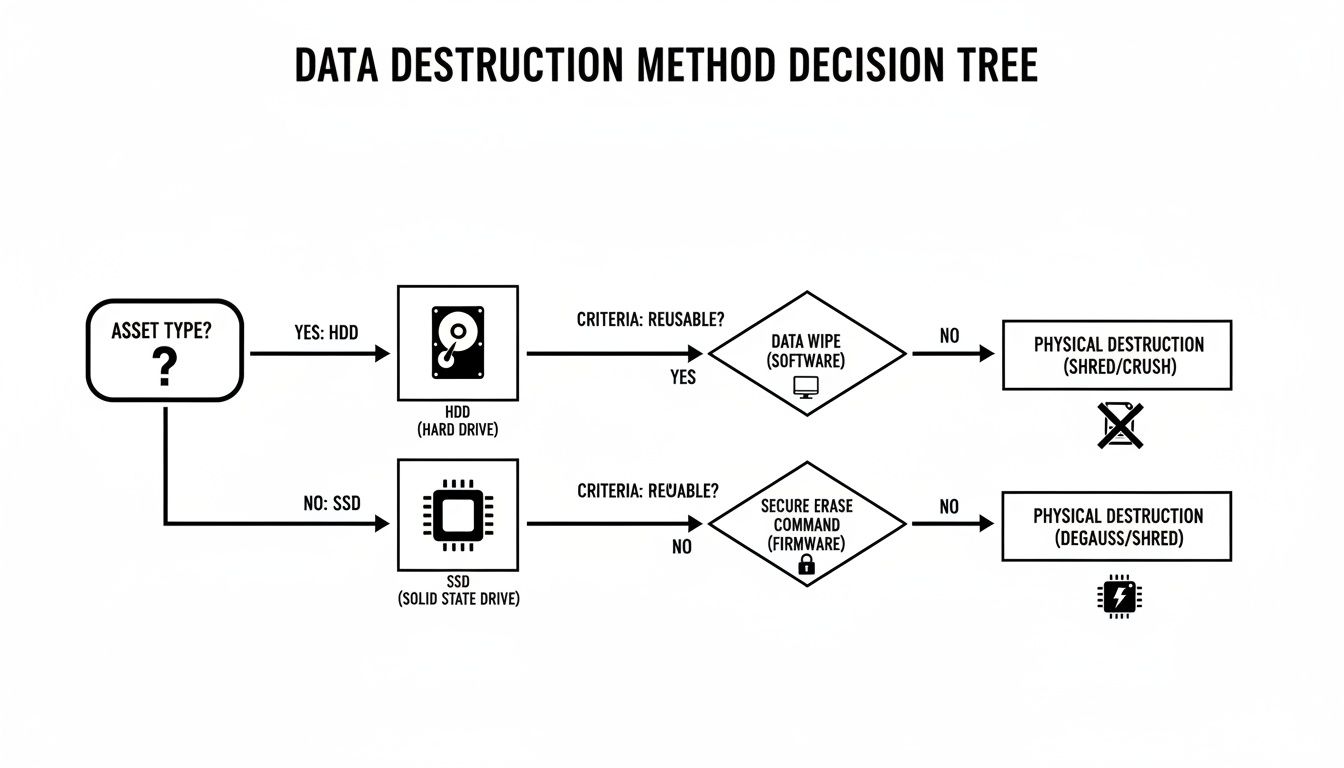
As this shows, the right method depends on whether you're dealing with a spinning hard drive (HDD) or a solid-state drive (SSD), and if its market value justifies secure data wiping for reuse.
Value Recovery and Downstream Transparency
If some of your retired assets still have resale value, you need to know exactly how a vendor handles that process. Transparency is everything. Ask them to walk you through their value recovery model—how do they test and grade equipment, where do they sell it, and what's your cut?
Just as important is what happens to assets with no resale value. Where do all those raw materials actually end up?
- Can you show me a full map of your downstream recycling partners? A certified vendor (R2v3 or e-Stewards) is required to audit and document their entire downstream chain.
- Are any of my materials exported? A firm "no-export" policy for hazardous e-waste is the gold standard for environmental and corporate responsibility.
Be wary of suspiciously low pricing, as it’s often a sign that a vendor is cutting corners by using non-certified partners or illegally exporting e-waste—a liability that could easily come back to you. Reviewing a list of qualified IT asset disposition companies can give you a good benchmark for what to expect.
To help you screen potential partners, here are some questions that will quickly separate a top-tier provider from a risky one.
Sample Vendor Questions and Ideal Answers
This table lays out what to ask and, more importantly, what you should hear back.
| Question to Ask Your Vendor | What a Strong Answer Looks Like | Red Flag Response to Avoid |
|---|---|---|
| How do you guarantee my data is destroyed? | "We provide a serialized Certificate of Destruction compliant with NIST 800-88, detailing each asset and the method used. You can also witness the destruction on-site or via video." | "Don't worry, we wipe everything. We’ll send you a certificate." |
| Can you describe your chain of custody? | "Our own badged employees use GPS-tracked trucks. We scan every asset at your site and again at our secure, access-controlled facility, with full reporting." | "We have a logistics partner who handles all our pickups. They're very reliable." |
| What happens to my non-working electronics? | "As an R2v3 certified recycler, we audit all our downstream partners to ensure all materials are responsibly processed right here in North America. We have a zero-landfill policy." | "We send it to a recycler who takes care of it. It’s all recycled." |
These questions aren't just for show; the answers you get will reveal a vendor's commitment to security, compliance, and transparency. A professional partner will have no problem providing detailed, verifiable answers.
You’ve vetted your options and chosen a partner for your ITAD services in Plano. Now it’s time to put that plan into action. This is where the theoretical meets the practical—turning your selection into a smooth, repeatable operational process. A successful rollout depends on clear communication, solid internal prep, and a firm grasp of the service level agreement (SLA) that will govern the partnership.
The process kicks off with an official onboarding call. Don't treat this as a simple meet-and-greet. This meeting sets the tone for the entire relationship. It's your chance to meet your dedicated account manager, confirm the scope of the first pickup, and establish who the primary contacts are on both sides. This is where you align expectations on everything from scheduling to reporting.
This initial call is also the ideal time to walk through the SLA line by line. This document is the operational backbone of your ITAD program, so you need to understand every clause.
Nailing Down the Service Level Agreement (SLA)
Your SLA is more than just a contract; it’s the rulebook for how service gets delivered. It should clearly outline key performance indicators (KPIs) and timelines. If a requirement isn't specified in the SLA, you can't assume it's guaranteed.
Pay close attention to these specific commitments:
- Pickup Scheduling: How much notice is needed to schedule a pickup? For most Plano-area businesses, a 3-5 business day window is a reasonable expectation.
- Processing Time: The SLA must define how long it takes for assets to be inventoried after arriving at the facility. A typical timeframe to look for is 5 to 10 business days.
- Reporting Turnaround: How quickly will you receive your Certificate of Data Destruction and final reports? Aim for a commitment of no more than 15-30 days after the pickup.
A strong SLA provides clarity and accountability. It protects both you and your vendor by ensuring everyone is aligned on service expectations, from the moment your assets leave your facility to the final signature on your compliance documents.
With the SLA signed and communication channels established, the focus shifts inward to preparing your assets for the first collection.
Preparing for a Smooth First Pickup
A little organization on your end goes a long way. While your ITAD partner handles the logistics and secure transport, how your team prepares the equipment is crucial for a smooth handoff. An efficient process starts before the truck ever arrives.
Here’s a practical checklist we’ve seen work time and again. Imagine a mid-sized Plano tech company decommissioning 150 employee laptops and a dozen servers.
- Consolidate and Stage Assets: Designate a secure, low-traffic area for all equipment awaiting pickup. This prevents devices from getting lost in the shuffle and makes the collection much faster. Our example company used a locked storage room they could control access to.
- Create an Internal Asset List: Your vendor will create their own detailed inventory upon receipt, but creating your own preliminary list is a smart best practice. Simply noting the device type and serial number gives you a baseline to reconcile against the vendor's final report.
- Communicate with Your Team: Let your facilities or office staff know the date and time of the pickup. Make sure the ITAD provider’s team will have clear, easy access to the staged assets, whether that’s a specific office or a loading dock.
Following these simple steps sets your vendor up for success and immediately creates efficiencies. For that Plano tech company, this prep work cut the on-site pickup time by nearly 40%, minimizing disruption to their day-to-day operations. This isn't just about a single project; it’s about building a repeatable, effective process for a long-term ITAD partnership.
Common Questions About ITAD Services in Plano
When IT leaders in Plano and across the DFW area start planning an IT asset disposition project, a few key questions always come up. We hear them from organizations of all sizes. Here are the straightforward answers you need to move forward with confidence.
What Is the Typical Cost for ITAD Services in the Plano Area?
There’s no single price tag for ITAD services in Plano. The cost really depends on the specifics of your project: the volume and type of equipment, the level of data destruction you need, and the logistics involved.
For example, a large batch of newer, high-value servers might qualify for a value recovery program. In those cases, the service could be free or even generate a check back to your company. On the other hand, a collection of older equipment with no resale value will have a cost for certified recycling and physical destruction, usually calculated by weight or per item. A transparent partner will always provide a detailed quote breaking down every charge, so you aren't hit with surprises.
Always demand a line-item proposal before committing. This is the only way to get a clear financial picture and compare vendors effectively. A vague quote is a major red flag.
How Do I Handle Specialized Equipment Like Medical or Lab Devices?
Disposing of specialized gear from medical, lab, or manufacturing environments requires a partner with specific expertise. These devices are often governed by HIPAA because they can store protected health information (PHI), and many contain hazardous materials that fall under strict EPA guidelines.
A qualified ITAD vendor will have documented, auditable procedures for managing these assets. This should include everything from sanitized transport to prevent cross-contamination to data destruction methods that are fully compliant with healthcare regulations. When you’re vetting a provider, ask them directly about their experience with your specific equipment and to see their documentation for health and safety compliance.
Can My Small Business or Nonprofit Use ITAD Services?
Absolutely. Professional ITAD isn't just for massive corporations. In fact, for a small business that may not have a dedicated IT security team, outsourcing asset disposition to an expert is one of the smartest moves you can make to stay secure and compliant.
Reputable providers in the DFW area offer flexible solutions designed for smaller volumes. Many also run programs specifically to support the community.
These initiatives often include:
- Cost-Effective Solutions: Special pricing or bundled services that make professional ITAD affordable for smaller budgets.
- Donation Programs: Refurbishing usable equipment and donating it to local nonprofits or schools, turning your retired assets into a community benefit.
- Fundraising Opportunities: Partnering with nonprofits to host e-waste collection events, helping them raise funds while promoting responsible recycling.
These programs make professional-grade asset management achievable for any organization.
How Long Does the ITAD Process Take From Pickup to Final Report?
The exact timeline can vary, but a professional provider will always define it clearly in your Service Level Agreement (SLA). For the most part, the process follows a predictable sequence.
- Pickup: Scheduling a pickup in the Plano and greater DFW area can usually happen within a few business days of your request.
- Processing: Once your assets arrive at the secure facility, the auditing, testing, and data destruction phase typically takes 5 to 10 business days, depending on the size and complexity of the job.
- Reporting: You should receive your complete reports, including the crucial Certificate of Data Destruction, within 15-30 days from the pickup date. You can learn more about what to expect by reading our detailed guide on the Certificate of Destruction for hard drives.
If your project involves value recovery, the timeline for resale and final payment might be longer. A trustworthy partner will always communicate these milestones upfront so you know exactly what to expect.
At Dallas Fortworth Computer Recycling, we provide transparent, secure, and compliant ITAD solutions for organizations of all sizes. Our team is ready to answer your questions and build a program that protects your data and your reputation. Request a quote today.