
Discover arlington computer recycling for secure IT asset disposition
For Arlington businesses, computer recycling is much more than simple disposal—it's a critical security and compliance function. Properly managing retired IT assets protects your company from data breaches and environmental penalties, turning a potential liability into a documented, secure process.
Why Secure Computer Recycling Is a Business Imperative in Arlington
For any organization in Arlington, from the growing tech firms to major employers like GM Financial, the life of IT equipment doesn't just stop when it's unplugged. Old computers, servers, and hard drives aren't just bulky e-waste; they are vaults filled with sensitive company and customer information. Disposing of them improperly is like leaving your company’s digital back door wide open for data thieves.
The financial, legal, and reputational stakes are incredibly high. A single hard drive tossed into a dumpster can trigger a catastrophic data breach, leading to significant fines under regulations like the Texas Identity Theft Enforcement and Protection Act (§ 521.052). This isn't a far-fetched scenario; it's a real-world risk that IT directors and executives must proactively manage.
Shifting from Disposal to Strategic ITAD
Thinking of this process as just "disposal" is a fundamental mistake. Instead, smart Arlington businesses are adopting a formal IT Asset Disposition (ITAD) framework. ITAD reframes technology retirement as a strategic process focused on risk mitigation, compliance, and even value recovery.
A compliant ITAD process isn't about calling a junk removal service. It requires a documented, secure chain of custody from the moment an asset leaves your building. This ensures every single device is tracked, sanitized of all data, and recycled or disposed of according to strict environmental standards.
The core principle of a strong ITAD program is accountability. Without a verifiable audit trail detailing how each asset was handled and its data destroyed, your business remains exposed to legal and financial penalties long after the equipment is gone.
The Real Risks of Non-Compliance
Let's walk through a common example. A mid-sized Arlington company completes a 200-laptop refresh. If they simply hand these devices to an uncertified recycler, they have no proof of what happens next. Were the hard drives wiped to NIST 800-88 standards? Were they physically shredded? Can the vendor provide a Certificate of Data Destruction that lists every single serial number?
If not, the company is taking a massive gamble. The consequences of a data breach from improperly disposed hardware are severe and can include:
- Hefty Fines: Federal and state regulators can impose major financial penalties for failing to protect sensitive data.
- Reputational Damage: News of a data breach can destroy customer trust and tarnish a brand's reputation for years.
- Legal Liability: Your company could face lawsuits from customers or partners whose data was compromised.
- Environmental Violations: Improperly dumping electronics can also lead to fines for violating e-waste regulations.
By partnering with a certified specialist for Arlington computer recycling, you effectively transfer that risk. A professional ITAD provider delivers the documentation and assurance needed to prove due diligence. For additional resources on handling other e-waste, you can learn more from our guide to comprehensive Arlington electronics recycling. This makes secure recycling less of an operational task and more of a fundamental part of your company's security posture.
Preparing Your IT Assets for Secure Disposition
Before any Arlington computer recycling partner ever sets foot in your facility, the real work has already started. Proper internal preparation is the bedrock of a secure and auditable IT Asset Disposition (ITAD) process. This isn't about ticking boxes on a generic checklist; it's about building a solid framework that ensures no device—and no data—gets left behind.
The first move is always to build a comprehensive asset inventory. This is much more than a simple headcount of old machines. It's a detailed log that establishes accountability right from the start. Let's say your Arlington office is cycling through a 500-workstation refresh. Every single one of those devices needs to be tracked meticulously.
Creating an Audit-Ready Inventory
Your inventory, whether it's a spreadsheet or part of a larger asset management system, must capture the essential details for every item you're getting rid of. Think of this as the initial chain of custody record that will follow your assets through the entire recycling journey.
Your log should include these key data points for each asset:
- Asset Type: (e.g., Laptop, Desktop, Server, Monitor)
- Manufacturer and Model: (e.g., Dell Latitude 7420)
- Serial Number: This is the non-negotiable unique identifier for each device.
- Asset Tag Number: Your company's internal tracking number.
- Last Known User and Department: Critical for tracking data ownership and getting context.
- Physical Location: (e.g., Building A, Floor 3, Storage Closet 301)
Getting this level of detail is your first line of defense. If a laptop goes missing between being taken offline and pickup, this log proves it was accounted for and helps you pinpoint exactly where things went wrong.
This process flow shows the core stages of a secure ITAD plan, moving from initial risk assessment to final, verified data protection.
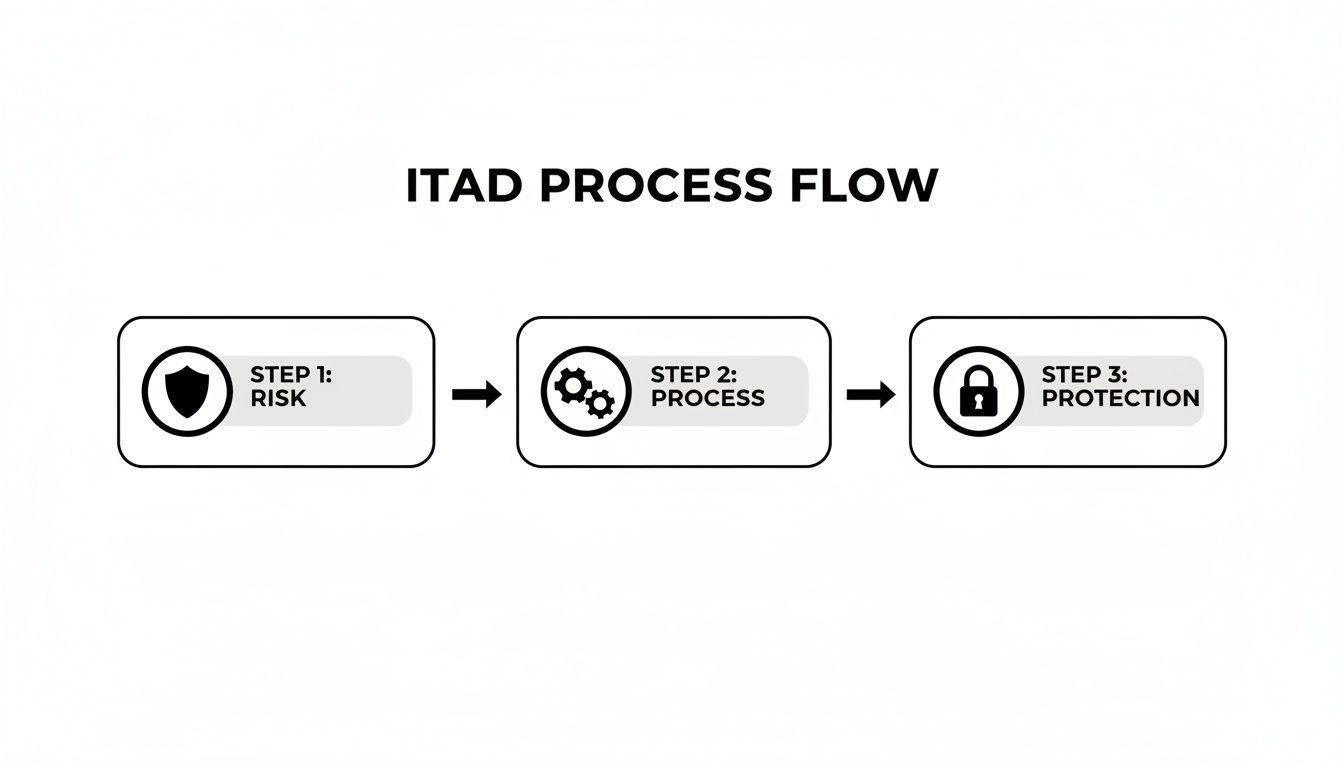
As you can see, a successful disposition plan is a continuous cycle of managing risk, following a structured process, and ensuring protection is verified.
Consolidating Assets for Secure Staging
Once your equipment is inventoried, don't just leave it scattered around the office. This is a surprisingly common—and massive—security blind spot. A laptop tucked under an empty desk or an old server sitting in an unsecured hallway is a prime target for theft.
Instead, your next step should be to consolidate all decommissioned equipment into a single, secure, access-controlled area. This could be a locked storage room, a caged-off section of your warehouse, or even a dedicated office with restricted keycard access.
Designating a secure staging area is a simple, low-cost action that dramatically reduces the risk of asset loss or internal theft before your recycling partner even arrives. It’s a mandatory step for a defensible chain of custody.
Controlling who gets in and out is essential. Only authorized IT or facilities personnel should be able to enter the staging area. We often see clients implement a simple sign-in/sign-out sheet, which adds another layer of accountability. This step is particularly vital when dealing with high-density hardware like server racks. For a deeper dive, check out our guide on building a comprehensive server decommissioning checklist.
The Role of Internal Sanitization Policies
While your certified ITAD partner will handle the final, certified data destruction, your own internal policies still play an important part. Some organizations, especially in finance or healthcare, have security mandates that require a preliminary data wipe before any asset leaves the building.
This "belt-and-suspenders" approach provides an added layer of security. If your team does perform a basic wipe, make sure you document it in your asset inventory log. A quick note like, "Internal DBAN wipe performed on 10/26/2024" shows due diligence at every stage of the process.
However, it's critical to understand that this internal effort does not replace the need for certified, third-party data destruction. The Certificate of Data Destruction from your professional Arlington computer recycling partner is the official document that proves compliance for any audit. Your internal wipe is a best practice; their certificate is your legal proof. This careful preparation is what ensures a smooth handoff and a fully defensible process from start to finish.
Once you’ve inventoried your assets, it’s time to tackle the most critical phase of Arlington computer recycling: ensuring every last byte of data is gone for good. A simple pickup receipt won't cut it. It offers zero protection if an auditor comes knocking. Real security comes from knowing the different data destruction methods and demanding the right paperwork to prove it.
For any business handling sensitive information, the stakes are incredibly high. Think about major healthcare providers in the area, like the 493-bed Medical City Arlington. They have to follow rigid protocols to sidestep huge federal and state fines. Here in Texas, compliance is the law, not just a suggestion. Texas Business and Commerce Code § 521.052 requires businesses to use 'reasonable procedures' for destroying sensitive data, and you have a tight 60-day window for breach notifications. You can see more on how Arlington businesses handle these complex rules on this ITAD solutions page.
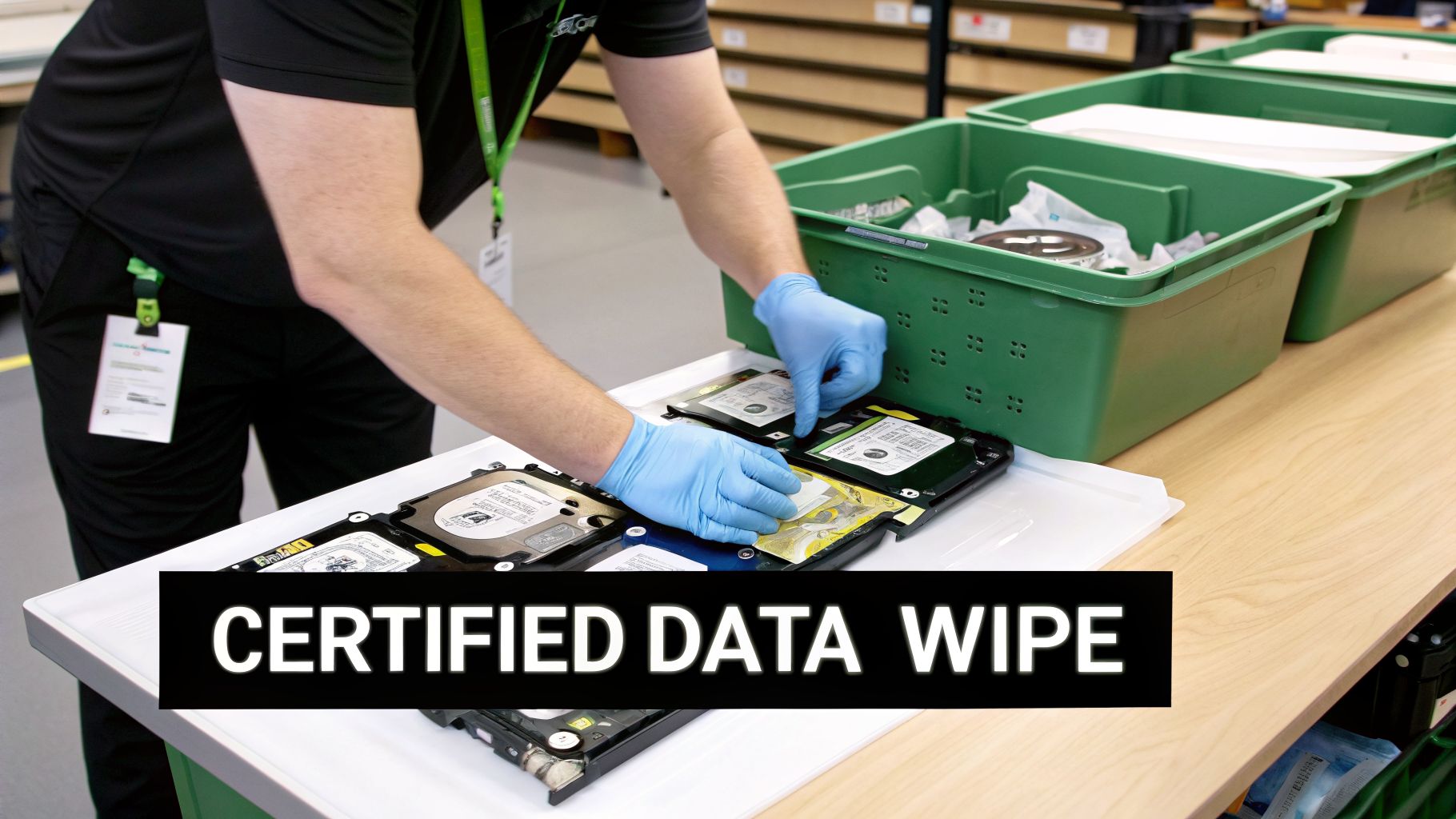
Choosing Your Data Destruction Method
Not all data destruction is created equal. The method you choose—or that your ITAD partner uses on your behalf—is what keeps you compliant with regulations like HIPAA, FACTA, and the FTC Disposal Rule. Understanding the pros and cons of each is essential.
There are three primary methods we use in the industry:
- Software-Based Wiping (Sanitization): This is where specialized software overwrites the entire hard drive with random characters, often multiple times. Done right, it makes the original data unrecoverable while preserving the drive for reuse.
- Degaussing (Purging): This technique uses an extremely powerful magnetic field to instantly scramble the magnetic domains on hard drives and tapes where data lives. The drive is toast afterward—completely inoperable.
- Physical Shredding (Destruction): This is the most visually satisfying and definitive method. The hard drive is fed into an industrial shredder that grinds it into small, unrecognizable metal bits. There’s no coming back from that.
So, how do you decide? Let's break down the options in a more direct comparison.
Data Destruction Methods A Comparison For Enterprise IT
| Method | Process | Best For | Compliance Level | Key Consideration |
|---|---|---|---|---|
| Software Wiping | Overwrites drive sectors with random data using certified software (e.g., NIST 800-88 Clear/Purge). | Assets intended for resale or remarketing, where value recovery is a goal. | High | Verifiable process that maintains the drive's functionality. Slower than other methods. |
| Degaussing | Exposes media to a powerful magnetic field, erasing data and rendering the drive useless. | End-of-life magnetic media (HDDs, tapes) with highly sensitive data. Not effective on SSDs. | Very High | Fast and highly effective for supported media, but destroys the asset. |
| Physical Shredding | Mechanically grinds the drive into small metal fragments. | End-of-life drives (both HDD and SSD) or when company policy demands total physical destruction. | Highest | Provides undeniable proof of destruction. Asset is completely destroyed with no resale value. |
The best approach depends on your internal security policies, the type of data you're dealing with, and whether you want to recover any value from the old hardware.
A pickup receipt proves your equipment was collected. A Certificate of Data Destruction proves your data was destroyed. Only the latter will protect you in an audit, but only if it includes serialized proof for every single asset.
Just as important as the method is the vendor you choose. You need a partner with credentials. Look for a partner who is R2 Certified—it's a key indicator that they follow the highest industry standards for both data security and environmental responsibility. You can learn more about what it means to work with an R2 Certified electronics recycler and how it solidifies your compliance posture.
The Anatomy Of An Audit-Proof Certificate
A legitimate Certificate of Data Destruction isn't just a piece of paper. It’s a detailed, legally binding document that serves as your get-out-of-jail-free card during an audit. To be considered audit-proof, it must create an unbroken chain of custody with specific details.
If your certificate is missing these elements, it’s not worth much:
- Unique Serial Numbers: Every single hard drive or data-bearing device has to be listed by its factory serial number. No exceptions.
- Destruction Method: The certificate must state exactly how the data was destroyed (e.g., "NIST 800-88 Purge via Degaussing" or "Physical Shredding to 2mm").
- Date of Destruction: The exact date the process was completed.
- Authorized Signatures: Confirmation from the vendor that the work was done as described.
This level of detail is non-negotiable. Imagine trying to get through a HIPAA audit with a certificate that just says, "100 hard drives destroyed." An auditor would laugh it out of the room, leaving your company exposed to fines that can run into the millions. Serialized tracking is the only way to prove you responsibly protected every single asset you were entrusted with.
The Logistics of Pickup and Processing for Arlington Businesses
Once your IT hardware has been inventoried and staged, the next step is coordinating the physical handoff. This isn't like calling a standard moving company; a professional Arlington computer recycling service executes a specialized logistical operation built around security and accountability from start to finish.
Scheduling a pickup is straightforward. You'll provide your certified ITAD partner with your asset list and the equipment's physical address. Based on the volume and type of devices, they will dispatch a team with the right resources—from pallets and shrink wrap for an office cleanout to specialized server lifts for heavy data center hardware.
What to Expect on Service Day
On the scheduled day, a team of background-checked, uniformed technicians will arrive at your Arlington location. They come equipped with everything needed to safely pack and transport your assets, ensuring minimal disruption to your operations.
Their first action is to verify the equipment against your inventory list. This ensures every single item is accounted for before it leaves your control. For a typical project involving 150 laptops and 20 servers, the team would:
- Bring rolling, lockable security carts or pallets directly to your staging area.
- Scan the serial number of each asset as it's loaded, creating a real-time digital record of the transfer.
- Pack the equipment carefully to prevent damage during transit.
- Securely seal the carts or shrink-wrap the pallets before they are moved.
This documented handoff is a critical part of maintaining the chain of custody. You receive a signed receipt that confirms the transfer of liability, providing immediate, documented proof that the assets are no longer your responsibility.
The moment your equipment is loaded onto a secure, GPS-tracked truck, the responsibility for its security and compliant disposal shifts to your ITAD partner. This transfer isn't just physical; it's a documented, auditable event that protects your organization.
Secure Transit and Timely Processing
From your office, the assets are transported directly to a secure, access-controlled processing facility. These facilities are purpose-built for security, often equipped with 24/7 video surveillance and strict badge-access protocols. This guarantees your equipment remains in a secure environment throughout the entire journey. We provide more detail on our process for business electronics recycling pickups across Texas.
Upon arrival, your assets are checked in again, reconciling them against the initial pickup records. This dual-verification process eliminates any chance of items going missing. For Arlington businesses, this entire cycle is remarkably efficient. Turnaround times often range from just 3 days to 2 weeks, balancing speed with the uncompromising security required for everything from a few office PCs to entire data center hauls.
The process is designed to be reliable and efficient, freeing up your internal teams. From scheduling the pickup to receiving your final Certificate of Data Destruction, every step is documented. This meticulous approach to logistics is what separates professional Arlington computer recycling from simple junk removal—it’s a complete solution that stands up to any audit.
Finding Value in Responsible E-Waste Recycling
Beyond just security and compliance, a professionally managed IT asset disposition program brings real strategic value to your Arlington business. It’s not just about dodging fines—it's about improving your bottom line, elevating your brand, and participating in the circular economy.
Viewing old IT equipment as worthless is an outdated and expensive mistake. Every server, laptop, and desktop contains materials with tangible value. Responsible Arlington computer recycling is the process of unlocking that value safely while ensuring hazardous materials never see a landfill.
The Impact on Your Brand and the Environment
The sheer volume of e-waste is staggering. Each year, millions of tons are generated globally, much of it packed with toxic substances like lead, mercury, and cadmium. When this stuff ends up in landfills, it can leach into the soil and water, creating a serious risk to public health and the environment.
A professional ITAD program ensures these hazardous components are handled correctly. But it’s more than just good environmental stewardship; it’s a powerful story for your brand. For companies in Arlington, showing a commitment to zero-landfill e-waste policies can significantly boost your reputation with customers, employees, and stakeholders who care about sustainability.
The Economic Upside of a Circular Economy
Responsible recycling also delivers a powerful economic punch. The process creates local jobs and recovers valuable materials that can be put back into the manufacturing supply chain. Here in Texas, the impact is substantial.
Statewide electronics recycling programs are a real force in the local green economy. Collections have already topped 488 million pounds, with 46 million of that coming directly from computer manufacturers' own take-back programs. On a larger scale, Texas recycled 9.2 million tons of municipal solid waste back in 2015, which was valued at an incredible $702 million and supported thousands of jobs in processing and reuse.
This isn't just an expense; it’s an economic engine.
Turning Costs into Revenue Through Asset Reuse
One of the most direct financial wins comes from reselling and remarketing used equipment. Not everything you retire is truly at the end of its life. A three-year-old developer laptop or a five-year-old server might not meet your enterprise standards anymore, but it still holds plenty of value for other users.
A certified ITAD partner identifies these assets through a clear process:
- Testing and Grading: Technicians assess the functional and cosmetic condition of every device.
- Secure Data Sanitization: All data is professionally wiped using certified methods, making the asset safe for resale.
- Remarketing: The refurbished equipment is then sold through established secondary market channels.
A well-run asset reuse program can transform your IT department from a cost center into a source of revenue. The funds from these sales can directly offset your recycling costs or even generate a net profit for your company.
Think about it: an Arlington tech firm refreshing 300 high-end laptops could see a major return. If just half of those devices are resalable, the revenue could easily fund the entire disposition project. If your retired assets are mostly individual components, you may also find value by looking into where to sell used computer parts.
Supporting the Community with Nonprofit Donations
What about equipment that isn’t valuable enough for resale but is still perfectly functional? These assets can find a second life supporting local organizations. Many Arlington computer recycling programs have partnerships with area nonprofits and schools that are in constant need of technology.
Donating your refurbished desktops, monitors, and peripherals helps bridge the digital divide for underserved communities. This not only keeps usable electronics out of the waste stream but also builds a strong corporate social responsibility (CSR) narrative. It’s a true win-win, providing tangible benefits to the community while reinforcing your company's commitment to making a positive local impact.
Common Questions on Enterprise Computer Recycling
Even with a solid ITAD plan, practical questions always come up during a large-scale project. For IT managers and procurement teams in Arlington, getting direct answers is key to ensuring security and compliance. We’ve compiled some of the most common questions we hear from businesses to give you clear, real-world insights.
These aren't generic answers. They’re based on our experience handling the specific challenges of Arlington computer recycling projects for enterprises like yours.
Do You Handle Specialized Equipment Beyond Standard PCs and Laptops?
Yes, absolutely. Our services go far beyond standard office electronics. We are fully equipped to manage the specialized, high-value, and regulated equipment found in corporate, medical, and industrial settings. This is a critical capability, since these assets often hold highly sensitive data and demand specific handling protocols.
We routinely process a wide range of hardware, including:
- Data Center Hardware: This includes servers, storage area networks (SANs), network-attached storage (NAS), and networking gear like switches and routers. This equipment requires ironclad data destruction and a documented chain of custody.
- Medical and Laboratory Equipment: We understand the strict compliance needs tied to patient data under HIPAA. We securely handle diagnostic machines, imaging systems, and other regulated healthcare devices.
- Industrial and Point-of-Sale (POS) Systems: Specialized manufacturing controls and retail POS terminals are also within our scope, ensuring every piece of technology is managed correctly.
Whether it’s a full rack of servers from a data center near the Arlington Entertainment District or a diagnostic machine from a local medical clinic, we make sure every single item is processed with the highest security and complete chain-of-custody documentation.
How Does Your Program Support Local Nonprofits?
Making a positive community impact is a core part of our mission. We believe responsible recycling should benefit not just the environment, but the Arlington community as well. We help make that happen by creating a bridge between our corporate clients and local nonprofits.
The process is straightforward. We identify viable IT equipment from our clients—devices that may no longer meet enterprise-grade performance standards but are perfect for other uses. After undergoing certified data sanitization, these assets are professionally refurbished and prepared for a second life.
This approach transforms a simple disposal process into a powerful act of corporate social responsibility. It diverts usable e-waste from landfills and simultaneously bridges the technology gap for organizations that serve our Arlington community.
By donating your company's used but functional computers, monitors, and peripherals, you can turn a cost center into a direct community benefit. It's a meaningful way to extend the life of your IT assets while supporting important local causes.
What Is the Minimum Item Count for a Free Pickup in Arlington?
We offer complimentary on-site pickups for businesses with ten or more qualifying IT assets. We set this threshold to be accessible for most small to mid-sized businesses and to efficiently handle common projects like tech refreshes or office moves.
Qualifying items generally include:
- Desktop Computers
- Laptops
- Servers
- Network Switches
- Other significant IT hardware
This minimum count allows us to streamline logistics and deliver a high level of service without passing on unnecessary transportation costs.
For organizations in Arlington with fewer than ten items, we can still absolutely provide service. In these situations, a small, transparent logistics fee may apply to cover our costs. We always encourage businesses to contact us with their inventory list, no matter the size. It allows us to create a custom plan that fits your exact needs, timeline, and budget, ensuring your Arlington computer recycling is handled securely and professionally. For more context on creating a secure disposal strategy, you can get additional details in our article about how to dispose of old computers safely.
Ready to implement a secure, compliant, and responsible ITAD program for your Arlington business? Dallas Fortworth Computer Recycling offers end-to-end solutions tailored for enterprise needs, ensuring your data is protected and your assets are handled responsibly. Contact us today to schedule your secure pickup.