
Your Guide to Secure Business Electronics Recycling and ITAD
When a company's technology reaches the end of its life, it needs a formal process for secure and sustainable disposal. This isn't just about getting rid of old hardware; it's a critical risk management function known as IT Asset Disposition (ITAD). A proper ITAD program is designed to protect sensitive data, ensure you're meeting all regulatory requirements, and handle e-waste responsibly.
Building Your Secure IT Asset Disposition Program
Simply tossing out old office computers, servers, or company phones is a direct threat to your business. Each device is a potential liability, holding a trove of sensitive information—from financial records and client data to proprietary intellectual property.
Without a structured program for business electronics recycling, you expose your organization to devastating data breaches, steep regulatory fines, and permanent brand damage. This is where a formal ITAD program becomes essential. You can learn more about the fundamentals in our complete guide to what is IT asset disposition.
Unlike a haphazard, one-off disposal, a robust ITAD program provides a defensible, end-to-end process for managing risk. It transforms a potential crisis into a controlled, auditable business function.
A well-designed ITAD program provides a clear, documented framework for handling every retired asset, from the moment it’s taken offline to its final certified destruction or recycling. Below, we've outlined the essential pillars that form the foundation of a successful program.
Core Pillars of a Successful ITAD Program
| Pillar | Primary Goal | Key Business Impact |
|---|---|---|
| Asset Inventory | To create a complete and accurate record of all assets slated for disposition. | Ensures no device is lost or unaccounted for, providing a baseline for security and auditing. |
| Data Destruction | To render all data on storage media completely unrecoverable. | Prevents data breaches and protects against financial, legal, and reputational damage. |
| Vendor Management | To select a certified partner who can prove downstream accountability. | Mitigates third-party risk and ensures compliance with environmental and data security standards. |
| Chain of Custody | To document the entire journey of an asset from pickup to final disposition. | Creates a verifiable audit trail to prove compliance and secure handling for regulators and stakeholders. |
These pillars work together to create a shield of security and compliance around your retired assets. Each step is a crucial link in a chain designed to protect your organization from significant risk.
The need for formal ITAD programs has never been greater. The world generated a record 62 million tonnes of e-waste in 2022, a staggering 82% increase from 2010. Worse, projections show this figure will climb another 32% by 2030.
A well-designed ITAD program isn't just another IT expense—it's a company-wide insurance policy against financial, legal, and reputational catastrophe. It is the definitive playbook for responsible business electronics recycling.
Ensuring Absolute Data Destruction Across All Assets
Data security is the absolute heart of any responsible business electronics recycling program. A single data breach from a supposedly "retired" asset can cause devastating financial and reputational harm, long after the device has left your facility. This is where your ITAD program moves from planning to execution, making sure every byte of sensitive information is rendered completely unrecoverable.
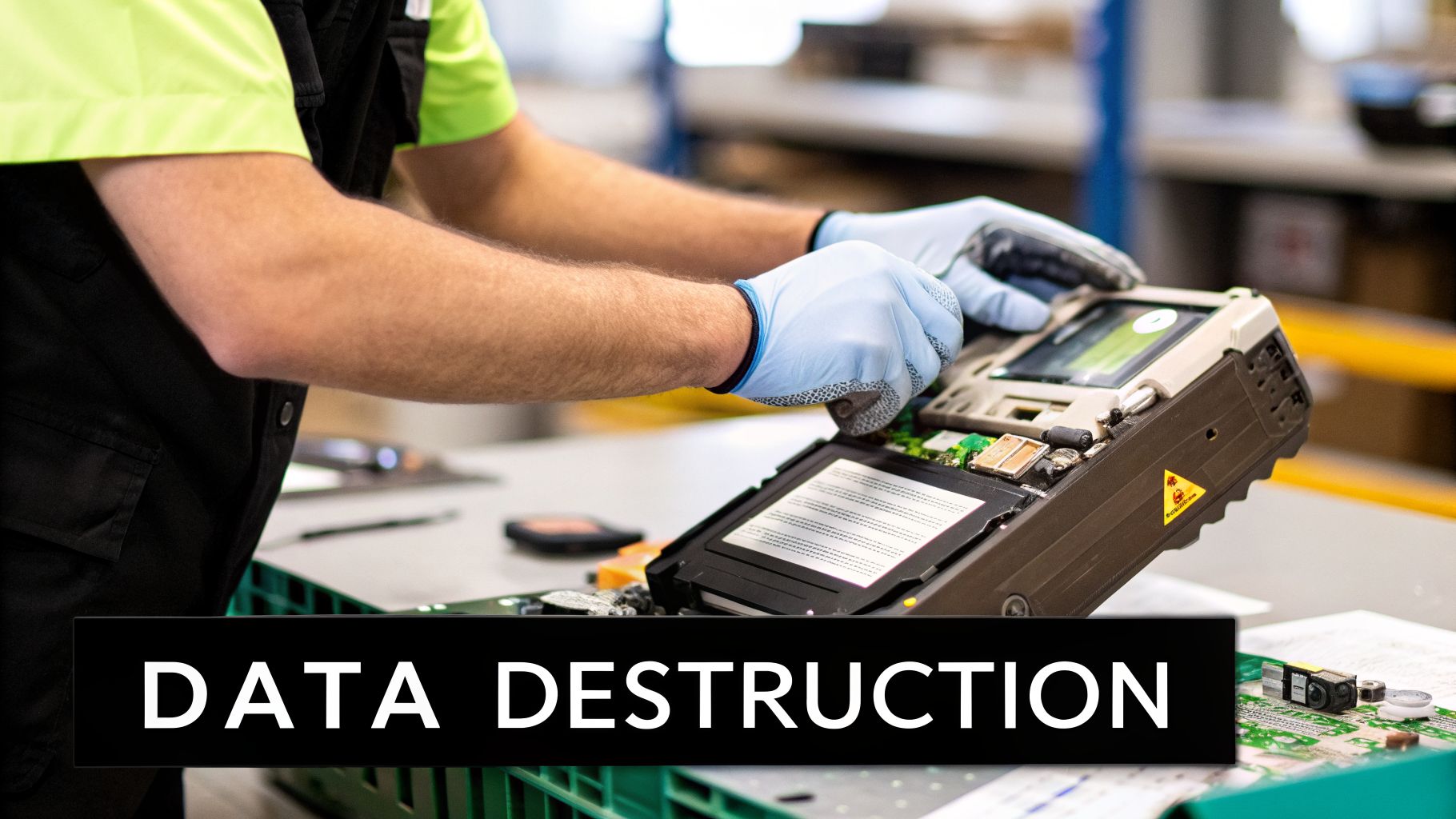
The entire process hinges on a meticulous asset inventory. You can’t secure what you don’t track. Before any device is unplugged, you must create a definitive log of every single asset slated for disposition.
This inventory needs to be more than a simple headcount. We're talking about a detailed record that includes the asset tag, serial number, device type, and its physical location. This serialized list becomes the unshakable foundation for your chain of custody, ensuring no device goes missing between your office and the final destruction facility.
Matching Destruction Method to Security Needs
Not all data destruction methods are created equal. Choosing the right one comes down to your industry's compliance requirements and whether the asset will be reused or recycled. Let's be clear: simply deleting files or reformatting a drive is completely inadequate. Data can often be recovered with basic software tools.
True data sanitization requires one of three industry-standard methods:
Software-Based Data Wiping: This process uses specialized software to overwrite the entire hard drive with random binary data. A multi-pass wipe is a secure method for sanitizing drives that may be refurbished and resold, rendering the original data unrecoverable while preserving the hardware.
Magnetic Degaussing: For this method, a powerful magnet destroys the magnetic field on a hard drive's platters where data is stored. This instantly and permanently erases all information but also renders the hard drive inoperable. Degaussing is a fast, highly effective option for loose hard drives not intended for reuse.
Physical Shredding: This is the ultimate form of data destruction. The hard drive or solid-state drive is fed into an industrial shredder that grinds it into small, mangled fragments. This makes data recovery physically impossible and is often the required standard for government, healthcare, and financial institutions with the highest security mandates.
The choice of method is critical. For instance, a financial services firm decommissioning data center servers may require on-site shredding to meet NIST 800-88 compliance for all media. In contrast, a marketing agency refreshing its employee laptops might opt for certified data wiping, allowing the still-valuable hardware to be remarketed to recover some of its initial cost.
The Certificate of Data Destruction: Your Proof of Compliance
Documentation is your final line of defense in any audit. After your assets have been processed, your ITAD partner must provide a Certificate of Data Destruction (CoDD). This isn't just a receipt; it's a legal document that serves as your official, auditable proof of compliance.
A robust Certificate of Data Destruction is non-negotiable. It should be a serialized document that ties directly back to your initial asset inventory list, confirming that every single data-bearing device was sanitized or destroyed according to a specified standard.
A legitimate CoDD must contain specific information to be considered valid during an audit:
| Certificate Component | Description | Why It's Critical |
|---|---|---|
| Unique Serial Number | A distinct tracking number for the certificate itself. | Allows for easy reference and verification in your records. |
| Client Information | Your company's legal name and address. | Officially ties the destruction event to your organization. |
| Asset Details | A serialized list of the processed devices. | Creates an unbroken chain of custody from your inventory to destruction. |
| Destruction Method | The specific method used (e.g., NIST 800-88 Purge, Shred). | Proves that the appropriate security level was applied. |
| Date of Destruction | The date the sanitization or shredding was completed. | Establishes a clear timeline for your compliance records. |
| Authorized Signature | The signature of a representative from the ITAD vendor. | Confirms the vendor's accountability for the completed work. |
This certificate closes the loop on your data security obligations for retired assets. It’s the final, tangible evidence that you have fulfilled your duty to protect your company's sensitive information. To learn more about this vital process, you can explore our detailed overview of secure data destruction services.
How to Vet and Select a Certified Recycling Partner
Finding a company to haul away old electronics is easy. Finding a true partner you can trust with your company's sensitive data and brand reputation is an entirely different challenge. The right partner for your business electronics recycling program is a shield, protecting you from data breaches, environmental fines, and reputational damage. The wrong one can become your single greatest liability.
Choosing a vendor based on the lowest price alone is a critical mistake we see businesses make all too often. A rock-bottom quote usually signals shortcuts in data security, environmental compliance, or downstream vendor management. Your vetting process should be a rigorous evaluation of risk management, with price being a secondary, not primary, consideration.
The Gold Standard of Certifications
Certifications are your first line of defense. They provide independent, third-party verification that a recycler follows strict standards for data security, environmental responsibility, and worker safety. In the ITAD industry, two certifications stand above all others:
R2v3 (Sustainable Electronics Recycling International): The R2 standard is the most widely adopted certification for a reason. The latest "v3" revision places an even greater emphasis on data security, demanding a documented data sanitization plan and strict chain-of-custody controls. An R2v3-certified recycler is audited on their entire process, from the moment they receive your assets to their final disposition, ensuring they securely manage everything. You can learn more about what it means to be an R2 certified electronics recycler and why it's a non-negotiable for secure ITAD.
e-Stewards (Basel Action Network): The e-Stewards standard is known for its uncompromising environmental protections. It strictly prohibits the export of hazardous electronic waste to developing countries and forbids the use of prison labor. It also maintains robust data security requirements, making it a hallmark of ethical and secure processing.
When a potential partner holds one or both of these certifications, it shows a proven commitment to industry best practices. Always ask for a copy of their current certificate and take a moment to verify its status directly on the certification body's website.
Beyond the Certificate: Questions to Ask
While certifications are crucial, they are the starting point, not the finish line. Your due diligence must go deeper to uncover a vendor's true operational security.
Your questions should all center on creating an auditable trail. This means you need verifiable proof that every single asset was handled securely from the moment it left your facility to its final destruction or recycling.
Here are the critical questions to ask any potential ITAD partner:
- Can you provide a complete, serialized chain of custody report? A simple bill of lading isn't enough. You need a detailed report that tracks assets by serial number from your facility to theirs.
- How do you audit your downstream vendors? No recycler processes 100% of materials in-house. They all use downstream partners for things like smelting metals or refining plastics. A trustworthy partner will have a formal, documented process for auditing these vendors to ensure they meet the same security and environmental standards. Ask for proof.
- What are your facility's physical security protocols? Their facility is an extension of your own security perimeter. Ask about access controls, 24/7 video surveillance, employee background checks, and whether they have a segregated, access-controlled area for processing data-bearing devices.
- What type of insurance do you carry? Ask for a certificate of insurance and review their coverage. Look specifically for Errors and Omissions (E&O) and Cyber Liability insurance. This coverage protects you if a data breach or environmental incident happens on their watch. A lack of robust insurance is a major red flag.
A true partner welcomes these tough questions. Evasion or vague answers are clear signs that a vendor may not have the robust security and compliance controls your business requires.
Understanding the Growing Market
The need for qualified partners is expanding rapidly. The global electronics recycling market is projected to reach approximately USD 39,960 million by 2025, growing at a strong CAGR of 13.1%. This growth is driven by the sheer volume of e-waste from shorter product lifecycles. This market expansion underscores the need for partners who can manage nationwide logistics and navigate regional compliance differences. You can learn more by reviewing the market research on electronic recycling.
Choosing the right partner for your business electronics recycling program is a strategic decision that directly impacts your risk profile. By prioritizing certifications, demanding a verifiable audit trail, and asking the tough questions, you can select a partner who will protect your business, not expose it to unnecessary risk.
Managing Secure Logistics and Specialized Disposals
Even the best-laid ITAD plans can break down at the final stage: logistics. The journey from your facility to a certified recycling plant is packed with risk. This is where your chain of custody moves from a paper concept to a real-world, physical operation.
Secure logistics for business electronics recycling isn't just about moving boxes. It’s about extending your security perimeter far beyond your own four walls.
Your responsibility for these assets doesn’t end when the truck pulls away. It only ends when you have a final, serialized report confirming their destruction or disposition. That makes the physical transport phase one of the most critical links in your entire compliance and security chain. A single pallet of missing hard drives can quickly become a catastrophic data breach.
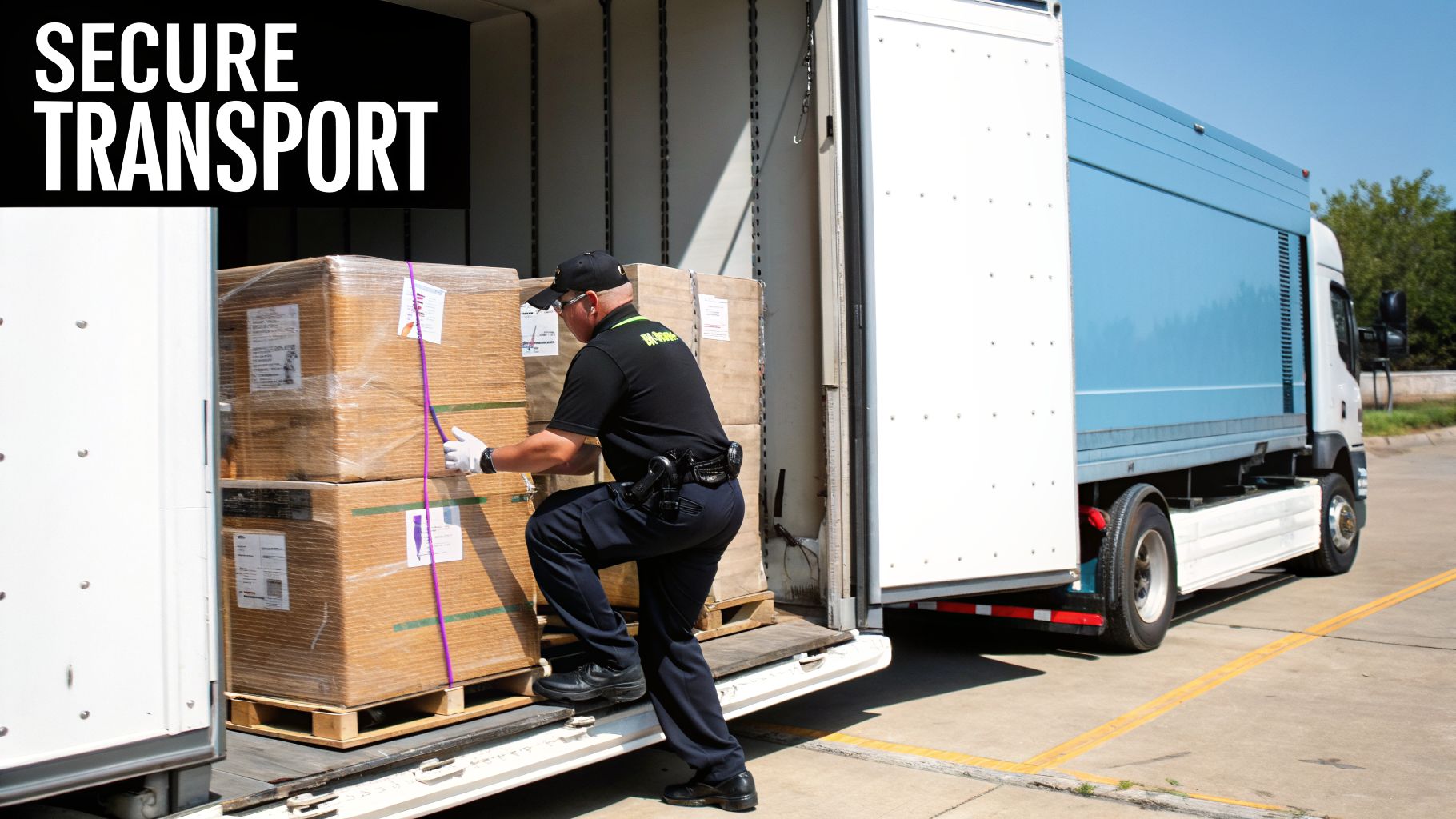
This reality calls for a hands-on approach to preparing your assets for pickup. Whether it’s a few pallets from a regional office or a full truckload from corporate HQ, proper prep work is non-negotiable.
Preparing Assets for Secure Transport
Before the logistics team arrives, your staff should have all retired assets staged and ready in a designated, secure area. This simple step prevents end-of-life equipment from getting mixed up with active inventory and makes the pickup process much smoother.
For most pickups, your assets should be consolidated onto pallets. From there, a professional ITAD partner will take over completely.
- Secure Palletizing: Their technicians will expertly stack and wrap the equipment, ensuring stability to prevent any damage or loss during transit.
- Inventory Verification: Before a single box is loaded, the logistics team should verify the physical assets against your inventory list, double-checking serial numbers and asset counts.
- Sealed Transport: For high-security loads, assets are often placed in sealed, GPS-tracked containers. This provides an extra layer of protection and real-time monitoring.
Following a structured process like this ensures what leaves your building is exactly what arrives at the processing facility, with no gaps in the chain of custody.
The Complexity of Data Center Decommissioning
Nowhere are logistics more complex or the stakes higher than in a data center decommissioning. This is a highly specialized project that goes well beyond a simple equipment pickup. It’s a carefully orchestrated operation to minimize downtime and ensure every single piece of hardware is securely managed from rack to recycling.
A full-service ITAD partner manages this entire process. Their team works alongside your data center staff to de-rack servers, disconnect networking gear, and pull storage arrays according to a pre-approved project plan.
Decommissioning a data center isn't just a big office cleanout. It's a surgical extraction of your company's most critical infrastructure. The logistics must be flawless to prevent operational disruption and guarantee the security of massive volumes of data.
On-site services are often essential for these projects. This might include on-site hard drive shredding, where a mobile shredding truck processes all media before it ever leaves your property. This provides immediate, verifiable data destruction for your most sensitive assets, completely eliminating the risk of data exposure during transit.
For a more detailed look at this intricate process, you can explore our in-depth guide to understanding the data center decommissioning process.
Handling Specialized and Regulated Equipment
Logistical challenges escalate when you're dealing with specialized equipment from regulated industries. A biotech firm retiring lab instruments or a hospital disposing of old medical devices faces unique compliance and handling requirements. These are not your standard office electronics.
Consider these examples:
- Medical Devices: Equipment from hospitals, such as patient monitors or infusion pumps, may contain protected health information (PHI). This brings HIPAA compliance into play, meaning they must be handled with the same data security rigor as a server.
- Laboratory Instruments: Scientific equipment from a research lab could be contaminated with biological or chemical residues. These assets require specialized decontamination procedures before they can be safely transported, protecting both the logistics team and the environment.
A competent ITAD partner will ask about these specific needs from the very first conversation. They will have documented procedures for handling such assets, ensuring your business electronics recycling program remains fully compliant with industry-specific regulations and environmental safety rules.
Ultimately, a true full-service recycling partner simplifies these complex scenarios. They have the expertise and logistical capability to manage everything from a single pallet of laptops to a multi-day data center teardown, ensuring every asset is securely transported, accounted for, and processed to the highest standards.
Decoding Compliance Costs and Final Reporting
The final stage of any business electronics recycling program is all about accountability. This is where you prove the job was done right, justify the investment, and close the loop on compliance. Your final reporting package isn't just a receipt—it's your definitive proof that every single asset was handled securely and responsibly from start to finish.
Navigating this final step means understanding the real-world financial and regulatory risks. The fines for non-compliance with regulations from bodies like the EPA, or data security standards like HIPAA and NIST, can be absolutely crippling. These penalties can run into the millions of dollars for a single data breach, which immediately re-frames the cost of a professional ITAD program as a high-value risk mitigation strategy.
Calculating the True Cost of Your Program
The financial piece of an ITAD program is more nuanced than a simple disposal fee. The "cost" is actually a calculation, weighing the service expenses against the potential value you can get back from your old equipment. A transparent partner will always provide a detailed quote that clearly outlines all of these variables.
Key factors that influence the final invoice include:
- Data Destruction Services: Certified data wiping, degaussing, and physical shredding all come with different price points. On-site shredding, for example, offers maximum security but naturally comes at a premium compared to off-site processing.
- Logistics and Labor: The complexity of the job matters. A multi-floor office cleanout or a full data center decommissioning will involve more labor and transportation than a simple dockside pickup.
- Specialized Handling: Certain items, like old CRT monitors or specific types of lab equipment, contain hazardous materials. These require special processing that may have an associated environmental fee to ensure they are handled correctly.
The good news is that these costs are often offset by the value recovered from your retired assets.
Unlocking Value from Retired Electronics
Not all of your retired electronics are "waste." Many devices, even a few years old, still hold significant residual value. A skilled ITAD partner knows how to unlock that value, potentially turning a cost center into a revenue stream for your business.
This value recovery is a critical part of a financially sustainable business electronics recycling program. It typically happens in two ways:
- Remarketing: Newer assets like laptops, servers, and networking gear can be securely data-wiped, refurbished, and sold on the secondary market. You then get a share of that resale revenue, which directly offsets the program's costs.
- Material Reclamation: For older or non-functional equipment, value is found in the commodity materials inside—things like copper, aluminum, and precious metals. While the per-unit return is lower than remarketing, it contributes to a circular economy and still reduces your net cost.
A professional ITAD partner will track this meticulously and show it on your final settlement report, giving you a clear, line-item credit against your service fees.
Your Final Reporting Package: What to Demand
This final batch of documentation is your shield in an audit and your proof of a job well done. It needs to provide a complete, serialized account of the entire process. Without it, your program has no auditable proof of compliance.
Your final report is more than paperwork—it's your tangible evidence of risk mitigation and responsible stewardship. Insist on a comprehensive package that leaves no questions unanswered for regulators, auditors, or your own leadership team.
At a minimum, your final reporting package must include these essential documents:
- Serialized Asset List: This is the master inventory list detailing every single asset we processed, identified by serial number, your asset tag, and device type. It must perfectly match the inventory you provided at the start.
- Certificate of Destruction: This is the legal document confirming that all data-bearing media was securely sanitized or physically destroyed. It should be serialized and specify the destruction method used for each device. To learn more, see what goes into a proper Certificate of Destruction for hard drives.
- Certificate of Recycling: This document certifies that all non-reusable assets were processed in an environmentally compliant manner, according to R2v3 or e-Stewards standards.
- Financial Settlement Report: A transparent financial summary showing all costs, any fees, and the value recovered through remarketing or material reclamation. This all adds up to a final net total for the project.
This complete reporting package provides the hard data you need to justify the program's budget, demonstrate a clear ROI through risk avoidance, and protect your company's reputation.
Frequently Asked Questions About Business E-Waste
Even the most well-oiled ITAD program runs into questions on the ground. IT and facilities managers constantly face one-off situations that don't quite fit the playbook.
This is where experience counts. Here are some of the most common questions we get from businesses about business electronics recycling and how to handle them.
How Do We Handle Small, Infrequent Batches of E-Waste?
It’s a common misconception that certified recycling is only for pallet-sized projects. What about the small branch office with just five old laptops and a box of cables? The security and compliance rules don't change just because the volume is smaller.
A professional ITAD partner should have flexible options ready for this exact scenario. These might include:
- Scheduled Milk Runs: The provider often has regular routes in your area and can easily add your smaller pickup to their schedule, which keeps it cost-effective.
- Mail-Back Programs: For just a few devices, some recyclers offer secure, pre-paid shipping boxes. You simply pack the equipment, attach the provided label, and send it in for certified processing.
- Consolidation Points: You may be able to drop off equipment at a secure, pre-approved collection point run by your vendor.
The bottom line is that even one laptop requires the same secure chain of custody. Never cut corners on security or skip the Certificate of Destruction, no matter how small the job is.
How Is Resale Value Determined for Our Old Equipment?
Knowing if your retired electronics have any resale value is key to managing your program's budget. It can mean the difference between paying for a service and getting a check back. An asset's value really comes down to a few core factors.
The secondary market for IT hardware is always in flux, but what drives value stays consistent: age, condition, and current demand. A two-year-old enterprise-grade server will always have more potential value than a seven-year-old office desktop.
Your ITAD partner will assess your assets based on this kind of criteria:
- Age and Specifications: Devices under three years old with modern processors (Intel Core i5 or better), plenty of RAM, and solid-state drives are the best candidates for remarketing.
- Cosmetic Condition: Equipment that is physically clean with minimal wear and tear will always fetch a higher price.
- Completeness: Having all the original parts, especially power adapters for laptops, makes a big difference.
- Market Demand: Some models or hardware types are simply in higher demand at any given time, and that plays a huge role in the final value.
A transparent partner will give you a detailed report showing exactly which assets were sold and the revenue they generated. That revenue should then be applied as a credit against your service fees.
What Is Our Company's Liability During the Recycling Process?
This is probably the most important question we get. Your company’s liability for its electronic assets—and the data on them—does not stop when the truck pulls away from your loading dock. Your responsibility continues until you have documented proof of final disposition.
This is precisely why your choice of vendor is so critical. Your liability is managed through an unbroken, documented chain of custody.
- During Transport: You are on the hook until the assets are received and signed for at the certified facility. Using a vendor with secure, GPS-tracked trucks is non-negotiable.
- At the Facility: The liability shifts to your ITAD partner, but only if they hold the right certifications (R2v3, e-Stewards) and insurance. Specifically, look for Errors and Omissions and Cyber Liability policies that protect you if something goes wrong on their watch.
- Final Proof: Your liability is officially over when you receive a serialized Certificate of Destruction and a Certificate of Recycling. These documents are your proof that you performed your due diligence.
If you choose a non-certified vendor or one without proper insurance, your company is shouldering almost all the risk through the entire business electronics recycling process.
Managing retired IT assets requires a partner you can trust with your data, your brand, and your compliance. Dallas Fortworth Computer Recycling provides nationwide, end-to-end ITAD services built on security and accountability. With over a decade of experience, we deliver auditable, compliant solutions for organizations of all sizes.
Ready to build a secure and responsible disposition program? Schedule your pickup with Dallas Fortworth Computer Recycling today.