
Secure IT equipment recycling Arlington: Your 2026 Guide
When your Arlington business retires old IT hardware, you're not just making space—you're managing risk. Disposing of old servers, laptops, and networking gear the right way is a non-negotiable part of protecting your company’s sensitive data and staying compliant. This means partnering with a certified recycling vendor who understands the stakes.
Why Secure IT Equipment Recycling in Arlington Is a Boardroom Issue
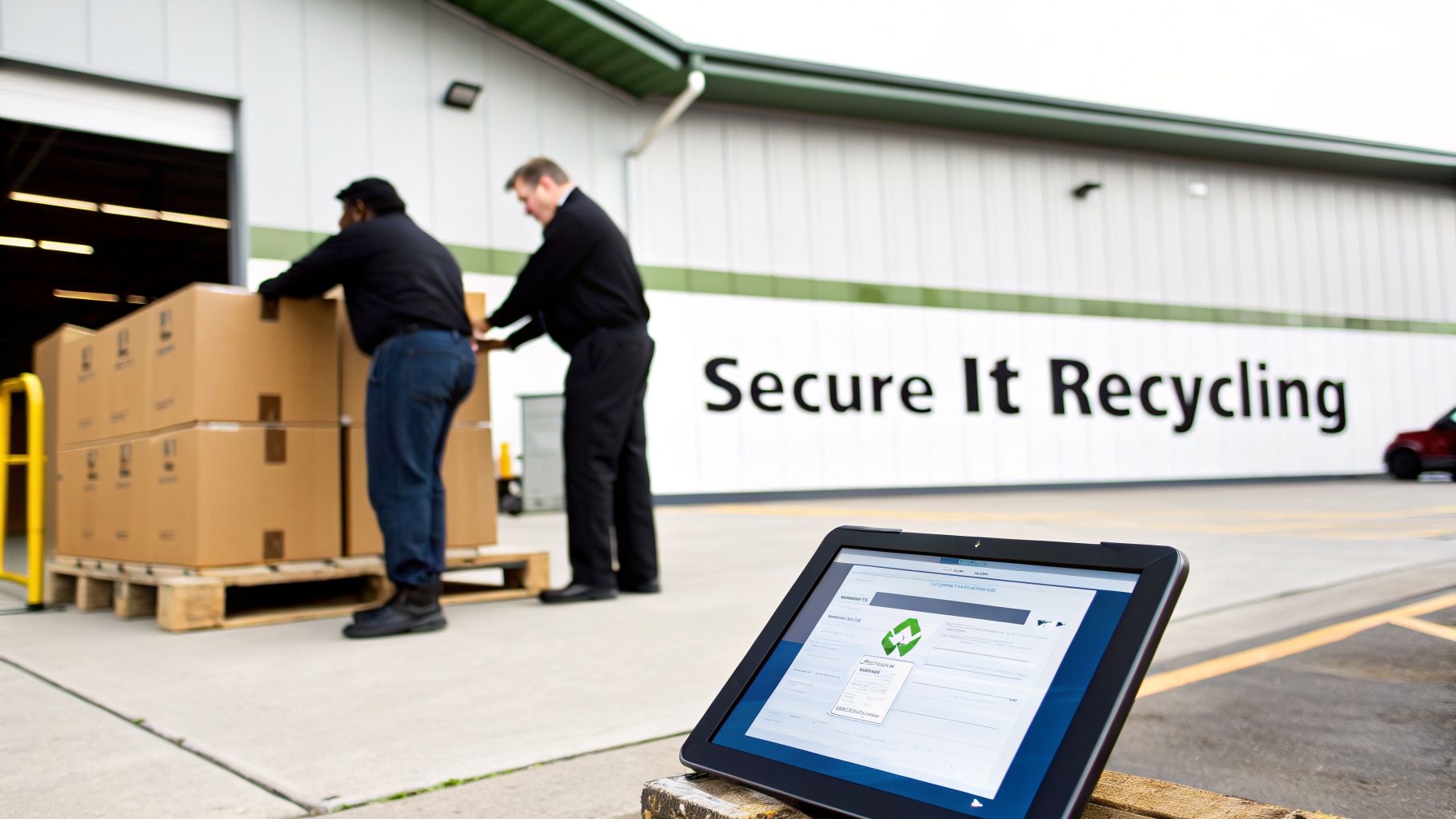
For IT leaders in Arlington, treating retired hardware as an afterthought is no longer an option. Think of it this way: the final phase of your equipment's lifecycle is just as critical as its purchase and deployment. Dropping the ball here leaves your entire organization exposed to serious financial and reputational damage.
The Challenge of Constant Upgrades
The North Texas tech corridor is defined by innovation, which means a constant cycle of new hardware coming in and old hardware going out. Those state-of-the-art servers from three years ago? They're already being decommissioned. The laptops from your last refresh are piling up in a storage closet. This relentless pace puts enormous pressure on IT departments to handle e-waste correctly.
This isn't just a local observation. The North American market for IT asset disposition is booming, expected to hit $1,257.6 million by 2025 and grow at a steady 8% CAGR through 2033. This growth is driven by companies retiring equipment faster than ever. For businesses in Arlington, that means a growing mountain of old tech where secure data destruction is absolutely mandatory.
To help IT leaders in Arlington navigate these challenges, we've summarized the key priorities below.
Table: Key Priorities for IT Asset Disposition in Arlington
This table outlines the critical factors you should be thinking about when planning for secure equipment recycling.
| Priority Area | Key Challenge | Recommended Action |
|---|---|---|
| Data Security | A single discarded hard drive can lead to a catastrophic data breach. | Partner with a vendor offering certified data destruction with a clear chain of custody. |
| Regulatory Compliance | Navigating environmental (EPA) and data privacy (HIPAA, etc.) regulations is complex. | Work with a recycler who provides Certificates of Destruction and Recycling to prove compliance. |
| Environmental Responsibility | Improperly disposed e-waste pollutes landfills with toxic materials. | Choose a vendor committed to R2 or equivalent standards for responsible recycling. |
| Logistical Efficiency | Managing the pickup and transport of bulky equipment is disruptive and time-consuming. | Select a local partner who offers scheduled, on-site pickups to minimize operational impact. |
Focusing on these areas transforms IT recycling from a logistical headache into a strategic part of your risk management plan.
From a Backroom Chore to a Strategic Imperative
What used to be a simple task of clearing out old gear has become a core business function. A single data breach from an improperly wiped hard drive can trigger devastating fines, lawsuits, and a loss of customer trust that takes years to rebuild.
A strong IT asset disposition (ITAD) strategy isn't just an operational expense; it's an investment in your company’s security, reputation, and long-term sustainability. It shields you from penalties and shows a real commitment to corporate responsibility.
A proactive approach to IT equipment recycling in Arlington is essential. It ensures you're not just getting rid of old equipment, but methodically protecting your business from very real threats. By treating asset retirement with the same seriousness as asset acquisition, you safeguard your company's future.
To dig deeper into the advantages, check out our guide on the benefits of e-waste recycling.
Understanding E-Waste Regulations and Data Security Compliance
Disposing of old IT equipment in Arlington isn't just about clearing out a storage closet. The moment a server, laptop, or hard drive is slated for retirement, it becomes a liability governed by a strict set of data security and environmental laws. Getting this wrong isn't an option—it exposes your business to serious legal and financial risk.
Think of it as establishing a digital chain of custody. Just like physical evidence in a legal case, your retired IT assets need an unbroken, documented trail from your office to their final destruction. This documentation is your proof of due diligence and your shield against compliance violations.
The Legal Framework You Must Know
Several overlapping laws create a compliance minefield for any business. These aren't just guidelines; they are federal and state mandates with steep penalties. A single data breach from an improperly discarded hard drive can trigger massive fines and cause irreparable damage to your company's reputation.
Key regulations include:
- HIPAA (Health Insurance Portability and Accountability Act): If your organization handles protected health information (PHI), HIPAA’s privacy and security rules extend to all data-bearing devices, even at their end of life. You can learn more about our process for HIPAA compliant electronics recycling in Texas.
- FACTA (Fair and Accurate Credit Transactions Act): This law requires businesses holding any consumer information to completely destroy it before disposal to prevent identity theft.
- State Environmental Laws: Texas and federal EPA regulations dictate how e-waste must be handled to keep hazardous materials like lead and mercury out of our landfills and water supply.
Choosing a vendor for IT equipment recycling in Arlington based only on the lowest price is a dangerous gamble. An uncertified recycler can easily cut corners, leaving your organization liable if data gets out or equipment is illegally dumped.
Certifications Are Your Compliance Armor
So, how can you be sure a vendor is operating by the book? The answer is third-party certifications. These aren't just logos for a website; they are rigorous, audited standards that serve as your guarantee of a secure, compliant, and environmentally sound process.
Think of them like a CPA or a medical license—they prove a recycler has the expertise and accountability to handle your assets correctly. For IT asset disposition (ITAD), these are the credentials that matter most:
R2v3 (Sustainable Electronics Recycling International): This is the premier standard for responsible electronics recycling. An R2v3-certified partner guarantees your equipment won't be exported to an overseas landfill and that they follow a strict hierarchy of reuse, recycling, and disposal, all while prioritizing data security.
e-Stewards: Another globally respected standard, e-Stewards is known for its uncompromising stance against exporting hazardous e-waste to developing nations. It also mandates stringent data destruction protocols.
NAID AAA Certification (National Association for Information Destruction): This is the gold standard specifically for data destruction. A NAID AAA certified vendor undergoes unannounced audits of their facilities, employees, and processes. It is the ultimate assurance that your sensitive data is 100% destroyed and unrecoverable.
When you work with a vendor holding these certifications, you are effectively transferring your compliance risk to a vetted expert. It frees you up to focus on your business, confident that your retired IT assets are being handled responsibly, securely, and with a complete audit trail to prove it.
A Look Inside Our Secure 5-Step ITAD Process
Turning a packed storage room of old IT gear into a fully documented, secure, and compliant project can feel overwhelming. But a proven IT asset disposition (ITAD) process makes it manageable. This is our playbook for safely decommissioning your hardware, ensuring every step is repeatable, auditable, and built to protect your business.
A successful ITAD project starts long before our truck arrives. Proper preparation is the key to a smooth and secure handoff. The first phase is all about getting organized and ready for pickup.
Phase 1: Asset Inventory and Staging
First things first, we need to know what we're working with. Create a detailed inventory of all equipment you need gone, including asset tags, serial numbers, device types (like servers, laptops, or switches), and where they are in your building. This list is the starting point for your chain-of-custody paperwork.
Once you have your list, group similar items together—laptops in one spot, servers in another, and peripherals like monitors and keyboards elsewhere. This simple step prevents confusion and guarantees an accurate count when our team arrives.
This visual breaks down the core compliance flow for IT equipment recycling in Arlington.
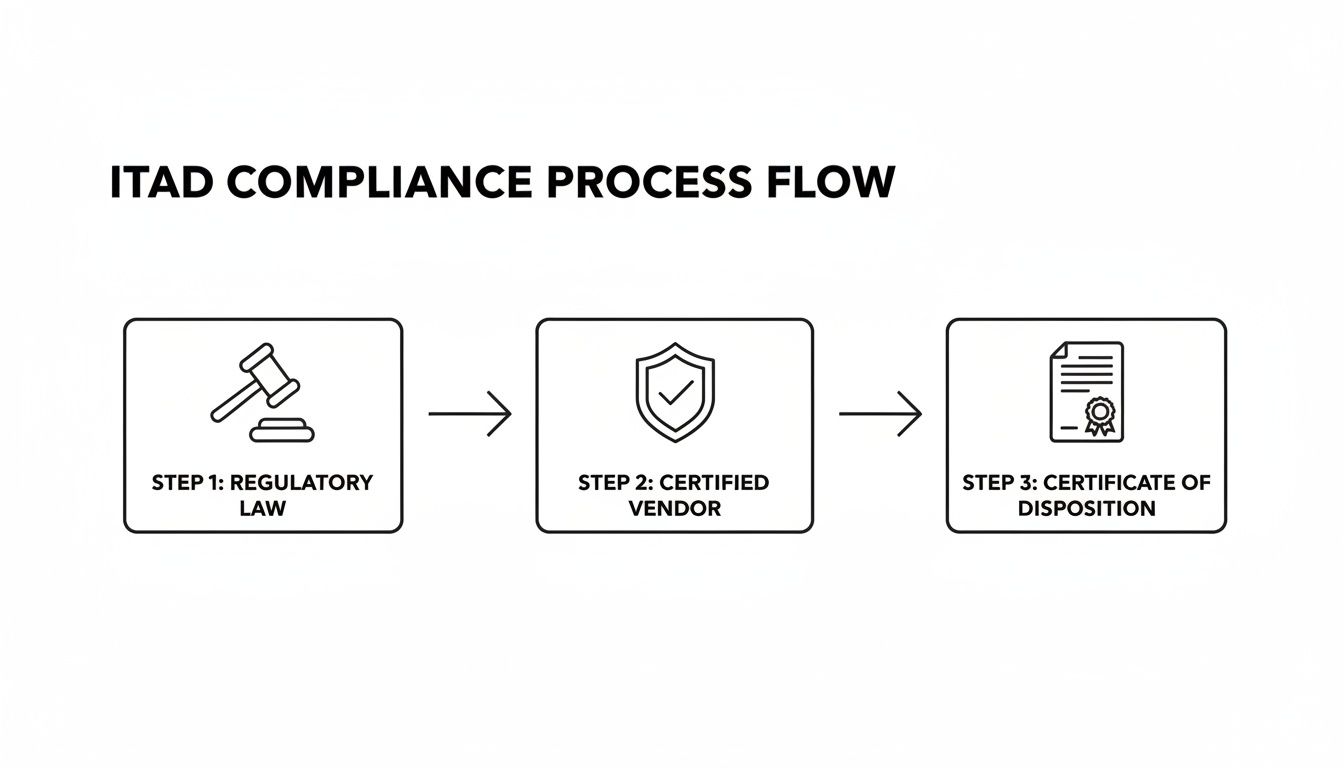
It shows the clear path from regulatory requirements to partnering with a certified vendor, which ultimately provides the crucial Certificate of Disposition.
Phase 2: Secure On-Site Containment
After sorting the gear, the next step is to stage it securely for pickup. This prevents any unauthorized access and keeps every asset accounted for right up until the moment we take possession.
How you pack the equipment depends on its size and volume:
- Laptops, Hard Drives, and Small Devices: Box these items up securely. We can provide gaylord boxes (large, pallet-sized cardboard containers) to make this as efficient as possible.
- Servers and Networking Gear: Stack these neatly on pallets. Shrink-wrapping the pallet is a must to keep equipment from shifting or falling.
- Loose Cables and Peripherals: Use smaller boxes to consolidate these items before putting them on a pallet or into a gaylord.
Moving everything to a single, secure staging area—like a locked storage room or a monitored section of your loading dock—is the final and most important prep step.
Phase 3: Scheduling Logistics and Pickup
With your assets counted and staged, it’s time to get us on the calendar. Contact us to schedule the pickup and provide your inventory list and any key details about your location, like loading dock hours or specific security protocols for entry.
As a professional IT equipment recycling Arlington provider, we'll work with you to find a convenient time, typically within standard business hours (Monday-Friday, 8 AM – 5 PM). This ensures we get in and out with minimal disruption to your day-to-day operations.
Phase 4: The Chain of Custody Transfer
On pickup day, the formal chain of custody transfer happens. Our uniformed and badged technicians arrive on-site to verify your inventory against the list you provided. Every pallet and container is counted before being loaded onto our secure, GPS-tracked truck.
Before our truck leaves, you'll sign a transfer of liability document. This is the official handoff—it’s the moment we assume full responsibility for the secure transport and final disposition of your assets.
Phase 5: Certified Destruction and Recycling
Once the equipment reaches our certified recycling facility, the final steps begin. All hard drives and data storage devices are destroyed according to NAID AAA standards, using either physical shredding or degaussing. This process guarantees your data is 100% unrecoverable.
All other components are then responsibly recycled in full compliance with R2v3 standards. This ensures any hazardous materials are managed safely and valuable commodities are recovered for reuse, minimizing your company’s environmental footprint. You can get a closer look at the complete IT asset disposition process in our detailed guide.
The job isn't done until the paperwork is in your hands. We provide serialized reporting that proves every single asset was handled according to industry best practices and legal requirements.
Finally, we issue the critical documentation that closes the loop on your project: a Certificate of Data Destruction and a Certificate of Recycling. These documents are your official, auditable proof of compliance and demonstrate your commitment to responsible IT management.
How to Choose Your Arlington IT Recycling Partner
Selecting the right IT asset disposition (ITAD) partner is one of the most critical decisions an IT leader in Arlington will make. This choice has a direct impact on your company's data security, legal compliance, and environmental reputation.
This isn't just about finding someone to haul away old equipment. It’s about entrusting a vendor with your most sensitive digital assets and your corporate integrity.
Think of it like choosing a bank to guard your money. You wouldn't hand over your company's finances to just anyone—you'd demand proof of security, a history of reliability, and transparent processes. The same rigor applies when selecting a partner for IT equipment recycling in Arlington. The right vendor acts as a seamless extension of your security team, while the wrong one can expose you to catastrophic risk.
This decision is especially timely given Arlington's role in the DFW tech corridor. Globally, the computer recycling market is projected to grow from $13,634.26 million in 2025 to $22,981.53 million by 2033. For local IT managers facing a constant stream of retired desktops, servers, and mobile devices, this growth underscores the urgent need for reliable recycling partners. You can find more details in this global computer recycling market analysis.
The Non-Negotiable Certifications
In the ITAD industry, certifications are the bedrock of trust. They provide independently audited, third-party verification that a vendor meets the highest standards for data security and environmental responsibility. Without them, you’re just relying on promises instead of proof.
R2v3 (Sustainable Electronics Recycling International): This is the leading global standard for electronics recycling. An R2v3-certified partner guarantees your equipment will be handled in an environmentally sound way, prioritizing reuse and ensuring no hazardous materials are improperly discarded. It also includes strict requirements for data sanitization.
NAID AAA (National Association for Information Destruction): This certification is the gold standard for data destruction. A vendor with NAID AAA certification undergoes rigorous, unannounced audits of their entire destruction process—from employee background checks to facility security. It is the ultimate assurance that your data will be rendered completely unrecoverable.
Choosing a vendor without both R2v3 and NAID AAA certifications is like hiring an accountant who isn't a CPA. They might know the basics, but they lack the validated expertise and accountability needed to protect your business when the stakes are high.
Data Destruction and Reporting Transparency
How a vendor destroys your data is just as important as the certifications they hold. You need absolute certainty that sensitive information is gone forever. Your potential partner must offer clear, defensible data destruction methods.
Key questions to ask any potential vendor include:
- Do you offer on-site data destruction? Services like mobile hard drive shredding allow you to witness the destruction firsthand. This provides an unbroken chain of custody for your most sensitive data.
- What is your process for off-site destruction? If equipment is taken off-site, it must be transported in secure, GPS-tracked vehicles to a monitored facility where destruction is meticulously documented.
- What kind of documentation will I receive? A trustworthy partner provides a Certificate of Data Destruction and a Certificate of Recycling. These reports must include serialized tracking, confirming that every single asset you handed over was processed correctly.
A vendor who is hesitant to provide detailed reports or clear answers is a significant red flag. Transparency isn't a bonus feature; it's a fundamental requirement for any ITAD partnership. Understanding these credentials is vital, and you can learn more by exploring what it means to be an R2 certified electronics recycler.
To help Arlington businesses compare potential partners, we've created a straightforward checklist of the most important evaluation criteria.
ITAD Vendor Evaluation Checklist
| Evaluation Criterion | What to Look For | Why It Matters |
|---|---|---|
| Certifications | R2v3 and NAID AAA certifications are non-negotiable. Ask for copies of their current certificates. | These prove adherence to the highest industry standards for environmental responsibility and secure data destruction. |
| Data Destruction Methods | A full suite of options: on-site shredding, off-site shredding, and certified data wiping. | Your security needs vary by asset type. A good partner offers flexible, documented solutions to meet them. |
| Reporting & Documentation | Serialized Certificates of Data Destruction and Recycling. Detailed asset tracking reports. | This documentation is your proof of compliance for audits and internal records. It closes the liability loop. |
| Logistics & Security | Secure, GPS-tracked vehicles. Vetted, background-checked employees. Secure, monitored facilities. | Your assets must be secure from the moment they leave your office until they are fully processed. |
| Local Presence | A physical location and dedicated team serving Arlington and the DFW metroplex. | A local partner provides faster response times, greater flexibility, and a better understanding of regional business needs. |
This checklist provides a solid framework for vetting potential ITAD partners. The goal is to find a provider who operates with the same level of diligence and security that you apply within your own organization.
Managing Specialized Projects Like Data Center Decommissioning

A standard office cleanout is one thing. A full data center teardown is another beast entirely. Not all IT recycling projects are created equal, and some demand a much higher level of precision, security, and project management.
Data center decommissioning and handling equipment from regulated industries like healthcare are two perfect examples. It’s the difference between retiring a handful of desktops at a branch office and decommissioning an entire power plant. One is predictable; the other is a complex system of interconnected assets where a single mistake can have major consequences.
These large-scale projects require a partner who has been there and done that. A successful data center decommissioning involves meticulous on-site planning, coordinating a skilled crew, and carefully dismantling hundreds—or even thousands—of servers, storage arrays, and network devices.
The Unique Demands of Data Center Projects
A data center is the heart of an enterprise, and taking it apart requires surgical precision. This isn’t just about pickup and recycling; it’s a full-scale project management operation from start to finish.
You’re up against a few key challenges:
- Asset Management at Scale: Tracking every single drive, server, and switch by serial number is non-negotiable. It's the only way to maintain a perfect chain of custody.
- On-Site Logistics: Working in a live or recently shut-down facility means coordinating every move to avoid disrupting any remaining operations.
- Maximum Data Security: With such a high concentration of sensitive data, on-site services like mobile hard drive shredding are often the best way to eliminate risk.
A data center decommission isn't just about recycling hardware. It’s about methodically dismantling a critical infrastructure asset while guaranteeing that 100% of the data it once held is certifiably destroyed. The margin for error is zero.
For IT leaders in Arlington, finding a partner with proven experience in this arena is critical. The right vendor will provide a detailed statement of work, a dedicated project manager, and a team that knows how to handle the specific challenges of your data center. Our detailed overview of the data center decommissioning process can help you get prepared.
Handling Equipment from Regulated Industries
Just as data centers have unique technical demands, industries like healthcare and life sciences have their own compliance hurdles. Recycling medical devices, lab equipment, and patient-facing hardware adds another layer of complexity to the IT disposal process.
This equipment often contains embedded Protected Health Information (PHI), making strict HIPAA compliance the top priority. A qualified partner for IT equipment recycling in Arlington must have documented procedures for handling these assets, ensuring every single data-bearing component is identified and securely destroyed.
On top of that, some lab and medical equipment can pose biohazard risks if not handled correctly. A responsible recycling partner will have protocols to assess and manage these potential contaminants, protecting both their staff and the environment. It’s this deep understanding of high-stakes environments that gives you peace of mind that every asset is managed with the right level of care.
The Real ROI of Responsible IT Equipment Recycling
It's easy to look at professional IT asset disposition (ITAD) as just another line item on the expense sheet. But that perspective misses the bigger picture entirely. The real conversation isn't about the cost of proper disposal—it's about the staggering cost of inaction.
A single discarded hard drive falling into the wrong hands can trigger data breach notification laws, leading to regulatory fines that easily climb into six or seven figures. That doesn't even account for the irreparable harm to your brand. A certified program for IT equipment recycling in Arlington isn’t an expense; it’s an investment in bulletproof compliance and peace of mind. The return comes from the catastrophic risks you completely avoid.
The True Cost of Inaction
When you sidestep a professional ITAD process, you’re not saving money. You're unknowingly accepting massive liabilities that can cripple a business.
Here’s what you’re up against without a certified partner:
- Data Breach Fines: A breach from improperly disposed equipment can trigger enormous penalties under HIPAA, FACTA, or GDPR, often costing millions.
- Environmental Penalties: Illegally dumping e-waste can result in significant fines from the EPA and state authorities for non-compliance.
- Loss of Customer Trust: A public data breach is the fastest way to destroy customer loyalty. Rebuilding that trust is a long, expensive, and sometimes impossible process.
- Legal Fees: Defending your company against lawsuits from affected customers or regulatory bodies adds yet another layer of financial strain.
A professional ITAD program is your insurance policy against these outcomes. The modest cost of certified recycling is insignificant compared to the immense financial and reputational exposure of going it alone or using an uncertified vendor.
The real ROI of responsible recycling isn't measured in dollars recovered from old equipment. It's measured in the millions of dollars in fines, legal fees, and brand damage that you never have to face. It’s an investment in your organization's future security.
Beyond Risk Mitigation to Brand Enhancement
While mitigating risk is the primary driver, the value doesn't stop there. Committing to a certified recycling program is a tangible action that reinforces your company’s dedication to Corporate Social Responsibility (CSR). It’s clear proof of your commitment to protecting customer data and the environment.
This sends a powerful message to your customers, partners, and employees, showing that your organization operates with integrity through the entire technology lifecycle. In the end, this commitment to security and sustainability becomes a key differentiator, enhancing your brand and building stakeholder trust. Choosing a certified partner like Dallas Fortworth Computer Recycling secures your data, ensures compliance, and protects your company’s future.
Common Questions About IT Equipment Recycling in Arlington
When you're handling an IT refresh or office move in Arlington, you're bound to have questions. To help IT managers like you, we've put together some straightforward answers to the questions we hear most often.
What Kinds of Business IT Equipment Can Be Recycled?
Many people think IT recycling is just for old laptops and desktop computers. But as a full-service ITAD partner, we handle a much wider range of business technology. We responsibly process everything from your server room to specialized hardware.
Our services cover:
- Servers and Networking Gear: This includes rack servers, blade servers, switches, routers, and firewalls.
- End-User Devices: Laptops, desktops, tablets, and company mobile phones.
- Data Storage: Individual hard drives (HDDs), solid-state drives (SSDs), and entire storage arrays like SANs and NAS systems.
- Specialized Equipment: We have extensive experience with equipment from regulated industries, including medical devices and laboratory electronics.
Can You Perform Data Destruction at Our Location?
Yes. We know that for many businesses, especially in healthcare and finance, letting sensitive data leave your facility isn't an option. That's why we offer on-site data destruction services across the Arlington area.
Our mobile shredding trucks can come right to your office or data center. This allows your team to witness the physical destruction of hard drives and other storage media, ensuring a completely secure chain of custody and giving you total peace of mind.
On-site destruction is the gold standard for managing risk. It completely eliminates any chance of data exposure during transit and provides immediate, verifiable proof that your information is gone for good.
How Do We Get Started with a Pickup?
Scheduling a pickup is a simple, direct process. It all starts with a conversation. Just get in touch to discuss your inventory, and our logistics team will handle the rest. We’ll work with you to find a time that fits your schedule and causes minimal disruption to your operations.
Our standard service windows are Monday through Friday, from 8:00 AM to 5:00 PM, giving businesses across the Arlington metroplex plenty of flexibility.
Are Your Services Only for Large Corporations?
Not at all. While we have the scale to manage huge data center decommissionings and large enterprise projects, our services are built to support organizations of all sizes. We provide certified IT equipment recycling in Arlington for a wide variety of clients.
We work with mid-sized businesses, schools, government agencies, and healthcare providers. Every client gets the same certified, secure, and documented service, no matter the size of the project.
Ready to secure your retired IT assets and ensure total compliance? As a nationwide, B2B leader with over 13 years of experience, Dallas Fortworth Computer Recycling provides certified data destruction and responsible electronics recycling for organizations of all sizes. Schedule your secure pickup today at https://dallasfortworthcomputerrecycling.com.