
Secure Data Destruction Arlington: Certified ITAD & Compliance 2026
In Arlington's competitive business world, it's easy to treat old IT equipment as an afterthought. But just hitting 'delete' on old computers or servers is a gamble you can't afford to take, leaving your company’s sensitive data wide open and surprisingly easy to recover.
Professional data destruction isn't just another business expense; it's a fundamental part of your company's security strategy and long-term survival.
Why Data Destruction Is A Non-Negotiable Business Priority

Too many businesses operate under the false assumption that formatting a hard drive or dragging files to the trash bin gets rid of them for good. Nothing could be further from the truth. These actions are like removing a book's card from an old library catalog—the book itself is still sitting on the shelf, waiting for someone to find it.
With readily available software, that "deleted" data can be quickly recovered, putting your organization in a world of trouble. This information could easily include:
- Customer financial data and credit card numbers
- Employee personally identifiable information (PII) like Social Security numbers
- Your company's proprietary business plans and trade secrets
- Confidential internal communications and client lists
If this data falls into the wrong hands, the consequences can be devastating, ranging from crippling financial penalties and brand damage to a complete loss of customer trust.
The Staggering Cost of Inaction
This threat isn't just theoretical; it has a very real price tag. With global cybercrime costs projected to hit $10.5 trillion annually by 2026, secure data destruction has become a primary line of defense. A single data breach can cost a company millions, factoring in everything from recovery expenses and intellectual property theft to massive regulatory fines. You can explore a more detailed breakdown in our complete guide to secure data destruction in DFW.
In this environment, every retired laptop, server, or mobile device that isn't properly sanitized represents a potential security failure. The data you thought was gone could become a headline tomorrow.
More Than Just a Security Measure
Beyond just managing risk, having a formal data destruction policy is a powerful statement about your company's integrity and commitment to responsible governance. It shows your clients, partners, and any regulatory bodies that you take data privacy seriously. This builds tremendous confidence and strengthens your brand’s reputation right here in the Arlington market.
Ultimately, secure data destruction isn't about getting rid of old hardware. It’s about protecting your business’s future, safeguarding its reputation, and ensuring your most valuable asset—your data—never becomes your biggest liability. As more business operations move to the cloud, the secure retirement of the physical devices that once accessed that data becomes even more critical.
Exploring Your Data Destruction Options
Once you've decided that professional data destruction is necessary, the next step is to understand the different methods available. Not all techniques are interchangeable; the best choice for your business will depend on the type of media, your specific security requirements, and any compliance rules you need to follow.
Let's break down the three primary methods used for professional data destruction Arlington businesses can trust. These approaches go far beyond just hitting 'delete' on a file—they ensure data is permanently and verifiably unrecoverable.
Software Overwriting
Software-based data destruction, often called overwriting or wiping, uses specialized programs to write patterns of ones and zeros over every sector of a hard drive. This process is repeated several times, burying the original information under layers of new, meaningless data.
Think of it like painting over a wall. One coat of paint might let the old color show through, but multiple coats will completely obscure it. This is an ideal method for hard drives and other assets you plan to reuse, resell, or donate, as it preserves the hardware.
A professional service will use software that meets the standards set by the National Institute of Standards and Technology (NIST) in its Special Publication 800-88. This guarantees the job is done right and is backed by a certificate of sanitization.
Degaussing
Degaussing is a powerful and rapid method for destroying data on magnetic media, like traditional hard disk drives (HDDs) and backup tapes. A machine called a degausser generates an incredibly strong magnetic field that instantly scrambles and neutralizes the magnetic storage platters inside the drive.
The process completely randomizes the magnetic particles that hold the data, rendering the drive's own mechanisms unable to read anything. The drive is left totally inoperable, and the data is gone for good. Degaussing is an extremely fast and effective way to destroy large volumes of magnetic media.
Physical Destruction
When data must be eliminated with absolute certainty and the media will never be used again, physical destruction is the final answer. This involves shredding, crushing, or pulverizing hard drives, solid-state drives (SSDs), and other devices into tiny, unsortable pieces.
Imagine feeding a hard drive into a high-powered industrial shredder. The result is a pile of metallic confetti, making it physically impossible to reassemble the fragments and recover any data. This method is the gold standard for high-security needs and is the only surefire way to destroy data on damaged or non-functional drives. For a deeper look into this process, you can find more details on our page about secure hard drive disposal.
Data Destruction Methods At A Glance
This table compares the top three methods for secure data sanitization to help you choose the right approach for your assets.
| Method | How It Works | Best For | Pros | Cons |
|---|---|---|---|---|
| Software Overwriting | Writes random data patterns over existing information multiple times. | Reusable HDDs and SSDs. | Allows for asset reuse; environmentally friendly. | Can be time-consuming for large volumes. |
| Degaussing | Uses a powerful magnetic field to scramble data on platters. | HDDs and magnetic tapes. | Extremely fast and highly effective for magnetic media. | Renders the drive unusable; ineffective on SSDs. |
| Physical Shredding | Grinds media into small, irrecoverable pieces. | All media types, including SSDs and damaged drives. | Highest level of security; visually verifiable. | Destroys the asset completely, preventing reuse. |
Choosing the right method ensures your organization’s data security and compliance needs are fully met. Each technique offers a different balance of security, cost, and potential for asset reuse.
On-Site vs. Off-Site Destruction: Which Is Right For You?
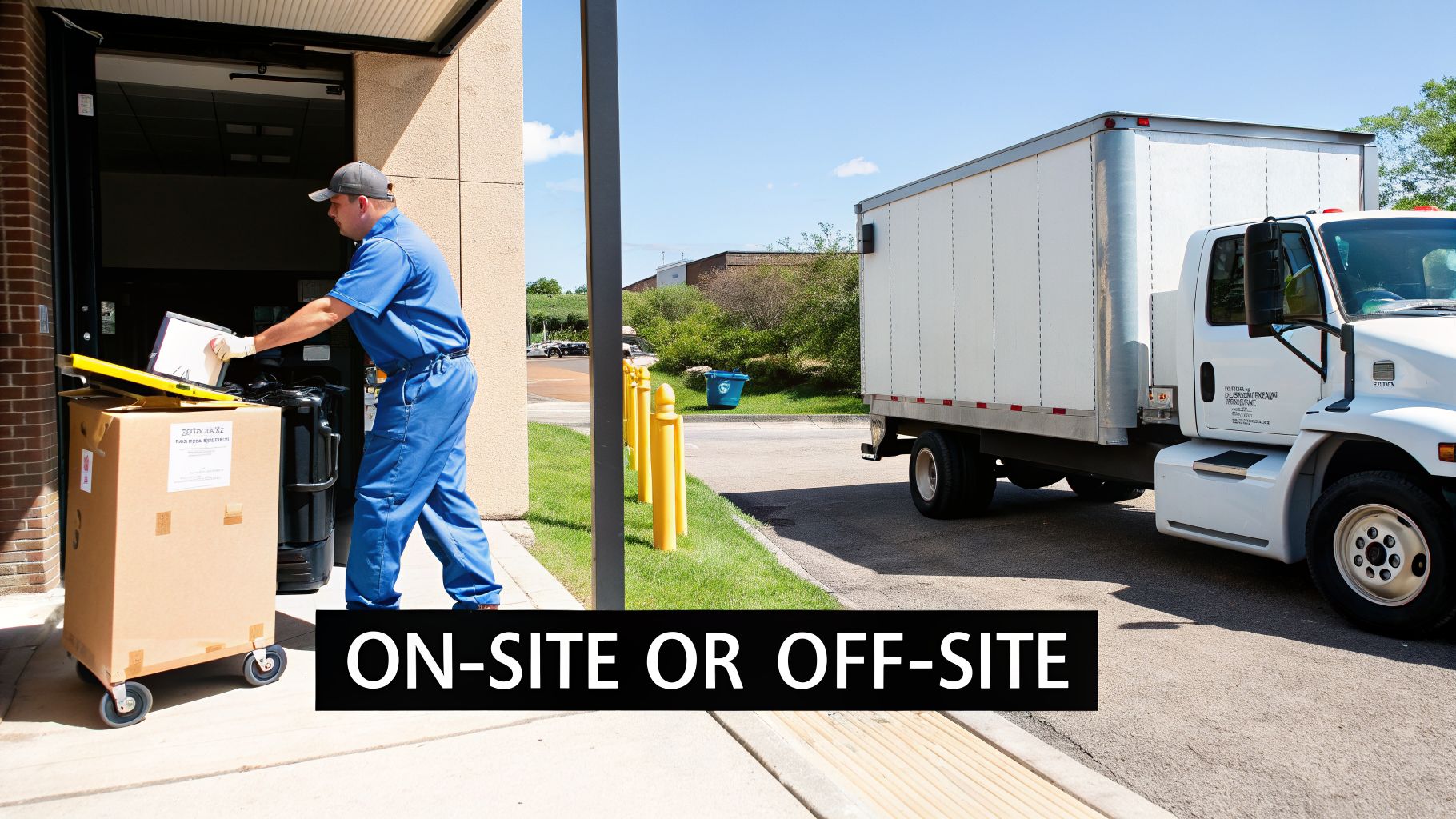
Once you've settled on a destruction method, the next big question is where it should happen. Should the process take place right at your office, or should your equipment be transported to a specialized facility? For any Arlington business, the answer really boils down to your security policies, compliance demands, and the sheer volume of assets you need to handle.
Think of on-site destruction as having a front-row seat to your data security. A mobile shredding truck comes directly to your location, and you can physically watch every single hard drive get destroyed. It offers an unmatched level of transparency and immediate proof that the job is done.
Off-site destruction, on the other hand, is all about efficiency and scale. Your assets are securely transported in a GPS-tracked vehicle to a purpose-built facility designed for high-volume processing. This is often the most practical route for large IT asset retirements or full data center decommissioning projects.
On-Site Destruction: The Ultimate Transparency
The main reason businesses choose on-site service is for absolute, undeniable peace of mind. For industries with strict compliance rules like healthcare (HIPAA) or finance (FACTA), witnessing the destruction firsthand isn't just a preference—it’s often a non-negotiable requirement.
Key benefits of on-site service include:
- Unbroken Chain of Custody: Your assets are destroyed before they ever leave your property, completely eliminating any risk during transport.
- Immediate Verification: You get a Certificate of Destruction on the spot, confirming the task is complete before our truck even pulls away.
- Compliance Assurance: It provides indisputable proof for any audit, showing that you maintained total control throughout the entire process.
This approach is perfect for businesses with a small to moderate number of assets or those handling extremely sensitive data where visual confirmation is critical. If this sounds like the right fit, you can learn more about how we bring on-site shredding services near you for maximum security.
Off-Site Destruction: Efficiency at Scale
Off-site destruction is built for efficiency without ever sacrificing security. A certified partner like us uses locked bins, secure transport with documented chain-of-custody protocols, and a facility under 24/7 surveillance to protect your assets from the moment of pickup to final destruction.
Choosing a certified partner ensures your assets are handled under stringent security protocols every step of the way. The process is fully documented, providing a clear and auditable chain of custody from your door to our destruction plant.
This model is the ideal solution for organizations that need to dispose of a large quantity of assets and want to minimize any disruption to daily operations. We handle all the logistics, freeing up your team's time and resources. By centralizing destruction at our facility, we can process materials more cost-effectively and manage recycling streams with greater efficiency. This makes it the go-to choice for enterprise-level data destruction in Arlington.
Navigating The Complex World Of Compliance
Trying to make sense of data privacy laws can feel like wading through an alphabet soup of acronyms. From HIPAA and FACTA to NIST 800-88, it’s easy to get bogged down in the technical jargon and lose sight of the main point.
But when you cut through the noise, all these regulations share one critical goal: protecting people and organizations from harm. Whether it’s a patient's private medical history, a customer's financial details, or sensitive government information, compliance is really all about accountability. For any Arlington business, meeting these standards isn't just a box-ticking exercise—it’s a fundamental part of operating with integrity.
From Acronyms to Actionable Steps
Certified data destruction in Arlington is one of the most direct and effective ways to meet these strict legal requirements. Instead of simply hitting "delete" and hoping for the best, professional destruction services provide a final, auditable step that proves you’ve taken data security seriously.
The cornerstones of any compliant destruction process are a secure chain of custody and a formal Certificate of Destruction. These documents are your tangible proof of due diligence, showing exactly what was destroyed, when, and how. In an audit, they are your best defense.
This documentation shifts your company’s position from simply hoping for security to actively proving it. To see how this applies specifically to the healthcare field, you can find more information in our article on HIPAA-compliant electronics recycling in Texas.
The need for these verifiable services is growing fast. The hard drive destruction service market is projected to skyrocket from $1.65 billion in 2024 to $5.05 billion by 2035, a trend fueled by rising concerns over data security. With U.S. data breaches climbing from just 447 in 2012 to over 3,200 in 2023, physical shredding is no longer optional—it's essential for preventing data leaks after disposal. You can dive deeper into these hard drive destruction service market trends at SphericalInsights.com.
Key Regulations At A Glance
While this isn't a complete list, here are some of the key regulations that frequently require certified data destruction for businesses in and around Arlington:
- HIPAA (Health Insurance Portability and Accountability Act): Mandates the strict protection of patient health information (PHI), which includes the secure and permanent disposal of any media that ever stored it.
- FACTA (Fair and Accurate Credit Transactions Act): Requires businesses to destroy consumer information taken from credit reports to prevent identity theft and fraud.
- NIST Special Publication 800-88: This isn't a law, but a set of federal guidelines for media sanitization. It provides a clear, respected framework for data destruction that is now a best-practice standard across many industries.
At the end of the day, compliance is about building trust. A professional data destruction strategy gives your Arlington business the confidence to face any audit and assure your clients and partners that their information is safe—from the moment you receive it to its final, secure disposal.
How To Choose The Right Data Destruction Partner
Choosing a partner for data destruction in Arlington isn't just about price—it's about managing risk. The right vendor is a critical part of your security infrastructure. The wrong one can leave your business exposed to costly fines and serious reputational harm. This decision isn't about finding the cheapest service; it's about finding the most secure and dependable one.
A professional partner doesn't make vague promises. They operate with proven security protocols and total transparency. You need verifiable proof that your sensitive data is handled securely from the moment it leaves your facility until it's verifiably destroyed.
Verify Certifications And Insurance
Before discussing any logistics, start by verifying the vendor’s credentials. This is a non-negotiable first step.
Look for key industry certifications like R2v3 (Responsible Recycling) or e-Stewards. These aren't just logos on a website; they are hard-earned credentials that require rigorous, ongoing third-party audits to prove adherence to strict data security and environmental standards.
Next, ask for their certificate of liability insurance. This document protects your organization from liability in the rare case of a data breach during transit or destruction. Any legitimate partner will provide this without hesitation.
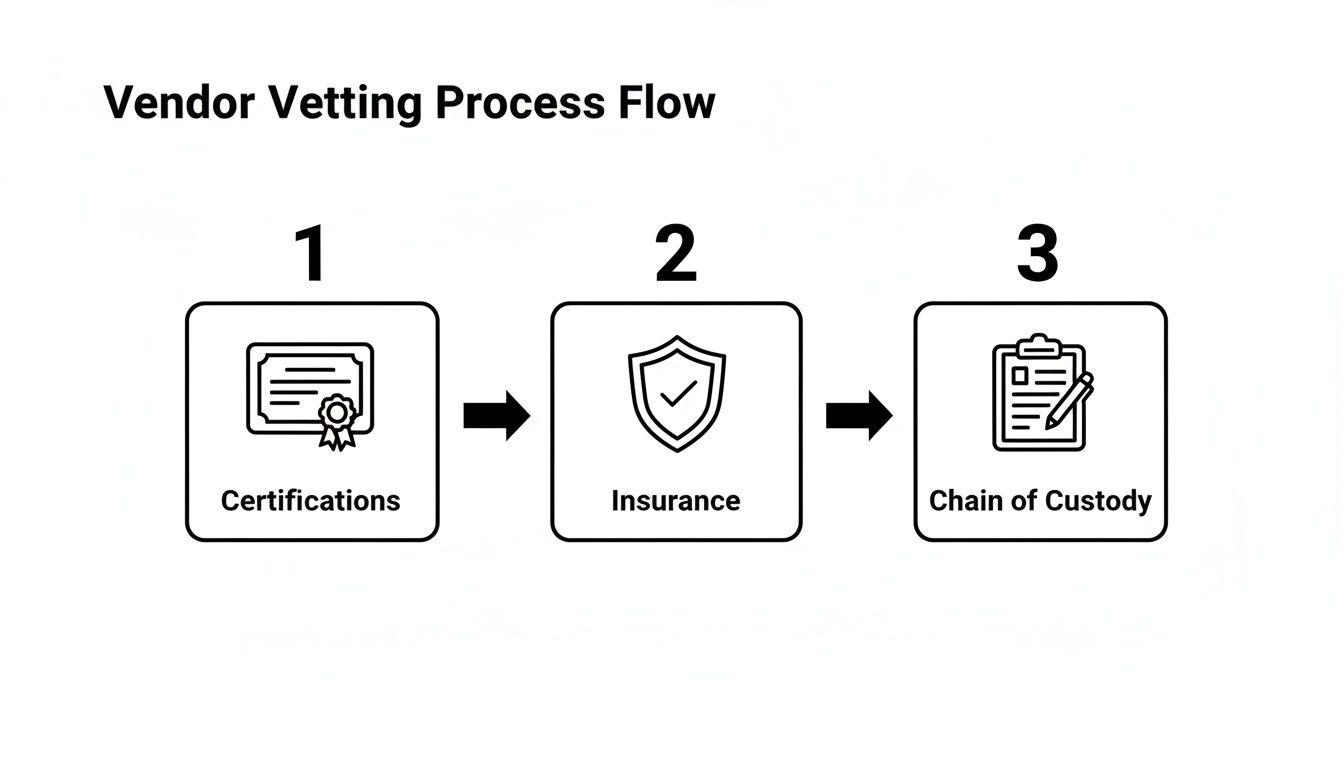
As this process shows, vetting is a sequential process. If a vendor can't pass the initial certification and insurance check, their other security claims are irrelevant.
Scrutinize Security And Documentation
With credentials confirmed, it's time to dig into their day-to-day operational security. How do they maintain a secure chain of custody? These aren't minor details; they are fundamental to a secure process.
A professional vendor should be able to describe their security measures, including:
- GPS-tracked vehicles for all pickups.
- Secure, locked containers used during transport.
- Screened, uniformed employees who have passed thorough background checks.
The most crucial documents you will receive are a detailed Chain of Custody form and a final Certificate of Destruction. The certificate is your legal proof of compliance, itemizing every asset destroyed and protecting your business in the event of an audit.
Finally, keep an eye out for red flags. Vague pricing, an unwillingness to provide documentation, or a lack of a clear environmental policy are all signs of a vendor to avoid. A trustworthy partner is always transparent. For more detailed advice, our guide on selecting from various IT asset disposition companies provides additional helpful criteria.
A Step-by-Step Look at Our Data Destruction Process

When you’re dealing with sensitive information, you need to know exactly how your assets are being handled. A professional data destruction Arlington service should feel straightforward and completely secure, giving you total peace of mind.
It all starts with your call or email. We’ll work with you to create a clear, itemized quote based on the equipment you need to dispose of. Once you approve it, we’ll schedule a pickup at your Arlington facility that works for your schedule, whether you’ve chosen on-site or off-site destruction.
For off-site service, our team inventories and serializes every asset before securely loading them into locked, GPS-tracked vehicles for transport to our facility. If you opt for on-site service, we bring our mobile destruction equipment right to your doorstep.
Destruction, Documentation, and Recycling
Whether at our facility or your location, the destruction method you’ve selected—shredding, degaussing, or data wiping—is carried out under strict, documented protocols. Every device is tracked from start to finish, maintaining an unbroken chain of custody.
After every last drive is destroyed, we issue a formal Certificate of Destruction. This is a legally binding document that serves as your official, auditable proof of compliance. It details every single serialized asset that was sanitized, confirming your due diligence is complete.
This final piece of documentation is non-negotiable. With the data destruction market projected to hit $22.84 billion by 2029 and cyberattacks exposing millions of records—like the 17.3 million leaked in a single month in 2025—this certificate is your verifiable proof of security. You can find more on these data destruction market projections at ResearchAndMarkets.com.
Finally, the process ends with the responsible recycling of all shredded materials, ensuring your electronic waste never ends up in a landfill.
Frequently Asked Questions About Data Destruction
When it comes to permanently disposing of sensitive business data, it's natural to have questions. For businesses across Arlington, getting clear, straightforward answers is the first step toward a secure and compliant IT asset disposition strategy. Here are some of the most common questions we hear from our clients.
Is Formatting My Hard Drives Good Enough To Erase The Data?
No, simply formatting a hard drive is a common but risky mistake. Formatting only removes the file system's pointers to the data, not the data itself. Think of it like tearing out the table of contents from a book—all the chapters are still there, just harder to find for a casual user.
The actual files remain on the drive and can often be recovered with basic, widely available software. True data security requires professional methods like multi-pass data wiping, degaussing, or physical shredding to ensure the information is 100% unrecoverable.
What Documentation Proves My Data Was Securely Destroyed?
A reputable data destruction partner provides a complete, auditable paper trail. The two most important documents you should receive are the Chain of Custody form and a Certificate of Destruction.
The Chain of Custody tracks your assets by serial number from the moment they leave your facility to their final disposition.
The Certificate of Destruction is your official, legally binding proof of compliance. It details what was destroyed, when, and how, protecting your business in the event of an audit. It confirms that the professional data destruction Arlington businesses need has been completed to certified industry standards.
How Much Does Data Destruction In Arlington Typically Cost?
Pricing for data destruction can vary based on several key factors. The primary cost drivers include the quantity and type of media you have (e.g., hard drives vs. backup tapes), the service model you choose (on-site vs. off-site), and the specific destruction method. On-site services, for instance, typically carry a premium for the dedicated truck and technician time at your location.
The best approach is always to request a detailed quote based on a specific inventory of your assets. A transparent partner will provide clear, itemized pricing without any hidden fees, so you know exactly the security and value you're getting.
Don't leave your data's final chapter to chance. For a secure, compliant, and documented process that protects your business, trust the experts at Dallas Fortworth Computer Recycling.
Schedule a secure pickup or get a free quote for your data destruction needs today