
Texas Ranger: Law Enforcement, Baseball & Beyond
You may have typed texas ranger looking for an investigator, a baseball team, or a vehicle. Search results rarely help. They mix law enforcement history, Arlington sports coverage, pickup truck specs, and frontier mythology into one pile.
That confusion matters more than it seems. In security, compliance, and IT asset disposition, mislabeling a thing is how mistakes begin. The first control is always identification. Know what you’re looking at, who owns it, and what process applies.
For a professional audience, the Texas Ranger Division is the version that deserves the closest attention. Not because of the legend, but because the agency represents something familiar to anyone who manages regulated assets. It relies on screening, documentation, controlled escalation, and evidence integrity. Those aren’t romantic ideas. They’re operating disciplines.
An Introduction to the Texas Ranger Legacy
The term texas ranger carries a lot of cultural baggage. Some of it comes from real law enforcement history. Some of it comes from movies and television. Some of it comes from people thinking first about the baseball club in Arlington or a Ford Ranger parked outside a warehouse.
For business leaders, especially in infrastructure-heavy environments, that kind of ambiguity should feel familiar. The same word can refer to a retired laptop, a production server, or a regulated storage device that still holds sensitive data. If the label is sloppy, the handling process becomes sloppy too.
Why precision matters
The Texas Ranger Division is part of the Texas Department of Public Safety and operates as an elite investigative body. That’s the version of texas ranger that intersects most closely with professional concerns like chain of custody, investigative standards, and controlled handling of evidence.
What makes the agency useful as a business analogy isn’t the badge. It’s the method.
- Selection matters: High-trust work starts with strict entry requirements.
- Process matters: Sensitive investigations depend on documented handling.
- Specialization matters: Different threats require different units and response models.
- Oversight matters: Public legitimacy depends on accountability, not just tradition.
Practical rule: If a process would fail under investigative scrutiny, it’s too weak for regulated IT disposition.
That’s why the Texas Rangers are worth understanding beyond folklore. Their public image is dramatic. Their operational value, at least as a model for professional discipline, is much more procedural.
A Name with Multiple Meanings
Most confusion around texas ranger comes from three separate meanings being treated as if they’re interchangeable. They’re not.
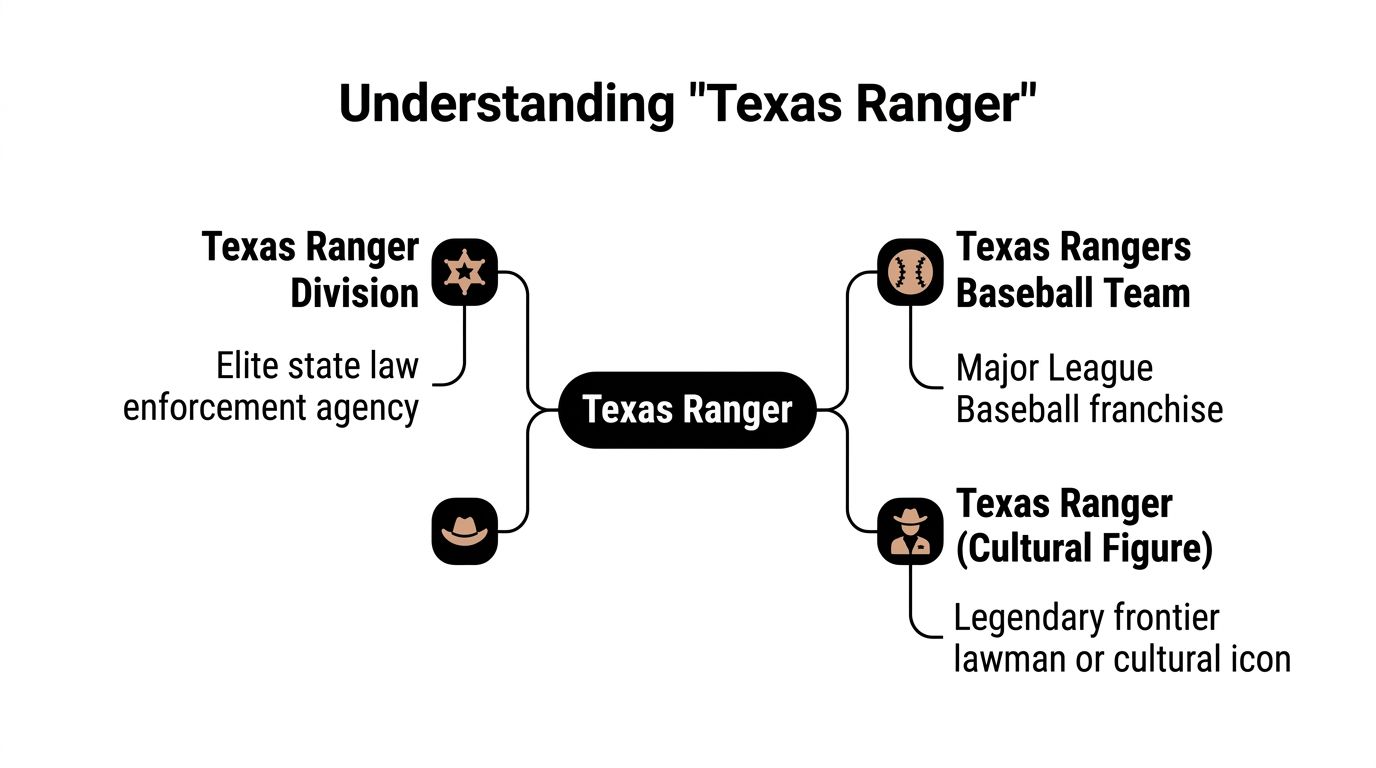
Three distinct categories
| Meaning | What it refers to | Why people confuse it |
|---|---|---|
| Texas Ranger Division | State law enforcement investigators within DPS | The historic name dominates search results |
| Texas Rangers | Major League Baseball team in Arlington | Regional visibility in DFW is huge |
| Ranger vehicles and cultural uses | Ford Ranger, Polaris Ranger, and frontier imagery | The name carries strong Texas branding |
The baseball side is easy to recognize once you see it in context. If the discussion is about Arlington, the ballpark, players, or standings, it’s the MLB team. If you’re looking for other regional sports context, the nearby culture around Texas teams often overlaps with topics like Texas football.
The vehicle side gets trickier because both trucks and utility vehicles use the Ranger name. In the utility vehicle segment, the Polaris Ranger Crew XP 1000 Texas Edition has a substantial bed capacity, and in the truck segment, post-launch changes to the 2024 Ford Ranger 4×4 lowered minimum running ground clearance from 10.4 inches to 9.3 inches, which changes its off-road behavior, according to this rundown of 2024 Ranger spec changes.
The practical takeaway for business readers
In compliance work, names aren’t enough. You need context.
A vendor says “Ranger.” Do they mean a fleet vehicle, a utility platform, or a state investigator? A site manager says “Texas Rangers.” Are they talking about a game-day traffic issue in Arlington or an investigative referral? Professionals avoid those errors by forcing clear categorization early.
Treat the phrase texas ranger the same way you’d treat “server,” “drive,” or “disposal.” The word alone isn’t actionable. The operating context is.
That habit sounds basic. It’s also one of the fastest ways to avoid preventable mistakes.
The Forging of a Legend Historical Background
The law enforcement Texas Ranger has one of the strongest public myths in American policing. That myth was built over a long period. It draws from frontier patrol work, border conflict, criminal investigations, and later retellings that simplified a messy reality into a clean heroic story.

Why the legend stuck
The image is durable because it’s easy to understand. A lone lawman, wide-open territory, fast decisions, rough justice. Popular culture amplified that version because it travels well. It’s cinematic.
Operational reality is never that simple. Agencies inherit procedures, politics, incentives, blind spots, and public pressure. Anyone who has managed a decommissioning project across multiple facilities knows how quickly a clean story falls apart once records, responsibility, and exceptions enter the picture.
The history isn’t clean
A serious view of the Texas Rangers has to include the record of abuse as well as the record of service. One of the clearest examples is the Porvenir Massacre. In 1918, Texas Rangers executed 15 unarmed Mexican men and boys, and the 1919 investigation led by State Representative José T. Canales exposed broader abuses. That inquiry led to several firings but no criminal prosecutions, as summarized in this account of surprising stories about the Texas Rangers.
That matters because accountability is part of institutional history, not an afterthought. In compliance work, people sometimes talk as if process integrity begins the moment a policy is written down. It doesn’t. It begins when an organization admits where prior controls failed and builds mechanisms that make quiet abuse harder.
A useful parallel appears in regulated equipment retirement. Organizations often focus on environmental benefit first, which is valid, but the harder lesson is governance. Without documented custody, auditable disposition, and clear responsibility, even well-intended programs drift. That’s why environmental handling and security handling are tightly connected in mature programs, a theme that also shows up in discussions about the environmental impact of electronic waste.
What history teaches practitioners
- Reputation isn’t control: A famous institution can still fail basic accountability tests.
- Myth can obscure risk: Public admiration often delays scrutiny.
- Reform requires structure: Standards need enforcement, records, and consequences.
Historical prestige never substitutes for auditable process.
That’s the right frame for understanding the modern texas ranger. The badge carries history. The work has to stand on procedure.
Common Misconceptions vs Modern Reality
The most persistent misconception about the texas ranger is that the job is mostly instinct, grit, and physical presence. That image still dominates public discussion. It’s also outdated.
Modern Rangers don’t operate as isolated frontier figures. They work inside a structured investigative environment, and that environment increasingly includes digital evidence, fraud matters, and public corruption cases with a technical footprint.
The lone-wolf myth fails the first audit
A real investigation lives or dies on what can be documented. Who collected the evidence. Where it was stored. Who had access. Whether the record can survive challenge.
That should sound familiar to any IT director who has ever had to answer basic but uncomfortable questions after a device leaves a site:
- Who signed the release?
- Was the inventory reconciled?
- Was storage media handled under a defined destruction standard?
- Can you prove the device that left is the device that was processed?
The romantic image of the Ranger leaves no room for those questions. Real-world investigative work revolves around them.
Their mandate now includes digital work
A major gap in public understanding is the Rangers’ role in cybercrime and digital forensics. Public conversation often ignores that duty entirely. Yet the division had 166 commissioned members as of 2019, and those investigators handle digital evidence in fraud and public corruption matters, according to the Texas Ranger Division overview.
That number also highlights a trade-off. A small elite force can preserve standards, but capacity gets tight fast when cases involve both physical and digital evidence. That’s one reason organizations in Texas shouldn’t assume every investigation looks like a patrol response. Complex matters move through coordinated channels, often with inter-agency dependence and technical handling requirements.
For North Texas organizations, that shift from folklore to hybrid investigative reality mirrors the broader environment described in this regional overview of Texas business and infrastructure.
If your security model only accounts for physical custody and ignores digital evidence, it’s already behind the threat.
What doesn’t work is nostalgia. What works is procedure backed by technical competence.
The Modern Texas Ranger Elite Investigators
The present-day Texas Ranger Division makes the most sense when you stop thinking about myth and start thinking about controls. It’s a selective investigative function inside DPS. The standards are high because the casework is high consequence.
The entry barrier is the first control
Texas doesn’t treat Ranger status like an entry-level assignment. Candidates must have at least eight years of law enforcement experience in major crime investigations and must already hold the rank of Trooper II or higher within DPS. The official DPS description also notes that military police experience doesn’t count toward that requirement, and selected candidates move through exams, oral interviews, and background checks. Once appointed, they enter at a Sergeant-equivalent rank with entry-level pay starting at $89,980 annually for 2024 Step 1 and reaching $107,038 at Step 5, with mandatory 40+ hours of biennial in-service training. Those details appear on the official Become a Texas Ranger page from DPS.
That tells you a lot about the operating model. The agency doesn’t rely on symbolism to protect standards. It uses prerequisites, screening, and sustained training.
In business security, this is the part many programs skip. They build policy first and competence second. That order usually fails. If the people handling sensitive assets don’t already have the judgment and discipline the process assumes, the paperwork won’t save you.
Specialized units show how modern rigor works
The modern Rangers aren’t one generic investigative pool. They work through specialized functions.
- Ranger Reconnaissance Team: Used for covert border operations in remote areas where conventional presence may not work well.
- Special Response Teams: Rangers integrate with Highway Patrol for high-risk warrants and critical incidents.
- Crisis Negotiation Teams: Negotiation is treated as an intelligence-driven discipline, not an improvised conversation.
- Joint Operations Intelligence Centers: These support real-time information flow into the Border Security Operations Center for coordinated interdiction work.
That structure matters because specialization reduces unforced errors. The same principle applies in ITAD. A team that can move office desktops may not be the right team to decommission a data center cage, transport regulated medical devices, or document media destruction in a litigation-sensitive environment.
The chain-of-custody parallel is not abstract
The strongest business lesson from the Rangers is procedural integrity under pressure.
Consider the similarities:
| Ranger function | IT and compliance analogue |
|---|---|
| Evidence intake | Asset inventory and intake reconciliation |
| Background vetting | Vendor due diligence and personnel controls |
| Specialized unit assignment | Matching project type to handling capability |
| JOIC data flow | Centralized tracking and status visibility |
| In-service training | Ongoing compliance and handling refreshers |
None of that is glamorous. All of it works.
A mature chain of custody has a few essential requirements:
Identity before movement
The item must be identified correctly before it’s transported, transferred, or destroyed.Authorized handlers only
Access should follow role, not convenience.Documented transitions
Every handoff needs a record that survives scrutiny later.Proof of final disposition
The process is incomplete until the endpoint is documented.
The modern texas ranger is best understood as a disciplined investigative system with human judgment layered onto formal process, not as a legend operating outside process.
That’s why the comparison resonates with compliance teams. Good controls don’t slow legitimate work. They make legitimate work defensible.
The Rangers and the Dallas-Fort Worth Metroplex
For organizations in North Texas, the phrase texas ranger lands in two very different ways. One is operational. The other is cultural.

The operational side
The Rangers have statewide jurisdiction and work with local agencies on major matters. For businesses in Dallas-Fort Worth, that means the Rangers are less a daily street-level presence and more a high-level investigative resource that may intersect with serious cases, public integrity issues, or complex evidence handling.
That distinction is useful. Many organizations overestimate how often elite agencies touch ordinary incidents and underestimate how important preparation becomes when they do. If your company ever becomes part of an inquiry, the basics will matter immediately. Accurate inventories. preserved records. controlled hardware access. named custodians.
Those same habits also drive better outcomes in ordinary retirement projects, especially when organizations coordinate pickups, logistics, and device handling across the metroplex, as seen in regional services tied to Dallas-Fort Worth electronics recycling.
The cultural side
In DFW, the Texas Rangers also means baseball. Arlington makes that unavoidable. For many residents and employees, the baseball club is the first association and the law enforcement division is the second.
That overlap creates an odd but useful local lesson. Shared terminology can create assumptions, and assumptions create weak controls. In practice, good operators in DFW learn to specify the entity every time. Agency, team, vehicle, or historical figure.
A lot of operational discipline is that simple. Clarify the noun. Then apply the right process.
Engaging with the Texas Rangers Practical Guidance
If you need to interact with the Texas Rangers, treat it the way you’d treat any sensitive security matter. Use official channels. Verify identity. Keep records. Don’t rely on assumptions, social proof, or informal introductions.
Reporting and contact discipline
For crime reporting or tips, the safest approach is to go through official Texas Department of Public Safety channels rather than trying to route information informally. In business settings, that same discipline applies internally. If an issue may involve fraud, public corruption, evidence handling, or potentially relevant devices, preserve records early and narrow access.
What works:
- Use official pathways: Keep communication inside recognized agency channels.
- Preserve what exists: Don’t let devices, logs, or removable media drift before legal or security review.
- Record who touched what: The first hours after an incident often decide whether a timeline stays usable.
What doesn’t work:
- Ad hoc escalation: Forwarding sensitive material casually creates handling problems.
- Unverified credentials: Never assume a badge story is enough.
- Cleanup before review: Well-meant internal tidying can destroy context.
Verify before you disclose
For any in-person interaction with someone claiming to be a Ranger, verification matters. That isn’t distrust. It’s basic due diligence.
Ask for official identification. Confirm the agency connection through DPS. Document the date, time, and purpose of the interaction in your internal records. If company property, regulated equipment, or storage media may become relevant, involve counsel and security leadership quickly.
This is the same verification mindset organizations should apply to any downstream equipment partner, especially in projects involving secure retirement of enterprise systems and regulated hardware like those discussed in enterprise IT equipment recycling in Texas.
Your obligation isn’t just to cooperate. It’s to cooperate in a way that preserves internal control, legal defensibility, and evidence integrity.
For people interested in the public-facing history of the institution, the Texas Ranger Hall of Fame and Museum in Waco remains the best-known destination. But from a practitioner’s perspective, the more important takeaway is simpler: interact with the modern agency the way you’d want your own security program to be treated, with verification, documented custody, and disciplined handling from the first contact forward.
If your team needs that same level of rigor for retired technology, Dallas Fortworth Computer Recycling provides secure, auditable IT asset disposition, certified data destruction, and decommissioning support built for organizations that can't afford chain-of-custody gaps.