
Electronics Recycling Near Me Arlington An IT Leader’s Guide
For IT leaders in Arlington, electronics recycling has moved far beyond being an environmental footnote. It's now a critical business function centered squarely on risk management. When you search for "electronics recycling near me Arlington," you're taking the first step in protecting your organization from the major data security and compliance threats lurking in your retired technology.
Why Secure Electronics Recycling Is a Strategic Imperative
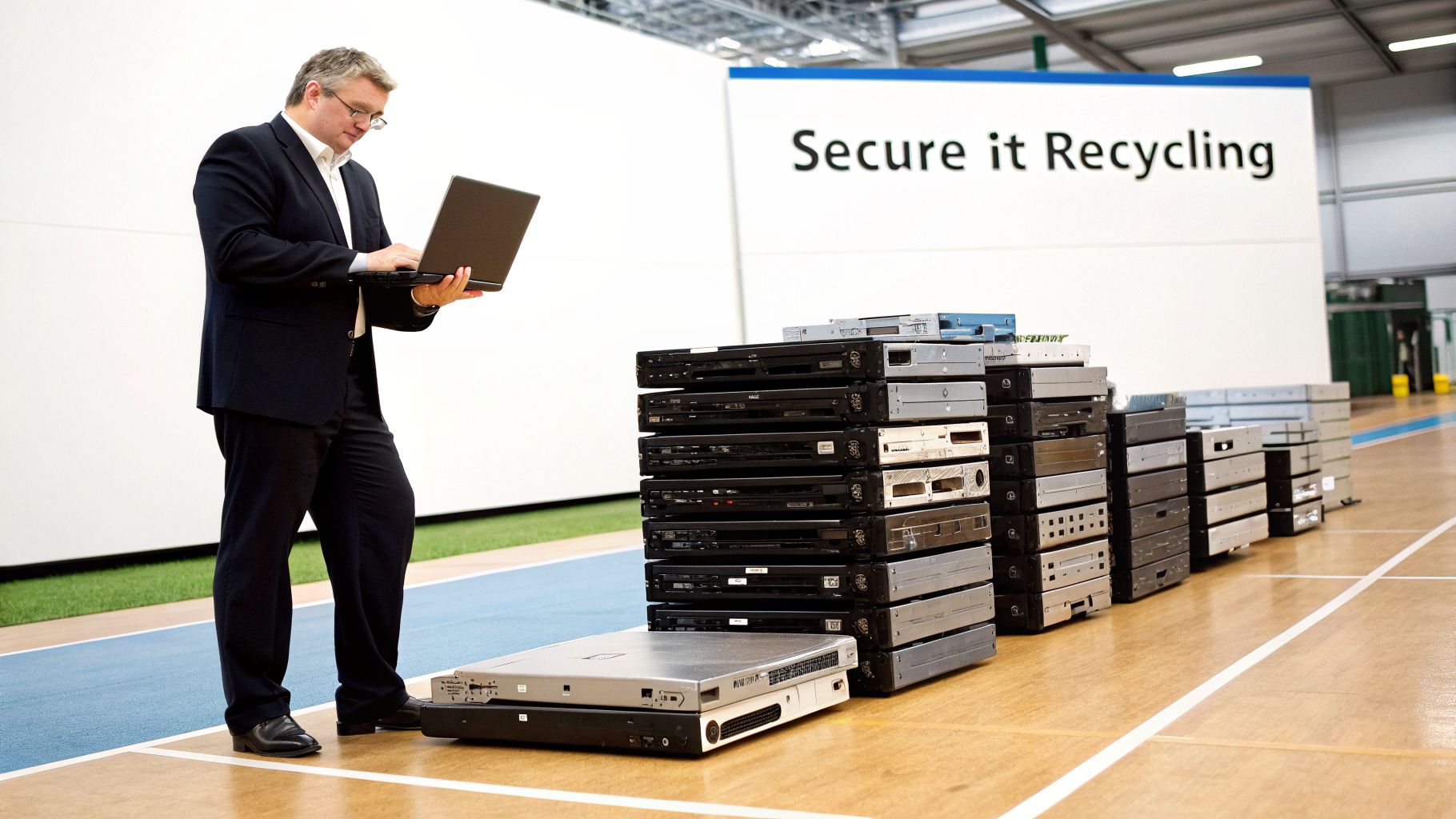
It's time to move past outdated views of e-waste disposal. Simply calling a junk hauler to clear out old servers, laptops, and networking gear is a gamble your organization can't afford to take. Every single retired device is a potential liability, holding sensitive corporate data, customer information, or even regulated personal health information (PHI).
Without certified data destruction, your company's most valuable secrets could easily end up on the secondary market or, worse, in the hands of malicious actors. The financial and reputational fallout from a data breach that traces back to improperly disposed hardware can be catastrophic.
The Real Costs of Non-Compliance
For Arlington businesses in regulated industries like healthcare (HIPAA) or finance (FACTA), compliance isn't optional. A standard recycler without certified processes can't give you the auditable documentation needed to prove your due diligence. A single misplaced hard drive can trigger steep fines, legal battles, and a permanent loss of customer trust. This is where a true IT Asset Disposition (ITAD) partner becomes invaluable.
The global e-waste problem is accelerating, with a staggering 62 million tonnes generated in 2022 alone. Alarmingly, only 22.3% of this volume was formally collected and recycled, highlighting a massive gap in responsible disposal. This trend underscores the urgent need for certified recycling partners to manage the growing tide of electronic waste securely.
A professional ITAD program is about more than just recycling; it's a core component of your risk mitigation and corporate governance strategy. It also directly supports your organization’s ESG (Environmental, Social, and Governance) goals, demonstrating a real, tangible commitment to responsible operations.
Choosing a certified partner like Dallas Fortworth Computer Recycling ensures every asset is handled within a secure, auditable chain of custody. This approach transforms a potential liability into a verified, compliant, and environmentally sound process. You can learn more about the extensive benefits of e-waste recycling for your business.
Choosing the Right ITAD Partner in the Arlington Area

Moving from a quick search for "electronics recycling near me Arlington" to finding a genuine IT Asset Disposition (ITAD) partner is a critical step. Any operator can claim to be a recycler, but only a certified specialist provides the security and compliance your business depends on.
The goal here is to cut through the marketing noise and focus on verifiable credentials. After all, you're not just getting rid of old gear; you're entrusting a vendor with your company's data and reputation.
Verify Critical Certifications
Your first filter should always be industry certifications. These aren't just logos for a website—they are proof of rigorous, third-party audits confirming a vendor’s processes meet strict environmental and data security standards.
The two certifications that matter most in the ITAD world are R2v3 (Responsible Recycling) and e-Stewards. A provider holding one or both has proven they are committed to responsible practices, like prohibiting the illegal export of e-waste and maintaining a secure chain of custody.
For instance, an R2v3-certified recycler is audited on over 50 different areas of performance. This delivers a level of assurance that a non-certified operator simply can't provide. You can learn more about what it means to work with an R2 certified electronics recycler and see why it’s a non-negotiable for managing risk.
Scrutinize Data Destruction Methods
With certifications confirmed, your next focus must be their data destruction protocol. Vague promises of "wiping" are a major red flag. You need specific answers to protect your organization's sensitive data.
Here are the key questions you should be asking:
- Do your data destruction methods align with NIST 800-88 guidelines?
- Do you offer on-site physical destruction (shredding) for maximum security?
- Can you provide a serialized Certificate of Data Destruction for every single data-bearing device?
A true ITAD specialist will have clear, confident answers for all three. If a vendor hesitates or can't produce detailed documentation, walk away. They should be equipped to handle everything from destroying server hard drives to sanitizing sensitive medical equipment.
Remember, your responsibility for a data breach doesn't end when the equipment leaves your building. A weak link in the disposal chain can lead directly back to you. Partnering with a vendor that provides auditable, certified proof of destruction is your best defense.
Assess Insurance and Experience
Finally, a professional partner carries insurance policies designed to protect you from the unexpected. Ask for proof of adequate data breach and pollution liability insurance. This coverage is a critical safety net that separates a professional operation from a smaller, less-equipped recycler.
You also need to evaluate their experience with your specific type of equipment. A company that mostly handles consumer electronics probably lacks the expertise to decommission complex data center hardware or specialized lab instruments. A provider like Dallas Fortworth Computer Recycling, with over a decade of hands-on experience, has the proven history to manage a wide range of commercial assets securely. This ensures your electronics recycling near me Arlington search ends with a partner who truly understands—and mitigates—your business's unique risks.
How to Prepare Your Assets for a Secure Pickup
A smooth and secure IT asset pickup doesn't start when our truck arrives at your Arlington facility. It begins with your own internal prep work. Getting your assets organized beforehand is what creates a clean handoff, avoids disrupting your daily operations, and establishes an airtight audit trail from the very beginning.
Your first job is to build a detailed asset inventory. This isn't just about getting a headcount of desktops and servers; it's about creating a specific log that serves as your primary tool for accountability. A solid inventory is the foundation for any transparent and defensible disposal project.
For every single device you're retiring, you need to capture a few key data points. This is absolutely critical for reconciling your internal records with the Certificate of Data Destruction we’ll provide after the job is done.
Your inventory spreadsheet should include:
- Asset Type: (e.g., Laptop, Server, Firewall)
- Manufacturer and Model: (e.g., Dell Latitude 7420)
- Serial Number: This is the most critical piece of data.
- Asset Tag Number: Your internal company tracking number.
- Physical Location: The department or office it came from.
Secure Staging and Internal Sanitization
Once your inventory is built, the next step is to consolidate all those assets into one secure, designated staging area. A locked office or a caged-off section of a warehouse works perfectly. This simple step prevents equipment from "walking away" and keeps everything organized for our logistics crew, making the actual pickup far more efficient.
While your ITAD partner will handle the certified data destruction, we always recommend following your own internal data sanitization policies as a first step. Wiping drives before they even leave your building adds a powerful extra layer of security. This dual-sanitization approach ensures that even in the unlikely event a device is compromised in transit, the sensitive data is already gone. Our guide explains how to wipe a hard drive completely using industry-standard methods.
Preparing for pickup is your first line of defense. A detailed, serialized inventory and a secure staging area aren't just for organization—they are essential components of your due diligence, demonstrating control over your assets before they ever leave your custody.
The global electronic recycling market is growing fast, projected to hit USD 39,960 million by 2025 as technology turnover accelerates. For organizations in the Arlington area, especially those in healthcare and government, this growth underscores the importance of finding specialized partners. Companies like Dallas Fortworth Computer Recycling, with deep experience in medical and lab equipment, provide the compliant, specific solutions needed in this environment. You can learn more about these electronic recycling market trends and what they mean for your business. This careful prep work, combined with a vetted partner, ensures your search for electronics recycling near me Arlington ends with a secure, compliant, and defensible result.
Understanding Your Service Agreement and Compliance Documents
Your responsibility for retired IT assets doesn’t end when they leave your Arlington facility. In fact, that’s where the real risk begins. The fine print in your service agreement is what truly transfers liability, turning that stack of paperwork from a formality into your legal shield. Getting this part right is non-negotiable.
A solid Service Level Agreement (SLA) is the bedrock of any secure ITAD partnership. It needs to clearly map out the entire process, from pickup logistics to the specific methods used for data destruction. If the language feels vague, that’s a massive red flag. Your agreement must have an explicit Chain of Custody clause that states liability for the equipment transfers to the vendor the moment they take possession.
Defining Liability and Data Destruction Guarantees
The contract needs to go beyond a simple promise to "wipe drives." That's not enough to protect you. Look for clauses that guarantee data destruction to a specific, verifiable standard like NIST 800-88.
Crucially, the SLA must require the vendor to provide a serialized Certificate of Data Destruction. This isn't just a receipt; it's your forensic proof that every single device containing data has been permanently sanitized or physically destroyed.
Getting your assets ready for this documented handoff is a straightforward, three-step internal process.
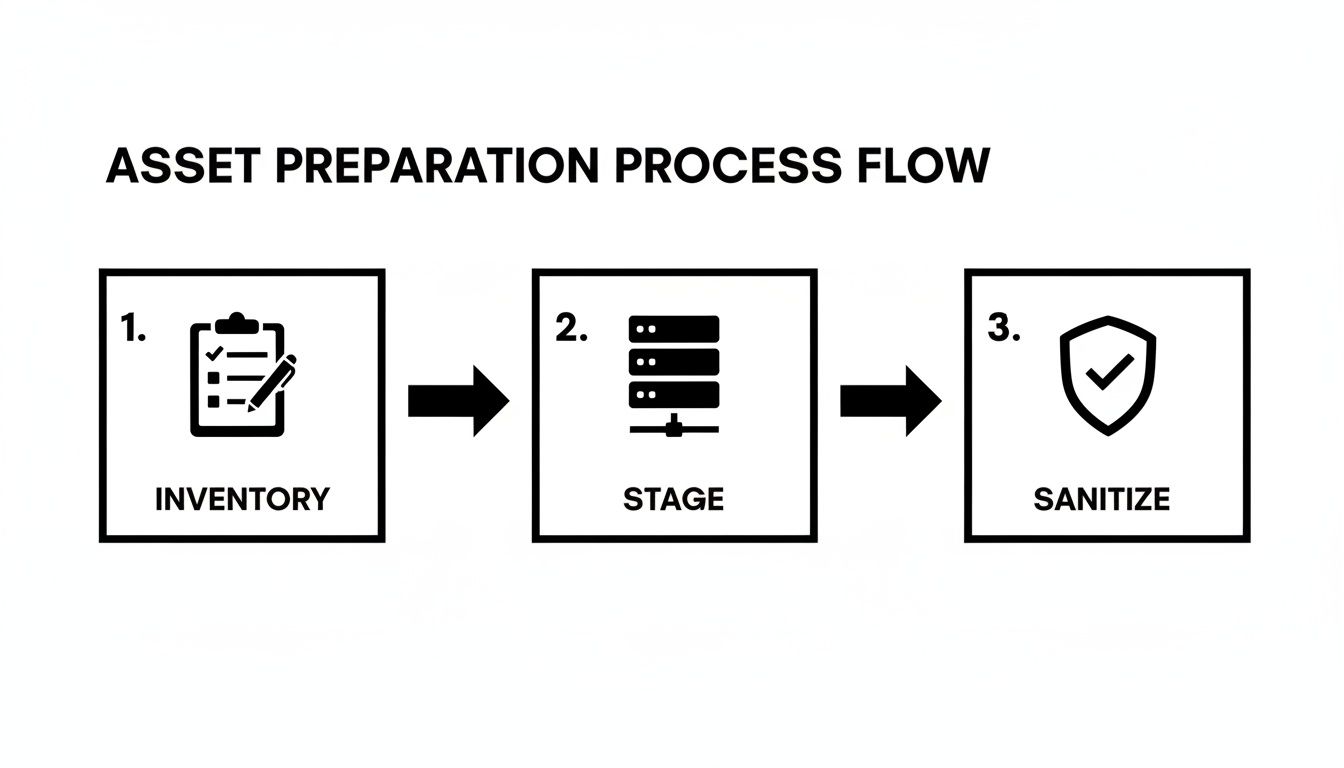
By properly inventorying, staging, and sanitizing your equipment beforehand, you ensure the assets you hand over perfectly match what's documented on your final compliance certificates.
Essential Clauses for Your ITAD Service Agreement
Your service agreement is your primary tool for managing risk. Here are the critical clauses you need to look for to ensure your Arlington business is fully protected.
| Clause Type | What to Look For | Why It's Critical |
|---|---|---|
| Chain of Custody & Liability Transfer | Language stating that liability transfers to the vendor upon their acceptance and secure transport of the assets. | This legally defines the moment your responsibility ends and theirs begins. Without it, you could be held liable for a breach that happens off-site. |
| Data Destruction Standards | A specific standard is named (e.g., NIST 800-88). It should also specify the methods to be used (wiping, degaussing, physical shredding). | A vague "data wiping" clause is unenforceable. A specific standard sets a clear, auditable benchmark for security. |
| Reporting & Documentation | The vendor is obligated to provide a serialized Certificate of Data Destruction and a Certificate of Recycling within a set timeframe. | These documents are your only tangible proof of compliance. The contract must make them a required deliverable, not an optional extra. |
| Downstream Vendor Management | A clause confirming the vendor vets and audits all their downstream recycling partners to ensure compliance (e.g., no e-waste exporting). | Your liability doesn't stop with your primary vendor. You are responsible for the entire disposal chain, so your vendor must guarantee their partners are also compliant. |
| Insurance & Indemnification | The vendor must carry adequate insurance (e.g., data breach, pollution liability) and agree to indemnify you against losses from their failure to perform. | This provides a financial backstop in a worst-case scenario, protecting your company from the costs associated with a data breach or environmental fine. |
Reviewing these clauses carefully before signing anything is one of the most important steps in the entire ITAD process.
The Final Compliance Documents You Must Have
Once the job is done, two key documents officially close the loop on your project. These are your definitive records for any audit, internal or external. Without them, you have no way to prove you handled the disposal responsibly.
- Certificate of Data Destruction: This document must list every single hard drive, SSD, and data tape by its unique serial number, certifying their complete and irreversible destruction.
- Certificate of Recycling: This confirms that all non-data-bearing assets and materials were processed in an environmentally compliant manner, adhering to zero-landfill policies and standards like R2v3.
Insist on receiving both serialized certificates within the timeframe specified in your SLA, typically 30-45 days after pickup. These papers are your auditable proof that your search for "electronics recycling near me Arlington" led to a secure and defensible outcome.
Make sure you archive these documents securely. They are your best defense against potential legal challenges and clearly demonstrate your company’s commitment to data privacy and environmental stewardship. For a closer look at what makes these documents so critical, check out our guide on the importance of a certificate of destruction for hard drives. It’s a great resource for understanding exactly what to look for.
Turning Retired IT Assets into Revenue
For most companies, IT asset disposition has always been viewed as a cost center—a final, necessary expense for retired equipment. But a professional ITAD strategy can change that, turning old technology from a budget line item into a source of revenue.
This is accomplished by finding the resale value in your used assets, a practice that is both financially smart and environmentally responsible. An experienced ITAD partner like Dallas Fortworth Computer Recycling sees more than just old hardware. We see recoverable value.
Our process begins with a detailed evaluation of every device. After all data is securely destroyed, our technicians test each piece of equipment to assess its condition and functionality.
Identifying High-Value Assets
Not all retired equipment is ready for simple recycling. A surprising amount of your IT inventory, even if a few years old, can still hold significant resale value. Our job is to pinpoint these assets and get them ready for the secondary market.
The most valuable equipment we see typically includes:
- Recent-Generation Laptops and Desktops: Business-class models from major brands that are three to five years old are often in high demand.
- Enterprise Servers and Networking Gear: Functional servers, switches, and routers from manufacturers like Cisco, Dell, and HPE can retain a high percentage of their original value.
- Specialized Equipment: High-end workstations and other specific business equipment can also command premium prices.
Once these devices are identified, they are refurbished and prepared for sale through our established remarketing channels. By knowing where to sell computer parts and whole systems, we work to maximize the return for your organization.
How Revenue Sharing Works
This value recovery process is handled through a straightforward revenue-sharing agreement. Your ITAD partner manages all the logistics of testing, data destruction, repair, and resale. In return, your business receives an agreed-upon percentage of the net profits from those sales.
This model creates a true partnership. It incentivizes your vendor to get the best possible price for your assets, which can help offset or even exceed the costs of data destruction and recycling for your other, non-value equipment.
Globally, electronic waste volumes are projected to exceed 60 million metric tons in 2025. With only 22.3% of e-waste properly processed in 2022, IT leaders in Arlington need a partner who can provide certified destruction and recover value from this growing stream of material. This approach elevates your electronics recycling near me Arlington program from a disposal task into a strategic win for your finances and sustainability goals. You can learn more about the future of electronic waste management on Back Thru The Future.
Common Questions About Arlington Electronics Recycling
IT leaders in Arlington need practical answers when managing retired IT assets. Questions about logistics, data security, and cost are always at the forefront for any business looking for a reliable electronics recycling partner. Here are direct answers to the most common questions we receive.
What Types of Electronics Can We Actually Recycle?
A professional IT Asset Disposition (ITAD) partner should accept nearly all business electronics, providing a single, secure process for your entire inventory. This is about comprehensive service, not just handling the easy items.
We manage everything from standard office equipment like laptops, desktops, and printers to specialized data center hardware. This includes servers, storage arrays, networking racks, switches, and uninterruptible power supply (UPS) systems. Our services also cover telecom equipment, mobile devices, and even regulated medical or lab equipment that requires special handling.
The goal is a one-stop solution so you avoid juggling multiple vendors. This ensures every device is managed under a consistent, secure chain of custody. Before any pickup, we always confirm your specific inventory list to guarantee a smooth process.
How Do We Get Absolute Proof Our Data Was Destroyed?
This is a critical question. The only acceptable answer is multi-layered, verifiable proof. Vague promises about "data wiping" are not enough to ensure compliance or protect your organization from a data breach.
First, the destruction methods must meet or exceed government standards. We follow NIST 800-88 guidelines for media sanitization, which include multi-pass data overwriting, degaussing for magnetic media, and—for ultimate security—physical destruction.
You should always have the option to witness the destruction process. We offer on-site shredding of hard drives and solid-state drives at your Arlington facility. This provides indisputable visual confirmation that your data is destroyed before it ever leaves your control.
Second, the entire process must be formally documented. After destruction is complete, you will receive a serialized Certificate of Data Destruction. This legal document lists every data-bearing device by its unique serial number, creating an auditable record that proves your due diligence and compliance.
Is Electronics Recycling a Cost or a Source of Revenue?
The answer can be both. The financial outcome depends entirely on the age, condition, and type of equipment you are retiring. A transparent vendor will provide a detailed quote that outlines all potential costs and credits.
Here’s how it works:
- Service Fees: Costs are associated with logistics, secure transport, labor, and the certified destruction and recycling of zero-value or hazardous materials.
- Value Recovery: If your inventory includes newer, functional assets with resale value—like laptops under five years old, enterprise servers, or recent-model networking gear—a good partner offers either a revenue-sharing agreement or an outright purchase.
This potential return on investment can often offset or even exceed service costs, turning a disposal project into a positive line item for your budget.
How Fast Can You Schedule a Pickup in the Arlington Area?
A provider with a strong local presence can typically schedule a pickup for an Arlington-based business within a few business days. The exact timeline depends on the project scope and your team's readiness.
Dallas Fortworth Computer Recycling operates Monday through Friday, 8:00 AM to 5:00 PM. We always work to find a service window that minimizes disruption to your operations. The best way to get a precise timeline is to contact us with an estimated inventory list.
Ready to manage your retired IT assets with a secure, compliant, and reliable partner? Dallas Fortworth Computer Recycling offers nationwide ITAD services tailored to the needs of businesses in Arlington and beyond. Schedule your secure electronics recycling pickup today.