
How to Choose the Right Computer Recycling Companies
Retiring old technology isn't just a cleanup task—it's a critical part of managing risk, protecting your company's data, and meeting environmental obligations. The best computer recycling companies act as strategic partners, giving you a secure, documented chain of custody for your IT assets from the moment they leave your office. They turn what seems like a simple disposal problem into a core piece of corporate governance.
Why Your IT Assets Deserve More Than Just Disposal
When a server or a fleet of laptops hits the end of its useful life, the real work for IT leaders is just beginning. Think of an old server as a locked filing cabinet packed with years of sensitive files—customer lists, financial records, and trade secrets. You wouldn't just drag that cabinet to the curb.
Yet, many companies treat their digital assets with far less care, opening the door to massive security and compliance risks.
This is where professional IT Asset Disposition (ITAD) comes into play. ITAD is much more than just recycling; it’s a complete framework for strategically managing the entire end-of-life journey for your hardware. It shifts the conversation from "getting rid of stuff" to smart asset management.
Shifting from Disposal to Strategic Management
The stakes have never been higher. Mishandled electronics are fueling a global crisis. In 2022 alone, the world generated a staggering 62 million tonnes of e-waste—an 82% jump from 2010. What’s worse, only 22.3% of it was properly collected and recycled, which means billions in recoverable materials were wasted and hazardous components were left to cause harm.
A true ITAD partner helps you navigate this complex environment by focusing on three key pillars:
- Risk Mitigation: Ensuring every single device is handled securely to prevent a data breach.
- Value Recovery: Finding assets that can be refurbished and resold, turning old gear into revenue.
- Environmental Compliance: Responsibly recycling all materials to meet your sustainability goals and legal duties.
Partnering with a professional firm isn't just another expense. It's a vital investment in your company's security, reputation, and long-term sustainability.
This approach ensures every piece of retired equipment is accounted for, from pickup to final disposition. For any organization looking to build a rock-solid program, understanding the details of corporate e-waste solutions is the first step. By the time you finish this guide, you’ll understand why choosing the right partner is one of the most important decisions an IT leader can make.
Understanding the Core Services of an ITAD Partner
It’s important to understand the difference between a basic electronics collector and a genuine IT Asset Disposition (ITAD) partner. While plenty of companies can haul away old equipment, a true partner provides a suite of services built to protect your data, ensure you meet all regulations, and even recover some financial value from your retired gear. These services are the foundation of any secure and responsible hardware retirement plan.
Think of an ITAD partner as a specialized logistics and security firm for your technology’s final journey. They don’t just move boxes from point A to point B. They manage a documented, auditable process from the moment they arrive at your door until every last piece of equipment is accounted for, ensuring nothing ever falls through the cracks.
Secure Logistics and Chain of Custody
The process kicks off the moment your assets are scheduled for pickup. A professional ITAD partner immediately establishes an unbroken chain of custody—a documented trail that tracks every single device from your facility to theirs. This isn’t just about loading a truck; it’s a critical security protocol.
Secure logistics should always include:
- Serialized Asset Tagging: Every laptop, server, or hard drive gets a unique ID number right at the point of collection, so it can be tracked individually throughout the entire process.
- GPS-Tracked Transport: All vehicles are monitored from your location to the secure processing facility, preventing any chance of loss or theft along the way.
- Locked and Sealed Vehicles: Your assets are transported in secure containers, making unauthorized access virtually impossible.
This meticulous tracking gives you a legal and operational shield, proving exactly where every piece of your equipment is at all times.
This diagram illustrates the core functions of a professional ITAD program.
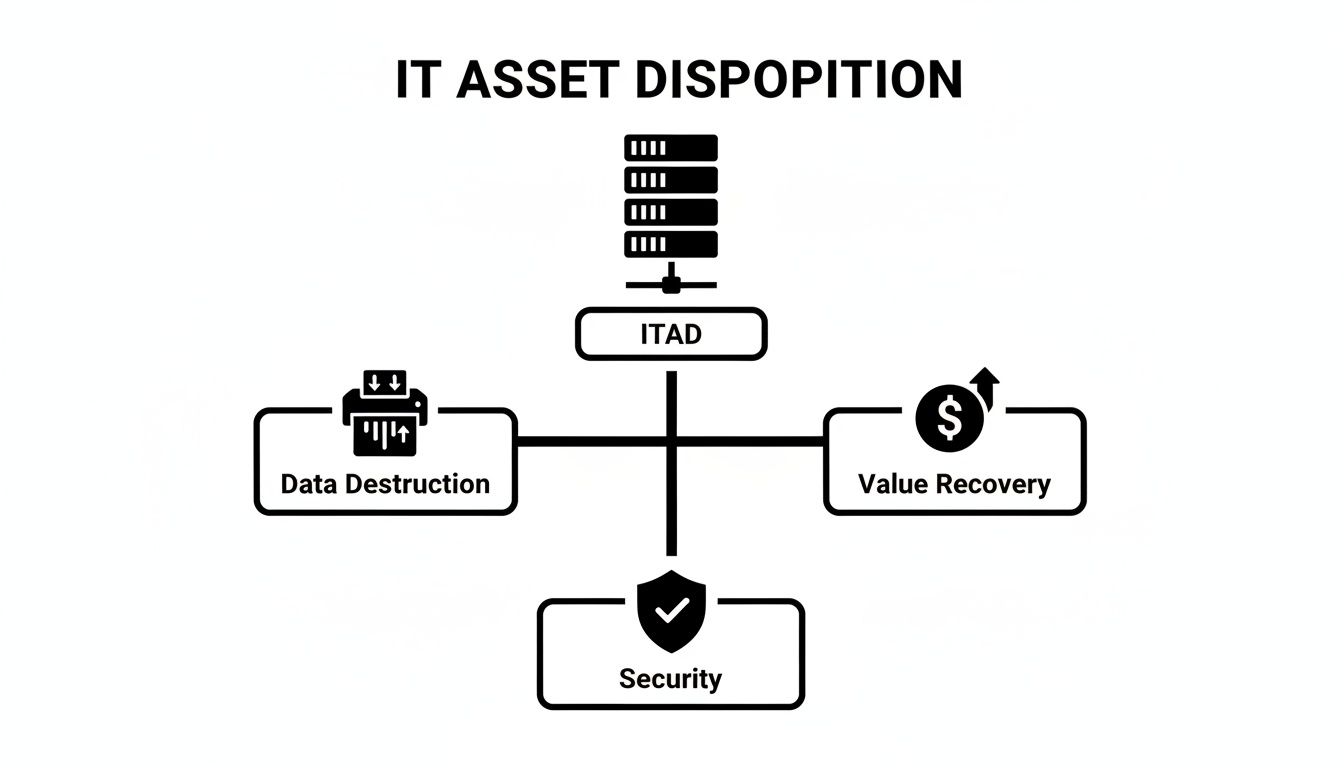
As you can see, data destruction and value recovery are central pillars of the process, both supported by an unwavering commitment to security.
Key Services Offered by ITAD Partners
A professional ITAD partner offers a comprehensive set of services that go far beyond simple recycling. Here’s a breakdown of what you should expect and why each service is crucial for protecting your organization.
| Service Category | Description | Primary Benefit for Your Organization |
|---|---|---|
| Secure Logistics | On-site pickup with serialized asset tagging, GPS-tracked transport, and a documented chain of custody from start to finish. | Provides a verifiable, auditable trail for every asset, eliminating the risk of equipment loss or theft during transit. |
| Data Destruction | Certified data sanitization using methods that meet or exceed NIST 800-88 guidelines, including software erasure, degaussing, and physical shredding. | Guarantees that all sensitive company and customer data is rendered completely unrecoverable, protecting you from data breaches and ensuring regulatory compliance. |
| Asset Remarketing | Testing, refurbishing, and reselling functional IT equipment with market value through established secondary channels. | Turns retired hardware into a revenue stream through profit-sharing agreements, helping to offset the costs of IT disposition. |
| Responsible Recycling | Dismantling end-of-life electronics to safely recover valuable commodities (metals, plastics) and dispose of hazardous materials in an environmentally sound manner. | Ensures compliance with all environmental regulations, prevents e-waste from ending up in landfills, and supports your corporate sustainability goals. |
| Reporting & Documentation | Providing detailed inventory reports, serialized Certificates of Data Destruction, and environmental compliance certificates for your records. | Delivers the necessary legal proof to satisfy internal audits, regulatory bodies (like HIPAA or FACTA), and corporate governance requirements. |
Ultimately, these integrated services work together to create a secure, compliant, and financially smart solution for managing the end of your IT asset lifecycle.
Certified Data Destruction
This is arguably the most critical service of all: the guaranteed destruction of every bit of sensitive information on your devices. Reputable computer recycling companies don't just "wipe" drives; they perform certified data sanitization that adheres to strict government and industry standards.
The gold standard for data erasure is NIST 800-88, a set of guidelines from the National Institute of Standards and Technology. Compliance ensures data is rendered completely unrecoverable, meeting the demands of regulations like HIPAA and FACTA.
There are a few ways to achieve this level of security:
- Data Erasure: Specialized software overwrites the entire hard drive with random data, often in multiple passes.
- Degaussing: A powerful magnetic field is used to scramble the magnetic domains on a drive, instantly destroying all data.
- Physical Shredding: For the highest level of security or for drives that have failed, the media is physically destroyed into small, irrecoverable fragments.
Once the job is done, you should always receive a Certificate of Data Destruction. This is a legal document that serves as your official proof of compliance.
Responsible Recycling and Remarketing
After the data has been securely destroyed, the asset’s journey isn’t over. Not all of your old equipment is destined for the shredder. A key function of a top-tier ITAD partner is figuring out the best path for each device to maximize both sustainability and your financial return.
First, all equipment is evaluated. Functional devices that still have market demand—like recent-model laptops or servers—are refurbished for resale. This process, often called value recovery or remarketing, can turn your retired assets into an unexpected revenue stream. Many partners offer a revenue-sharing model, where a portion of the resale profit is returned directly to your organization. To see how this works in practice, you can explore the details of professional IT asset disposition services in Dallas Fort Worth Texas.
For equipment that can't be reused, the focus shifts to responsible recycling. Devices are carefully de-manufactured. Hazardous materials like lead and mercury are safely removed and disposed of, while valuable commodities like copper, aluminum, and precious metals are recovered and put back into the manufacturing supply chain. This approach not only supports your company's environmental goals but also ensures you stay compliant with all e-waste regulations.
Navigating Data Security and Compliance Regulations
When you're retiring old IT hardware, data security isn't just a good idea—it's a legal and financial imperative. For any IT leader, the data left behind on old hard drives is a massive liability. Working with professional computer recycling companies is all about transferring that risk through a secure, documented, and fully compliant process. If you don't, your organization is left wide open to some pretty catastrophic consequences.
It's a lot like handling a tax audit. You wouldn't claim deductions without the receipts to back them up, right? In the world of IT Asset Disposition (ITAD), your paperwork—from certifications to detailed audit trails—is your proof of due diligence. It shows you took every necessary step to protect sensitive information, shielding your company from crippling fines and long-term damage to your reputation.
Key Regulations You Cannot Ignore
There are several major regulations that dictate exactly how companies must handle data, and these rules don't just vanish when a computer is unplugged. A data breach from a carelessly tossed-out server carries the same harsh penalties as a live network hack. While this isn't a complete list, your ITAD strategy absolutely has to account for standards like these:
- HIPAA (Health Insurance Portability and Accountability Act): This is the big one for any organization that handles protected health information (PHI). A single lost laptop or unsecured server can easily trigger fines that run into the millions.
- FACTA (Fair and Accurate Credit Transactions Act): This federal law demands that businesses destroy consumer information before getting rid of it. Just dragging files to the trash bin isn't enough; the data has to be made completely unreadable.
- GDPR (General Data Protection Regulation): If your company deals with data from European Union citizens, GDPR's incredibly strict data privacy rules apply. Penalties can be as high as 4% of your company's global annual revenue.
These regulations all point to one critical fact: your responsibility for the data on a device lasts long after you’ve powered it down for the last time.
Certifications: The Gold Standard of Trust
So, how can you be sure a vendor can actually handle these strict requirements? The answer is in their third-party certifications. These aren't just fancy logos they stick on a website; they represent tough, independently audited standards that prove a company follows established best practices for both data security and environmental handling. They're the credentials that separate a true ITAD partner from a simple scrap hauler.
When you're vetting potential computer recycling companies, keep an eye out for these essential certifications:
- R2 (Responsible Recycling): The latest standard, R2v3, is a comprehensive framework covering everything from environmental protection and worker safety to data security all the way through the recycling chain.
- e-Stewards: Known for its extremely strict standards, e-Stewards certification guarantees that no hazardous e-waste is exported to developing countries and requires rigorous data security protocols.
- NAID AAA: This certification is all about data destruction. A NAID AAA certified company has gone through intense, unannounced audits of its hiring, facility security, and destruction methods to prove that information is completely and securely eliminated.
A vendor that holds these certifications has poured significant resources into building a secure, transparent, and accountable operation. It’s a clear sign they get the risks you’re facing and have the proven systems to protect you.
Your Legal Shield: The Certificate of Data Destruction
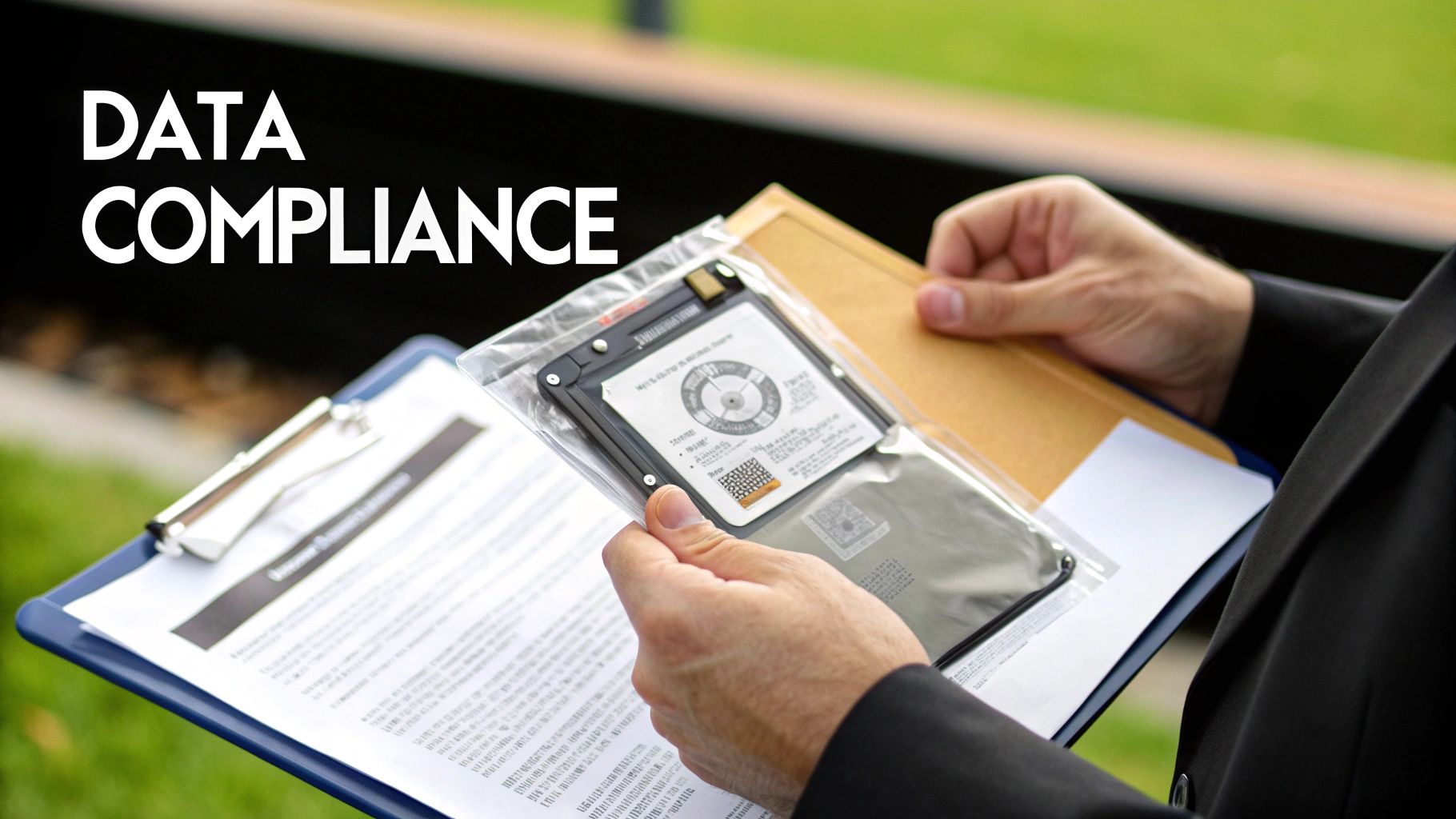
The single most important document you’ll get from your ITAD partner is the Certificate of Data Destruction (CoD). This is way more than just a receipt. It's a legally binding document that officially transfers the liability for the data from your company to the vendor. It acts as your definitive proof that the data on your old assets was destroyed in a compliant and irreversible way.
A proper CoD needs to be detailed and auditable. To get a better sense of what this critical document includes, you can learn more about the specifics of a certificate of destruction for hard drives and see why it’s the cornerstone of any secure ITAD program. It should list essential details like the date of destruction, the methods used (like shredding or wiping to NIST 800-88 standards), and a serialized list of every single hard drive that was destroyed.
This documentation, paired with a complete audit trail that tracks each device from pickup to final disposition, creates an unbroken chain of custody. This full reporting package is your ultimate defense in an audit, proving your organization acted responsibly and in full compliance with all relevant laws. Without it, you’re just leaving your business exposed.
How to Select the Right Computer Recycling Partner
Choosing the right partner from a sea of computer recycling companies is a critical business decision, not just a logistical one. The vendor you select becomes the final guardian of your company's most sensitive data and a key player in your environmental compliance strategy. This isn't a choice to be made by glancing at a price sheet; it requires a structured evaluation to ensure you’re entrusting your assets to a truly secure and responsible firm.
To confidently vet potential partners, you need a practical framework. Think of it as a pre-flight checklist for your retired IT assets. By methodically examining five core pillars of a trustworthy vendor, you can move beyond marketing claims and verify their ability to protect your organization from risk. This approach empowers you to ask the right questions and demand the right evidence, making sure the partner you choose is truly capable of managing your technology's end-of-life journey.
Pillar 1: Certifications and Compliance
The first and most important pillar is third-party validation. Certifications are non-negotiable because they prove a company has been independently audited and meets stringent industry standards for security and environmental practices. They are your initial filter for separating professional computer recycling companies from less reputable operators.
When evaluating a vendor, ask for proof of these key credentials:
- R2v3 (Responsible Recycling): This is a comprehensive standard that covers everything from data security protocols and downstream vendor management to worker safety.
- e-Stewards: Known for its rigorous environmental standards, this certification guarantees that no hazardous e-waste is exported to developing nations.
- NAID AAA: This certification focuses exclusively on secure data destruction, requiring unannounced audits of a facility’s security, employee screening, and destruction processes.
Without these certifications, you have no verifiable proof that a vendor is following best practices. That leaves your organization exposed to potential compliance violations and data security risks.
Pillar 2: Security Protocols and Procedures
Once certifications are confirmed, your next step is to dig into a vendor’s specific security measures. A secure chain of custody depends on robust physical and procedural controls at every single stage. This is where you need to get granular with your questions to understand their day-to-day operations.
A vendor’s security is only as strong as its weakest link. You need to verify that their entire process, from your loading dock to their facility, is designed to prevent any possibility of a data breach.
Essential questions to ask include:
- What are your facility's access controls, including surveillance, alarm systems, and visitor policies?
- Do all employees who handle sensitive materials undergo background checks and security training?
- How are assets transported? Are vehicles locked, sealed, and GPS-tracked?
The answers will reveal how seriously they take their role as a custodian of your sensitive information.
Pillar 3: Reporting and Transparency
True transparency is built on detailed, serialized reporting. A trustworthy partner should be able to provide a complete, auditable trail for every single asset they handle. Vague, summary-level reports are a major red flag, as they can easily hide gaps in the chain of custody.
You should demand documentation that includes:
- Serialized Inventory Lists: A detailed report listing the make, model, and serial number of every device collected.
- Certificates of Data Destruction: A legally binding document that confirms the secure erasure or destruction of data-bearing devices, cross-referenced by serial number.
- Environmental Compliance Reports: Documentation detailing the final disposition of all materials, confirming responsible recycling and providing metrics for your sustainability reporting.
This level of detail is your proof of due diligence and is essential for passing internal and external audits.
Pillar 4: Logistics and Capabilities
Not all computer recycling companies are equipped to handle the logistical complexities of every business. Your organization may have unique needs, from nationwide pickups to the disposal of specialized or heavy equipment. It’s crucial to confirm a potential partner has the operational capacity to meet your specific requirements.
This is especially true when you need a local presence, like an electronics recycling center that can handle swift, regional pickups.
Key logistical questions to consider are:
- Geographic Reach: Do they offer service nationwide or only in specific regions?
- Specialized Equipment: Can they manage the decommissioning of data centers, servers, or large-scale medical and lab equipment?
- On-Site Services: Do they provide on-site services like hard drive shredding or asset packing for added security and convenience?
A vendor’s ability to scale and adapt to your needs is a strong indicator of their professionalism.
Pillar 5: Financial Stability and Insurance
Finally, you must verify a vendor's financial health and insurance coverage. A partner handling millions of dollars worth of assets and sensitive data must be stable and adequately insured to protect you from liability. An underinsured vendor exposes your organization to significant financial risk in the event of a data breach or other incident.
In this rapidly expanding industry, stability matters. The electronic waste recycling market is forecasted to grow by USD 32.74 billion between 2024 and 2029, a rapid expansion that will attract many new players. Verifying a potential partner’s stability is crucial for ensuring they will be a reliable, long-term solution. You can discover more insights about this market growth on Technavio.com.
Be sure to ask for proof of:
- General Liability Insurance: Covers property damage or injury.
- Pollution Liability Insurance: Covers costs related to environmental contamination.
- Cyber Liability Insurance: Specifically covers damages resulting from a data breach.
A financially sound and properly insured partner provides the ultimate backstop, giving you peace of mind that your organization is protected.
Understanding Costs, Contracts, and Your Potential ROI
Let's talk money. Getting a handle on the financial side of computer recycling is the key to getting your leadership on board. While there's a cost to professional ITAD services, looking at it as just another expense is a huge mistake. The right partnership can actually protect you from massive financial risks and even create a new revenue stream, delivering a powerful return on investment (ROI).
The most common mistake we see is companies comparing the cost of a certified recycler against the "cost" of shoving old gear in a storage closet. This completely ignores the Total Cost of Ownership (TCO) for retired IT assets. That hidden cost includes the ever-present risk of a data breach, the threat of compliance fines, and the value of your hardware evaporating as it collects dust. A single data breach now costs companies millions on average—a number that makes any professional recycling fee look tiny.
Common Pricing Models
When you start getting quotes, you'll find that pricing usually falls into a few buckets. Knowing how these work will help you compare vendors and find one that aligns with your financial goals.
- Per-Pound or Per-Asset Fees: This is the simplest model. You pay based on the total weight or the number of items you're getting rid of. It’s most common for older, non-working equipment that has little to no resale value left in it.
- Flat-Fee Project Pricing: If you're looking at a big job, like a full data center cleanout or an office move, vendors will often give you a single, all-in price. This typically covers everything—logistics, data destruction, and the final recycling process.
- Value Recovery and Revenue Sharing: This is where things get interesting. For newer, functional equipment, your partner will refurbish and sell it on the secondary market. Then, they share a percentage of the profits back with you. This is how ITAD can actually make you money.
A truly experienced ITAD partner will often use a hybrid model. For example, the revenue you get from reselling a batch of newer laptops could completely cover—or even exceed—the cost of recycling all your old monitors and printers.
The goal of a strategic ITAD program isn't just to find the cheapest way to get rid of old tech. It's to maximize value recovery while completely eliminating data and compliance risks, creating a net positive outcome for the business.
Scrutinizing the Service Agreement
Your service agreement is the most important document in this whole process. It’s the legally binding contract that spells out every single detail of the partnership. Before you sign anything, you need to be sure it clearly defines the terms on a few critical points.
A solid contract should explicitly detail:
- Scope of Work: What, exactly, are they doing for you? This needs to cover logistics, any on-site work, specific data destruction methods (like wiping to NIST 800-88 standards or physical shredding), and what reports you'll get back.
- Chain of Custody Procedures: How are they tracking your stuff? The contract has to outline serialized tracking for every asset, from the moment it leaves your building to its final destination.
- Data Security Guarantees: This one is non-negotiable. The agreement must clearly state that the vendor assumes 100% liability for your data as soon as they take possession of your equipment.
- Reporting Timelines: When will you get your Certificate of Data Destruction and the final inventory reports? Clear deadlines keep everyone accountable.
- Downstream Vendor Management: Does the contract guarantee that any partners they use are also certified (R2 or e-Stewards)? This is crucial for making sure your e-waste isn't mishandled down the line.
When you invest in a certified service, you're really buying insurance against catastrophic financial and reputational damage. The right partner helps you manage the entire lifecycle of your technology, including providing guidance on responsible computer equipment recycling for every device you own. This strategic approach turns a necessary cost into a powerful part of your company's financial and operational health.
Real-World Examples of Successful ITAD Programs
It's one thing to talk about risk management and value recovery in theory. It’s another thing entirely to see how those principles play out on the ground. When you partner with the right ITAD vendor, they don't just pick up your old gear; they deliver a real solution to a complex business problem.
The following stories show how skilled computer recycling companies step up to solve critical challenges for organizations where the stakes are incredibly high. These aren't just simple disposal jobs—they're examples of strategic asset management that protects sensitive data, keeps companies compliant, and improves the bottom line.

Healthcare System Navigates a HIPAA-Compliant Refresh
A regional healthcare system with a network of hospitals and clinics was facing a monster of a project: retiring over 3,000 laptops and workstations. This wasn't just a simple refresh. Because of strict HIPAA rules, a single device containing unsecured patient health information (PHI) could trigger disastrous fines and shatter public trust. Their number one priority was bulletproof data security. No exceptions.
- The Challenge: How do you guarantee 100% data destruction across thousands of devices, many loaded with sensitive PHI, without disrupting day-to-day hospital operations?
- The Solution: The ITAD partner brought their mobile shredding trucks right to each hospital. This allowed for the secure, on-site physical destruction of every single hard drive before any equipment left the property. The hospital's own security team could watch the whole thing.
- The Outcome: The healthcare system received a serialized Certificate of Data Destruction that itemized every single asset, creating an undeniable audit trail for HIPAA regulators. The entire project was finished ahead of schedule with zero risk of a data leak.
By bringing the destruction process on-site, the ITAD partner eliminated the chain-of-custody risks associated with transporting data-bearing devices. This provided the healthcare system with the highest possible level of security and peace of mind.
Corporation Decommissions a Data Center for Maximum ROI
A large financial services firm was consolidating its infrastructure and needed to shut down an entire data center. We're talking over 1,200 servers, networking gear, and massive storage arrays. The logistics were a nightmare, involving careful de-installation, packing, and securely moving heavy, high-value equipment. The goals were clear: get the most money back from the valuable hardware while ensuring every byte of proprietary financial data was wiped clean.
The ITAD partner came in with a plan focused on value recovery. First, they audited every asset on-site, flagging servers and components that still had life in them and a strong resale value.
That functional equipment was moved to a secure facility for certified data erasure that met NIST 800-88 standards, preserving the hardware's value for the secondary market. Using their established remarketing channels, the partner sold the refurbished servers and components, generating a significant return. For the older, obsolete gear, they responsibly recycled everything and provided detailed environmental reports. The corporation received a substantial cut of the profits, which helped offset the cost of the decommissioning project itself.
This kind of project shows just how important—and financially smart—the ITAD market has become. The global computer recycling market is projected to hit USD 13,634.26 million in 2025 and is expected to climb to USD 22,981.53 million by 2033. This growth is driven by businesses demanding solutions that are both compliant and good for the budget. You can read the full research about global computer recycling trends on MarketResearch.com.
A Few Common Questions About Computer Recycling
Even with a solid plan in place, it’s natural for a few questions to pop up when you're ready to partner with a computer recycling company. Here are some direct answers to the things we hear most often from IT managers.
What Is the Difference Between an E-Waste Collector and a Certified ITAD Company?
Think of an e-waste collector as the first step in a long chain—they primarily just transport used electronics. A certified IT Asset Disposition (ITAD) company, on the other hand, provides the complete, secure, and fully documented solution for your retired technology.
This is a comprehensive service that includes a secure chain of custody, certified data destruction that meets government standards, responsible recycling, and even the potential for getting some money back from reusable assets. The most important part? It’s all backed by a verifiable audit trail that protects your business from liability.
Is Wiping Hard Drives Internally Good Enough for Data Security?
While wiping drives yourself is a great first step, it often doesn't meet the strict compliance standards required today. It also might not be fully secure against sophisticated data recovery methods.
Professional computer recycling companies use processes that align with rigorous standards like NIST 800-88.
These certified methods include multi-pass software erasure and physical destruction (shredding). Afterward, they issue a formal Certificate of Data Destruction—the crucial legal evidence you need for audits and to prove you did your due diligence.
Can We Get Money Back for Our Old Computer Equipment?
Absolutely. A key service that full-service ITAD partners offer is value recovery. Equipment that still has some life left in it—like newer servers, laptops, or networking gear—can be professionally refurbished and resold through established secondary markets.
Most reputable partners work on a revenue-sharing model. This means your business earns back a portion of the resale value, which can often help offset or even cover the entire cost of recycling your older, non-functional equipment.
Ready to implement a secure, compliant, and financially smart ITAD program? Dallas Fortworth Computer Recycling offers nationwide services with the certified processes you need to protect your data and maximize your ROI. Learn more and schedule your pickup at https://dallasfortworthcomputerrecycling.com.