
A Practical Guide to Computer Disposal Services for IT Leaders
Computer disposal services are specialized processes for securely and legally retiring outdated IT hardware. This goes far beyond just getting rid of old computers; it's a strategic function that manages immense risk, from protecting sensitive data to navigating a maze of environmental laws.
What Are Computer Disposal Services Really About
Think of decommissioning IT hardware like vacating a secure facility—you wouldn't just leave the doors unlocked and walk away. That’s the core principle behind professional computer disposal.
For IT leaders and procurement teams, the old ad-hoc methods of local recycling drops or filling a storage closet with obsolete tech are no longer defensible strategies. The stakes are simply too high. This process is formally known as IT Asset Disposition (ITAD), a comprehensive framework designed to mitigate all the risks that come with retiring technology. A certified ITAD partner transforms a complex liability into a secure, managed, and fully auditable process.
Moving Beyond the Dumpster
The sheer volume of electronic waste makes professional management a necessity, not an option. In 2022, the world generated a staggering 62 million metric tonnes of e-waste, marking an 82% increase from 2010. Shockingly, only 22.3% was formally collected and recycled.
For businesses, this translates to mountains of servers, laptops, and peripherals that become massive liabilities if disposed of improperly.
The real goal of computer disposal services is risk mitigation. It’s about ensuring that a retired laptop doesn’t become your next data breach headline or a compliance fine waiting to happen.
Risks of Improper vs Benefits of Professional Computer Disposal
Choosing the right path for your retired assets has serious consequences. The DIY approach creates vulnerabilities, while a professional ITAD program builds a fortress around your data and brand reputation. The contrast is stark. To get a deeper understanding of the entire lifecycle, you can find a helpful guide that explains what IT asset disposition entails.
The table below breaks down exactly what’s at stake when you compare the two approaches.
| Area of Concern | Risk of Improper Disposal | Benefit of Professional Services |
|---|---|---|
| Data Security | Sensitive company, employee, and customer data is left exposed to theft. A single hard drive can lead to a catastrophic breach. | Guarantees certified data destruction with auditable proof that your information is permanently and verifiably erased. |
| Regulatory Compliance | Failing to meet standards like HIPAA, GDPR, or state e-waste laws can result in severe financial penalties, legal action, and lasting reputational damage. | Ensures your disposal methods adhere to all relevant local, state, and federal regulations, providing a complete compliance paper trail. |
| Environmental Impact | Electronics contain hazardous materials like lead and mercury that contaminate soil and water if sent to a landfill, violating EPA regulations. | Follows strict, certified protocols (like R2) to safely recover and process these materials, supporting your company's ESG goals. |
| Brand Reputation | A data breach or environmental fine linked to improper disposal can destroy customer trust and create a PR nightmare. | Demonstrates corporate responsibility and a commitment to data privacy and sustainability, strengthening your brand's reputation. |
| Chain of Custody | Without a documented trail, you have no proof of where your assets went or how they were handled. You remain liable. | Provides a secure, documented chain of custody from the moment assets leave your facility to their final disposition, transferring liability. |
Ultimately, the choice comes down to managing liability. Professional services offer a clear, documented path to security and compliance, while improper disposal leaves your organization open to a host of preventable disasters.
The Secure Journey of Your Retired IT Assets
When a truck full of your company’s old computers and servers pulls away from the loading dock, what really happens next? For too many IT leaders, that moment is a black box of uncertainty. A professional IT Asset Disposition (ITAD) process turns that question mark into a secure, documented journey that protects your organization at every single step.
Let's say a single pallet of corporate laptops is ready for pickup. This isn’t just about moving boxes; it's the start of a tightly controlled process designed to kill risk from the moment that gear leaves your building.
Stage 1: Secure Logistics and Chain of Custody
The whole thing kicks off with secure logistics. This is a world away from a standard shipping company. Vetted, uniformed technicians show up in a secured vehicle to collect the assets. Every single device, from a laptop to a blade server, gets scanned and inventoried right there on-site before it’s even loaded.
This immediately establishes a chain of custody—a bulletproof digital and physical paper trail documenting who has touched your assets, where they are, and where they're headed. Think of it as a security detail for your data. This unbroken record is your first line of defense, proving you handled things responsibly and officially transferring liability from your company to the ITAD partner. The assets are then moved to a secure, access-controlled facility for processing.
The flowchart below shows exactly what’s at stake—how quickly things spiral out of control when this secure chain of custody is broken.
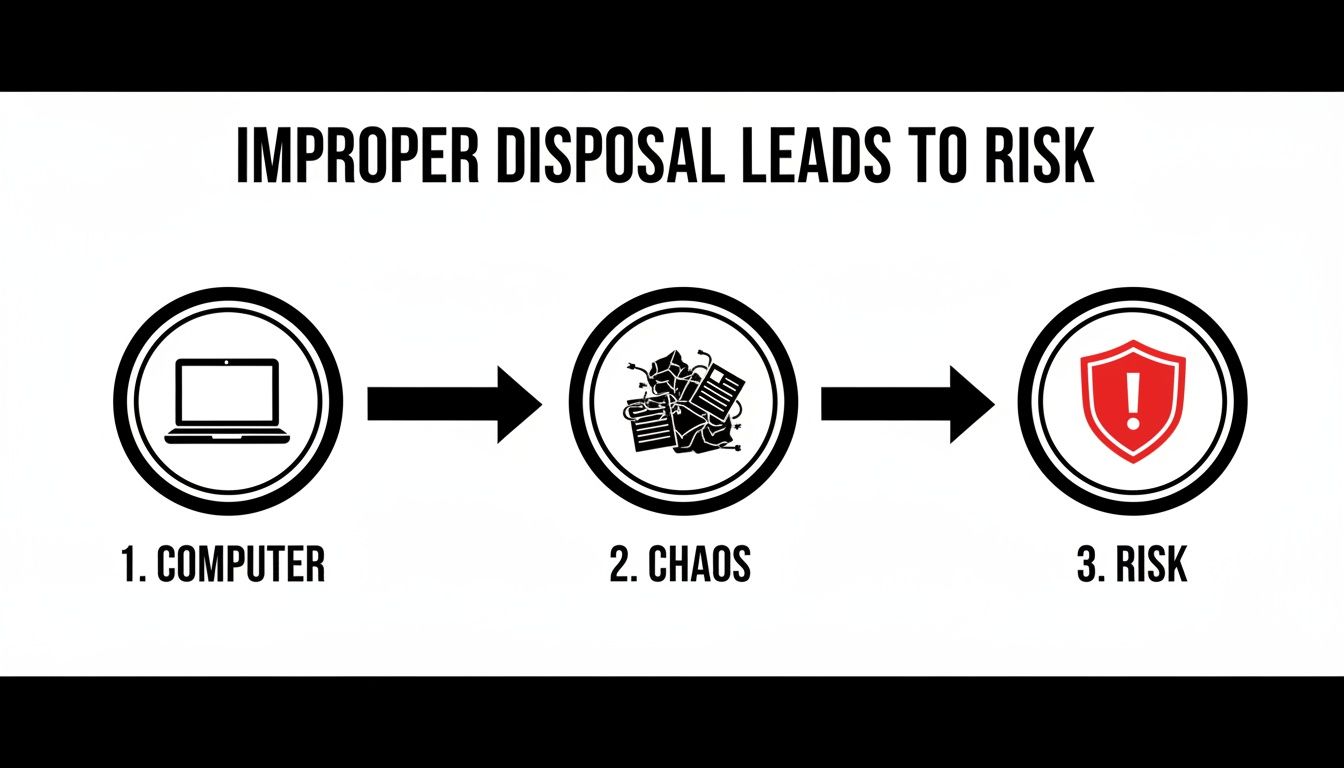
As you can see, a forgotten hard drive isn't just a piece of hardware; it’s a ticking time bomb of organizational risk.
Stage 2: Certified Data Destruction
Once your equipment is safely inside the secure facility, the mission shifts to data annihilation. Every hard drive, SSD, and data-bearing device is separated for certified data destruction. This is the most critical, non-negotiable step. It ensures your sensitive corporate, customer, and employee data is gone for good.
There are two primary ways to do this, both following strict standards like the NIST 800-88 Guidelines for Media Sanitization:
- Data Wiping (Sanitization): Special software overwrites the entire drive with random data, making the original information impossible to recover. This method is great because it preserves the drive, allowing it to be reused or resold.
- Physical Shredding (Destruction): For drives that are old, broken, or held top-secret information, physical destruction is the only answer. Industrial shredders grind the drives into tiny, confetti-like metal fragments, guaranteeing total data elimination.
After the job is done, you get a Certificate of Destruction. This is a legal document, your official, auditable proof that the data was destroyed responsibly. It’s what you’ll show auditors to prove you’ve met your compliance duties.
Stage 3: Asset Value Recovery and Remarketing
Not everything is destined for the shredder. Many of your retired assets still have cash value, and the next stage is all about unlocking it. Technicians perform a triage, testing and grading each piece of equipment for asset value recovery.
Working laptops, servers, and other components are carefully refurbished. They get cleaned up, repaired if needed, and prepped for remarketing through established secondary channels. This is a win-win: it gives the electronics a second life, which is great for the environment, and it generates a financial return that can seriously offset—or even completely cover—the cost of the disposal service. You’ll get a detailed report breaking down the value recovered from every resold asset.
If you're dealing with larger systems, our server decommissioning checklist is an incredibly useful resource to guide your process.
Stage 4: Responsible Recycling and Disposal
Finally, any assets with no resale value or that failed testing move on to the last stage: responsible recycling. Let's be clear: this isn't just tossing them in a bin out back.
Certified ITAD vendors de-manufacture the equipment, breaking it down into its base materials like plastic, steel, aluminum, and precious metals. Hazardous stuff like mercury and lead is carefully extracted and handled according to all environmental regulations. This ensures nothing ends up in a landfill, protecting the environment and backing up your company’s corporate social responsibility goals. Every step is documented, giving you a final report on the environmental impact and confirming compliant disposal.
Navigating Data Security and Compliance Mandates
Let’s be honest—when you’re retiring old IT assets, the hardware itself is the last thing you should be worried about. The real liability, and where the biggest risks hide, is the sensitive data still living on those devices.
For any IT director or procurement manager, this is the single most compelling reason to bring in professional computer disposal services. It's about navigating the tangled web of data security rules and regulations.
Getting this wrong isn't a simple mistake. It can lead to seven-figure fines, messy legal battles, and a hit to your brand's reputation that you may never recover from. Think of your ITAD partner less as a disposal vendor and more as a key part of your risk management team. They build an "audit shield" around the entire process.
The High Stakes of Non-Compliance
Different industries face their own unique set of regulatory hurdles, and they all come with steep penalties. These aren't just vague guidelines; they are legally binding requirements that spell out exactly how data must be managed, long after a device is unplugged for good.
Here are a few of the big ones:
- HIPAA (Health Insurance Portability and Accountability Act): If you're in healthcare, HIPAA is non-negotiable. A single lost or improperly wiped laptop containing patient records can trigger a massive data breach, with fines that can soar past $1.5 million for a single violation.
- NIST (National Institute of Standards and Technology): This is the gold standard, especially for government agencies and contractors. NIST SP 800-88 provides the definitive playbook for media sanitization, outlining precise methods for making data on hard drives and SSDs completely unrecoverable.
- State-Level E-Waste and Data Privacy Laws: On top of federal rules, many states have their own laws governing both e-waste and data privacy. These often demand documented proof of secure data destruction and responsible recycling, adding another layer of complexity to the process.
Ignoring these rules is like driving without insurance. It feels fine until it isn't, and by then, the consequences are already catastrophic.
Your Partner as an Audit Shield
This is exactly where a certified ITAD partner proves its worth. They don’t just haul away your old gear; they create the meticulous documentation you need to prove you’ve met every single legal and regulatory requirement. This paper trail becomes your airtight defense if an auditor ever comes knocking.
The core value of a professional computer disposal service is verifiable proof. Their process is built around creating an auditable, defensible record that demonstrates your due diligence in protecting sensitive information and complying with all applicable laws.
This documentation isn't just a simple receipt. It includes several critical components:
- Serialized Inventory Reports: A detailed manifest of every asset collected, identified by serial number, make, and model.
- Chain of Custody Records: A log that tracks each device from the moment it leaves your building to its final destination, showing who handled it and when.
- Certificates of Destruction: This is your golden ticket. It's a legally binding document confirming that the data on specific devices was permanently destroyed according to standards like NIST 800-88. To understand just how important this is, check out our guide on the Certificate of Destruction for hard drives.
The global e-waste recycling market ballooned to USD 70.1 billion in 2024 and is on track to hit USD 251.9 billion by 2034. Yet, despite this massive growth, only 42% of countries have formal e-waste laws, creating a confusing and risky regulatory landscape. For businesses in tightly regulated sectors like healthcare or government, certified destruction and a solid audit trail are the only ways to safely navigate these waters.
At the end of the day, compliance isn't a one-time task you can just check off a list. It's an ongoing responsibility—one that a reliable computer disposal partner manages for you, delivering documented proof and, most importantly, complete peace of mind.
How to Choose the Right ITAD Partner
Picking the right partner for your computer disposal isn't just another line item on a procurement list—it's a critical security decision. The vendor you choose becomes the custodian of your company’s sensitive data and its compliance reputation. The right choice requires looking past the price tag to seriously vet a partner's processes, certifications, and overall transparency.

This is about finding a company that truly aligns with your organization's risk tolerance and operational needs. A great partner delivers an airtight, auditable process that protects you long after your equipment is gone. A bad one? They can expose you to data breaches, steep regulatory fines, and brand damage that’s hard to shake.
Verifying Essential Certifications
Certifications are your first and most important filter. Think of them as proof that a vendor has subjected their operations to intense, third-party scrutiny and passed. They validate a commitment to the highest industry standards for data security and environmental responsibility. A vendor without the right credentials should be an immediate red flag.
You wouldn't hire an unlicensed doctor, right? The same logic applies here.
- R2 (Responsible Recycling): This certification is a big one. It focuses on environmentally sound practices, worker safety, and data security all the way down the recycling chain. An R2-certified partner gives you peace of mind that your e-waste won't end up in a landfill.
- e-Stewards: Often seen as the gold standard for environmental accountability, e-Stewards enforces a strict zero-landfill policy and forbids exporting hazardous e-waste. It's the certification for companies serious about their corporate social responsibility.
- NAID AAA: This one is all about data destruction. A NAID AAA-certified vendor has passed rigorous, unannounced audits covering everything from hiring practices to the shredders on their trucks. It's your guarantee that your data is verifiably destroyed.
Don't be shy about asking for copies of their certification documents. It isn't just due diligence; it’s a fundamental step in protecting your business. Any hesitation on their part is a clear warning sign.
Scrutinizing the Chain of Custody
A secure chain of custody is the unbroken, documented trail that follows your assets from the second they leave your office to their final disposition. This isn't just a shipping manifest; it’s your legal proof of responsible transfer. If that chain is weak or broken, your organization is still on the hook for whatever happens to those assets.
When evaluating a vendor, get specific with your questions:
- On-Site Asset Scanning: Do their technicians scan and log every single asset by serial number before it leaves your building? This is non-negotiable.
- Secure Transportation: Are their trucks locked and GPS-tracked? Are their drivers vetted, uniformed employees?
- Facility Security: Is their processing facility under 24/7 surveillance with strict access controls?
- Reporting Transparency: Will you get a detailed, serialized report confirming every asset was received and processed correctly?
A strong chain of custody is not a "nice-to-have." It’s the difference between knowing where your data is and hoping it was handled properly. Any ambiguity here is a major risk.
For a deeper dive into what top-tier providers offer, it's worth exploring the landscape of different IT asset disposition companies.
Assessing Asset Remarketing and Value Recovery
Beyond security and compliance, a premier ITAD partner should also be a financial ally, working to maximize the return on your retired assets. A strong asset remarketing program is a dead giveaway of a sophisticated operation. It shows they have the skills to test, refurbish, and resell equipment that still has life in it, turning a disposal cost into a revenue stream.
When you talk remarketing, demand transparency. A quality partner will give you a clear breakdown of how they assess value and exactly what percentage of the resale price comes back to you. They should provide detailed reports that match the final sale price of each asset back to your original inventory list. This approach not only helps pay for the disposal service but also supports a circular economy by giving your old hardware a second life.
Vendor Evaluation Checklist for ITAD Services
Finding the right ITAD partner requires a structured approach. This checklist is designed to help IT managers and procurement teams cut through the noise and focus on what truly matters when comparing potential vendors. Use it to score each candidate and identify the one that best fits your security, compliance, and financial goals.
| Evaluation Criteria | What to Look For (Green Flags) | Warning Signs (Red Flags) |
|---|---|---|
| Certifications | Holds current R2, e-Stewards, and NAID AAA certifications. Eager to provide documentation. | Vague about certifications, provides expired documents, or lacks key credentials like NAID AAA. |
| Chain of Custody | Detailed, documented process from on-site scanning to final disposition. Uses secure, GPS-tracked vehicles. | Ambiguous process, relies on third-party couriers, or lacks detailed, serialized tracking. |
| Data Destruction | Offers multiple on-site and off-site destruction methods (shredding, wiping). Provides serialized Certificates of Destruction. | One-size-fits-all approach. Vague reporting or no formal certification of destruction. |
| Facility Security | Secure, access-controlled facility with 24/7 video surveillance and audited security protocols. | Unwilling to share details about facility security or allows unescorted visitor access. |
| Asset Remarketing | Transparent, shared-revenue model. Detailed reporting on resale values and fees. | Opaque pricing, low value recovery estimates, or no clear process for refurbishing and selling assets. |
| Reporting & Auditing | Provides comprehensive, serialized reports for all assets. Offers a clear and accessible audit trail. | Generic, non-serialized reports. Unable to provide a clear audit trail for a specific asset. |
| Logistics & Scope | Owns and operates their own fleet. Can handle projects of your scale and geographic footprint. | Heavily relies on third-party logistics. Inexperienced with projects of your size or complexity. |
| Environmental Policy | Clear zero-landfill policy and documented downstream vendor auditing process. | No clear environmental policy or unable to document where materials go after processing. |
Remember, the goal is to find a long-term partner, not just a one-time vendor. The company that scores highest on this checklist is likely the one that will provide the most secure, compliant, and valuable service over time.
How Computer Disposal Costs Are Calculated
Budget is always a concern when managing IT hardware, but with computer disposal, the cheapest quote is almost never the best value. The real cost of getting it wrong—think data breaches or compliance fines—far outweighs the price of a professional service. Understanding how computer disposal services price their work is the first step to making a smart investment that actually protects your business.
A good ITAD partner will be completely transparent about their fee structure. This allows you to budget accurately and see the true total cost of ownership for your equipment, from purchase to final disposition. Ultimately, you're not just paying a fee; you're investing in risk management.
Common Pricing Models
When you start gathering quotes, you'll likely run into a few standard pricing structures. The right one for you usually depends on how much gear you have and what kind it is.
- Per-Asset Fee: This is a simple, straightforward model where you pay a flat rate for each individual item—a laptop, a server, a monitor, etc. It’s easy to understand and great for smaller projects with a mix of different equipment.
- Per-Pound Fee: If you’re clearing out a data center or an entire office with thousands of devices, a per-pound model is often more practical. The cost is based on the total weight of the assets, which simplifies quoting for large-scale disposals.
- Flat Project Fee: For well-defined projects, some vendors will offer a single, all-inclusive price. This typically covers everything from logistics and data destruction to final recycling, giving you a predictable, fixed cost right from the start.
No matter the model, make sure the quote explicitly includes essential services like certified data destruction and detailed reporting. You don't want any surprises or hidden fees showing up later.
The Impact of Value Recovery
The single biggest factor that can change your final cost is asset value recovery. This is where your ITAD partner tests, refurbishes, and resells retired equipment that still has some life left in it. A vendor with a strong remarketing network can generate a financial return that significantly offsets—or in some cases, completely covers—your disposal costs.
A strategic ITAD partnership isn't just about minimizing expenses; it's about maximizing value. A strong remarketing program can turn what was a line-item cost into a net-positive return for your IT department.
This process effectively turns a liability into an asset. Globally, unrecycled e-waste is expected to hit 347 metric tons by 2025, wasting billions in recoverable materials. By working with certified partners, businesses not only dodge compliance risks but also tap into a secondary market for used assets valued between $45-66 billion. You can find more details in this report on global e-waste statistics and their market implications.
What Drives the Final Price?
Several variables will ultimately shape the quote you receive. Knowing what they are will help you have more productive conversations with potential vendors and ensure you get a fair, accurate price.
- Logistics and Transportation: The distance a vendor has to travel, the need for on-site packing and palletizing, and the number of pickup locations all play a role in the cost.
- Equipment Type and Condition: Newer, working equipment has a much higher resale value, which will lower your net cost. Older, broken, or obsolete devices will have recycling fees tied to them.
- Data Destruction Requirements: The level of security you need matters. On-site hard drive shredding, for instance, provides immediate, verifiable destruction but usually costs more than off-site data wiping.
Disposal Strategies for Specialized Industries
A one-size-fits-all approach to computer disposal just won’t work for industries facing serious security and compliance rules. Standard procedures can easily overlook the specific demands of healthcare, government, or massive data centers, where one small mistake can lead to a devastating data breach or heavy regulatory fines. For these sectors, a tailored strategy isn't just a good idea—it's essential.
When you're in one of these fields, your computer disposal services partner needs to act more like a risk management specialist. They have to understand the unique data you handle and the laws that govern it. This means going way beyond a simple pickup-and-recycle service and building a deep, compliance-driven partnership.
Healthcare and HIPAA Compliance
In a healthcare setting, every retired device is a potential liability. That old laptop at the nurse's station or the server holding medical images? They’re likely filled with Protected Health Information (PHI). Under the Health Insurance Portability and Accountability Act (HIPAA), you have no choice but to ensure that data is securely and permanently destroyed. The penalties for getting this wrong are staggering, often running into millions of dollars in fines and causing irreversible damage to patient trust.
A disposal strategy for healthcare absolutely must include:
- On-Site Data Destruction: Many hospitals and clinics insist on watching hard drives get physically shredded right on their property. It’s the only way to completely eliminate chain-of-custody risks for devices loaded with PHI.
- Business Associate Agreements (BAA): Any ITAD vendor you work with must sign a BAA. This is a legal contract that binds them to protect your patient data with the same level of care you do.
- Serialized Audit Trails: You need meticulous, serialized reports to prove that every single asset that ever held PHI was handled and destroyed in a compliant manner. It's your proof when the auditors come knocking.
Data Centers and Large-Scale Decommissioning
Data centers are a whole different ballgame. The challenge here is the sheer scale and complexity of the job. Taking hundreds or even thousands of servers offline requires a partner with the muscle and know-how to handle massive projects without pulling the plug on your live operations. Plus, asset value recovery is a huge piece of the puzzle, since even retired servers can be worth a lot of money.
Key things to look for in a data center partner:
- Project Management Expertise: The vendor must be able to coordinate the entire process—from de-racking and palletizing on-site to securely transporting tons of equipment.
- Maximum Value Recovery: A strong remarketing program is critical. It can turn what would have been a significant expense into a project that actually generates revenue from high-value server components.
- On-Site Data Erasure or Shredding: For the ultimate security, many data centers require all data to be destroyed on-site before a single piece of equipment leaves the building. You can see how this works in our guide to the data center decommissioning process.
Government Agencies and NIST Standards
Government agencies, from city hall to federal contractors, live by the strictest security protocols. The data on their old computers could be anything from sensitive citizen information to classified national security intel. That’s why their disposal partners must meet the highest standards, primarily following the guidelines set by the National Institute of Standards and Technology (NIST).
For government entities, computer disposal is a matter of public trust and national security. The process must be flawless, with every step auditable and every piece of data verifiably destroyed according to federal mandates like NIST SP 800-88.
Old computers and monitors make up a huge chunk of e-waste, and globally, only 12.5% of screens get recycled. With new tech like AI PCs expected to hit 114 million shipments in 2025, that pile of outdated hardware is only going to get bigger. For specialized sectors like data centers and government labs, this makes partnering with a certified disposal service non-negotiable for staying compliant and keeping hazardous materials out of landfills. You can discover more insights about these e-waste statistics.
Common Questions About Computer Disposal
Even with a solid plan, a few practical questions always pop up when it's time to get rid of old office computers. Here are the answers to the questions we hear most often from IT directors and procurement teams, helping you lock down a secure and compliant process.
What’s the First Step to Get Our Old Computers Picked Up?
It's actually pretty simple: just reach out to a certified ITAD provider with a rough idea of what you have. To get a quick, accurate quote and a smooth pickup scheduled, try to have this info handy:
- A ballpark count of your gear: How many laptops, desktops, servers, and monitors are you retiring?
- Where the equipment is located: Is everything piled up in one storage room, or is it scattered across a few different floors or buildings?
- Any logistical hurdles: Will our crew need to navigate stairs, deal with limited elevator access, or follow specific security rules to get into your facility?
Giving your disposal partner these key details upfront lets them send the right size team and vehicle, making the whole collection process seamless.
How Can We Be 100% Sure Our Data Is Gone for Good?
You get absolute certainty by using a destruction method that is both verifiable and meets strict industry standards. You’ve got two rock-solid options:
- Data Wiping (Sanitization): This process uses specialized software to overwrite every single part of a hard drive according to the NIST 800-88 standard. It makes the original data completely unrecoverable but keeps the drive intact for potential reuse.
- Physical Shredding: For the highest level of security, or for drives that don't work anymore, industrial shredders physically demolish the device. They grind it down into tiny, irreparable pieces.
No matter which method you choose, the job isn't done until you have a Certificate of Destruction. This is your legally binding proof—it’s non-negotiable. It lists the serial numbers of every device destroyed and confirms your data has been permanently wiped out.
Can We Actually Get Any Money Back from Our Old Equipment?
Yes, you absolutely can. A lot of retired IT hardware, especially anything less than five years old, still has real monetary value. This is where asset remarketing comes in. A professional ITAD partner will test, grade, and refurbish valuable gear like laptops, servers, and network switches to sell them on the secondary market.
The whole point of asset remarketing is to turn what would be a disposal cost into a source of revenue. The value depends on factors like age, cosmetic condition, and specs, and the money generated can directly offset—or even exceed—your disposal fees.
You should always look for a partner that offers a transparent, shared-revenue model and provides detailed reports showing exactly how much was recovered for each serialized asset.
What Kind of Reporting and Paperwork Should We Demand?
Solid documentation is the bedrock of a defensible, auditable disposal process. At a bare minimum, you need to demand and keep these reports from your ITAD partner:
- Serialized Chain of Custody Forms: This document tracks every single asset by its unique serial number from the moment it leaves your building, showing every hand it passes through until its final destination.
- Detailed Asset Reports: This is a complete inventory list that breaks down the make, model, serial number, and the final outcome for each piece of equipment (e.g., resold, recycled, or destroyed).
- Certificate of Data Destruction: As we mentioned, this is the official document confirming that all your data-bearing devices were sanitized or destroyed in line with recognized standards.
These aren't just receipts; they're your critical evidence for internal audits and your proof of regulatory compliance.
Ready to put a secure, compliant, and value-focused disposal strategy in place? Dallas Fortworth Computer Recycling provides nationwide ITAD solutions with the certifications and transparent reporting you need. Learn more about our secure computer disposal services and schedule your pickup today.