
Onsite Shredding Near Me Your Guide to Secure Data Destruction
When your team starts searching for "onsite shredding near me," you're not just booking another vendor. You're activating the final, most critical layer of your entire data security protocol. Immediate, witnessed destruction is the only way to truly guarantee a secure chain of custody, turning a potential liability into a verified, compliant process right at your own facility.
Why Onsite Shredding Is a Non-Negotiable Security Layer
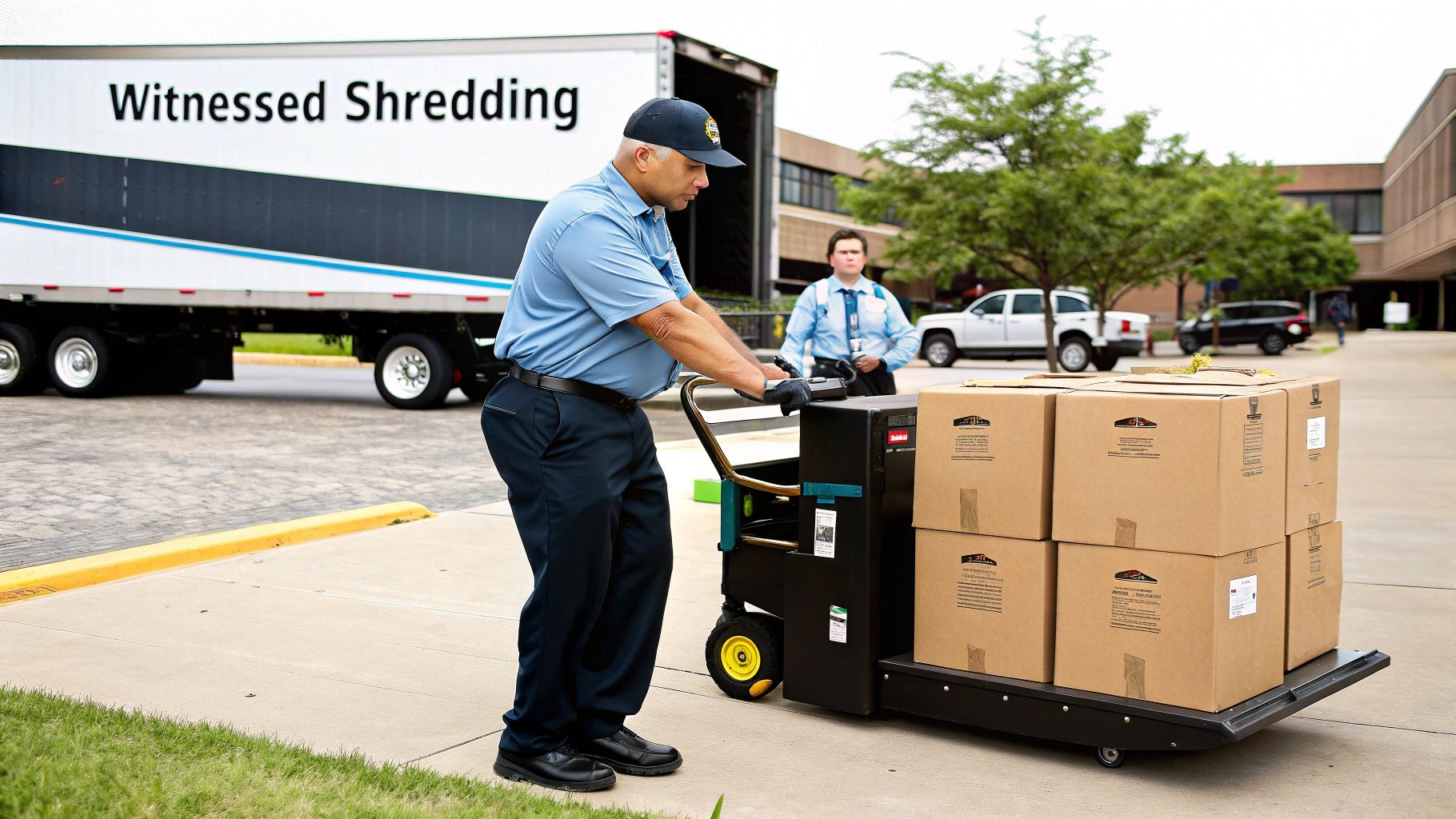
For any IT manager or procurement team, the decision to destroy sensitive assets is loaded with risk. Every moment that retired hard drives, old file cabinets, or decommissioned servers sit in a storage room, they represent a data breach waiting to happen.
The core value of onsite shredding is that it completely eliminates the single greatest vulnerability in the disposal process: transportation.
The Problem with Off-Site Services
Off-site services, by their very nature, create a gap in your chain of custody. Your assets leave your control and travel across town in a truck, making them susceptible to loss, theft, or simple mishandling.
This isn't just a hypothetical risk. I've seen the aftermath. A single lost box of documents or a misplaced hard drive during transit can trigger seven-figure regulatory fines under laws like HIPAA or GDPR, not to mention cause irreparable damage to your brand's reputation.
The Power of Direct Verification
Onsite destruction transforms data disposal from a hope-for-the-best scenario into a verifiable event. You and your team can physically stand there and witness every document and device being fed into the shredder. You see it destroyed before the truck ever leaves your property.
This direct oversight is the ultimate form of compliance assurance. It’s why the industry is moving so decisively in this direction. As the global document shredding market is projected to hit $15 billion by 2025, onsite services already command a dominant **60% market share over off-site options. This trend is a direct response to rising security threats, including a surge in corporate espionage, making witnessed destruction a critical risk mitigation strategy for IT leaders. You can learn more about the document shredding services market from this report.
For a mid-size financial firm decommissioning a local branch, onsite shredding was the only acceptable option. The firm’s CISO needed absolute certainty that client records and old server drives were unrecoverable. Witnessing the destruction firsthand provided the auditable proof needed to satisfy both internal governance and external regulators, closing the loop on their IT asset disposition securely.
Let's break down the practical differences.
Onsite vs Off-Site Shredding Risk and Compliance Comparison
This table offers a clear, at-a-glance look at why the location of shredding matters so much for security and compliance.
| Feature | Onsite Shredding | Off-Site Shredding |
|---|---|---|
| Chain of Custody | Unbroken. Assets are destroyed at your location before being transported. You witness the entire process. | Broken. Assets are transported from your site to a separate facility, creating a gap in oversight and control. |
| Verification | Direct & Immediate. You can visually confirm that every item has been destroyed before the vendor leaves. | Delayed & Indirect. You rely on the vendor's promise and paperwork, with no direct observation. |
| Security Risk | Low. The risk of loss, theft, or mishandling during transport is eliminated. | High. Transportation introduces significant risks from accidents, theft, or unauthorized access. |
| Compliance Evidence | Strong. The Certificate of Destruction is supported by your team's direct witness, providing robust audit proof. | Weaker. You receive a certificate, but it doesn't account for the unobserved transportation phase. |
| Time to Destruction | Immediate. Data is destroyed on the spot, closing security vulnerabilities quickly. | Delayed. Assets may sit at a warehouse for hours or days before being processed, extending the risk window. |
As you can see, the choice isn't just about convenience—it's a fundamental decision about how much risk your organization is willing to accept.
From Operational Cost to Security Essential
In the past, shredding might have been viewed as a simple line item in the operational budget. Today, it’s a fundamental component of any modern security framework.
Here’s why top IT leaders I work with insist on it:
- Eliminates Chain of Custody Breaks: The process begins and ends at your facility, removing any ambiguity about the location and status of your sensitive assets.
- Provides Immediate Proof of Destruction: You receive a Certificate of Destruction right then and there—a vital document for any compliance audit.
- Mitigates Insider and Outsider Threats: By destroying data immediately upon decommissioning, you shrink the window of opportunity for both internal and external bad actors.
Ultimately, onsite shredding is more than just a convenience; it's a strategic decision that aligns with the principles of zero-trust security. It's an integral part of a complete IT asset disposition strategy that protects your organization from the moment data is created until it is certifiably destroyed.
Navigating the Compliance Maze of Data Destruction
Let's be clear: compliance is the absolute foundation of secure data destruction. This isn't just about checking boxes on a form. It’s about building a defensible, auditable process that shields your company from crippling fines and nasty legal fights. When you hire an onsite shredding partner, you are literally handing over your compliance reputation.
That means verifying their certifications and understanding how their process plugs into specific legal frameworks isn't optional—it's your core responsibility. Regulations like HIPAA in the healthcare world or NIST guidelines for government contractors have incredibly strict standards for how data must be wiped clean. One misstep can be catastrophic.
The HIPAA Framework and Business Associate Agreements
For any organization that touches Protected Health Information (PHI), HIPAA compliance is non-negotiable. The law is crystal clear: any vendor handling PHI on your behalf, including your shredding company, is legally considered a "Business Associate."
This relationship absolutely must be formalized with a Business Associate Agreement (BAA). A BAA is a signed contract that legally binds your shredding partner to protect that data with the same rigor as your own organization.
Never, ever engage a shredding service for PHI without a signed BAA. A simple handshake or a standard service agreement won't cut it and leaves you completely exposed. The BAA is your first and most critical line of defense in proving you did your due diligence.
Decoding NIST 800-88 for Media Sanitization
While HIPAA governs health information, the NIST 800-88 guidelines are the technical playbook for media sanitization. These guidelines are the gold standard for federal agencies and have been widely adopted by the private sector because they offer a clear, risk-based approach.
NIST breaks down sanitization into three methods:
- Clear: This involves overwriting data using software. It’s not strong enough for highly sensitive data, as recovery might still be possible.
- Purge: This uses techniques like degaussing to make data recovery infeasible, even with advanced forensic tools.
- Destroy: Physically ruining the media, making data recovery flat-out impossible. This is where onsite shredding shines, offering the highest level of security.
When it comes to hard drives, servers, and backup tapes, physical destruction is the only NIST method that provides absolute, verifiable certainty. It’s a perfect match for the principles of witnessed, onsite shredding, ensuring every piece of media is rendered completely useless right before your eyes.
Think about a hospital upgrading its server room. Those old servers hold years of patient records. Simply wiping the drives (Clear) is nowhere near enough. By choosing a NAID AAA Certified onsite shredding partner, the hospital can witness the physical destruction (Destroy) of every single hard drive, satisfying both NIST recommendations and HIPAA requirements in one documented event.
Verifying Certifications Like NAID AAA
So, how do you actually confirm a vendor meets these high standards? You look for third-party certifications. In the secure destruction industry, the most respected credential by far is NAID AAA Certification.
This isn't some pay-to-play certificate. The NAID AAA program involves unannounced, surprise audits conducted by independent security professionals. They dig into more than 20 elements of operational security, including:
- Employee screening and background checks
- Secure chain-of-custody procedures
- Vehicle and facility security standards
- Insurance coverage requirements
Choosing a NAID AAA Certified provider gives you immediate confidence that their entire process has been put under a microscope and vetted against the industry's toughest standards. It dramatically simplifies your due diligence and gives you a clear security benchmark. You also need to confirm that you will receive proper documentation, as this is your key to passing any audit. Learn more about the importance of a certificate of destruction for hard drives in our detailed guide.
The demand for certified, witnessed destruction is only getting stronger. Tough regulations like GDPR and HIPAA have pushed enterprises to increase their shredded volume by 40% annually. This trend is driven by pure risk mitigation, especially when the average data breach now costs $4.45 million. Ultimately, navigating the compliance maze boils down to choosing the right partner—one with verifiable credentials, transparent processes, and the paperwork to prove it all.
How to Vet Shredding Vendors Beyond the Price Tag
When you start searching for "onsite shredding near me," the quotes you get back can be all over the map. It's tempting to jump on the lowest bid, but a rock-bottom price often signals some serious security gaps. A truly secure partner invests heavily in their protocols, people, and equipment—and that investment comes at a cost, but it delivers priceless peace of mind.
Your vetting process has to be more than just a cost comparison. You're not just buying a service; you're entrusting a vendor with your company's most sensitive information. A cheap quote from a vendor cutting corners can quickly turn into a multi-million dollar data breach.
The Unbroken Chain of Custody
The single most critical thing to demand from any potential vendor is a transparent, unbroken chain of custody. This isn't just industry jargon. It's a documented, verifiable process that tracks your sensitive materials from the moment they leave your control until they are confirmed destroyed.
For you, this process kicks off the second their technician arrives at your facility. Are they in a clearly marked uniform? Have they gone through rigorous, recurring background checks? These aren't small details; they're the very first links in that secure chain.
That security protocol needs to extend to their equipment, too. The shredding truck is essentially a mobile vault. It should be equipped with real-time GPS tracking and have secure, locked compartments for all materials. Any reputable shredding company will be proud to show you these features.
This diagram breaks down the core stages of a solid vetting process into a simple, actionable flow.
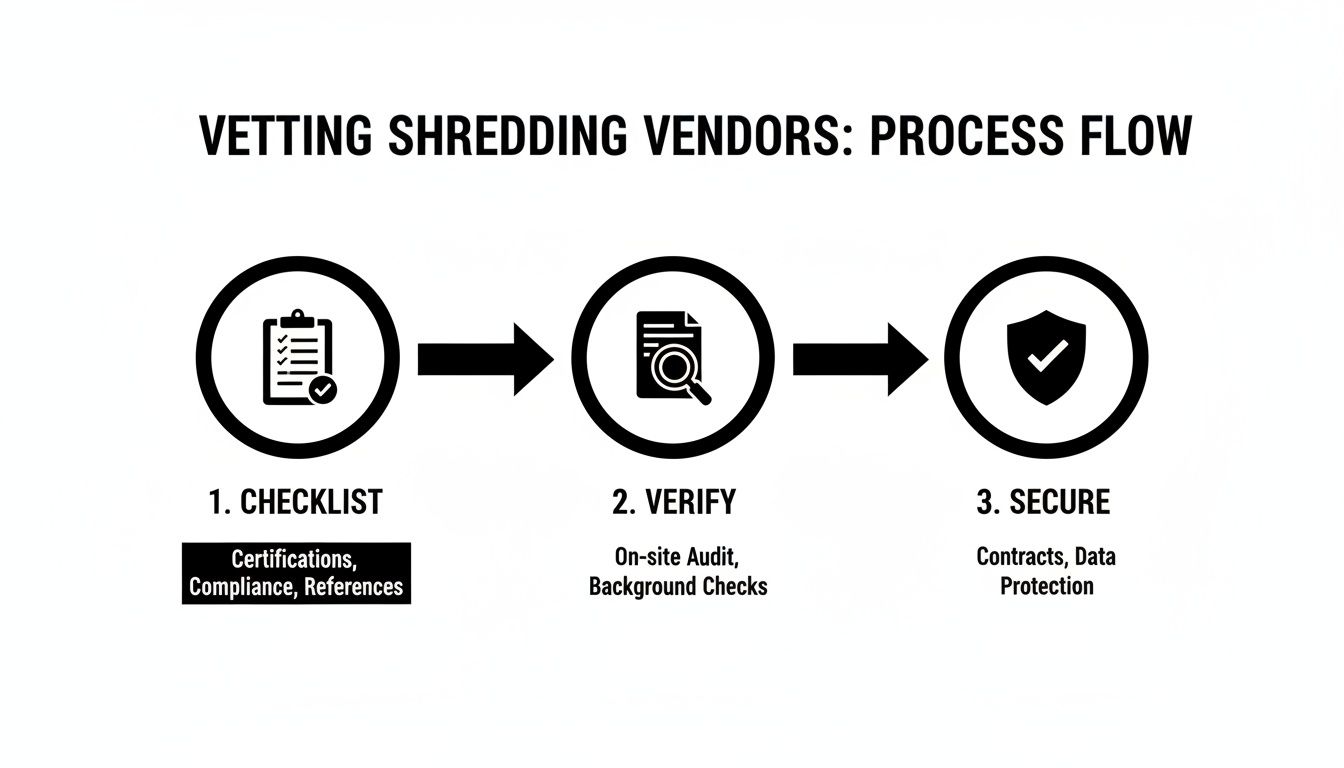
As you can see, the path to a secure partnership moves from building a checklist to actively verifying every claim, and finally, locking in a provider you can trust.
Key Questions for Your Vendor Checklist
To really separate the pros from the pretenders, you need to ask pointed, specific questions that get to the heart of their security posture. A secure vendor will have confident, immediate answers.
Here’s a practical checklist to help you evaluate potential onsite shredding partners. It covers the essentials you need to confirm before signing any contract.
Onsite Shredding Vendor Evaluation Checklist
| Evaluation Criteria | What to Ask / Verify | Importance (High/Med/Low) |
|---|---|---|
| Certifications & Compliance | Are you NAID AAA Certified? Can you provide a copy of your current certificate? | High |
| Insurance Coverage | What is your data breach liability insurance limit? Can I see the policy certificate? | High |
| Chain of Custody | Walk me through your entire chain-of-custody process, from pickup to final destruction. | High |
| Technician Screening | What does your employee background check process entail, and how often is it repeated? | High |
| Equipment Security | Are your trucks equipped with GPS tracking and locked compartments? | Medium |
| Shred Size Specifications | What is the final particle size for paper and hard drives? Does it meet NIST standards? | High |
| Audit Documentation | What documentation is provided after service (e.g., Certificate of Destruction)? | High |
| Recycling Procedures | Can you document your downstream recycling process to prove 100% of material is recycled? | Medium |
Using a structured checklist like this ensures you're making an apples-to-apples comparison based on security, not just price.
The real measure of a vendor's security is their transparency. If a potential partner gets evasive or can't provide clear documentation for their protocols, insurance, or employee screening, that’s a massive red flag. True security partners are proud of the investments they've made in these areas and are happy to prove it.
Differentiating Paper Shredders from ITAD Specialists
As your needs grow beyond just paper documents, the vetting process becomes even more critical. Many companies that started in paper shredding have tacked on hard drive destruction as a secondary service. But a specialized IT Asset Disposition (ITAD) provider offers a completely different level of expertise.
An ITAD specialist lives and breathes electronic media. They know the technical difference between destroying a traditional spinning hard drive (HDD) and a solid-state drive (SSD), which requires a different method to guarantee data is unrecoverable. For any IT manager dealing with regulated data, understanding the difference between a standard vendor and an R2 certified electronics recycler is non-negotiable.
A dedicated ITAD partner will provide:
- Serialized Asset Tracking: They will scan and record the serial number of every single hard drive or device before it's destroyed, giving you a detailed audit trail on your Certificate of Destruction.
- Expertise in Mixed Media: They have the right equipment and knowledge to handle a wide range of electronic assets, from servers and laptops to backup tapes and networking gear.
- Integrated Solutions: They can often manage the entire lifecycle of your IT hardware—from secure logistics and data destruction to certified recycling—all under one roof.
In the end, choosing the right partner comes down to prioritizing security over short-term savings. By digging deeper with these questions and understanding the difference between service types, you can build a partnership that truly protects your organization from risk.
Your Game Plan for a Flawless Shred Day
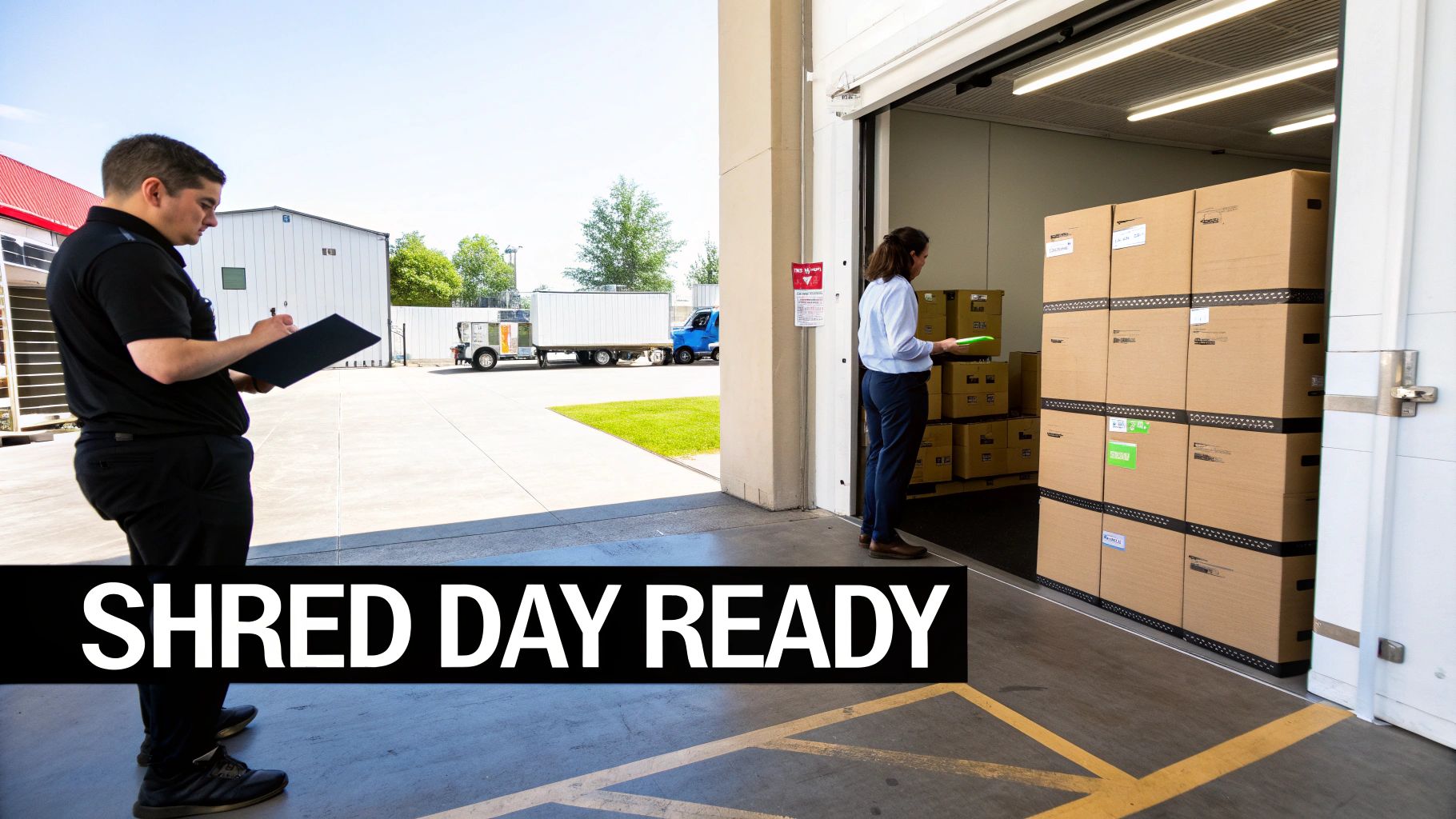
A successful shredding event doesn’t just happen. It’s the direct result of smart, detailed prep work. The difference between a smooth, secure purge and a day full of logistical headaches almost always comes down to the planning you do before the truck even pulls up.
First things first: you need to move from a rough guess to an accurate volume forecast. "We have a lot to shred" won't cut it for getting a solid quote or an efficient schedule. You need to get specific, whether you’re dealing with paper documents or retired hard drives.
This means doing a proper inventory. A standard file box, for instance, holds between 30 and 35 pounds of paper. For old electronics, you need an exact count of the hard drives, servers, or laptops. This detailed accounting helps your provider allocate the right amount of time and resources, which prevents surprise delays or extra charges on the invoice.
Setting the Stage for Security and Efficiency
Once you have a handle on the volume, it's time to think about the physical logistics. The spot you choose for staging and shredding is critical for both security and operational flow. It needs to be a secure, controlled area that doesn’t get in the way of your day-to-day business.
A loading dock is often the perfect spot. It gives the large shredding truck easy access and keeps the entire process contained. If you don't have one, pick an area near an exit that's clear of regular foot traffic.
Before the big day, do a quick site survey:
- Check for Obstacles: Look for low-hanging branches, tight corners, or parked cars that could block the truck’s path.
- Confirm Clear Access: Make sure the path from your staging area to the truck is clear and easy for moving heavy security bins.
- Designate a Witness: Assign one person from your team to be the official witness. Their only job that day is to watch the entire process, from the first bin to the last, and sign off on the paperwork.
This prep isn’t just for your benefit. It helps the shredding technicians work safely and efficiently, getting the job done with minimal disruption to your operations.
Your Pre-Service Checklist for a Smooth Event
To avoid any last-minute surprises, run through a final pre-service checklist with both your team and the vendor. This simple step ensures everyone is on the same page.
- Brief Your Internal Team: Make sure everyone involved knows their role, the day's schedule, and the security protocols. This includes clarifying who is authorized to be in the staging area.
- Confirm the Asset List: Do a final count of all boxes, bins, and electronic devices to make sure it matches what’s on the quote.
- Verify Documentation Procedures: Reconfirm with your vendor that you will receive a Certificate of Destruction on-site, immediately after the service is finished. This document is your non-negotiable proof of compliance.
Good planning also means knowing what to do with electronic media. While shredding paper is straightforward, you need to ensure hard drives are prepped correctly. You can check out our guide on how to wipe a hard drive completely for best practices before destruction.
A well-executed shred day is a quiet one. The goal is to make a high-stakes security process feel like a routine operational task. Meticulous planning is what transforms potential chaos into controlled, documented, and auditable destruction.
Even as technology moves forward, the need for secure physical destruction remains a top priority. In fact, despite the digital shift, mobile shredding services were valued at $3.42 billion globally in 2023 and are projected to keep growing. This highlights the industry's consensus that onsite, witnessed destruction is the most reliable way to mitigate risk. By following this game plan, you can ensure your organization's shred day is flawless, secure, and fully compliant.
Integrating E-Waste and Hard Drive Destruction
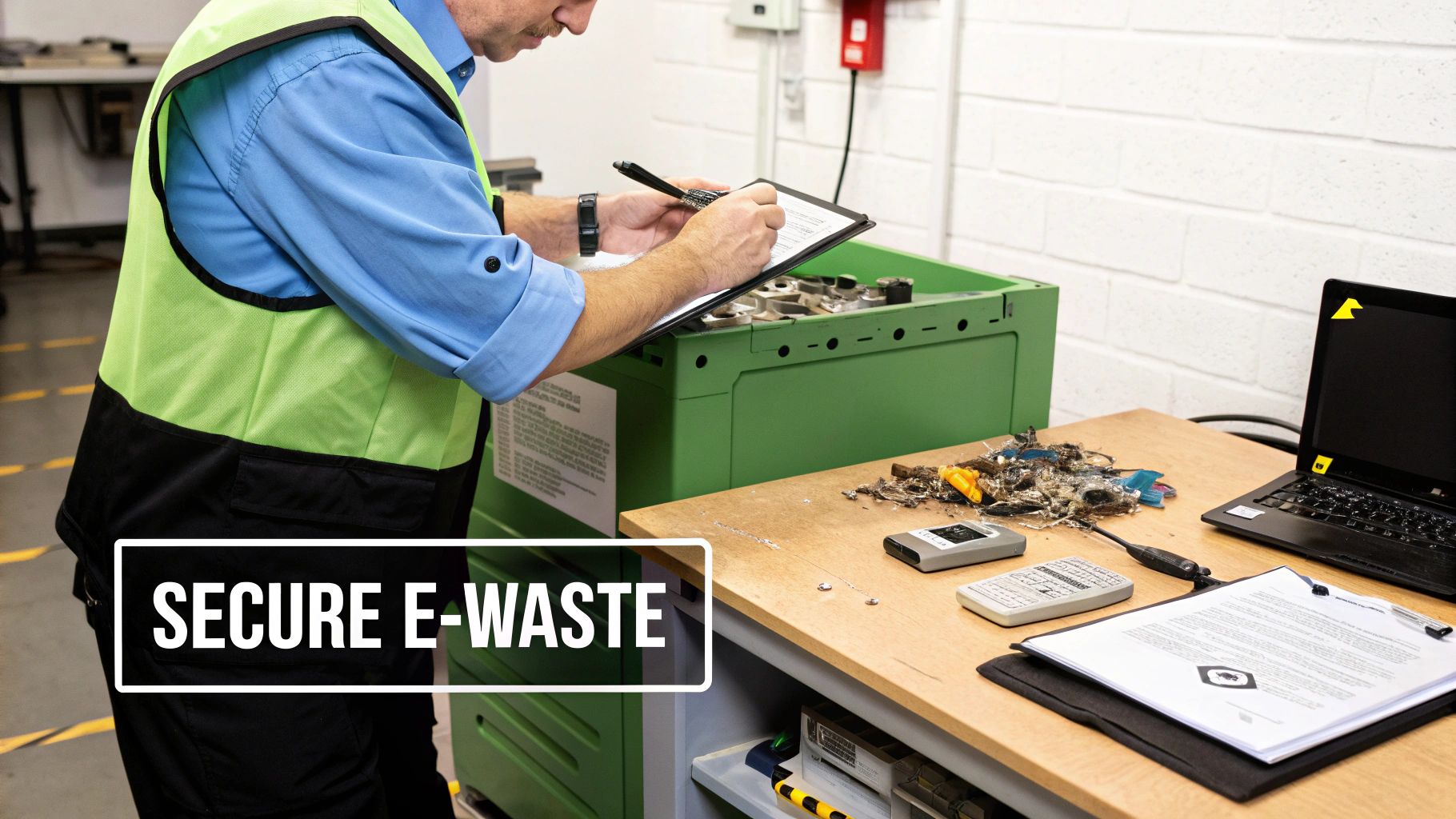
A data security policy that stops at paper documents isn't just incomplete—it's got a massive, glaring hole. Think about that IT closet full of retired laptops, servers, and old company smartphones. Each one contains a hard drive or solid-state drive absolutely packed with sensitive information.
Many people assume that formatting these devices is enough, but that’s a dangerously false sense of security. Data recovery tools can often pull "deleted" files back from the brink with surprising ease.
True data security demands the physical destruction of electronic media. This is where finding an integrated service partner becomes a game-changer. Instead of juggling a paper shredder and a separate e-waste company, you can streamline everything by working with a single, certified provider who handles both. This approach simplifies vendor management, cuts down on logistical headaches, and ensures you have one consistent security standard for all your retired assets.
Beyond Formatting: The Need for Physical Destruction
Let's be crystal clear: dragging files to the trash can or running a standard disk format does not permanently erase data. All that does is remove the digital signposts telling the operating system where the files are. The underlying data is still there, just waiting to be recovered.
For any IT manager, this is a critical distinction that directly impacts risk and compliance. To meet tough standards like NIST 800-88, data must be rendered completely and utterly unrecoverable. Physical destruction is the only way to guarantee that outcome with 100% certainty.
The most common and effective methods are:
- Shredding: Industrial-grade shredders built for electronics pulverize hard drives, SSDs, and other media into tiny, mangled fragments that are impossible to reassemble.
- Crushing: A hydraulic press applies thousands of pounds of force, bending, shattering, and destroying the drive's internal platters and components, making them completely unreadable.
Both methods achieve the same end goal: they make data retrieval a physical impossibility. This is the level of assurance you need when disposing of assets containing financial records, intellectual property, or protected health information (PHI).
One Partner for All Your Assets: A Real-World Scenario
Picture this: your company is doing a major tech refresh. You’re decommissioning 200 employee laptops, pulling 15 old servers out of the data closet, and finally purging 500 boxes of archived financial documents. This kind of mixed-asset retirement is a classic headache for IT and procurement teams.
If you take a fragmented approach, you'll be coordinating multiple vendors:
- A paper shredding company for the documents.
- An e-waste recycler for the laptops and servers, who may or may not offer certified onsite data destruction.
- Possibly even a third vendor for specialty items like backup tapes.
That means multiple chains of custody, separate invoices, and different security and documentation standards. It’s inefficient and creates too many opportunities for mistakes or security gaps.
Now, let's look at the integrated approach. You hire one certified IT Asset Disposition (ITAD) provider that offers onsite shredding for both paper and electronic media. On the scheduled day, a single team arrives with the right equipment for the entire job. They scan the serial number of every single hard drive before it goes into the shredder, then they move on to the file boxes.
By using a single, certified vendor for a mixed-asset purge, you consolidate your risk management. You get one unbroken chain of custody and one Certificate of Destruction that itemizes every single asset destroyed—from paper files to specific hard drive serial numbers. This creates a powerful, unified audit trail that simplifies compliance verification.
The benefits are immediate. You’ve simplified logistics, cut down on administrative work, and locked in a uniform, high-security standard for every piece of retired media. A unified strategy like this is the mark of a mature ITAD program, turning a complicated disposal project into a secure, manageable event. To make sure this process is handled correctly, it's wise to understand how to properly shred and recycle your electronics together to meet both security and environmental standards.
Answering Your Onsite Shredding Questions
Even with a solid plan, specific questions always pop up when you start searching for "onsite shredding near me." Getting clear, direct answers to these common queries is the best way to demystify the process and feel confident about the vendor you choose.
Here are the most frequent questions we hear from IT managers and procurement teams about onsite destruction services.
How Is the Cost of Onsite Shredding Typically Calculated?
The final price for onsite shredding is rarely a simple flat fee. It’s almost always a calculation based on the volume and type of material you need destroyed. Understanding these pricing models helps you budget accurately and avoid any surprises.
For big, one-time purges—like a year-end cleanout or an office move—vendors often charge by the pound. For regularly scheduled services, you'll likely see a price per secure bin or console that the vendor provides and empties on a recurring basis.
Electronic media destruction adds another layer.
- Hard Drives & SSDs: These are almost always priced on a per-unit basis. This reflects the specialized equipment needed to physically pulverize them into tiny fragments.
- Backup Tapes & Other Media: Pricing for these can vary. Sometimes it's per unit, and other times they're grouped by weight.
- Miscellaneous Fees: Always ask for a fully itemized quote. Keep an eye out for potential charges like fuel surcharges, environmental fees, or extra labor costs for hard-to-access locations.
A transparent vendor will never hesitate to break down their pricing structure. If a quote seems vague or is missing details, that’s a red flag. A clear, itemized estimate is the mark of a professional and trustworthy partner.
What Happens to the Shredded Material After Destruction?
This is a critical question for both security and environmental compliance. After everything is destroyed at your facility, the job isn’t finished. The now-unrecoverable fragments are securely transported to a certified recycling facility for processing.
What happens next depends on the material:
- Shredded Paper: The fragments are baled and sent to a paper mill. There, they get pulped, cleaned, and turned into new paper products like tissues, paper towels, and cardboard.
- Destroyed Electronics: Shredded hard drives, SSDs, and other e-waste go to specialized smelters. These facilities use advanced processes to separate metals—like aluminum, steel, and precious metals—from plastics. These raw commodities are then put back into the manufacturing supply chain.
This closed-loop system is essential. It guarantees your sensitive data is permanently gone while also supporting your organization's sustainability goals by minimizing landfill waste. Your vendor must be able to provide documentation certifying that 100% of the material was responsibly recycled.
What Is a Certificate of Destruction and Why Is It Important?
A Certificate of Destruction is much more than a receipt. It is a formal, legal document that serves as your official audit trail, proving you complied with all relevant data privacy laws like HIPAA, FACTA, and GDPR during the disposal process.
This document legally transfers liability for the destroyed materials from your company to the shredding vendor. Without it, you have no verifiable proof that the destruction ever happened, leaving your business exposed during an audit or a data breach investigation.
A proper Certificate of Destruction has to include specific details:
- A unique serial number for tracking
- The date, time, and location of the service
- A description of the materials destroyed
- The name of the technician who performed the service
- The signature of your designated employee who witnessed the destruction
Never work with a company that delays or fails to provide this document immediately after the service is complete. It’s the cornerstone of any defensible data destruction program.
Can Onsite Shredding Services Handle More Than Just Paper?
Absolutely. While the industry started with paper, modern onsite shredding providers are equipped to handle a wide range of sensitive media. The best vendors operate as full-service IT Asset Disposition (ITAD) partners, running industrial shredders that can destroy much more than documents.
These powerful shredding trucks can pulverize a variety of items, ensuring consistent security across all your retired assets.
- Hard Disk Drives (HDDs)
- Solid-State Drives (SSDs)
- Backup Tapes (LTO, DLT)
- CDs, DVDs, and Blu-ray Discs
- Company ID Badges and Credit Cards
- USB Drives and Flash Media
When you're vetting a provider for an "onsite shredding near me" search, be specific about everything you need destroyed. Choosing an integrated ITAD partner simplifies your logistics, strengthens your security, and makes sure no data-bearing asset gets overlooked.
For a partner with over 13 years of experience in secure, nationwide IT asset disposition, turn to Dallas Fortworth Computer Recycling. We provide certified onsite data destruction for both electronic media and paper, giving you a single, reliable solution for all your asset retirement needs. Get a quote for your project at https://dallasfortworthcomputerrecycling.com.