
A Guide to Corporate Computer Recycling and Secure ITAD
It's time to stop thinking about corporate computer recycling as just "throwing things away." A better way to look at it is as a strategic offboarding for your company’s technology. This isn't just about disposal; it's a critical piece of your IT Asset Disposition (ITAD) strategy that covers everything from secure data destruction and environmental compliance to recovering value from old gear.
What Is Corporate Computer Recycling Really?

In simple terms, corporate computer recycling is how a business securely and responsibly manages its electronic equipment when it's no longer needed. It’s a specialized field built to handle the unique challenges companies face when retiring everything from laptops and desktops to complex data center hardware.
Unlike dropping an old TV off at a collection event, the corporate world plays by a different set of rules. The stakes are much higher. A single misplaced hard drive can spiral into a catastrophic data breach, leading to millions in fines and damaging your brand's reputation beyond repair. That reality turns this process from a simple "green" initiative into a core part of your risk management plan.
Beyond The Blue Bin Mentality
It's easy to mistakenly lump this in with other recycling streams, but it's a far more sophisticated operation. A professional ITAD program is laser-focused on three specific goals:
- Data Security: Making sure every last bit of sensitive corporate, customer, and employee data is permanently wiped and impossible to recover.
- Environmental Compliance: Following strict local, state, and federal regulations that govern e-waste disposal so hazardous materials never see a landfill.
- Value Recovery: Finding assets that still have market value, which can be refurbished and resold—turning a potential cost into a new revenue stream.
This strategic mindset is what separates a professional ITAD partner from a simple junk hauler. It's about protecting your organization from legal, financial, and reputational nightmares before they ever happen.
"Every retired asset, from a single laptop to a rack of servers, represents a potential liability. A documented, certified corporate computer recycling program transforms that liability into a verifiable asset for security, compliance, and sustainability reporting."
The Growing Urgency For A Formal Plan
The need for a formal recycling strategy is only getting more urgent. Businesses are refreshing hardware faster than ever, which creates a constant flow of retired assets that have to go somewhere.
This is happening against a backdrop of a massive global e-waste problem. The world generated 62 million tons of e-waste in 2022, and that number is projected to hit 65.3 million tons by 2025. This growth is nearly five times faster than documented recycling rates, which are expected to drop to just 20% by 2030. This makes responsible corporate action more critical than ever.
Without a plan, old equipment ends up stacked in storage closets and forgotten corners of warehouses, creating a phenomenon known as "device sprawl." Every one of those forgotten devices contains a hard drive, silently ticking away and increasing your company's risk profile. Our guide to corporate e-waste solutions offers more detail on how to get this under control.
At the end of the day, a modern corporate computer recycling program isn't an afterthought—it's an essential business function. It protects your most valuable asset (your data) while demonstrating a real commitment to environmental responsibility and operational excellence.
Navigating Data Security and Compliance Rules
When your company retires a computer, you're not just getting rid of old hardware. You're dealing with a device that could be packed with sensitive data, and that simple fact makes security and compliance the absolute heart of any professional IT asset disposition program. Getting this wrong isn't just a minor slip-up—it's a direct threat to your business's reputation and financial stability.
Just imagine one of your old servers, still holding customer lists or financial records, ends up in a dumpster instead of being properly processed. If that data gets into the wrong hands, the fallout can be catastrophic. The company could face staggering fines, messy legal battles, and a complete loss of customer trust that could take years to rebuild, if ever.
This isn't just a hypothetical scare tactic. A single improperly discarded server can trigger a cascade of consequences, from regulatory penalties under laws like HIPAA for healthcare data to the immense cost of managing a public data breach. This is where certified data destruction becomes your most critical line of defense.
Your Digital Incinerator for Sensitive Data
Certified data destruction is the process of making data on a storage device completely, permanently unrecoverable—guaranteed. Think of it as a digital incinerator for your confidential files. Once the process is complete, that information is gone for good.
There are two primary, industry-approved methods for making this happen:
- Physical Shredding: This is exactly what it sounds like. We feed hard drives and solid-state drives into powerful industrial shredders that grind them into tiny, confetti-like pieces of metal and plastic. This method offers undeniable, visible proof of destruction.
- Cryptographic Erasure/Wiping: This software-based approach overwrites every single sector of a drive with random data, often multiple times, following strict protocols like the NIST 800-88 standard. It effectively buries the original data so thoroughly that it becomes impossible to reconstruct.
Which method is right for you? It often comes down to your internal security policies and whether the drive could be reused. For older drives, failed media, or devices holding exceptionally sensitive data, physical shredding is the go-to choice for its absolute finality. You can learn more about how these methods protect your organization in our guide to secure data destruction services.
The Certificate of Data Destruction Explained
After your media has been securely destroyed, your ITAD partner will provide a Certificate of Data Destruction (CoDD). This document is far more than just a receipt; it is your official, auditable proof that you fulfilled your legal and ethical duty to protect your company's sensitive information.
A proper CoDD is a detailed legal document that includes all the crucial information your compliance team needs.
A Certificate of Data Destruction is your legal armor. It provides a serialized, auditable trail proving that you took every necessary step to protect sensitive data, shielding your organization from liability in the event of an audit or legal challenge.
This certificate should always include:
- Unique Serial Numbers: Every single hard drive or SSD should be individually listed by its serial number.
- Method of Destruction: The certificate must clearly state whether the drives were physically shredded or digitally wiped.
- Date and Location: It specifies exactly when and where the destruction took place.
- Chain of Custody: It confirms who handled the assets and when, providing an unbroken security trail from your door to ours.
This documentation is essential for proving compliance with a wide range of regulations, from the Resource Conservation and Recovery Act (RCRA) for hazardous waste to industry-specific rules like HIPAA. Without this proof, your company remains exposed to significant risk. A thorough corporate computer recycling program isn't just about getting rid of old equipment—it's about building a fortress around your data.
The Journey of a Retired Company Server
What really happens to your company’s hardware after it leaves your facility? It’s easy to imagine it disappearing into a black box, but a professional corporate computer recycling program is a transparent, highly documented journey.
To pull back the curtain, let's follow a single retired server—we’ll call it "Server-734"—from the moment it's unplugged to its final, responsible disposition. This isn't just about abstract concepts like "chain of custody" or "downstream accountability"; it's a real-world story of security, compliance, and sustainability in action.
Stage 1: Secure Logistics and Pickup
The journey for Server-734 begins the second it’s scheduled for pickup. A trained, background-checked logistics team arrives at your data center with specialized equipment. This isn't a casual affair—they don't just toss it onto a truck.
Instead, they immediately scan its asset tag, logging its unique serial number into a secure tracking system. This first scan is the critical first link in the chain of custody, creating a documented trail that will stick with Server-734 for the rest of its life. The server is then carefully packed and loaded into a GPS-tracked, sealed vehicle, protecting it from both physical damage and prying eyes during transit.
Stage 2: Chain of Custody Tracking
When the truck arrives at the secure ITAD facility, its seal is broken and documented. Server-734 is unloaded, and its serial number gets scanned again, confirming its safe arrival. Right away, this second scan creates another auditable checkpoint, proving the asset that left your premises is the exact one we received.
This meticulous tracking is non-negotiable. It provides a solid, legally defensible record of who handled the server and when, leaving no "blind spots" where it could go missing. For any company managing a large-scale hardware refresh, this level of detail is a cornerstone of risk management.
Stage 3: Certified Data Destruction
Now for the most critical step of Server-734's journey: making sure its data is gone for good. Its hard drives are physically removed, and their serial numbers are scanned one last time before being destroyed.
Following strict NIST 800-88 guidelines, the drives are fed into an industrial shredder that grinds them into tiny, unreadable pieces of metal and plastic. This isn't just wiping—it's complete physical obliteration. Once destroyed, a serialized Certificate of Data Destruction is generated, officially documenting the time, place, and method used to destroy the server's drives.
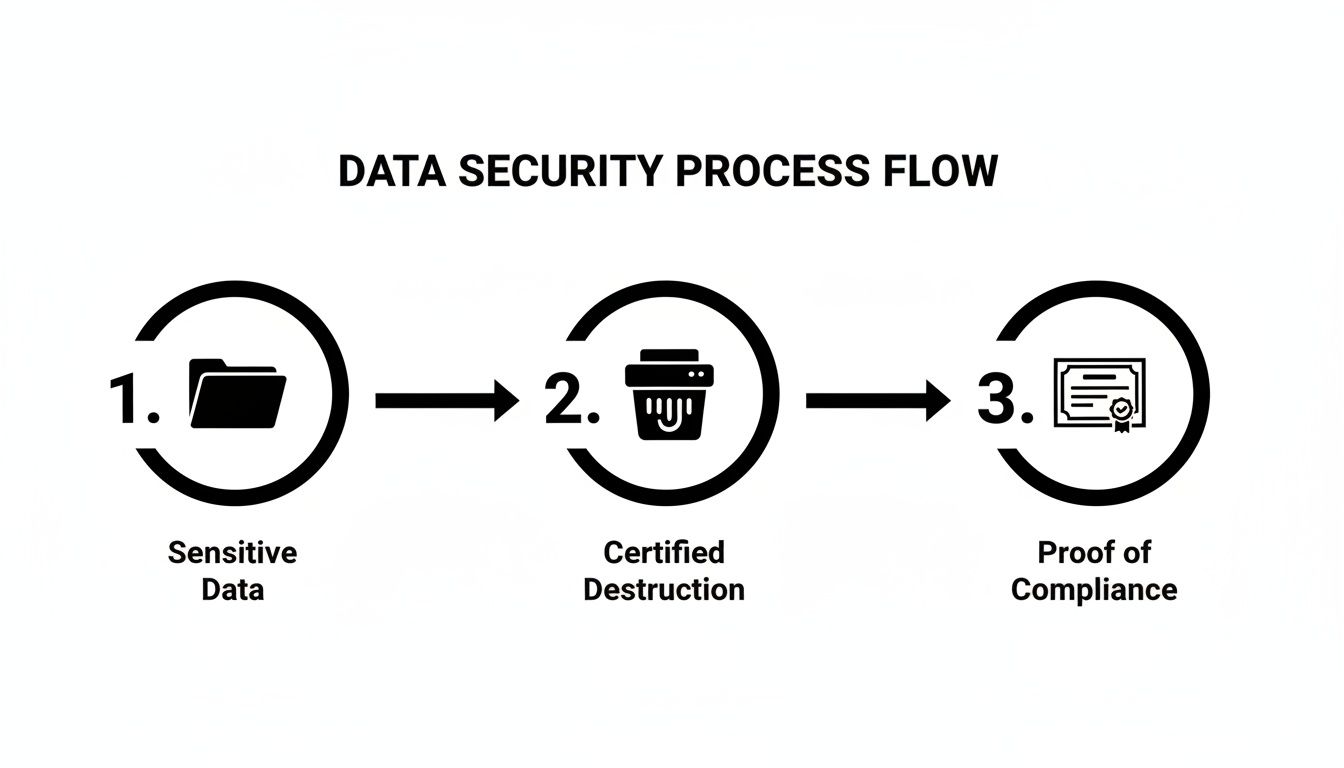
This process visualizes how sensitive data moves from your hands through a certified destruction process, ending with documented proof of compliance that you can keep for your records.
Stage 4: Sorting for Reuse or Recycling
With its data carriers completely destroyed, the rest of Server-734 is evaluated. Our technicians assess its components—RAM, CPUs, power supplies—to determine if they have any life left in them.
- If components are functional and have market value: They are thoroughly tested, graded, and prepped for refurbishment and resale. This circular economy approach extends the life of valuable electronics and can generate a financial return to offset program costs.
- If components are obsolete or non-functional: They are sorted for responsible materials recovery.
This is a key part of the modern ITAD process, ensuring every asset is handled in the most economically and environmentally sound way. With the global electronic waste recycling market valued at USD 80,432.8 million—and North America accounting for about 37%—it's clear that regulations and responsible practices are driving the industry forward.
Stage 5: Responsible Materials Recovery
The final stage for Server-734’s non-reusable parts is de-manufacturing. The server chassis is broken down into its base materials: steel, aluminum, copper, and plastics. Each of these material streams is then sent to certified downstream partners for smelting and recycling.
This final step closes the loop on the server's lifecycle, guaranteeing that no hazardous materials from Server-734 will ever see a landfill. It fulfills your environmental obligations and provides you with quantifiable data for your company's sustainability and ESG reports.
By following one server through this five-stage process, you can see how a robust corporate computer recycling program provides security at every checkpoint. To learn more about the complexities of retiring data center hardware, check out our guide on the data center decommissioning process.
Choosing the Right IT Asset Disposition Partner
Picking your IT Asset Disposition (ITAD) partner is probably the single most important call you'll make in your entire computer recycling strategy. This decision is directly tied to your data security, your legal compliance, and even your company's reputation. It’s not just about getting someone to haul away old gear; it’s about trusting a partner with your most sensitive information and your commitment to doing the right thing for the environment.
Think of it this way: you wouldn't pick a bank to handle your company's finances without doing some serious homework on their security, insurance, and regulatory standing. The same level of scrutiny has to apply to your ITAD vendor. The consequences of a bad choice—from a six-figure data breach to environmental fines—can be just as devastating.
The Non-Negotiable Certifications
The first thing you should look for is their industry certifications. These aren't just fancy logos for their website; they are hard proof that a third-party auditor has dug into their processes and verified they meet tough, internationally recognized standards.
Two certifications are the gold standard in the ITAD world:
- R2 (Responsible Recycling): The R2 standard is all about protecting the environment and ensuring the health and safety of workers and communities. An R2-certified partner can prove they have a documented process for managing the entire recycling chain, so you know your e-waste is handled correctly from your door to its final destination.
- e-Stewards: This is another globally recognized standard, and many consider it to be even stricter than R2. It puts a huge emphasis on preventing the illegal export of hazardous e-waste to developing countries—a practice that can turn into a legal and PR nightmare for your brand.
Asking for proof of one or both of these certifications is your first move. If a vendor doesn't have them, they likely lack the audited, verifiable processes needed to truly protect your business.
Digging Deeper with a Vendor Checklist
Once you've confirmed they have the right certifications, it's time to dig in with some specific questions that reveal what they're really made of. A solid vendor will have clear, confident answers for every single one.
The right partner provides more than just a pickup service; they deliver a fully documented, auditable shield against risk. Their ability to prove compliance at every step is the true measure of their value.
Use this checklist to guide your conversations:
Data Destruction Standards: Do they follow NIST 800-88 guidelines for media sanitization? This is the U.S. government's playbook for data destruction, and compliance is a non-negotiable for any serious vendor. Make sure to ask for a sample Certificate of Data Destruction to see if it's detailed and serialized.
Insurance Coverage: What kind of insurance do they carry, and what does it cover? A reputable partner will have robust policies covering data breaches, environmental liability, and errors and omissions. Ask to see their certificate of insurance—don't just take their word for it.
Downstream Vendor Management: How do they manage their own partners? Your responsibility doesn't just end when your equipment leaves your building. Ask them to walk you through their process for auditing their downstream vendors to ensure your e-waste isn't illegally shipped overseas or processed in an unsafe facility. This is absolutely critical for avoiding a supply chain scandal.
Chain of Custody and Reporting: What does their reporting actually look like? They should provide serialized, asset-level reports that track every single device from the moment they pick it up to its final disposition. This auditable trail is your ultimate proof of due diligence.
Finding the best fit among the various IT asset disposition companies is all about verification, not just conversation. By focusing on these critical points, you can cut through the sales pitches and find a partner that genuinely protects your business.
Measuring the Real Value of Your Program
It’s easy to mistake a corporate computer recycling program for a cost center. But when you look closer, a strategic program is actually a value generator. The secret is knowing how to measure its true return on investment (ROI). Once you look past simple disposal fees, a much bigger picture emerges—one that includes direct revenue, major cost avoidance, and a stronger brand.

To get the real numbers, you have to account for three core pillars: financial returns, risk mitigation, and environmental impact. Each one contributes directly to your bottom line and long-term stability, turning what feels like an expense into a measurable win.
Calculating Your Financial ROI
The clearest way to prove the program’s worth is by calculating its financial return. This isn’t just about subtracting disposal fees from your budget. A proper calculation includes both the money you make and the money you save.
The formula is pretty straightforward:
Total ROI = (Revenue Recovered + Costs Avoided) – Program Costs
Let’s break down what actually goes into each part of that equation:
- Revenue Recovered: This is the cash your ITAD partner pays you for equipment that can be resold. Newer laptops, servers, and networking gear often hold significant value and can be refurbished for a second life.
- Costs Avoided: This is a huge, often overlooked category. It covers everything from dodging a multi-million-dollar data breach fine to saving countless internal labor hours that would otherwise be spent managing old hardware. You even get back valuable office or warehouse space.
- Program Costs: These are the direct fees for services like secure logistics, certified data destruction, and the processing of non-valuable e-waste.
A Sample ROI Calculation
Let's make this real. Imagine your company is retiring 200 laptops. A simplified ROI calculation could look something like this:
| Financial Component | Calculation Example | Amount |
|---|---|---|
| Revenue Recovered | 150 laptops resold at an average of $80 each. | +$12,000 |
| Cost Avoidance | Internal IT labor saved (40 hours @ $75/hr). | +$3,000 |
| Program Costs | Logistics, data destruction, and recycling. | –$2,500 |
| Total Net Program Value | +$12,500 |
In this scenario, the program didn't cost a dime; it actually generated $12,500 in net value. This simple math changes the conversation from "How much will this cost?" to "How much value can we create?" For more tips on maximizing returns, our guide on where to sell computer parts has some great insights.
A well-executed ITAD program should be viewed through the lens of asset management, not waste disposal. The goal is to maximize the financial, security, and environmental value of every retired device.
Measuring Your Environmental Impact
Beyond the hard numbers, a quality ITAD partner delivers critical data for your Environmental, Social, and Governance (ESG) reports. This isn't just a feel-good exercise; it's about providing auditable metrics that boost your brand’s reputation and appeal to stakeholders who care about sustainability.
A detailed sustainability report from your partner should spell out key metrics, such as:
- Total Weight Diverted from Landfills: This shows the exact amount of e-waste your company kept out of the ground.
- CO2 Emissions Avoided: This metric quantifies the positive climate impact of reusing and recycling materials instead of mining new ones.
- Materials Recovered: This details the specific commodities—like copper, aluminum, and steel—reclaimed through the recycling process.
This data is gold. It allows you to prove your commitment to responsible operations, turning your corporate computer recycling program into a powerful story of corporate citizenship.
Common Questions About Corporate Computer Recycling
Even with the best strategy in place, you're bound to have questions when it comes time to recycle your company’s computers. Below are some practical, straightforward answers to the most common queries we get from IT, operations, and procurement managers across Dallas Fort Worth.
What Actually Happens to the Data on Our Drives?
This is always the first—and most important—question. The short answer is: your data is completely and verifiably destroyed. A certified ITAD partner doesn’t just delete files; they use methods that comply with strict standards like NIST 800-88 to ensure data is gone for good.
There are two primary ways this is handled:
- Physical Shredding: For hard drives (HDDs) and solid-state drives (SSDs) that are old, failed, or contained highly sensitive information, this is the most secure option. The drives are fed into industrial shredders that pulverize them into small, unrecognizable pieces of metal and plastic. It's impossible to recover data from shredded fragments.
- Cryptographic Erasure: If a drive is newer and has resale value, specialized software is used to overwrite every single sector with random data, often multiple times. This process effectively buries the original data, making it permanently inaccessible.
Once the process is complete, you’ll receive a serialized Certificate of Data Destruction. This is a legal document that serves as your official, auditable proof that every drive was sanitized according to compliance regulations, protecting your business from liability.
How Much Does This Service Typically Cost?
The cost of corporate computer recycling isn't a simple flat fee. It’s a dynamic calculation that often ends up putting money back into your budget. The final number comes down to balancing the service fees against the value recovered from your old equipment.
Any reputable ITAD partner will give you a transparent quote that breaks down both sides of the equation:
- Service Fees: These cover the logistics—the secure pickup and transport, the certified data destruction, and the responsible recycling of any materials that have no resale value.
- Value Recovery: This is the revenue generated by selling newer, functional equipment on the secondary market. Things like recent-model laptops, servers, and networking gear often hold significant value, and a portion of that revenue is shared back with you.
In many projects, the value recovered from remarketed assets is enough to offset—or even exceed—the service fees. This turns a necessary expense into a source of revenue for your IT department.
What Kinds of Equipment Can Be Recycled?
A full-service ITAD partner should be able to handle just about every piece of electronic equipment your business uses. The goal is to give you a single point of contact for all your retired technology, so you aren't stuck juggling multiple vendors for different items.
This typically includes a wide range of hardware:
- Standard Office Technology: This is the everyday equipment like desktops, laptops, monitors, printers, and docking stations found in any office.
- Data Center Hardware: This includes more valuable and complex equipment, such as servers, storage arrays (SANs), networking gear like switches and routers, and uninterruptible power supplies (UPS).
- Specialized and Industry-Specific Equipment: Professional recyclers can also manage specialized devices used in healthcare or manufacturing, like medical diagnostic machines, lab equipment, and industrial control systems.
A key sign of a top-tier ITAD partner is their ability to manage a diverse portfolio of assets. They should offer a “one-stop” solution that simplifies your logistics and guarantees consistent security standards across everything you’re retiring, from a single laptop to an entire data center.
Before scheduling a pickup, it’s always a good idea to give your vendor a general inventory list. This lets them confirm they can handle everything and plan the right logistics for a secure and efficient collection.
Do We Need to Prepare the Equipment for Pickup?
How much prep work your team has to do depends on the service level you choose. Most ITAD vendors offer flexible options, from having you do the prep work to providing a full "white-glove" service where they handle everything.
For maximum security and convenience, many businesses choose on-site services. With this option, the ITAD partner’s trained, background-checked technicians come to your location and manage the entire process. This can include:
- De-installation: Safely disconnecting servers from racks in your data center.
- Inventorying: Scanning and logging the serial number of every device on-site to establish a secure chain of custody from the very beginning.
- Secure Packing: Professionally palletizing and shrink-wrapping all the equipment to ensure it's protected during transport.
This full-service approach frees up your internal IT staff to focus on their core responsibilities. It also ensures a documented chain of custody is established the moment the equipment leaves your control, which is essential for any organization with strict compliance and audit needs.
At Dallas Fortworth Computer Recycling, we provide nationwide, secure, and compliant solutions for all your corporate computer recycling and IT asset disposition needs. Our certified processes ensure your data is destroyed, your environmental obligations are met, and your potential for value recovery is maximized. To schedule a secure pickup or learn more about our services, visit us at https://dallasfortworthcomputerrecycling.com.