
Hard Drive Destruction Dallas: hard drive destruction dallas services in 2026
Looking at a pile of old hard drives is like staring at a ticking liability bomb. For IT directors and compliance officers across the DFW metroplex, that risk isn't just an abstract concept—it’s a multi-million dollar threat, which is why professional hard drive destruction in Dallas is an essential business function. Certified services transform this major liability into a managed, auditable process.
Why Secure Data Destruction Is Non-Negotiable in Dallas
For any Dallas business, retired hard drives are far more than just obsolete equipment; they are containers filled with sensitive data. This can include everything from customer PII and financial records to internal trade secrets. Simply deleting files or reformatting these drives is a dangerously inadequate method for permanent data removal.
Think of it this way: a hard drive is like a library, and the data is the collection of books on its shelves. When you "delete" a file, you aren't actually burning the book. You're just removing the card from the old card catalog that points to its location. The book itself remains on the shelf, invisible to a casual visitor but easily discoverable by anyone who knows how to bypass the catalog and look directly at the shelves. That's exactly what data recovery software does.
The Real-World Consequences of a Data Breach
The potential fallout from improper disposal is staggering. In 2024, the global market for hard disk destruction services was valued at $1.65 billion and is projected to grow at a compound annual rate of 10.7% through 2033. This growth isn't arbitrary; it's fueled by the soaring frequency of data breaches and the explosion of sensitive information organizations must manage.
With the average cost of a data breach now at $4.45 million per incident, the financial incentive to properly secure retired assets is undeniable.
Data doesn't just disappear. Without certified physical destruction, your company’s confidential information—and your customers' trust—remains at risk indefinitely. A single discarded hard drive can become the entry point for a catastrophic security incident.
For Dallas-area organizations, particularly those in regulated industries like healthcare (HIPAA) and finance (GLBA), the consequences go far beyond financial loss. Reputational damage, erosion of customer trust, and severe legal penalties are all very real possibilities. A proven hard drive destruction dallas partner effectively neutralizes these risks by providing an auditable, compliant, and permanent solution.
Turning Liability into a Secure Process
A professional data destruction service transforms this complex challenge into a simple, secure workflow. Instead of merely hoping your data is gone for good, you receive documented proof that it has been irretrievably destroyed. This is the critical difference between simple disposal and certified destruction.
This documented process includes:
- A Verifiable Chain of Custody: Tracks each asset from the moment it leaves your facility until its final destruction.
- A Certificate of Destruction: A legal document that serves as your official record of compliance, listing every single destroyed device by its unique serial number.
- Compliance with Industry Standards: Adherence to regulations like NIST 800-88 ensures the destruction method meets federal guidelines for complete media sanitization.
By engaging a specialist, you shift the responsibility from your internal team to a certified expert whose entire business is built on secure, compliant data elimination. You can learn more about the different security data destruction services available to protect your organization. This approach provides true peace of mind, ensures you meet regulatory requirements, and shields your business from the costly aftermath of a data breach.
Choosing Your Destruction Method: Degaussing, Crushing, or Shredding
Once you realize that your retired hard drives are a major liability, the next question is obvious: what’s the best way to neutralize that threat? When you’re looking at professional hard drive destruction in Dallas, you generally have three options. Each has its own way of getting the job done and offers a different level of security, so making the right choice is key to meeting compliance and managing your risk.
This visual breaks down how certified destruction steps in to permanently eliminate the risk that old hard drives pose to your organization.
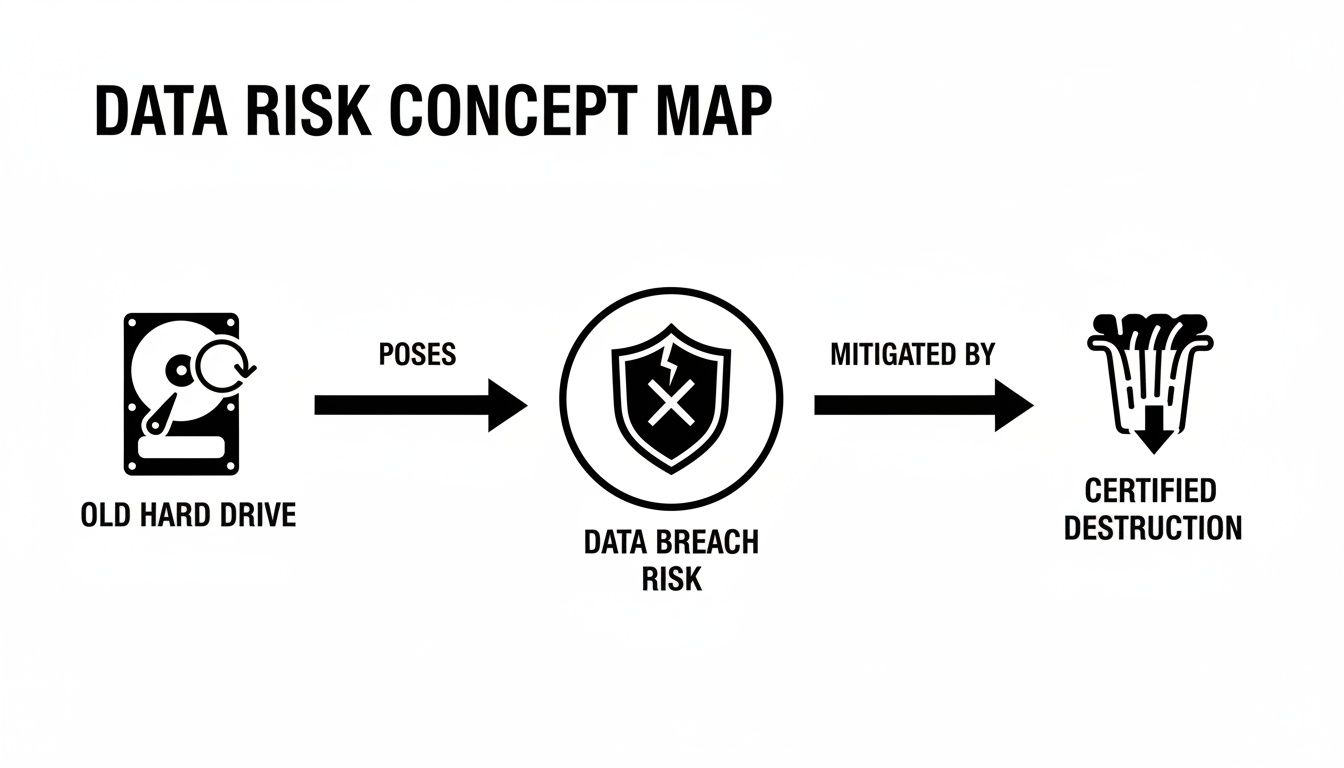
As you can see, a retired hard drive is a direct line to a potential data breach. The only way to break that chain is with a verified destruction process that guarantees your data is gone for good.
Degaussing
Degaussing uses an incredibly powerful magnetic field to wipe data from magnetic storage like traditional Hard Disk Drives (HDDs) and backup tapes. Think of it like holding a massive, industrial-strength magnet up to an old cassette tape—it instantly scrambles the recorded information, making it completely unreadable.
A degausser fires an intense magnetic pulse that completely neutralizes the magnetic fields on the drive's platters where your data lives. It's a fast and very effective process for the right kind of media. The only catch is that the physical drive remains intact, which can be a hang-up for companies that need visible proof of destruction.
And here’s the most important thing to remember: degaussing is completely useless on Solid State Drives (SSDs). SSDs don’t use magnetic storage; they use flash memory. A magnetic field does absolutely nothing to the data on them, a critical fact to know as more of your IT assets use SSDs.
Crushing
Crushing is exactly what it sounds like. This physical destruction method uses thousands of pounds of force to bend, break, and mangle a hard drive, making it impossible to ever recover data from it. Picture a hydraulic press coming down on a drive, warping the platters and shattering the delicate read/write heads.
Once those platters are bent out of shape, they can no longer spin correctly, making the data physically inaccessible.
Crushing is simple but brutally effective. It destroys the drive's ability to mechanically function. No spin, no read, no data.
This method works equally well on both HDDs and SSDs. While it doesn't grind the drive into tiny pieces, the catastrophic damage is more than enough to satisfy many compliance rules. As cyberattacks continue to rise 15% year-over-year, the demand for definitive destruction methods like crushing and shredding is exploding.
Shredding
For absolute, undeniable proof that your data is gone forever, there's shredding. Widely considered the gold standard, shredding provides the highest level of security available. Just like a cross-cut paper shredder turns documents into confetti, an industrial hard drive shredder uses powerful steel teeth to grind drives into a pile of tiny, mangled fragments.
Shredding is the universal solution. It works on everything:
- Hard Disk Drives (HDDs): The platters are shattered into small pieces, making data reconstruction physically impossible.
- Solid State Drives (SSDs): The memory chips are pulverized, destroying the data at its core.
- Backup Tapes, CDs, and USB drives: All are reduced to a heap of unrecognizable debris.
For any Dallas business dealing with strict regulations like HIPAA or PCI-DSS, shredding offers the most concrete, visually verifiable form of destruction you can get.
Hard Drive Destruction Methods at a Glance
To help you decide which method aligns with your organization's security and compliance needs, here’s a quick side-by-side comparison.
| Method | How It Works | Best For | Compliance Level (NIST 800-88) |
|---|---|---|---|
| Degaussing | An intense magnetic pulse erases data from magnetic media. The drive remains physically intact. | Loose magnetic tapes and older HDDs where physical destruction isn't required. Not effective for SSDs. | Purge |
| Crushing | A hydraulic press applies extreme force, bending platters and breaking internal components. | Organizations needing a cost-effective physical destruction method for both HDDs and SSDs that offers clear proof. | Destroy |
| Shredding | Industrial blades grind the drive into small, unrecognizable fragments, pulverizing platters and memory chips. | High-security needs (government, healthcare, finance) and any business needing absolute, verifiable destruction. | Destroy |
Ultimately, the best method depends on your specific media types, security policies, and regulatory burdens.
When you need complete certainty that your data is gone, nothing beats physical destruction. You can learn more about how our secure hard drive disposal process incorporates these proven methods to keep your business safe and compliant.
On-Site vs. Off-Site Destruction: Which Is Right for You?

When you arrange for professional hard drive destruction in Dallas, one of the biggest decisions is choosing where the destruction happens. You have two main options: on-site at your facility or off-site at a secure processing plant. The right choice hinges on your organization's security protocols, compliance mandates, and budget.
It’s a bit like choosing between having a security guard patrol your building versus monitoring it with cameras linked to a secure, off-site command center. Both are effective security measures, but they cater to different needs for direct oversight and process control.
On-Site Destruction: The Gold Standard for Security
On-site hard drive destruction is exactly what it sounds like. A mobile shredding truck comes to your Dallas office or data center to destroy your hard drives and other media right there on your property. This service provides the highest level of assurance and an unbroken chain of custody.
The process is transparent and straightforward:
- A technician scans and inventories the serial numbers of every drive.
- Your team can physically escort the assets to the mobile shredding truck parked at your location.
- You can watch the entire destruction process on a monitor mounted on the truck, confirming each drive is completely destroyed.
This method totally eliminates the risks that come with transporting live data off your premises. For organizations in heavily regulated industries like healthcare, finance, or government, witnessing the destruction firsthand is often a non-negotiable compliance requirement.
On-site destruction offers unmatched transparency. It’s the most definitive way to prove that sensitive data never left your control before being rendered unrecoverable, providing an ironclad audit trail.
Opting for on-site service is the premium choice for maximum security and immediate verification. Nothing provides peace of mind quite like watching your old hard drives turn into a pile of metal fragments right before your eyes.
Off-Site Destruction: A Secure and Cost-Effective Solution
Off-site destruction is a secure, reliable, and more budget-friendly alternative. With this service, your hard drives are collected from your location in locked containers and transported to a certified destruction facility for processing.
Even though you don't witness the destruction in person, security is maintained with a strict, documented protocol at every step:
- Secure Collection: Your drives and media are placed into locked, tamper-evident containers at your site.
- GPS-Tracked Transport: The sealed containers are moved in a secure, GPS-tracked vehicle directly to the processing plant.
- Facility Security: The destruction facility is a controlled-access environment with 24/7 surveillance and strict security protocols.
- Documented Destruction: Upon arrival, the drives are destroyed according to industry standards. You receive a Certificate of Destruction with serialized reporting, just as you would with on-site service.
This option works extremely well for large-scale IT asset disposition projects where the cost-per-drive is a major consideration, or for businesses that don't have a strict requirement to witness the process. It delivers the same compliant result as on-site destruction but relies on a fully documented chain of custody for verification.
Making the Right Choice for Your Dallas Business
Deciding between on-site and off-site services comes down to balancing your organization's unique risk tolerance, compliance needs, and project budget.
| Factor | On-Site Destruction | Off-Site Destruction |
|---|---|---|
| Security | Highest level; data never leaves your premises intact. | High level; secured with documented chain of custody and GPS tracking. |
| Verification | Immediate visual confirmation as destruction occurs. | Documented proof via a formal Certificate of Destruction. |
| Cost | Higher per-drive cost due to specialized mobile equipment. | More cost-effective, especially for larger quantities of drives. |
| Best For | HIPAA, finance, government, and high-security enterprises. | Large-scale projects and budget-conscious organizations. |
Ultimately, both paths lead to the same compliant outcome: permanent and irreversible data elimination. Whether you require the absolute certainty of witnessing the process or prefer the logistical efficiency of secure transport, a professional vendor will ensure your data is handled correctly. To learn more about how these services work, you can read about on-site shredding options near you.
The Critical Role of Compliance and Audit Documentation
When you dispose of old hard drives, the job isn't finished when the equipment is broken. Far from it. The real work is proving the data was destroyed beyond any possibility of recovery. Without that proof, you’re leaving your organization wide open to risk. This is where compliance and audit documentation becomes your most important line of defense.
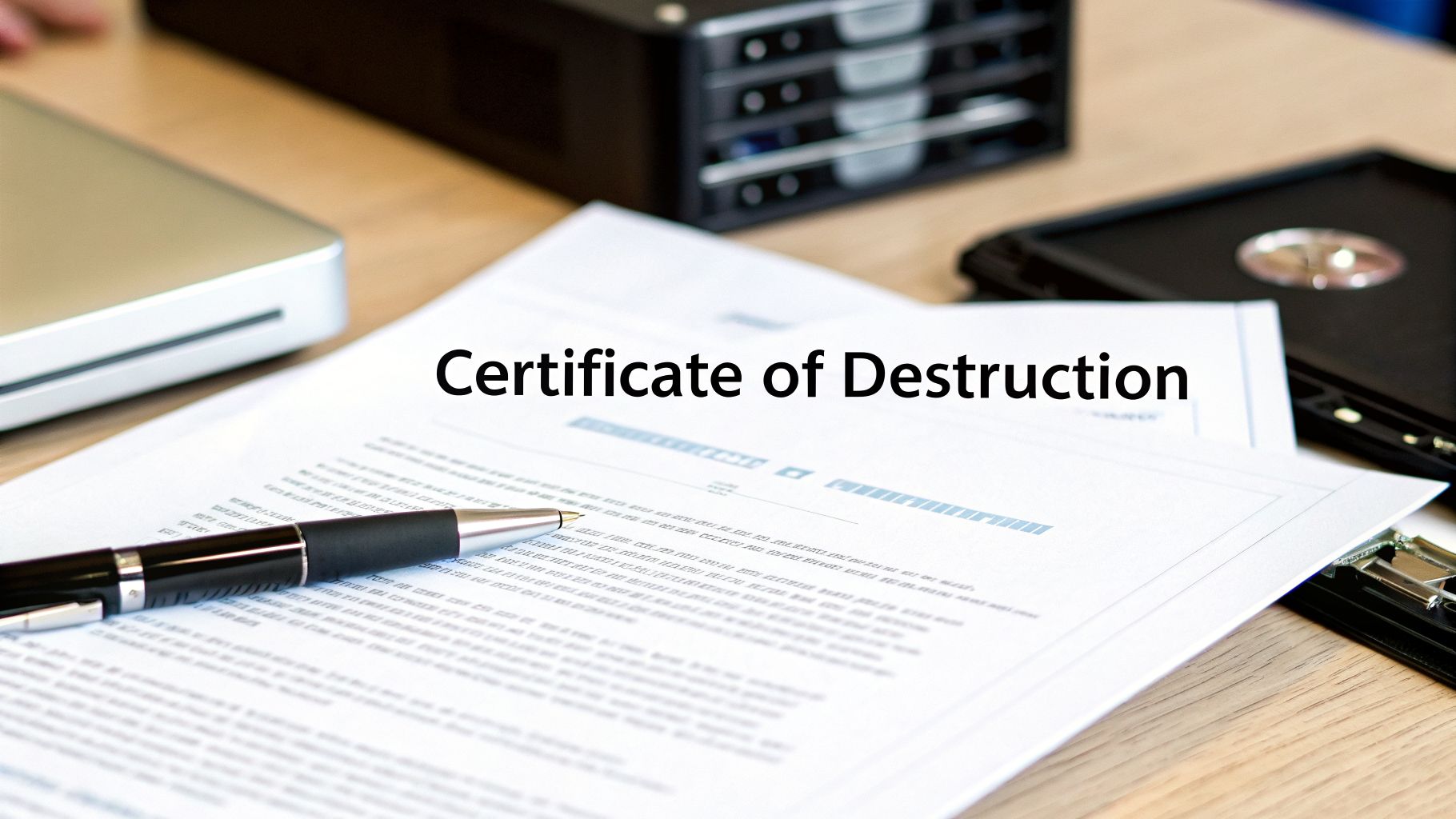
Think of it this way: a Certificate of Destruction is the official death certificate for your sensitive data. It’s the legal document that closes the loop on your data's lifecycle, delivering the auditable proof that regulators, legal teams, and internal auditors demand. It's your primary shield against any accusation of negligence.
What Makes Documentation Audit-Proof
A simple receipt or a basic invoice just won't cut it during an audit. To be considered audit-proof, your documentation needs to be meticulous and specific. A legitimate Certificate of Destruction from a professional hard drive destruction dallas provider will always include several key details that create an ironclad, defensible record.
This critical document must contain:
- A Unique Serialized Asset List: Every single drive must be listed by its unique serial number. This creates a one-to-one match between the assets that left your facility and those that were destroyed, leaving no room for ambiguity.
- Details of the Destruction Method: The certificate has to state exactly how the drives were destroyed—shredded, crushed, or degaussed. This confirms you’re meeting both your internal policies and any external regulations.
- Date and Location of Destruction: This detail is crucial for establishing a clear timeline. It’s especially important for on-site services, as it proves destruction happened at your Dallas location before the assets ever left your custody.
- Authorized Signatures: Signatures from both your organization and the destruction vendor formalize the transfer of custody and the completion of the service.
Without this level of detail, your "proof" is effectively worthless in a real audit scenario. To get a closer look at what a proper certificate includes, you can read our detailed guide on the Certificate of Destruction for hard drives.
Your Defense Against Legal and Financial Penalties
For businesses in key Dallas industries like healthcare or finance, this paperwork is completely non-negotiable. If a hospital system bound by HIPAA can't produce a valid Certificate of Destruction for retired server drives, it can face crippling fines and corrective action plans. For a financial firm, it could mean failing a critical regulatory audit.
Your audit trail is your story of due diligence. A complete chain of custody record paired with a serialized Certificate of Destruction proves you took every reasonable step to protect sensitive information from its first day to its last.
The growing importance of this documentation is clear. The data destruction market is projected to hit $12.75 billion by 2026, driven largely by regulations that demand auditable proof. With data showing that post-disposal leaks are behind 50% of security incidents, partnering with a professional who provides audit-ready certificates is a strategic necessity. This is especially true as the average cost of a breach is expected to reach $4.88 million by 2025. You can discover more about these market insights on secure data handling. Ultimately, this documentation is your definitive proof of compliance, safeguarding your organization from the devastating fallout of a data breach.
Making Data Security Part of Your ESG Strategy
For modern Dallas businesses, securely destroying data is only half the battle. What happens to the physical hardware after your hard drives are shredded is just as important. This is where a routine security task can become a powerful part of your company's corporate responsibility strategy.
Responsible hard drive destruction is a key component of a strong ESG (Environmental, Social, and Governance) framework. When a hard drive is shredded, the resulting fragments of aluminum, steel, and circuit board components aren't just discarded—they enter a new lifecycle.
From Data Liability to Environmental Asset
Instead of ending up in a landfill and contributing to the growing e-waste problem, these materials are carefully managed by a certified e-waste partner. This process ensures the valuable commodities are recovered and put back into the circular economy.
This responsible approach involves several key steps:
- Sorting: The shredded material is separated into distinct commodity streams, such as ferrous metals (steel), non-ferrous metals (aluminum), and electronic components.
- Smelting and Refining: These materials are sent to certified downstream processors to be smelted and refined back into raw materials.
- Reuse in Manufacturing: The recycled commodities are then used to create new products, reducing the need to mine virgin resources and minimizing the environmental footprint of manufacturing.
This not only keeps hazardous materials out of the environment but also actively contributes to a more sustainable supply chain. For Dallas businesses working to strengthen their ESG credentials, this is a tangible, reportable action that resonates with stakeholders and customers.
By choosing a certified partner for hard drive destruction in Dallas, you are not just ticking a box for data security. You are making a conscious decision to support a circular economy and demonstrate a measurable commitment to environmental stewardship.
Why This Matters for Your Dallas Business
In today's market, strong corporate citizenship is no longer a "nice-to-have"—it's a critical differentiator. Aligning your data destruction practices with your ESG goals turns an operational cost into a value-added activity. It shows that your organization is forward-thinking, responsible, and aware of its impact on the community and the planet.
To better understand the positive outcomes of responsible electronics handling, you can learn more about the environmental impact of electronic waste and how certified processes make a difference. Partnering with a vendor who guarantees both secure destruction and responsible recycling ensures your old technology serves one final, valuable purpose.
Your Questions Answered About Dallas Hard Drive Destruction
When it comes to arranging professional data destruction, we find that most Dallas IT managers and business owners share the same core questions about the process, costs, and logistics. Below are direct answers to the most common inquiries we receive about our secure hard drive destruction services.
How Much Does Hard Drive Destruction Cost in Dallas?
There really is no one-size-fits-all price for hard drive destruction in Dallas. Pricing is almost always calculated on a per-drive basis, but a few key factors will influence the final quote, which is why a custom estimate is essential for accurate budgeting.
The main cost drivers include:
- Service Location: On-site destruction at your facility costs more because it involves specialized mobile shredding equipment and dedicated personnel. Off-site service at our secure plant is the more economical option.
- Total Volume: As with most services, a higher volume of drives brings down the cost per unit. Destroying 500 drives will always have a better per-drive rate than destroying just 50.
- Destruction Method: The physical destruction method you choose, whether shredding or crushing, can also affect the final price.
Because of these variables, it’s always best to get a detailed quote based on your specific project. This ensures your budget is accurate and there are no surprises down the line.
Can You Destroy Solid State Drives?
Yes, but it's absolutely critical to use the right method. This is a common point of confusion as more IT assets move from traditional Hard Disk Drives (HDDs) to Solid State Drives (SSDs). Degaussing, which uses powerful magnets to erase data, is completely useless on SSDs because they rely on flash memory, not magnetic storage.
For SSDs, physical destruction isn't just recommended—it's required. Shredding is the gold standard, as it pulverizes the drive's memory chips, making data recovery physically impossible and ensuring your information is gone for good.
Do You Only Service the Dallas Area?
While we are headquartered in Dallas, our logistics network extends far beyond the DFW metroplex. A nationwide ITAD partner can coordinate secure pickups and services across Texas and the entire country, even if our primary facility is local.
This capability is especially valuable for companies with multiple offices or remote data centers. Using a single vendor allows you to manage the entire process under one umbrella, ensuring consistent security protocols, documentation, and chain of custody, no matter the location. It simplifies vendor management and guarantees all your assets are handled under the same compliant framework.
What Proof of Destruction Will I Receive?
This is perhaps the most critical question of all. After every service, you should receive a formal Certificate of Destruction. This isn't just a receipt; it is a legal document that serves as your official, auditable record of compliance.
This certificate must provide a serialized list of every single hard drive that was destroyed. Each serial number creates a verifiable link between the assets that left your control and the assets that were verifiably destroyed. The document confirms the date, method, and location of destruction, giving you the definitive proof needed to satisfy auditors and internal stakeholders.
Ready to turn your old hard drives from a liability into a secure, documented, and environmentally responsible part of your IT lifecycle? Dallas Fortworth Computer Recycling offers certified on-site and off-site destruction services tailored to your needs. Contact us today for a custom quote and ensure your data is permanently destroyed.