
Hard Drive Shredding Fort Worth A Guide to Data Protection
If you're looking for reliable hard drive shredding in Fort Worth, you need a solution that guarantees your data is gone for good. Professional, physical destruction is the only method that renders data completely unrecoverable, protecting your business from costly data breaches and ensuring you meet privacy regulations.
Why Shredding Is Your Best Defense for Data Security
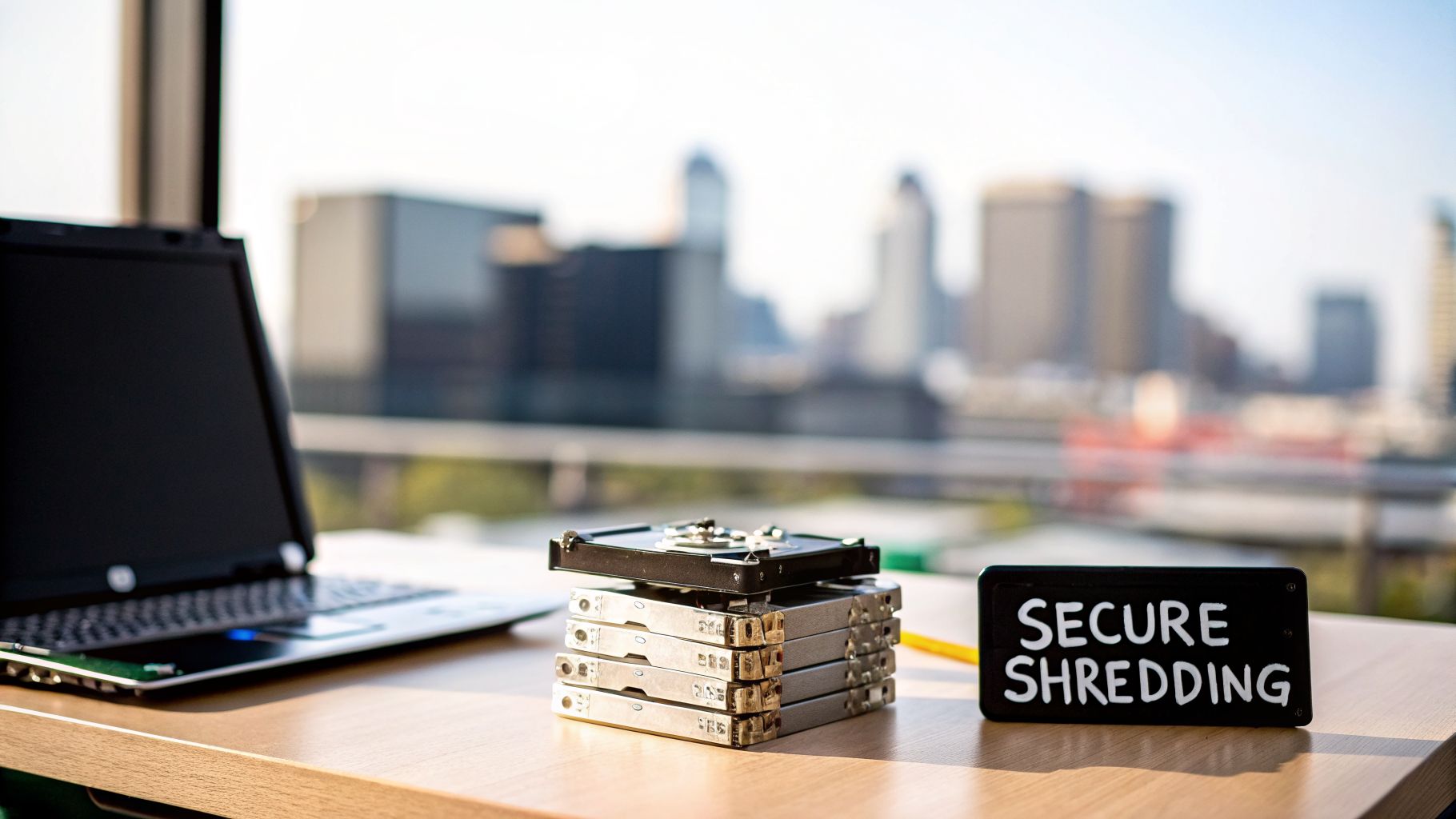
Think of your company's old hard drives not as junk, but as unlocked filing cabinets sitting on a busy downtown Fort Worth sidewalk. Every retired device—from a server, laptop, or desktop—is a concentrated archive of sensitive information. This could include customer lists, financial records, employee data, or proprietary business strategies.
Simply deleting files or even formatting a drive is not enough security. It’s like scribbling out a word on paper; a determined person can still figure out what was written underneath. Data thieves use specialized software to recover "deleted" information from discarded drives, turning your old IT assets into a significant liability. The risk is just too great to ignore.
The Real-World Risks of Improper Disposal
The consequences of a data breach from improperly disposed electronics are severe. The financial fallout alone can be crippling, with the average cost of a data breach reaching millions. Beyond the immediate financial impact, your company could face:
- Legal Penalties: Violating data privacy laws like HIPAA or FACTA can lead to substantial fines and legal action.
- Reputational Damage: Losing customer trust is difficult to regain and can impact your brand for years.
- Competitive Disadvantage: If your trade secrets fall into the wrong hands, your market position is immediately threatened.
This is why professional hard drive shredding in Fort Worth is not just a disposal task—it is a critical security measure. The process physically pulverizes the drive platters where data is stored, making recovery impossible. You might be interested in our deep dive on secure hard drive disposal methods to understand the full scope of protection.
For modern businesses, physical data destruction is the final and most definitive step in a robust cybersecurity strategy. It moves the conversation from "Is the data gone?" to "The data is proven to be gone."
A Proactive Security Mindset
Adopting a proactive approach means viewing every retired piece of IT equipment as a potential security risk until it has been verifiably destroyed. The sheer volume of data generated by businesses across the Dallas-Fort Worth metroplex only amplifies this need.
By partnering with a certified shredding provider, you shift from a reactive cleanup effort to a structured, preventative security protocol. This mindset protects your sensitive information, ensures regulatory compliance, and safeguards your company’s future with every single shredded drive.
Understanding Your Data Destruction Options
When a hard drive reaches the end of its life, simply dragging files to the trash bin is a major security risk. Think of it like scribbling over a sensitive document with a pen—with a little effort, the original text is still recoverable. This is what we call data remanence, where digital ghosts of your information stay on the drive even after you’ve tried to delete or format it.
For data thieves, these lingering files are a goldmine. Using readily available recovery software, they can piece together everything from your company’s financial records to customer PII from drives you thought were clean. It’s crucial for businesses to understand the difference between making data hard to find and making it gone forever.
Why Software-Based Wiping Isn't Always Enough
Many organizations start with software-based tools, assuming they offer adequate protection. While these methods have a role in data management, they can create a false sense of security when it comes to final, permanent disposal of IT assets.
Let’s break down the common methods and their limitations:
- Formatting: This is the least secure option. Formatting a drive is like tearing the table of contents out of a book; the chapters are all still there, just not neatly indexed. Anyone with basic data recovery software can easily restore the files.
- Wiping: Also known as overwriting, this process writes new patterns of ones and zeros over your old data. It’s a step up from formatting, but it's not foolproof. A single pass might miss data, and it’s very difficult to verify that every single sector was overwritten, especially on older or damaged drives. You can learn more about the intricacies of wiping hard drives in our detailed guide.
- Degaussing: This method uses a powerful magnet to scramble the magnetic fields on traditional hard disk drives (HDDs). While it works for that older technology, it is completely ineffective on modern Solid-State Drives (SSDs), which store data on flash memory chips, not magnetic platters.
These software methods are time-consuming, leave room for human error, and can be nearly impossible to verify with 100% certainty. For Fort Worth businesses that can't afford any risk, there's only one guaranteed solution.
Physical destruction isn't just about disposal; it’s about total data annihilation. When a hard drive is shredded into tiny pieces, there is no "undo" button. The data is physically gone, forever.
To help clarify these differences, here's a comparison of the most common data destruction methods.
Data Destruction Methods Compared
This table compares common data destruction methods, highlighting their effectiveness, compliance suitability, and key risks to help IT managers make informed decisions.
| Method | How It Works | Effectiveness | Best For | Key Risk |
|---|---|---|---|---|
| Formatting | Removes the file index, making data appear gone. | Very Low | Preparing a drive for reuse by the same user. | Data is easily recoverable with basic software. |
| Wiping (Overwriting) | Writes new data (e.g., all 0s) over every sector. | Medium to High | Sanitizing drives for internal reuse or donation. | Incomplete wipes on damaged sectors; doesn't work on SSDs reliably. |
| Degaussing | Uses a powerful magnet to destroy the magnetic field. | High (for HDDs) | Sanitizing magnetic media like HDDs and tapes. | Completely ineffective on SSDs, flash drives, and phones. |
| Physical Shredding | Grinds the device into small, irrecoverable metal fragments. | Absolute (100%) | Final disposal of all media types (HDDs, SSDs, tapes). | None, when performed by a certified vendor. |
As you can see, when the goal is permanent and verifiable data removal, only one method stands out.
The Gold Standard: Physical Destruction
Professional hard drive shredding provides the definitive answer to the problem of data remanence. The process uses industrial-grade machinery to pulverize hard drives, SSDs, tapes, and other media into small, unrecognizable pieces. This brute-force approach completely destroys the platters and memory chips where your data lives, making any kind of recovery physically impossible.
This need for absolute security is why the market is growing so quickly, especially in tech-heavy regions like Dallas-Fort Worth. The hard drive shredding services market was valued at $1.65 billion in 2024 and is projected to expand as data volumes and privacy regulations become more stringent. You can find more data on this expanding market's growth here.
For businesses managing sensitive information, the value of certified destruction far outweighs the risks of relying on software alone. Choosing a service that specializes in hard drive shredding in Fort Worth means you aren't just checking a box for IT disposal. You're implementing a final, irreversible security control that delivers complete peace of mind and an auditable record of destruction.
Meeting Compliance Demands in Fort Worth
For businesses operating anywhere in Fort Worth, secure data destruction isn't just a good practice—it’s the law. Failing to properly destroy sensitive information on retired hard drives can lead to devastating penalties, reputational ruin, and serious legal trouble. From medical practices in the Hospital District to financial firms in the downtown core, compliance is a non-negotiable part of doing business.
These regulations aren't just abstract rules; they're strict frameworks built to protect consumers and hold organizations accountable. For instance, a single HIPAA violation can trigger fines up to $50,000 per record. That makes the cost of non-compliance far steeper than the investment in secure disposal. Partnering with a professional service for hard drive shredding in Fort Worth is the most effective way to meet these demands.
Key Regulations Impacting Fort Worth Businesses
While dozens of laws touch on data privacy, a few federal regulations are especially relevant to local industries. Understanding their specific requirements for data disposal is the first step toward building a compliant IT asset disposition strategy. For a deeper dive into this topic, check out our guide on IT asset disposition in Fort Worth.
Here are the primary regulations you need to know:
- HIPAA (Health Insurance Portability and Accountability Act): This law mandates uncompromising protection for Protected Health Information (PHI). It requires healthcare providers, insurers, and their partners to make PHI unusable and unreadable before disposal. Physical destruction is the only method that truly guarantees this outcome.
- FACTA (Fair and Accurate Credit Transactions Act): Created to combat identity theft, FACTA requires any business handling consumer information—from credit reports to job applications—to destroy it so it cannot be pieced back together.
- GLBA (Gramm-Leach-Bliley Act): Aimed at financial institutions like banks, investment firms, and insurance companies, GLBA requires the secure disposal of customer financial data to protect their privacy and security.
Failing to follow these rules can have catastrophic consequences. The main takeaway is that each of these laws mandates the complete and final destruction of sensitive data—a standard that only physical shredding can reliably meet.
The NIST Standard for Media Sanitization
Beyond industry-specific regulations, the National Institute of Standards and Technology (NIST) provides the technical roadmap for data destruction. The NIST Special Publication 800-88, "Guidelines for Media Sanitization," is the go-to resource for IT professionals everywhere.
This document outlines three methods for sanitization:
- Clear: This involves overwriting data with software tools. It’s acceptable for low-security situations where the media will be reused inside your organization.
- Purge: This method uses techniques like degaussing to make data recovery highly impractical. It's more robust but doesn't work on all media types, especially SSDs.
- Destroy: This is the ultimate solution. It means physically destroying the media through shredding, disintegrating, or melting, which makes data recovery impossible.
According to NIST 800-88, destruction is the only method that provides absolute certainty. When you physically shred a hard drive, you are not just purging the data—you are eliminating the possibility of its existence.
The constant threat of cyberattacks has pushed these standards front and center. More and more organizations are turning to certified hard drive shredding in Fort Worth to ensure they meet NIST's highest level of security. Industrial shredders can pulverize up to 500 drives per hour, providing a documented and auditable process that simple methods like bending or hole-punching can't match. You can read more about cybersecurity trends and their impact on e-waste here.
By partnering with a certified destruction provider, Fort Worth businesses can turn a complex regulatory burden into a streamlined, risk-free process, ensuring compliance and protecting their most valuable asset: their data.
Choosing Between Onsite and Offsite Shredding Services
When you’re planning your hard drive shredding in Fort Worth, one of the first practical decisions to make is where the destruction will happen. Should the shredder come directly to your office, or should your drives be transported to a secure facility? This choice comes down to two service models: onsite and offsite shredding.
Each approach has its own set of advantages, designed to fit different business needs around security, compliance, budget, and logistics. Getting a handle on the pros and cons of both is the first step in picking the right service for your company.
Onsite Shredding for Maximum Oversight
Onsite shredding, often called mobile shredding, brings the entire destruction process right to your doorstep. We arrive at your Fort Worth office or data center with a specialized truck equipped with an industrial-grade shredder. Your team can then physically watch as each hard drive is fed into the machine and pulverized into tiny, unrecoverable pieces of metal.
Think of it as bringing a mobile, high-security vault to your location that destroys the evidence on the spot. The primary benefits here are total transparency and an unbreakable chain of custody.
Benefits of Onsite Shredding:
- Total Transparency: You get to witness the entire process from start to finish. This provides absolute, undeniable proof that your data is gone for good.
- Maximum Security: Because your hard drives never leave your property intact, the risk of them being lost or stolen in transit is completely eliminated.
- Immediate Confirmation: You’re handed a Certificate of Destruction right then and there, finalizing your audit trail before our truck even pulls away.
This is the gold standard for organizations with the most stringent security requirements, like healthcare providers bound by HIPAA, government agencies, and financial firms. If your compliance framework demands direct, personal verification, onsite shredding delivers unmatched peace of mind.
Offsite Shredding for Efficiency and Scale
Offsite shredding follows a different, but just as secure, process. A certified technician comes to your location to collect the hard drives. They are immediately sealed in locked, tamper-evident containers for transport. These containers are then moved in GPS-tracked vehicles to our secure destruction facility.
Once at the plant, the containers are opened, and the drives are destroyed under constant video surveillance. It’s a lot like using a bonded courier service to move valuable assets to a central bank vault—every step is secure, audited, and efficient. If you want a deeper dive into our mobile services, you can explore our guide to onsite shredding services for a closer look.
Offsite shredding provides a highly secure and audited process that is often more cost-effective and scalable for large-volume projects. It’s the workhorse of enterprise-level IT asset disposition.
Comparing Onsite vs Offsite Shredding
While both methods achieve the exact same end result—the complete destruction of your data—the logistics make them better suited for different situations.
| Feature | Onsite (Mobile) Shredding | Offsite (Plant-Based) Shredding |
|---|---|---|
| Location | At your business premises | At a secure, certified facility |
| Key Advantage | You can witness the destruction | More cost-effective for large volumes |
| Best For | High-security needs (HIPAA, DoD) | Large-scale cleanouts, data centers |
| Cost | Typically higher due to logistics | More budget-friendly |
| Verification | Immediate, visual confirmation | Documented via video and audit trail |
Choosing the right service for your hard drive shredding in Fort Worth is all about balancing your company’s risk tolerance, budget, and the scale of your project. For a few dozen highly sensitive drives, onsite is often the clear winner. But for a data center cleanout involving thousands of assets, offsite typically offers the most practical and economical solution without cutting any corners on security.
How to Verify Your Data Has Been Destroyed
Once you hand over your hard drives for destruction, you need absolute certainty that the data is gone for good. This isn't just about trust; it's about having documented, undeniable proof that the job was done correctly. For any business in Fort Worth, this verification is essential for legal and compliance peace of mind.
The entire process hinges on two critical components: a rigorous Chain of Custody and a formal Certificate of Destruction. Together, they create a transparent, auditable trail from your office to the final shredded particles.
Securing the Chain of Custody
The Chain of Custody (COC) is your first line of defense in the verification process. It's a formal paper trail that documents every single person who handles your hard drives, from the moment they leave your possession until they are physically destroyed. A professional hard drive shredding service in Fort Worth will always initiate a strict COC protocol.
This process ensures your assets are never unaccounted for and typically includes:
- Secure Collection: Your drives are placed into locked, tamper-evident containers right at your location.
- Documented Hand-Off: A formal sign-off occurs between your representative and the technician, creating the first official record in the audit trail.
- GPS-Tracked Transport: The secure vehicle carrying your assets is tracked in real time, guaranteeing no unauthorized stops or route deviations on the way to the destruction facility.
The Chain of Custody is more than just paperwork; it’s a security protocol. It is the documented promise that your assets are accounted for and secure every step of the way, from your Fort Worth office to the shredder itself.
The infographic below shows how this secure process is managed for both onsite and offsite shredding, maintaining an unbroken chain of custody regardless of the service you choose.
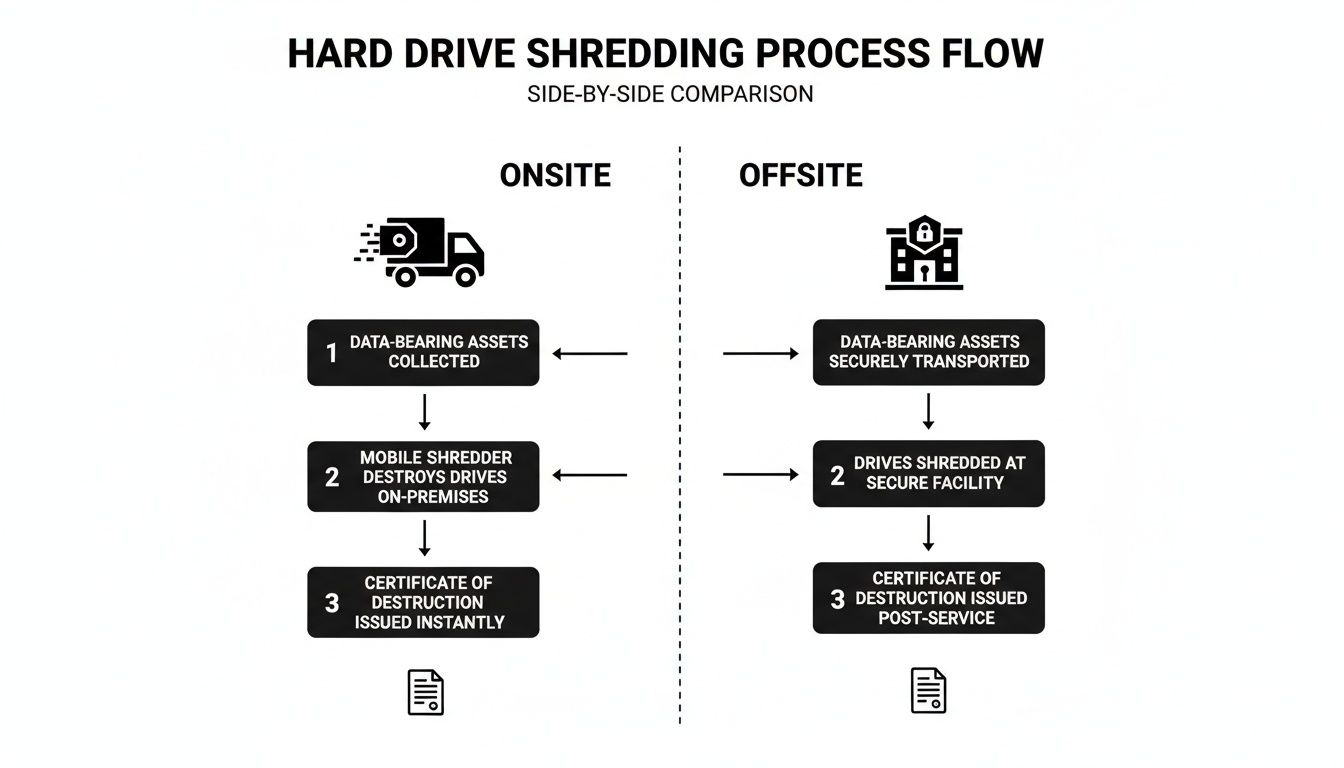
As you can see, every step is designed to maintain the integrity and security of your assets throughout the entire destruction process.
Your Ultimate Proof The Certificate of Destruction
The final, and most important, piece of documentation you will receive is the Certificate of Destruction (COD). This isn't just a receipt—it's a legally binding document that serves as the official death certificate for your data. It is your definitive proof of compliance in the event of an audit or legal inquiry.
To be valid, a COD must contain specific, critical information. A legitimate certificate from a certified vendor will always include:
- A unique serial number for tracking the certificate.
- The exact date and location where the destruction took place.
- A detailed list of the destroyed media, often including individual serial numbers.
- The name of the company that performed the destruction.
- The signature of an authorized individual who witnessed the process.
This formal document confirms that your company has met its due diligence requirements for protecting sensitive information under regulations like HIPAA and FACTA. To learn more about what to look for, you can review our in-depth guide to the Certificate of Destruction for hard drives. It is your final, undeniable evidence that your data has been permanently destroyed.
Selecting a Secure Shredding Partner in Fort Worth
Choosing a vendor for hard drive shredding in Fort Worth isn't just another line item on a procurement list—it's a critical security decision. The company you hire becomes a temporary custodian of your most sensitive information. Picking the right partner protects your business from risk, while the wrong one can open the door to serious legal and financial consequences.
This decision should never come down to price alone. A quality shredding provider offers more than just a machine; they deliver a complete security service backed by certified processes and thoroughly vetted personnel. You're trusting them with your company’s reputation, so it’s essential to look past the quote and understand how they operate.
The Non-Negotiable Vendor Checklist
To choose with confidence, you need a clear checklist. Think of it as a guide for vetting potential partners. Any legitimate data destruction company should be able to meet these standards without hesitation. If a vendor struggles to provide this documentation, it's a major red flag.
Your evaluation checklist should include:
- NAID AAA Certification: This is the gold standard for the data destruction industry. NAID AAA certification means the provider undergoes rigorous, unannounced audits of their security, employee screening, and destruction processes. It is your single most important guarantee of a secure service.
- Proof of Insurance: Ask for their general liability insurance and, more importantly, a specific policy for data breach coverage. This professional liability insurance protects your business if data is somehow compromised while in their care.
- Employee Screening: The technicians handling your hard drives have to be trustworthy. A reputable vendor enforces strict hiring protocols, including background checks and drug screenings for every employee with access to your media.
- Secure Chain of Custody: The vendor must have a clear, documented Chain of Custody process. This should include the use of locked, tamper-evident containers and a formal sign-off procedure that tracks your assets from the moment they leave your hands to their final destruction.
By insisting on these core requirements, you can quickly filter out unqualified operators and focus only on professional, security-first organizations.
Beyond the Basics: Environmental and Logistical Factors
Once a vendor has proven they meet the non-negotiable security standards, you can look at what separates a good partner from a great one. A company’s environmental policy, for example, says a lot about its professionalism and corporate responsibility.
Choosing a vendor with a transparent recycling policy ensures your e-waste is managed responsibly, keeping hazardous materials out of landfills and aligning your IT disposal practices with broader corporate sustainability goals.
In a major hub like Fort Worth, responsible e-waste management is a big deal. The scale of electronics recycling here is massive—for instance, the Universal Recycling Technologies (URT) facility on Sylvania Cross Drive processes over 10 million pounds of electronic waste every year. Partnering with a destruction vendor like Dallas Fort Worth Computer Recycling, which works with certified downstream recyclers, ensures your shredded materials are handled responsibly. You can discover more about Fort Worth's role in large-scale e-waste processing.
Finally, ask about their logistics. Do they offer both onsite and offsite services? Can they handle the volume you have, whether it's a few drives from a small office or a full data center decommissioning project? A flexible, responsive partner can adapt to your needs, making the entire process smooth and efficient from start to finish.
Common Questions About Hard Drive Shredding
When you're considering a service as important as data destruction, it's natural to have questions. Getting clear, straightforward answers is the first step toward making a confident decision for your business. We've compiled the most common questions we hear about hard drive shredding in Fort Worth to help you understand the process from start to finish.
These questions cover the essentials, from how pricing works and what you need to do beforehand, to what happens after the shredding is complete.
How Is the Cost of Hard Drive Shredding Determined?
The price for professional hard drive shredding isn't a one-size-fits-all figure. Instead, it’s based on a few key factors that allow for a quote tailored to your specific project.
The main variables that influence cost include:
- Quantity of Drives: This is the primary cost driver. The total number of hard drives, SSDs, or tapes you need to destroy will determine the base price. Most vendors provide volume-based pricing, meaning the cost-per-drive decreases as the quantity goes up.
- Service Type: Onsite shredding, where a mobile shred truck comes to your Fort Worth location, generally costs more due to the specialized equipment and logistics involved. Offsite shredding, where your drives are securely transported to a certified facility for destruction, is typically the more economical option.
- Reporting Detail: A standard Certificate of Destruction is included with every service. However, if you require a detailed report that tracks the serial number of each individual drive, there is an additional cost for the manual labor involved in scanning and logging each asset.
For a precise quote, it’s always best to contact a certified vendor with the details of your project.
Should I Wipe My Hard Drives Before Shredding?
No, you don't need to. In fact, a major benefit of physical shredding is that it makes software-based wiping completely unnecessary. The process of physical destruction is absolute.
Think of it this way: wiping a drive is like erasing a whiteboard, but shredding it is like shattering that whiteboard into dust. The pulverization of the drive’s internal platters and memory chips makes the data 100% unrecoverable, saving your team the significant time and effort that data wiping software requires.
A Certificate of Destruction is a formal, legally recognized document that serves as your official proof of compliance with data privacy laws like HIPAA or FACTA. It provides an audit trail demonstrating your organization performed its due diligence in safeguarding sensitive information.
What Happens to the Shredded Materials?
Once your hard drives are reduced to small, indecipherable metal fragments, the job isn't done. The destroyed material is securely transported to a certified recycling partner for responsible processing, ensuring your environmental stewardship goals are met.
At the recycling facility, the shredded particles undergo a sophisticated separation process to recover valuable commodities, including:
- Aluminum
- Steel
- Precious metals from the circuit boards
These raw materials are then reintroduced into the manufacturing supply chain. This ensures that while your data is gone forever, the physical components are repurposed, keeping hazardous e-waste out of landfills.
Is a Certificate of Destruction a Legal Document?
Yes, a Certificate of Destruction is a formal document that carries legal weight. It is your official record proving that your organization complied with data privacy regulations by securely destroying sensitive information.
In the event of a compliance audit or legal inquiry, this certificate is the primary evidence that you took deliberate, verifiable steps to protect customer, employee, and company data. For any business serious about risk management, it's an essential part of your compliance documentation.
Ready to implement a secure, compliant, and documented data destruction strategy for your Fort Worth business? The experts at Dallas Fortworth Computer Recycling provide certified hard drive shredding services with an unbroken chain of custody. Contact us today for a transparent quote and protect your organization's most valuable assets.