
Your Guide to business computer recycling Frisco: Safe, Certified, Easy
For businesses here in Frisco, getting rid of old computers isn't just about clearing out a storage closet. It’s a critical security and compliance decision. A professional strategy for business computer recycling in Frisco is about directly addressing major risks like data breaches, steep regulatory fines, and the brand damage that comes from improper disposal.
Why Secure Business Computer Recycling in Frisco Is Essential
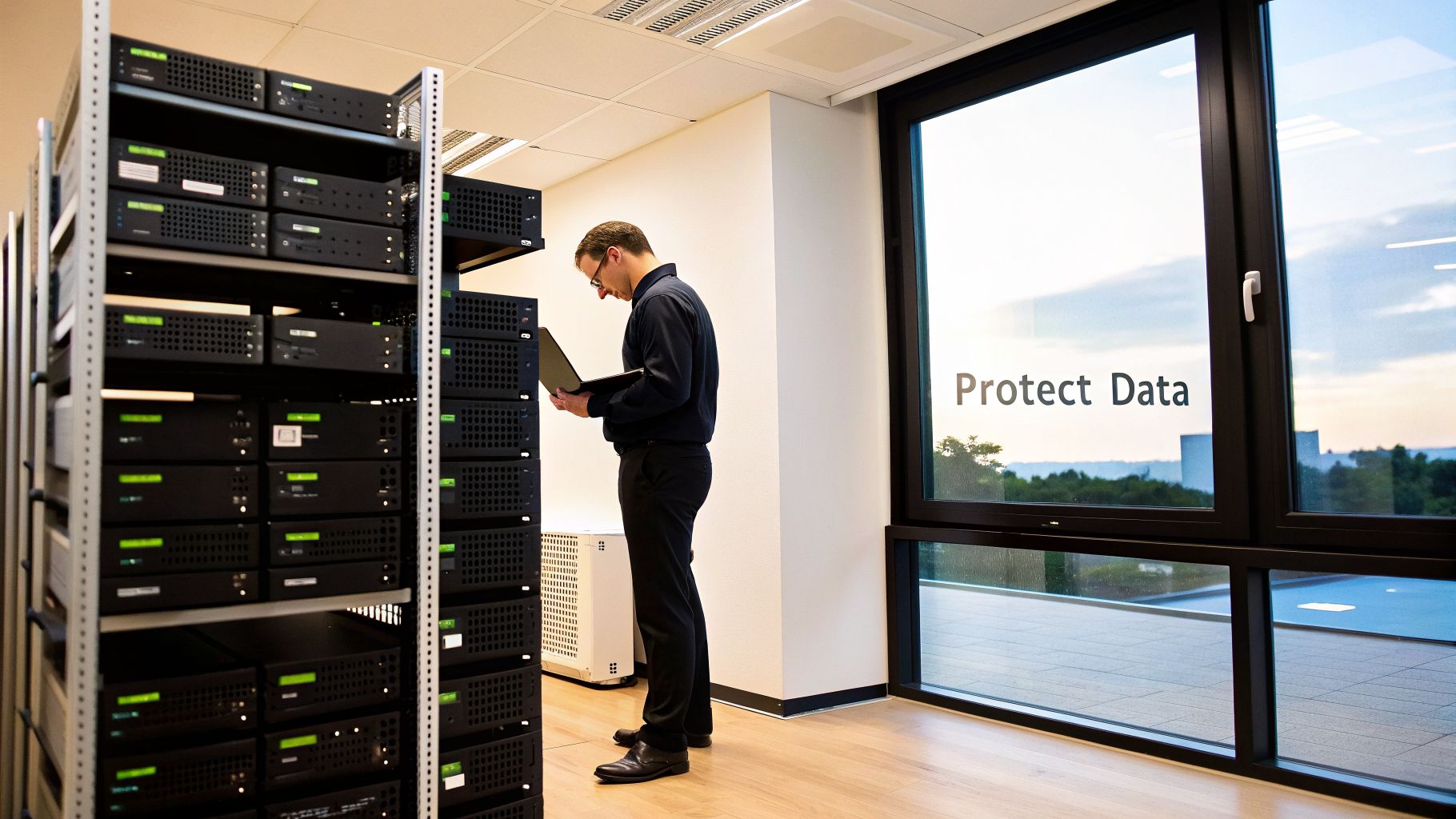
When your company upgrades its technology, that old equipment doesn’t just lose its monetary value—it becomes a significant liability. Every single retired desktop, server, and laptop is a container for sensitive information. We're talking financial records, client lists, employee data, and even proprietary trade secrets.
Simply deleting files or reformatting a hard drive isn't nearly enough to protect this information from someone who knows what they're doing.
Leaving these devices to pile up in a back room, or worse, tossing them in a dumpster, opens your Frisco business to some serious risks. It's really not a matter of if that data can be recovered, but when and by whom. A single data breach can lead to devastating financial losses, reputational harm that takes years to repair, and legal trouble for non-compliance.
Key Risks of Improper IT Asset Disposal in Frisco
Failing to use a professional ITAD process creates tangible risks. Here’s a quick rundown of what’s at stake for Frisco companies.
| Risk Category | Potential Impact on Your Business |
|---|---|
| Data Breaches | Unauthorized access to customer lists, financial data, employee PII, and trade secrets, leading to financial loss and loss of customer trust. |
| Regulatory Fines | Penalties for non-compliance with data privacy laws like HIPAA, FACTA, and GDPR, which can cost thousands or even millions of dollars. |
| Reputational Damage | Negative press and erosion of your brand's credibility, making it difficult to attract and retain customers, partners, and employees. |
| Environmental Liability | Fines for improper disposal of e-waste containing hazardous materials like lead and mercury, violating EPA regulations. |
| Legal Action | Lawsuits from customers, employees, or partners whose data was compromised due to negligent disposal practices. |
As you can see, the potential fallout goes far beyond a simple IT headache, affecting every part of the business.
Beyond Data Security: The Compliance Mandate
For many Frisco businesses—especially those in healthcare, finance, or legal services—strict regulations govern how data must be handled and disposed of. Failing to follow laws like HIPAA or FACTA isn't just a misstep; it can result in crippling fines and serious legal action.
A professional IT Asset Disposition (ITAD) partner provides a structured, documented process that gives you proof of compliance. This is about much more than just recycling. It includes:
- Certified Data Destruction: Using methods that meet or exceed government standards like NIST 800-88 to make sure data is completely irrecoverable.
- Secure Chain of Custody: Documenting every single step, from pickup at your Frisco office to final destruction, ensuring no asset ever gets lost.
- Detailed Reporting: Providing Certificates of Destruction and Recycling that serve as your official audit trail.
This level of professional rigor turns a huge potential liability into a manageable and secure business process. It’s the difference between just hoping for the best and ensuring complete protection.
The Growing E-Waste Challenge
The need for responsible recycling is also a global issue with a very real local impact. The global computer recycling market is on track to hit nearly USD 23 billion by 2033, a surge driven by new regulations and corporate sustainability goals.
But there's still a huge gap. In 2022, small IT devices like laptops and tablets generated 4.6 million tonnes of e-waste, yet only 22% were formally recycled. The rest were left vulnerable. With millions of tonnes of e-waste being shipped across borders, often without documentation, choosing a certified partner for business computer recycling in Frisco is a critical move toward being a responsible corporate citizen.
Properly managing this e-waste stream isn't just an environmental duty; it’s a competitive advantage. When you partner with a certified recycler, your company shows a real commitment to corporate social responsibility, which strengthens your brand's reputation with customers and stakeholders. Understanding the full benefits of e-waste recycling highlights why a formal strategy is so important.
It's a strategic choice that safeguards your business, fulfills your compliance duties, and contributes to a healthier environment for the Frisco community and beyond.
Preparing Your IT Assets for Secure Recycling

Before your old computers and servers ever leave your Frisco office, a bit of prep work is essential. Taking the time here makes the entire process smoother, far more secure, and completely accountable. I've seen too many businesses rush this part, leading to logistical headaches or, even worse, security blind spots down the road.
The absolute first thing you need to do is create an IT asset inventory. Don't overcomplicate it. The goal is an accurate master list that becomes your primary tool for tracking every single device you hand over.
This inventory is your manifest—it’s the foundation of a secure chain of custody, ensuring nothing gets lost in the shuffle.
Building Your Asset Inventory
Just open up a simple spreadsheet. For every asset heading for recycling, you’ll want to log a few key details. This list is your proof of what was sent for disposal, which you'll use to reconcile the final reports from your recycling partner.
Make sure your inventory includes:
- Asset Tag Number: Your company's internal ID for the device.
- Serial Number: The unique number from the manufacturer.
- Device Type: Be specific (e.g., "Dell Latitude 7420 Laptop," "HP ProLiant DL380 Server").
- Physical Location: The room or department where the asset was last used.
- Condition: A quick note on whether it’s functional or non-functional.
This simple list gives you an immediate picture of the project's scope. It also helps the business computer recycling Frisco partner you choose to give you a precise quote and plan logistics, like what size truck to send and how many technicians are needed for the pickup. For a deeper dive, you can learn more about IT asset management best practices in our complete guide.
The First Layer of Data Security
While certified data destruction is the only way to guarantee information is gone for good, performing a preliminary internal data wipe is a smart first step. It adds an initial layer of security before the equipment is even out of your hands.
Use a reputable software tool to perform a basic wipe on the hard drives. It's critical to understand this does not meet compliance standards like NIST 800-88.
Key Insight: Think of an internal wipe as locking your front door. It’s a good first-level deterrent, but it doesn’t replace the bank-level security of a professional vault. Certified destruction is the vault.
This initial wipe just reduces the surface-level risk while the assets are waiting for pickup on your premises. Never treat it as a substitute for professional, certified services.
Consolidate and Secure Your Equipment
Once everything is inventoried, gather all the retired assets into one, secure spot. A locked storage room or a designated, low-traffic corner of your office works perfectly. This simple step does two things: it makes the pickup incredibly efficient for the logistics team and prevents devices from accidentally "walking away" or being mistaken for active equipment.
For a Frisco business, this might mean clearing out a small conference room or a section of your warehouse. Make sure to label the area clearly with signs like "Assets for Certified Recycling – Do Not Move."
Finally, take a moment to flag any devices that need special handling. This is particularly important for industries like healthcare or finance. Does a computer have patient data subject to HIPAA? Did a piece of lab equipment come into contact with sensitive materials?
Mark these items clearly so your recycling partner can apply the proper handling protocols from the moment they arrive. A little foresight here ensures compliance and safety for everyone involved.
Choosing Your Certified Data Destruction Method
Once you have your inventory list, it’s time to tackle the most critical part of the process: deciding how to permanently destroy the sensitive data on your old equipment. For any Frisco business handling financial records, client lists, or proprietary information, this isn't just about getting rid of old hardware—it's about managing risk.
Simply deleting files or reformatting a hard drive just doesn't cut it. That data is almost always recoverable with basic software tools. Certified data destruction is the only way to ensure the information is gone for good, protecting you from a breach long after the equipment has left your office. Your business computer recycling Frisco partner should offer a few different validated methods, and we'll walk through them here.
On-Site Data Destruction
On-site destruction is the gold standard for absolute peace of mind. A mobile shredding truck comes directly to your Frisco facility, and you can physically watch every single hard drive, SSD, or tape get pulverized into tiny metal fragments. The chain of custody never leaves your control.
When is this the best choice?
- Maximum Security Needs: For organizations governed by strict compliance rules like HIPAA or those handling sensitive legal documents, witnessing the destruction is often a requirement. It completely eliminates any risk during transport.
- Ultimate Peace of Mind: Many IT directors and compliance officers just sleep better at night knowing they saw the drives destroyed with their own eyes.
- Immediate Verification: You get a Certificate of Data Destruction right there on the spot, confirming the job is done before the shredded material is even hauled away for recycling.
Think of a local medical practice retiring a set of computers from their exam rooms. With on-site shredding, the clinic's compliance officer can personally watch every drive containing patient health information (PHI) get destroyed. That visual confirmation creates an ironclad audit trail.
Off-Site Data Destruction
In an off-site destruction scenario, your IT assets are loaded into secure, locked containers and transported by a GPS-tracked vehicle to a specialized facility. There, the drives are destroyed in an access-controlled environment, with the entire process documented and often recorded.
For this service, you must verify your partner is NAID AAA Certified. This certification isn't just a logo; it means the company submits to rigorous, unannounced third-party audits of their facility security, employee screening, and destruction processes. It’s the industry’s top validation.
What does NAID AAA Certified really mean? It’s an independent guarantee that a company meets the highest security standards for information destruction. For your Frisco business, this translates to reduced liability and a documented, defensible process you can count on during any compliance audit.
This is a very secure and cost-effective option for a huge range of businesses—from marketing agencies to software companies—that require certified destruction but don't need to physically witness it.
NIST 800-88 Data Sanitization
A third option is data sanitization, also known as data wiping. This is far more advanced than just hitting "delete." Certified sanitization uses professional software to overwrite a drive's entire surface with random data, typically in multiple passes. This process follows the robust guidelines of the National Institute of Standards and Technology (NIST 800-88).
The major benefit here is that the physical hard drive is preserved, allowing it to be safely reused or resold to help you recover value from your retired IT assets. Any reputable vendor will provide a detailed report verifying that each drive's serial number was successfully sanitized to this standard. For a deeper dive into these methods, our guide on comprehensive security and data destruction offers more detail.
The sheer volume of discarded electronics shows why these certified methods are so vital. Globally, 62 million tonnes of e-waste were generated in 2022, a figure projected to hit 82 million tonnes by 2030. With the U.S. recycling rate at a dismal 15%, a massive security gap exists for businesses. Choosing the right destruction method is your first line of defense.
Keeping Your Assets Secure: Chain of Custody Explained
Once your inventory is squared away, the most critical part of the process kicks off: the journey from your Frisco office to the final processing facility. This path is what we in the industry call the chain of custody. Getting it wrong is where security gaps appear and liability skyrockets.
Think of it like a baton in a relay race—you can't afford to drop it. A secure chain of custody means every single handoff is documented, creating an unbreakable, auditable trail from your door to ours. This is your proof that every laptop, server, and hard drive was handled securely.
What to Expect During Pickup and Transit
When you schedule a pickup for business computer recycling in Frisco, the team that shows up should be more than just a guy with a truck. They should be security-screened, uniformed professionals who understand they're handling sensitive business assets, not just junk.
Here’s how a professional pickup should unfold:
- On-Site Verification: The logistics team will verify your asset list against the physical equipment, ensuring nothing is missed.
- Secure Loading: Your equipment is loaded into locked, secure containers right there on site before being placed onto a GPS-tracked vehicle. Loose hard drives or laptops are never left unattended.
- Documentation Handoff: Before the truck even pulls away, you’ll be given a Bill of Lading or pickup receipt. This is the document that officially transfers liability from your company to the recycling partner.
That initial receipt is your first piece of critical paperwork. It confirms the date, location, and a count of the items being taken, proving the "baton" has been successfully passed.
The Importance of Secure Logistics
The security of the transport vehicle is a detail you can't afford to overlook. Reputable ITAD partners use GPS-tracked trucks for a reason. It provides a real-time, digital breadcrumb trail from your Frisco office straight to the secure facility. No questions, no unauthorized stops.
Locked containers inside the vehicle add another essential layer of security. Even if the truck doors were somehow opened, individual assets remain secured and inaccessible.
A vague answer to questions about vehicle security, GPS tracking, or driver background checks is a massive red flag. A professional partner will have clear, confident answers because these protocols are central to their business.
Visualizing the Data Destruction Journey
Once your assets are in transit, they are on a direct path to secure data destruction. This flowchart shows the three primary, certified methods for handling the data on your devices.
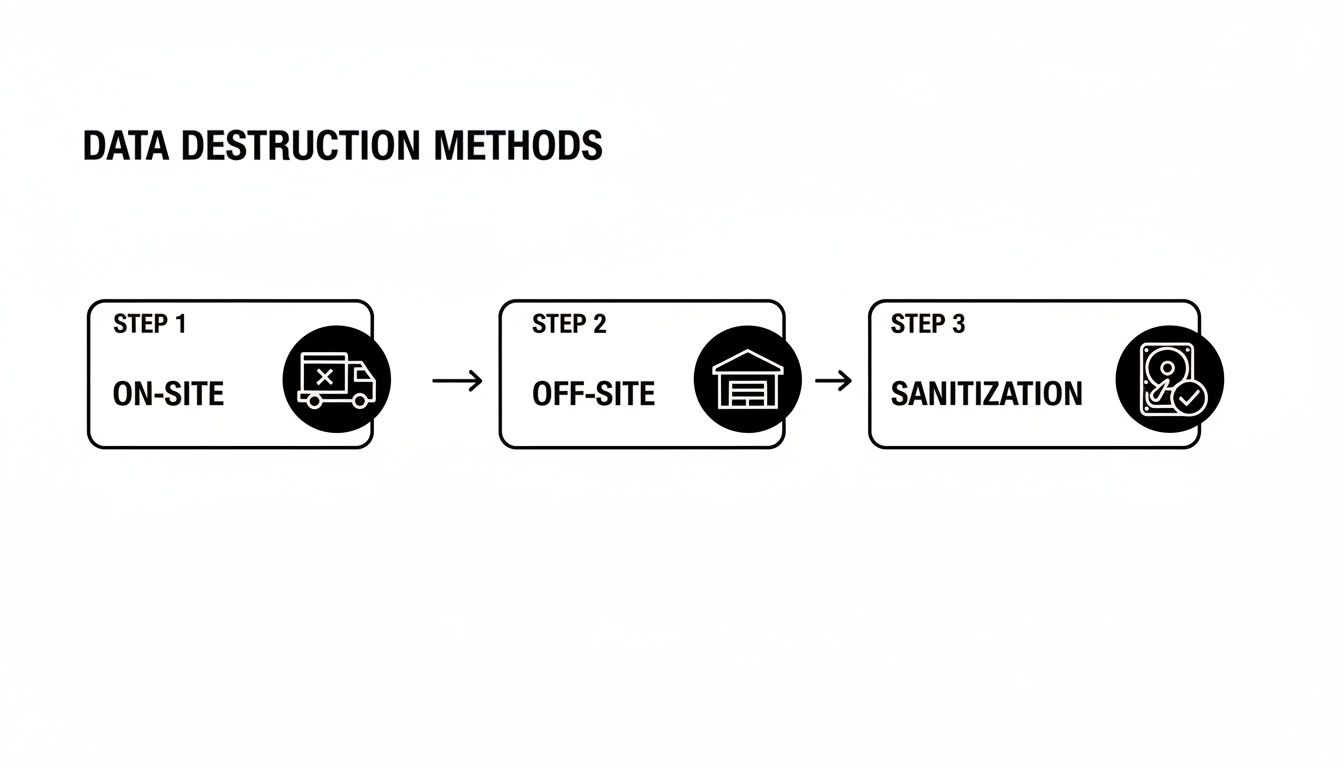
Whether you opt for the immediate certainty of on-site shredding or the efficiency of off-site processing, the goal is the same: complete, certified data erasure.
Final Documentation: Your Proof of Compliance
After your assets are processed, the chain of custody loop closes with the delivery of final documentation. This is the paperwork you’ll want to file away for any future audits, providing definitive proof of secure and compliant disposal.
You should always receive:
- A Serialized Audit Report: This report lists every single asset by serial number and your asset tag, confirming that everything you sent was received and processed.
- A Certificate of Data Destruction: This is arguably the most important document for your liability. It certifies that the data on your devices was destroyed according to a specific standard, such as NIST 800-88.
- A Certificate of Recycling: This confirms that the physical hardware was recycled responsibly and in compliance with environmental regulations, keeping e-waste out of landfills.
This complete documentation package provides total peace of mind. For Frisco businesses in healthcare, finance, or any other regulated industry, the highest level of assurance often comes from witnessed destruction. You may want to learn more about on-site shredding near you if your compliance framework demands it.
Navigating Compliance and Environmental Regulations in Texas
For any Frisco business, handling old computers and IT gear is about more than just data security—it’s about meeting your legal and environmental obligations. The rules for electronics disposal can seem complicated, but understanding them is crucial for avoiding hefty fines and legal headaches.
These state and federal regulations exist for a reason. Your old desktops, servers, and monitors are full of hazardous materials like lead, mercury, and cadmium. If that equipment ends up in a landfill, those toxins can seep into the soil and groundwater, posing a serious risk to public health and the local environment. That’s why strict laws govern their disposal.
Key Federal and State Regulations
At the federal level, the Resource Conservation and Recovery Act (RCRA) is the primary law you need to know. It gives the Environmental Protection Agency (EPA) the authority to manage hazardous waste from "cradle-to-grave." What this means for your business is simple: you are legally responsible for your e-waste from the moment you decide it's obsolete until it's been properly recycled or disposed of.
Texas has its own specific laws that build on this federal foundation. For instance, the Texas Computer Equipment Recycling Act requires computer manufacturers to provide free recycling programs for consumers. While aimed at individuals, this law underscores a clear statewide policy to keep e-waste out of our landfills.
Key Takeaway: Claiming ignorance of these laws won't protect you. The responsibility for compliant disposal lies with the business that created the waste. Partnering with a certified recycler is the only way to properly transfer that liability, but only if they adhere to every regulation.
Working with a certified expert in business computer recycling in Frisco ensures every single piece of your equipment is managed in full compliance with both EPA and Texas state rules. We provide the complete documentation to prove it, shielding your company from potential penalties.
Beyond Compliance: The Environmental Impact
Staying compliant is non-negotiable, but the positive environmental impact of proper recycling is just as compelling. Choosing a certified recycler is a clear statement about your company's commitment to corporate social responsibility and its Environmental, Social, and Governance (ESG) goals.
Just think about the materials inside a typical office PC. It contains valuable commodities like gold, silver, copper, and palladium. When recycled correctly, these materials are recovered and put back into the manufacturing stream. This process, often called urban mining, achieves several important goals:
- Reduces Your Carbon Footprint: Building a new computer from scratch is incredibly energy-intensive. Reusing recovered metals requires far less energy than mining and refining virgin materials.
- Conserves Natural Resources: Every ounce of metal recovered from old electronics is an ounce that doesn't need to be mined from the earth.
- Prevents Pollution: It guarantees that hazardous materials are managed safely instead of being dumped in a landfill where they can cause lasting damage.
The global picture makes these local actions even more vital. Worldwide, only 81 countries (42%) have any kind of formal e-waste legislation, leading to enormous gaps in responsible recycling. In 2022 alone, an estimated 3.3 million tonnes of e-waste were shipped undocumented to developing nations, where crude disposal methods risk releasing dangerous toxics. You can review more eye-opening e-waste statistics to understand the scale of this global challenge.
Enhancing Your Brand Reputation in Frisco
Demonstrating your commitment to responsible IT asset disposition does more than just tick a compliance box—it strengthens your brand's reputation right here in the Frisco community. Customers, employees, and partners are increasingly choosing to work with companies that take their environmental duties seriously.
By highlighting your partnership with a certified e-waste recycler, you can turn a routine operational task into a positive story. It shows your business is a forward-thinking, responsible local leader that cares about more than just the bottom line. This focus aligns perfectly with community efforts like Frisco's own "Clean It and Green It" events, proving your company is an active participant in protecting our local environment.
Common Questions About Business Computer Recycling in Frisco
When it’s time to retire old IT assets, we find most Frisco businesses have the same core concerns: cost, security, and logistics. Getting straight answers is the first step toward building a secure and compliant process, so we’ve put together a list of the questions we hear most often.
These are the practical, no-fluff answers designed to address your key concerns and help you make an informed decision that protects your company's data and reputation.
What Does Business Computer Recycling Cost in the Frisco Area?
This is almost always the first question we get, and the answer really comes down to the specifics of your project—mainly, the volume of equipment and the data destruction services you need.
For most standard IT equipment like laptops, desktops, servers, and networking gear, the recycling service itself is often free. This is because the value of the recovered commodities inside these devices helps offset the labor and processing costs.
However, you might see a small fee for certain items. Older electronics, especially CRT monitors or specific types of lab equipment, contain hazardous materials that require special handling and disposal, which comes with a cost.
The best approach is to request a custom quote. Any trustworthy partner will provide a transparent, itemized breakdown with no hidden fees, so you know exactly what to expect for services like on-site hard drive shredding or special handling.
How Can I Be Sure Our Company's Sensitive Data Is Gone Forever?
This is the most critical question, and the only acceptable answer is a Certificate of Data Destruction. This document is your official, auditable proof that every bit of data was destroyed according to strict industry standards. Anything less leaves you exposed.
Top-tier vendors provide a few ways to get you to that point:
- Physical Shredding: This is the gold standard. Hard drives are pulverized into tiny, unreadable metal fragments. There's no coming back from that.
- NIST 800-88 Sanitization: This is a software-based method where every sector of a hard drive is overwritten with random data, making the original information completely irrecoverable.
For total peace of mind, many Frisco businesses in sensitive fields like healthcare and finance choose on-site shredding. This allows your team to witness the entire destruction process firsthand before the materials ever leave your property.
What Kind of Paperwork Should We Get After Recycling?
Solid documentation isn't just a nice-to-have; it's your official record for internal audits and your proof of due diligence. After the job is done, you should expect a complete reporting package that closes the loop on liability.
Your final report suite should always include these key documents:
- Bill of Lading: This is provided at pickup and officially transfers custody and liability of the assets from your business to the recycling partner.
- Serialized Audit Report: This is a detailed manifest listing every asset by its serial number and your internal asset tag, confirming nothing was lost in transit.
- Certificate of Data Destruction: This is the crucial document for compliance. You can learn more about why a certificate of destruction for hard drives is so essential for your liability protection.
- Certificate of Recycling: This certifies that all the physical hardware was dismantled and recycled responsibly in line with federal and Texas state environmental laws.
This complete set of paperwork creates a defensible, auditable trail from your office to final disposition.
Our Office Is on an Upper Floor With No Elevator. Is Pickup Still Possible?
Absolutely. Logistical challenges are just part of the job for an experienced ITAD provider. Whether your office is in a high-rise, has narrow hallways, or lacks an elevator, a professional team will come prepared.
Pro Tip: Make sure to mention any access issues when you schedule your service. Details like stairs, tight corners, specific security protocols, or loading dock hours allow the logistics team to plan ahead.
An experienced crew will show up with the right equipment and manpower to remove your assets safely and efficiently from anywhere in your building. Giving them a heads-up just ensures the pickup goes smoothly, with no surprises for anyone.
Ready to ensure your company's old computers are handled securely and compliantly? Dallas Fortworth Computer Recycling offers certified, end-to-end IT asset disposition services for businesses of all sizes. Schedule your free pickup and get the peace of mind that comes with a documented, responsible process. Contact us today for a transparent quote.