
Arlington Business Electronics Recycling A How To Guide
For any Arlington business, handling old electronics is much more than just spring cleaning. It’s a core function that protects your company from serious financial and reputational harm. This isn't just about being green; it's about being smart.
Why Electronics Recycling Is A Core Business Function
Many IT leaders we talk to in Arlington have a storage closet filled with outdated servers, laptops, and monitors. It feels like a problem for another day, but that pile of old tech isn't just dormant—it's an active and growing liability.
Thinking of this process as simple "disposal" is the first mistake. We see this all the time. The proper approach is called IT Asset Disposition, or ITAD. This shifts the mindset from just "getting rid of junk" to strategically managing the entire lifecycle of your technology. It's a crucial distinction that gets to the real stakes involved.
More Than Just Going Green
While the environmental benefits are a great bonus, the real drivers for a formal e-waste strategy are security and compliance. Every retired hard drive, company phone, and server has a ghost of your business data on it. If that data gets into the wrong hands, the fallout can be devastating.
This isn't just a hypothetical. A single data breach from a carelessly tossed device can lead directly to:
- Crippling Fines: If you're in healthcare (HIPAA) or work with the government (NIST), non-compliance can bring fines that are hard to recover from.
- Reputational Damage: The public trust you lose after a data breach is incredibly difficult, and sometimes impossible, to win back.
- Legal Liability: Your company is legally on the hook for its data, even long after the device has left your building.
For savvy business leaders in the DFW metroplex, this isn't about clearing out a storage closet—it's about strategic risk management and upholding corporate responsibility.
This proactive approach is gaining traction right here at home. While the U.S. as a whole only recycled 15% of the 6.9 million metric tons of e-waste generated in 2019, local efforts in the Dallas-Fort Worth area are making a real difference. Arlington, for example, boosted its overall recycling rate by 13% in recent years, which saved an estimated 40,000 cubic yards of critical landfill space.
A Strategic Business Advantage
When you view Arlington business electronics recycling as a strategic function, you start to see its true value. A documented, certified process doesn't just prevent bad outcomes; it creates positive ones.
It sends a clear message to your clients, partners, and employees that you're a responsible company committed to protecting both sensitive information and the environment. You can learn more about the complete benefits of e-waste recycling in our detailed guide.
Ultimately, a strong ITAD program is a core business function that protects your bottom line and strengthens your brand. It turns a potential liability into a verified asset of trust and responsibility.
Developing Your Internal E-Waste Management Plan
A successful Arlington business electronics recycling program is built on a solid foundation, and that foundation gets laid long before a single piece of equipment leaves your building. I’ve seen it time and again: companies that rush this part of the process are the ones that end up with security gaps, logistical nightmares, and surprise costs. It all starts by creating a clear, repeatable internal plan that takes the guesswork out of the equation.
Without a formal framework, you're left with an ad-hoc mess where different departments handle old tech their own way. That’s how a server full of customer data or a laptop with financial records ends up in a dumpster. A real plan ensures every retired asset follows the same secure, compliant path from its workstation to its final, certified destruction.
Start With A Comprehensive Equipment Inventory
Before you can get a handle on your e-waste, you have to know exactly what—and where—it is. This means getting on your feet and conducting a thorough inventory of every retired, outdated, and non-functional electronic device across your entire organization. Don’t just peek in the IT closet. You need to check storage rooms, departmental cabinets, and even under desks. You’d be surprised where old tech hides.
The goal is to get a full accounting of every device that's no longer in use or nearing its end-of-life. A simple spreadsheet is your best friend here.
To help you get started, we've put together a basic checklist. Use this to walk your site and begin categorizing what you find.
Electronics Inventory And Assessment Checklist
This simple table is a great starting point for any IT or facilities manager tasked with assessing the scope of a cleanup project. It helps you organize your assets and identify potential data security risks from the very beginning.
| Asset Category | Location (e.g., Data Center, Office) | Data-Bearing (Yes/No) | Special Handling Notes (e.g., Medical, Lab) | Estimated Quantity |
|---|---|---|---|---|
| Laptops & Desktops | General Office | Yes | None | 75 |
| Servers & Networking Gear | Data Center | Yes | Serial number tracking required | 15 |
| Mobile Phones & Tablets | Marketing/Sales Dept. | Yes | Company and personal data | 120 |
| Lab Analyzers | R&D Laboratory | Yes | Potential biohazard residue | 4 |
| Office Printers & Scanners | All Departments | Yes (Internal Memory) | 20 |
This inventory becomes the backbone of your disposition strategy. It not only allows potential recycling partners to give you an accurate quote but also ensures you have a complete record of what needs to be disposed of. This is a critical piece of the puzzle and aligns with our recommended IT asset management best practices.
Gaining Executive Approval And Buy-In
Once you have a clear picture of your e-waste liability, it’s time to get executive buy-in. Here’s a pro tip: don't pitch this as a "cleanup project." That’s the fastest way to get it pushed to the bottom of the priority list. Frame it for what it is: a critical risk management initiative that directly protects the business from financial and reputational harm.
Focus your presentation on the tangible risks of doing nothing versus the clear benefits of a formal, certified recycling program. A single mistake can set off a devastating chain reaction.
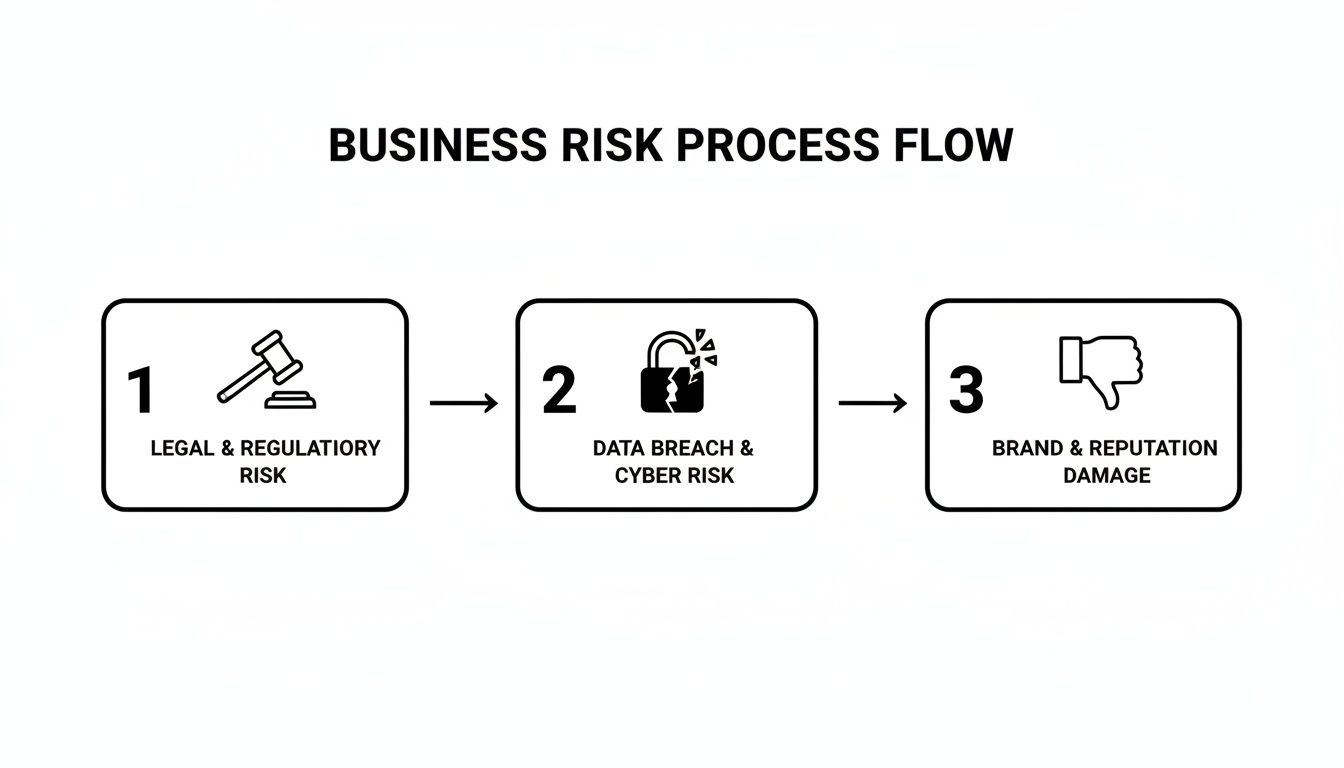
This shows exactly how one unsecured device can escalate from a simple compliance issue to a full-blown data breach and lasting brand damage.
When you talk to leadership, talk in dollars and cents. A single HIPAA violation, for example, can result in fines up to $1.5 million per year. That’s a number that gets the attention of any C-suite executive. Compare that to the manageable, predictable cost of a certified e-recycling program.
Your pitch should clearly show how your plan mitigates data breach risks, ensures compliance with regulations like HIPAA, NIST, or FACTA, and in some cases, can even generate a positive ROI through remarketing valuable assets.
Drafting A Clear Internal E-Waste Policy
With your leadership's support, the next step is to make it official. It's time to draft an internal e-waste policy that serves as the single source of truth for how your company handles retired electronics. Keep it clear, concise, and make sure it’s accessible to every single employee.
This policy isn’t just for the IT department. It’s for everyone. A good policy educates the entire team on why tossing an old keyboard or company phone in the trash is a major liability—and a fireable offense.
Your policy must explicitly define roles and responsibilities. It needs to answer a few key questions:
- Who is authorized to request an equipment disposal?
- Who is responsible for managing the inventory of retired assets?
- Who is the point person for coordinating with the external recycling vendor?
Answering these questions in a formal document eliminates confusion and creates a repeatable, auditable system for all your Arlington business electronics recycling efforts.
How To Choose A Certified DFW Recycling Partner

This is the most important decision you'll make in your entire equipment disposal plan. Who you partner with will determine your security, your compliance, and ultimately, your peace of mind.
A quick Google search for "electronics recycling" brings up a lot of options. The problem is, most are just scrap haulers. They see your old equipment as a commodity to be weighed and sold.
Your Arlington business needs a real IT Asset Disposition (ITAD) partner. A true partner sees your old gear for what it is first and foremost: a data security liability. The difference between these two approaches is huge, and it directly affects your company's exposure to risk.
Vetting a Partner: Look for These Key Certifications
The e-recycling industry is a sea of acronyms, but there are a few certifications that are absolutely non-negotiable. These aren't just logos for a website; they represent a serious commitment to standards that are verified by tough, third-party audits. If a potential vendor doesn’t have these, they shouldn’t be on your list.
R2 (Responsible Recycling): This is the leading global standard for our industry. An R2-certified recycler is audited on everything from data security and environmental impact to worker safety. It’s proof that they have a documented, professional process for everything they do.
e-Stewards: Often seen as the most rigorous environmental standard, e-Stewards certification includes a strict ban on exporting hazardous e-waste to developing nations. It's your guarantee that your old equipment won’t become someone else's environmental problem.
NAID AAA Certification: This one is the gold standard specifically for data destruction. A NAID AAA certified company undergoes surprise inspections to prove their data wiping, degaussing, and shredding processes are bulletproof. If you handle any sensitive information, this is a must.
These certifications are your baseline. They prove a vendor has invested the money and effort to handle your assets the right way.
Asking the Tough Questions About Data Destruction
Once you've confirmed a vendor has the right certifications, you need to dig into their security process. It all comes down to the data. Your goal is to get undeniable proof that every piece of information has been permanently destroyed.
You need to ask direct, specific questions. Any legitimate ITAD partner will have confident, clear answers.
Essential Questions for Any Potential Vendor:
- What data destruction methods do you use? A quality partner should offer a menu of options—wiping, degaussing, and shredding—and help you decide what’s best for your assets and security policy.
- Is destruction performed at your own secure facility? You don’t want a vendor who outsources this critical step. It breaks the chain of custody and introduces risk.
- Will I receive a serialized Certificate of Data Destruction? This isn’t just a generic receipt. It’s a legal document that lists the unique serial number of every single hard drive and device you handed over, creating a perfect audit trail.
Vague answers are a huge red flag. A true security partner is proud of their process and can walk you through every step, from your office to their shredder.
For a deeper dive into what these certifications mean for your company's security, check out our guide on what being an R-2 certified electronics recycler really involves.
A Real-World Example: An Arlington Healthcare Clinic
Let’s make this practical. Imagine an Arlington-based healthcare clinic is getting rid of old patient check-in kiosks and administrative laptops. This is a classic HIPAA scenario, where a data breach could be devastating.
The Scrap Hauler: An uncertified recycler quotes a cheap price to haul everything away. They might give you a basic receipt, but there's no certified proof of data destruction. The devices could be resold with patient data still on them or dumped improperly, leaving the clinic wide open to massive fines and reputational ruin.
The Certified ITAD Partner: A NAID AAA and R2 Certified partner knows exactly what’s at stake. They provide locked security bins for collection, document the chain of custody from pickup to final destruction, and perform physical shredding of the hard drives. The clinic gets a serialized Certificate of Data Destruction—the auditable proof they need to satisfy a HIPAA audit.
The contrast couldn't be clearer. Effective Arlington business electronics recycling isn’t about finding the lowest bidder; it’s about finding a partner who eliminates your risk.
Executing A Secure Pickup And Data Destruction
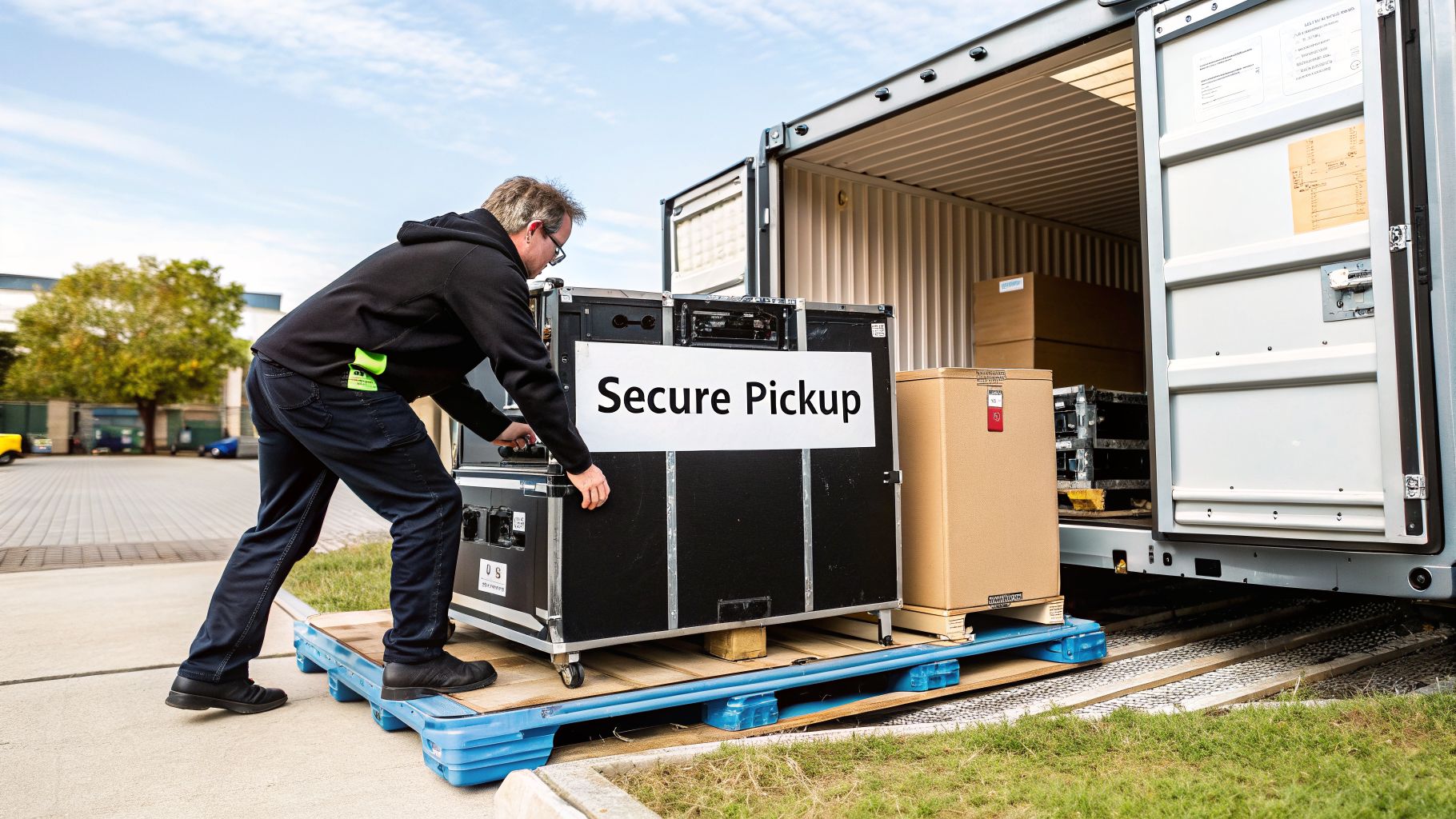
Once you've chosen a certified ITAD partner, the next step is execution. A smooth, secure pickup doesn't just happen—it’s the result of clear communication and careful prep work. This is where your plan becomes reality, moving retired assets securely out of your facility and on their way to final disposition.
The first move is to coordinate logistics with your vendor. A professional partner will work with your team to find a pickup window that causes the least disruption to your Arlington business. For a big project like a data center decommissioning, that might mean an after-hours or weekend job. For a typical office cleanout, it could be a quick appointment during the workday.
Preparing Your Assets For Secure Transit
Before the truck pulls up, your equipment needs to be staged properly. This isn't just about keeping things tidy; it's a critical step for security and efficiency. While your recycling partner should give you clear instructions, the initial prep work is up to your team.
A key part of this is separating devices based on how sensitive their data is. All electronics need secure handling, but hardware with sensitive PII, financial records, or intellectual property demands extra care.
- Palletize Heavy Equipment: Stack servers, networking gear, and other bulky hardware securely on pallets. Shrink-wrapping them makes them much safer and easier to move.
- Isolate Data-Bearing Devices: Group all laptops, desktops, hard drives, and mobile phones together. These are your highest-risk items and should be kept separate from peripherals like keyboards or monitors.
- Use Secure Containers: For your most sensitive hard drives, your vendor can often provide locked, tamper-evident bins. This creates an unbroken chain of custody from the moment they leave your control.
Properly staging your assets leads to a faster, more organized pickup. It also helps your vendor process them more efficiently back at their facility, a crucial part of any successful Arlington business electronics recycling program.
The Unbreakable Chain Of Custody
The moment your equipment leaves your building, the chain of custody officially begins. This is the documented paper trail that tracks every single asset from your door to its final destruction. Your vendor should be scanning your existing inventory barcodes or applying their own serialized asset tags right there on-site.
That initial scan is your first piece of proof. The driver should provide you with a receipt or bill of lading confirming the transfer of assets and listing the number of pallets, bins, or items collected. This document is the starting point for the complete audit trail you'll receive later.
A secure pickup is more than just logistics; it’s a transfer of liability. When that truck pulls away, you need to be confident that your risk is being managed by a professional, certified process.
Understanding Your Data Destruction Options
Once your assets arrive at the secure recycling facility, the most critical part of the process begins: data destruction. A reputable partner will offer several methods, and the right choice depends on your internal security policies, the sensitivity of the data, and your budget.
The three main methods of data destruction each provide a different level of security. Choosing the right one is essential for meeting your compliance and risk management goals.
Comparing Data Destruction Methods
| Method | Description | Security Level | Best For |
|---|---|---|---|
| Software Wiping | Overwrites the entire drive with random data (0s and 1s), making the original data unrecoverable. | High | Devices intended for resale or reuse; meets NIST 800-88 standards. |
| Degaussing | Exposes magnetic drives (HDDs, tapes) to a powerful magnetic field, instantly erasing all data. | Very High | Erasing large batches of magnetic media quickly; renders drives inoperable. |
| Physical Shredding | Feeds the physical hard drive into an industrial shredder, grinding it into small, unsalvageable pieces. | Highest | Maximum security for the most sensitive data; provides visual proof. |
Physical shredding is the most definitive method and offers the ultimate peace of mind. For many organizations, a hybrid approach—wiping assets slated for reuse and shredding all others—is the perfect strategy.
If your policy demands you witness the destruction yourself, you can also look into options for on-site hard drive shredding where the vendor brings the shredder right to your Arlington location.
Finalizing The Process With Compliance Reporting
Your job isn't over just because the truck has pulled away. For IT managers and compliance officers in Arlington, the most critical phase is just beginning: securing the documentation that proves your business acted responsibly.
This paperwork is your official record, closing the loop on the entire IT asset disposition process. Without it, you have no verifiable proof that sensitive data was destroyed or that your old equipment was handled in compliance with environmental regulations. A professional ITAD partner provides this documentation as a standard part of their service—it's non-negotiable.
The Three Essential Compliance Documents
After your assets are processed, your recycling partner must deliver a package of reports. This isn't just a simple receipt; it’s a collection of legal documents that create a complete audit trail. There are three core reports you must have.
- Certificate of Recycling: This document confirms that all non-data-bearing assets and the raw materials recovered from destroyed devices were processed according to environmental laws and industry best practices.
- Certificate of Data Destruction: This is arguably the most important document you’ll receive. It certifies that every data-bearing device was sanitized or destroyed, typically following standards set by the National Institute of Standards and Technology (NIST).
- Serialized Chain-of-Custody Report: This is a detailed manifest listing every single asset by its serial number. It tracks each item's journey from pickup at your Arlington facility all the way to its final disposition—be it recycling, shredding, or remarketing.
These reports work together to create an unbroken, auditable history for every piece of retired technology. For more on why this is so critical, see our guide on the importance of a certificate of destruction for hard drives.
What To Look For In Your Reports
Not all certificates are created equal. A generic, non-serialized report offers very little real protection in an audit. When you review your compliance paperwork, make sure it contains specific, verifiable details.
Your Certificate of Data Destruction, for example, must list the unique serial number of every single hard drive or device it covers. It should also clearly state the destruction method used—whether it was physical shredding, degaussing, or multi-pass software wiping. This level of detail is what holds up under scrutiny.
A proper compliance package is your shield against liability. It transforms your electronics recycling program from a logistical task into a documented, defensible business process that satisfies internal stakeholders and external regulators alike.
This documentation serves as your final proof of responsible asset management. By demanding these detailed reports and verifying their contents, you ensure your Arlington business is fully protected long after the old equipment is gone. It's the final, essential step in a secure and compliant ITAD strategy.
Answering Your Top Questions About Business E-Waste Recycling
Even the most thorough ITAD plan can bring up questions. For many Arlington businesses, this is new territory, and it's perfectly normal to have a few points of confusion. We've heard them all over the years.
Here are the practical, real-world concerns that IT and operations managers bring to us every day. Getting these answers right is the key to making sure your program is secure, compliant, and cost-effective.
What Does Business Electronics Recycling in Arlington Actually Cost?
This is usually the first question we get, and the honest answer is: it depends. The cost isn’t a flat fee but a calculation based on the age, condition, type, and volume of your equipment.
For newer, high-value assets like recent-generation servers, networking gear, or large batches of late-model laptops, many ITAD partners offer value recovery. In these cases, the partner refurbishes and resells the equipment, sharing a portion of the revenue back with you. You could actually get paid for your "e-waste."
On the other hand, for older, mixed electronics with little or no resale value, you will likely pay a service fee. This fee covers the secure logistics, certified data destruction, and labor-intensive work of responsible recycling. Pricing is typically determined by weight or the number of pallets.
The most critical "cost" to think about is the cost of not using a certified recycler. The potential hit from a data breach, regulatory fines, and permanent brand damage will always dwarf any legitimate recycling fee.
Can My Business Use City-Run Recycling Events?
While Arlington provides excellent recycling events for its residents, these programs are not built for the specific needs of a business. It’s a common point of confusion, but the distinction is absolutely critical for your security and compliance.
Residential events almost always have strict limits on the number of items they can accept. More importantly, they are simply not equipped to provide the level of security and documentation that businesses require to eliminate liability.
Key Differences Between Residential and Business Recycling:
- Data Destruction: City events do not offer certified, auditable data destruction. You won’t get a Certificate of Data Destruction, leaving you with zero proof that sensitive company information was ever eliminated.
- Chain of Custody: These events lack the formal chain-of-custody tracking that documents every touchpoint from pickup to final disposition. This documentation is your legal safeguard.
- Volume: They aren't set up to handle the bulk quantities that a typical office cleanout or data center project generates.
A commercial Arlington business electronics recycling partner is specifically structured to handle these business requirements, giving you the security protocols and paperwork you need to protect your company.
How Should We Handle Specialized Medical or Lab Equipment?
Specialized equipment, like the kind found in healthcare clinics or R&D labs, demands a vendor with specific, verifiable expertise. These devices are not standard office e-waste and come with a unique set of challenges.
Medical and lab equipment often contains embedded systems that store highly sensitive Protected Health Information (PHI), which is strictly regulated by HIPAA. These devices can also be contaminated with biological or chemical residues, putting them in the category of hazardous materials that require special handling.
You must choose a partner who can prove they have experience with your exact type of equipment.
Questions to Ask About Specialized Equipment:
- Have you handled this specific model of lab analyzer or diagnostic machine before?
- What is your process for destroying data from the embedded, non-standard hard drives in these devices?
- How do you ensure compliant disposal of components that might contain hazardous materials?
Always verify a vendor’s experience and certifications for handling medical or lab assets before you sign anything. The risk of non-compliance is simply too high to leave to a generalist.
What Happens If Our Data Is Breached From Improperly Recycled Tech?
The fallout from a data breach traced back to a retired asset can be catastrophic and long-lasting. Your business remains legally liable for any data compromised from your devices, even after they've left your building in a recycler's truck.
The immediate consequences are financial. A single breach can trigger massive fines under a host of regulations:
- HIPAA: Penalties can climb to $1.5 million per violation category, per year.
- GDPR: For companies with European customers, fines can reach up to 4% of annual global revenue.
- CCPA: Fines can be levied per individual affected, quickly ballooning into a huge financial liability.
Beyond the fines, you'll face the direct costs of remediation—customer notifications, credit monitoring services, and legal fees. But the most damaging consequence is often the severe reputational harm that erodes customer and partner trust for years.
This is precisely why partnering with a NAID AAA Certified recycler is non-negotiable. The serialized Certificate of Data Destruction they provide is your only verifiable proof that you took the necessary steps to protect your data and your business.
Navigating the complexities of IT asset disposition can be daunting, but you don't have to do it alone. For more than 13 years, Dallas Fortworth Computer Recycling has provided secure, compliant, and documented electronics recycling solutions for businesses across Arlington and the nation. Our certified processes ensure your data is destroyed and your risks are eliminated. Schedule your free assessment today to create a secure ITAD plan for your business.