
Arlington Corporate IT Recycling Your Essential 2026 Guide
Smart Arlington corporate IT recycling is more than just a line item on a compliance checklist—it's a strategic move. It means bringing in certified specialists to securely manage the entire end-of-life process for your technology. We're talking everything from servers and laptops to specialized equipment, ensuring every piece of data is destroyed and every asset is recycled responsibly.
This isn't just about risk management; it's about leading on sustainability and, in many cases, recovering value from retired assets.
Why Your Business Needs a Strategic IT Recycling Plan
For any business operating in Arlington—a major commercial hub in the Dallas-Fort Worth metroplex—managing electronic waste has become a fundamental part of secure, sustainable operations. As an IT manager or procurement lead, you know this isn't about just tossing old computers. It's about protecting sensitive company data, keeping up with complex regulations, and safeguarding your company’s reputation.
The whole conversation is shifting. We've moved past a simple "disposal" mindset and toward a much more thorough approach known as IT Asset Disposition (ITAD). A proper ITAD strategy covers everything from auditable data destruction to environmental reporting.
Corporate vs Residential IT Recycling in Arlington
One of the biggest mistakes we see is companies confusing professional ITAD services with the local residential e-waste drop-off event. While community events are fantastic for household electronics, they simply don't have the security, scale, or documentation that a business requires.
Here’s a quick breakdown of the differences:
| Feature | Residential Recycling Events | Corporate ITAD Services |
|---|---|---|
| Security | Basic; the main goal is just to keep electronics out of landfills. | High; certified data destruction and a documented chain-of-custody are non-negotiable. |
| Volume | Designed for a few items from a home. | Built to handle pallets of servers, desktops, and other bulk equipment. |
| Documentation | Typically none. You drop it off and that's it. | Provides serialized Certificates of Destruction for your compliance and audit trails. |
| Asset Types | Consumer electronics like TVs, printers, and old gadgets. | Enterprise-grade assets like servers, networking gear, laptops, and specialized industrial tech. |
The stakes are just so much higher for a business. A single hard drive that ends up in the wrong municipal bin can easily become a catastrophic data breach. A true ITAD partner gives you the auditable proof you need to show that every single asset was handled correctly from start to finish.
The Financial and Environmental Upside
Beyond just protecting your business, there’s real value to be found here. A well-run recycling program isn't just an expense; it can actually become a source of revenue. For example, recycling one ton of circuit boards can recover up to 800 times their weight in gold and silver. This not only keeps hazardous materials like lead and mercury out of our landfills but can also result in cash payouts for your company.
For Arlington businesses, the goal is twofold: achieve zero-landfill status for electronic waste and turn retired technology into a financial asset through remarketing or materials recovery. This approach strengthens your environmental, social, and governance (ESG) profile.
On top of that, with the upcoming 2026 Texas state mandates expected to require certified disposal for industrial and electronic equipment, having a proactive plan is no longer a "nice-to-have." Getting ahead of these regulations now positions your company as a forward-thinking leader in the region. This strategic view aligns with the many benefits of e-waste recycling, turning what could be a major headache into a clear operational win.
Building Your Secure IT Asset Disposition Playbook
A successful ITAD program moves from strategy to action with a clear, documented plan. This playbook is your guide to managing the entire process, and it begins with the most important internal step: creating a detailed inventory of every single asset you plan to retire.
A simple checklist won't cut it. For a comprehensive Arlington corporate IT recycling plan, you need a granular, categorized list. Think beyond just "laptops" and "servers." Segmenting your equipment into logical groups makes it far easier to assess potential value and identify the specific data security risks tied to each asset type.
This groundwork is the foundation of your disposition strategy. It allows you to have a much more productive conversation with potential recycling partners because you'll know exactly what you have and what services you need.
Initial Asset Inventory and Categorization
Before you even think about calling a vendor, your first job is to look inward. A detailed audit of your retiring assets is non-negotiable.
Start by classifying your hardware into groups:
- User Endpoints: This covers all laptops, desktops, tablets, and mobile phones your employees use.
- Data Center Hardware: These are your high-risk, high-value assets. This includes servers (blade, rack-mounted), storage area networks (SANs), and network-attached storage (NAS) devices.
- Networking and Telecom Gear: This category is for your switches, routers, firewalls, and VoIP phone systems.
- Specialized Equipment: Don't overlook unique assets. This could be anything from lab equipment in a healthcare setting to industrial control systems in a manufacturing facility.
For each item, capture key details like the asset tag, serial number, make, model, and physical condition. This careful record-keeping is the first link in your chain of custody, turning a pile of old electronics into a managed, auditable asset list. You can explore a deeper dive into this process by understanding the full scope of what IT asset disposition entails.
Vetting Your Certified Recycling Partner
With your inventory complete, you can start the crucial process of selecting a certified ITAD partner. Not all recyclers are the same, and their certifications are the best indicator of their commitment to security and environmental standards.
The gold standard in our industry is the R2v3 (Responsible Recycling) certification.
An R2v3 certified partner has been audited by a third party to verify they adhere to the strictest standards for data destruction, environmental protection, and worker safety. For your business, this certification is your assurance that your partner operates ethically and securely, protecting you from downstream liability.
When evaluating a partner for your Arlington corporate IT recycling needs, ask specific questions about their process. How do they maintain chain of custody from the moment your assets leave your facility? What does their data destruction process look like? Can they provide serialized Certificates of Destruction for every single storage device?
This visual breaks down the corporate IT recycling journey into three core phases: retiring assets, securing a trusted partner, and creating tangible value.
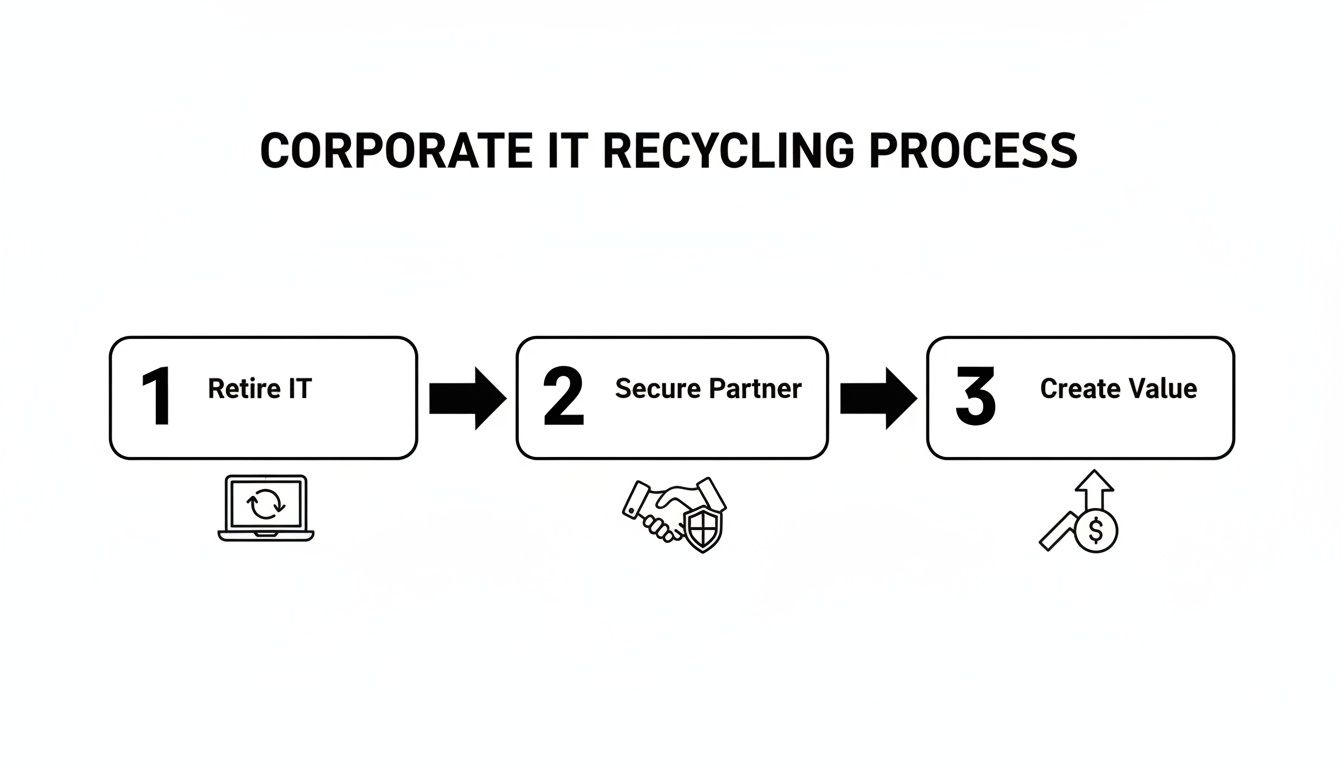
The flowchart shows that successful ITAD is a structured workflow, not just a one-off disposal event. This ensures security and compliance at every step.
Logistics From Pickup to Final Certification
Let’s walk through a common scenario. Imagine a mid-size healthcare provider in Arlington decommissioning a small server room. They have an inventory of 12 servers, 2 network switches, and a rack of older backup drives.
Here’s what the logistics should look like with a professional ITAD partner:
- Scheduling the Pickup: The process starts with a call to schedule a pickup. The vendor should provide a clear arrival window and dispatch a secure, GPS-tracked truck with trained technicians.
- On-Site Verification: Upon arrival, the technicians will verify the equipment against your inventory list. Each pallet or container is inventoried, recorded, and securely shrink-wrapped before being loaded.
- Secure Transit: The driver provides a bill of lading, which officially transfers custody of the assets to the vendor. This is a critical piece of your chain-of-custody documentation. The assets are then transported directly to the secure processing facility.
- Receiving and Auditing: At the facility, the shipment is received, and each asset’s serial number is scanned into the vendor’s tracking system. This creates a complete digital audit trail.
- Data Destruction and Reporting: The storage media from the servers and drives are removed and destroyed according to the pre-agreed standards. Once finished, the vendor issues a serialized Certificate of Destruction—your legal proof that the data is unrecoverable.
This seamless, documented workflow is what separates a certified professional from a simple scrap hauler. It ensures your equipment is tracked, secure, and handled in full compliance with all regulations from your loading dock to its final disposition.
Mastering Data Security with Certified Destruction
Once your inventory is complete, it's time to tackle the single most critical step in the entire process: data destruction. Improperly handling the sensitive information on retired hard drives, servers, and mobile devices isn't just a simple mistake—it's a direct threat to your company's security and legal standing. Secure Arlington corporate IT recycling is built on a foundation of absolute, verifiable data security.
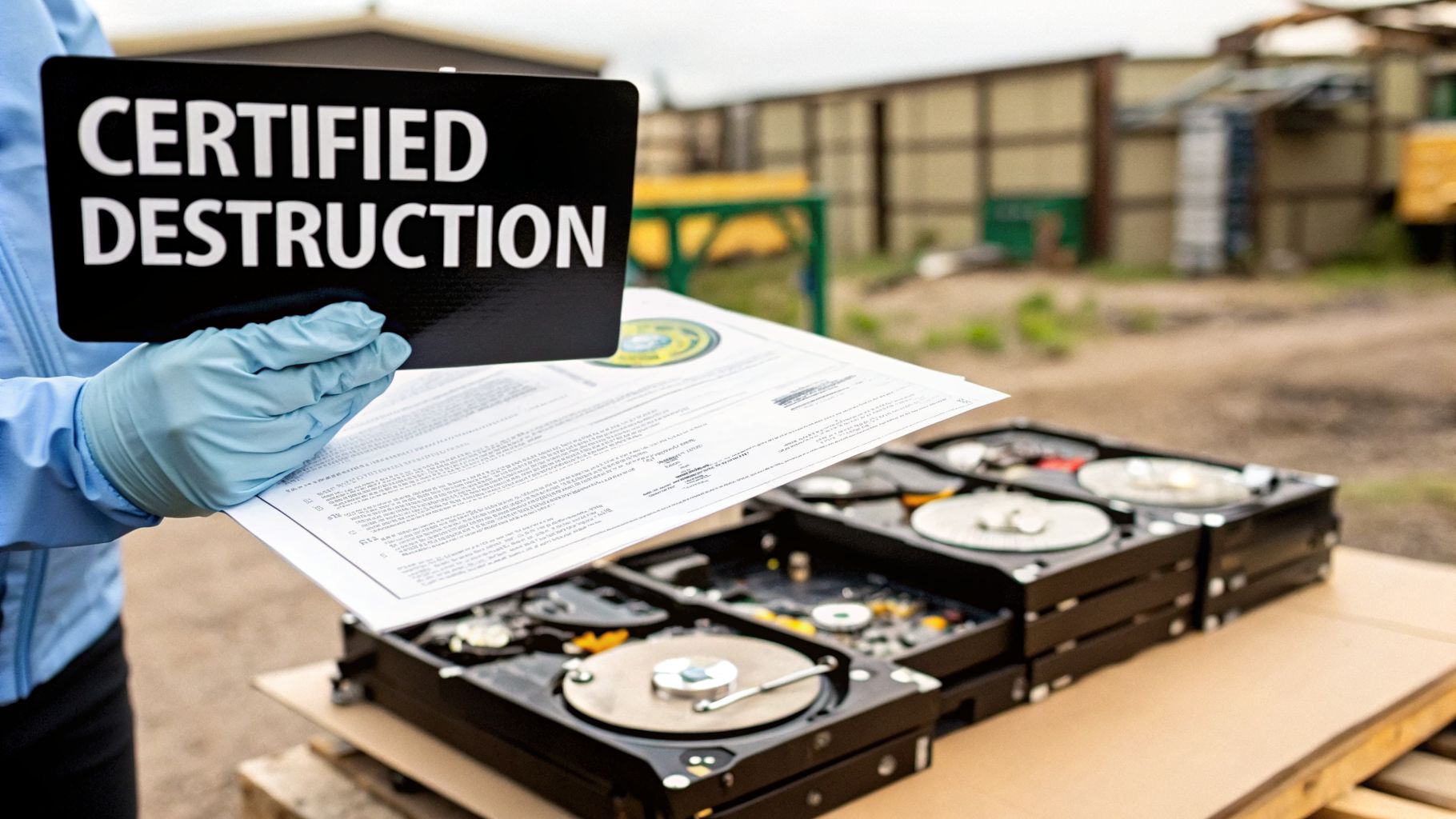
This is one area where you absolutely cannot afford to cut corners. The consequences of just one data breach can include crippling regulatory fines, legal battles, and a loss of customer trust that's incredibly difficult to win back. A certified destruction process is your only real guarantee that sensitive data is gone for good.
Choosing Your Destruction Method
Not all data destruction methods are the same. The right approach for your business depends on your industry's compliance rules, your internal security policies, and whether you plan to reuse any of the assets. Generally, it comes down to two industry-accepted options.
Software-Based Data Wiping
This process uses specialized software to overwrite every sector of a hard drive with random data, making the original information completely unrecoverable.
- Best For: Assets you intend to remarket, donate, or redeploy internally. Wiping preserves the physical drive, allowing it to be used again.
- Standard to Look For: Your partner must use a process that meets or exceeds NIST 800-88 guidelines, the definitive standard for data sanitization.
Physical Destruction
For the highest level of security, nothing beats physical destruction. This process involves feeding hard drives and other storage media into an industrial shredder, which pulverizes them into tiny, unrecognizable pieces of metal and plastic.
- Best For: Drives containing highly sensitive data, damaged or non-functional drives, or for organizations with a strict "no-reuse" policy for data-bearing media.
- Key Benefit: It provides undeniable, visual proof that the data can never be accessed again.
For IT managers in heavily regulated fields like healthcare or government contracting, the stakes are even higher. A healthcare provider in Arlington must ensure its process is fully HIPAA compliant, where physical destruction is often the preferred path for protecting patient data. Likewise, a local government contractor needs to satisfy CJIS (Criminal Justice Information Services) mandates, which require a rigorous and auditable destruction process.
On-Site Versus Off-Site Destruction
Another key decision is where the destruction happens. Each option offers clear benefits depending on your organization's specific security needs.
| Destruction Location | Key Advantages | Ideal Scenario |
|---|---|---|
| On-Site Destruction | You can witness the entire process at your own facility. Offers maximum peace of mind as data never leaves your premises intact. | A financial institution or government agency in Arlington with strict security protocols that require direct oversight of the destruction process. |
| Off-Site Destruction | Assets are securely transported to a specialized facility for destruction. This is often more cost-effective and efficient for larger volumes. | A corporate office decommissioning hundreds of laptops where logistics favor a streamlined, bulk process handled by a certified partner. |
No matter which method or location you choose, the non-negotiable outcome is a serialized, auditable trail.
The most crucial document you will receive is the Certificate of Destruction. This legally binding document serves as your official proof of compliance, itemizing every single serialized asset that was destroyed. It's your defense in an audit and your assurance that you've met your due diligence.
For many businesses, partnering with an experienced ITAD provider simplifies these decisions. A seasoned vendor not only handles the secure processing of all your assets but also optimizes the logistics, from secure nationwide pickups to turning surplus equipment into value. To learn more about the importance of this final document, see our detailed guide on the certificate of destruction for hard drives.
Navigating Arlington and Texas Compliance Demands
When it comes to retiring corporate IT assets in Arlington, simply dropping them off somewhere isn't an option. You're dealing with a serious web of state, federal, and industry-specific rules built to protect data and the environment. One wrong move can lead to heavy fines, a damaged reputation, and legal headaches. Getting a handle on these compliance demands is the first real step in building a secure Arlington corporate IT recycling program that won't come back to bite you.
On the state level, the Texas Commission on Environmental Quality (TCEQ) sets the rules for electronic waste. While many people have heard of the Texas Recycles Computers program, that's really for consumers and manufacturers. For businesses, the responsibilities are much more complex and are deeply connected to data privacy laws. This is exactly where a professional ITAD partner becomes non-negotiable.
The Impact of Evolving State Mandates
Texas is getting more serious about managing e-waste, and as a business, you need to be paying attention. There's a big date to circle on your calendar: January 31, 2026. This deadline is tied to an evolution in manufacturer compliance, but it's going to send ripples straight to your company's recycling program. As manufacturers are held to stricter take-back standards, they’ll lean even more on certified processors—the same kind of partners your business should already be working with.
This change highlights a clear trend: the state wants more accountability across the board. For your business, it means the days of using an informal or uncertified recycler are over. The expectation now is that every company will have an auditable, secure, and environmentally responsible process for its old tech.
The bottom line is simple: if your company created or stored the data, you are responsible for its secure destruction. That responsibility never goes away, even when you hand the hardware off. You can only delegate the work to a certified partner who can give you proof that the job was done right.
These state-level changes are also reflected locally. For example, as part of Texas’s 2026 e-waste evolution, Arlington's own budget plans show a growing focus on corporate responsibility and secure data management. For data centers and public-sector IT teams, this means having a formal ITAD process to inventory assets, wipe data, and dismantle hardware for recycling is becoming a baseline requirement.
Sector-Specific Compliance Scenarios
Different industries operate under different rules. A generic approach to IT recycling is not just lazy; it’s a compliance disaster waiting to happen.
Let's look at a few real-world Arlington scenarios:
A Government Agency: Imagine an Arlington city department retiring old servers that stored sensitive citizen records. To pass a state audit, they need a perfect, unbroken chain of custody and a serialized Certificate of Destruction for every single drive. Their ITAD vendor will likely need to perform on-site shredding to guarantee that data never physically leaves the building intact.
A Healthcare Laboratory: A local lab is getting rid of diagnostic equipment and PCs full of protected health information (PHI). They're bound by strict HIPAA rules. Their recycling partner absolutely must understand these regulations and provide all the necessary paperwork to prove compliant handling. You can learn more about what this involves in our guide on HIPAA-compliant electronics recycling in Texas.
A Financial Services Firm: A wealth management office is swapping out employee laptops. These machines hold client financial details protected by laws like the Gramm-Leach-Bliley Act (GLBA). For them, the top priority is absolute, undeniable data destruction. The only acceptable method is software wiping to NIST 800-88 standards, immediately followed by physical shredding.
In every one of these cases, a certified partner is more than just a vendor—they're your compliance shield. They bring the expertise and, more importantly, the documentation you need to prove you did everything right. This paperwork is your key to passing audits, protecting your brand, and boosting your company's Environmental, Social, and Governance (ESG) profile.
Creating Value from Your Retired IT Assets
Most companies see old IT gear as a sunk cost waiting for disposal. But a modern approach to Arlington corporate IT recycling treats retired technology as a source of recoverable value, not just an expense line. It's about shifting from a disposal mindset to a strategic one that prioritizes a financial return.
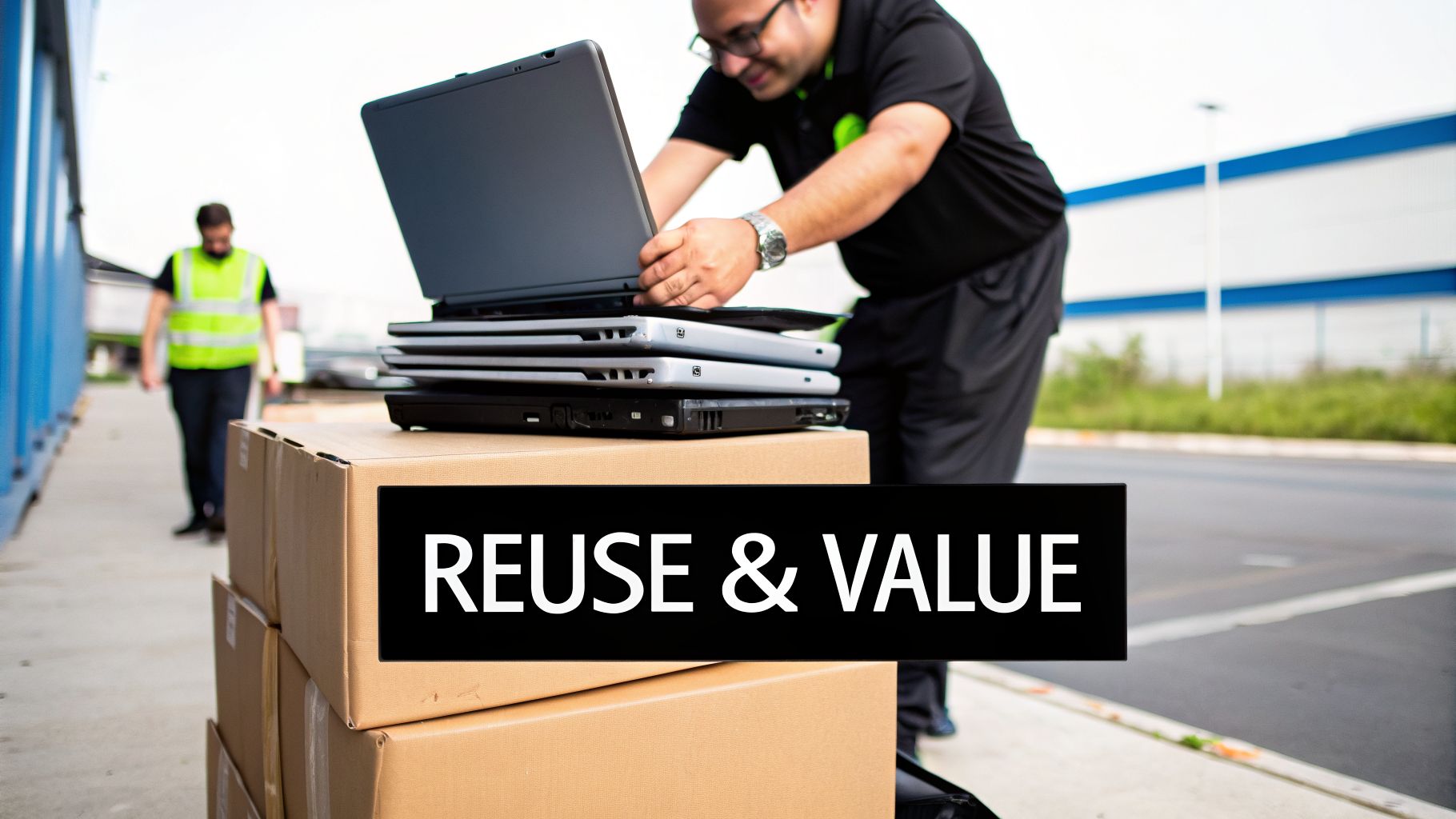
The foundation of this strategy is a "zero-landfill" policy. This isn’t just an environmental goal; it’s a financial one. It means every single asset is evaluated for its highest and best use, which directly translates to a better bottom line for your company. This turns the entire process from a cost center into a value-generating part of your operations.
The Hierarchy of Value Recovery
A professional ITAD partner doesn’t just see a pallet of old computers; we see a collection of opportunities. Our process follows a clear hierarchy designed to maximize your return at every stage.
Remarketing and Reuse: The most significant value comes from reselling functional equipment. Laptops, servers, and networking gear that are only a few generations old can be securely wiped, tested, and sold on secondary markets. This often generates enough revenue to offset or even exceed the cost of the entire project.
Refurbishment and Component Harvesting: If a device isn’t fully functional, it still has valuable parts inside. RAM, CPUs, and power supplies can be harvested from non-working servers or desktops and sold individually. It's a great way to extract cash from equipment that might otherwise be considered worthless. For more on this, our guide on where to sell used computer parts has practical tips.
Responsible Materials Recovery: For assets truly at the end of their life, the final step is breaking them down into their core commodities—plastics, steel, aluminum, and precious metals from circuit boards. This ensures nothing ends up in a landfill and returns raw materials to the manufacturing supply chain.
This structured approach guarantees you extract every bit of value from your retired assets before defaulting to simple recycling.
From Corporate Surplus to Community Impact
Beyond the direct financial return, a smart ITAD program is a powerful tool for boosting your company's Environmental, Social, and Governance (ESG) profile. Donating functional, data-safe equipment to local organizations creates a tangible, positive impact right here in the Arlington community.
Take this real-world scenario: An Arlington-based engineering firm upgrades 50 workstations. Instead of shredding them, they work with an ITAD partner to securely wipe the drives and refurbish the machines. A portion of these computers are then donated to a local school district or a nonprofit providing job training, giving them access to technology they couldn't otherwise afford.
This isn't just about charity; it's smart corporate citizenship. It shows a commitment to the community, provides a potential tax benefit, and creates a positive story to share with customers and employees.
Key Benefits of a Donation Program:
- Boosts Your ESG Score: Demonstrates a measurable commitment to social responsibility.
- Strengthens Community Ties: Builds goodwill and positive brand association within Arlington.
- Provides Tax Advantages: Donations to qualified 501(c)(3) organizations are often tax-deductible.
- Supports the Circular Economy: Extends the useful life of electronics, reducing the demand for new manufacturing.
When you start looking at your retired IT assets through a lens of opportunity, you can turn a routine operational task into a multi-faceted win. It's a strategy that delivers financial returns, supports your local community, and solidifies your company's reputation as a responsible corporate citizen.
Common Questions About Arlington IT Recycling
When it comes to IT asset disposition, we find that IT and procurement managers in Arlington often have similar questions. Getting clear, straightforward answers is essential for protecting your business and ensuring compliance.
Here are some of the most common questions we hear about Arlington corporate IT recycling, with the direct information you need to make the right decisions.
What Types of Electronic Equipment Can Be Recycled?
This is usually the first question we get: "What can you actually take?" The simple answer is that a certified ITAD partner can handle nearly every piece of technology a business uses, going far beyond just desktops and laptops.
A comprehensive recycling program should cover a wide range of corporate electronics.
Standard Office and Data Center Gear:
- Servers: This includes rack-mounted, blade, and tower servers.
- Data Storage: SANs, NAS devices, tape libraries, and individual hard drives (HDDs and SSDs).
- Computers: Desktops, laptops, docking stations, and thin clients.
- Networking Hardware: Switches, routers, firewalls, and modems.
Peripheral and Specialized Equipment:
- Telecom Systems: VoIP phones, PBX systems, and other communications hardware.
- Monitors: LCD, LED, and CRT monitors (though CRTs may involve special handling fees).
- Medical and Lab Devices: Specialized diagnostic machines and scientific instruments containing electronic components.
Basically, if it has a circuit board or a power cord, a professional recycler can almost certainly process it. The key is working with a partner who understands the unique handling and data security needs for each asset class.
How Much Does Corporate IT Recycling Cost?
The question of cost is not always a simple one-line answer. The final price—or even a potential return—depends entirely on the specifics of your project.
There are three main factors that determine the cost:
- Volume and Type of Equipment: The total amount of hardware is a primary driver. A single pallet of laptops has very different logistical costs compared to decommissioning an entire data center with dozens of server racks.
- Data Destruction Services: Your required level of security is a major factor. On-site physical shredding, where a mobile shred truck comes to your Arlington office, has a different cost structure than secure off-site data wiping.
- Logistics: This covers details like your building's location and access (e.g., loading dock vs. stairs) and the labor required to safely inventory, pack, and transport the assets.
It's important to remember that recycling costs are often offset by the value of the equipment itself. Through revenue sharing from the remarketing of functional laptops or servers, it's common for all service fees to be covered, sometimes even resulting in a net payment back to your company.
How Can I Verify a Recycler Is Certified?
This is a critical step in your due diligence. Taking a vendor's word for their certification is a risk you can't afford. Verifying their status is a straightforward process and is absolutely non-negotiable for secure Arlington corporate IT recycling.
The two most important certifications in the U.S. are R2v3 (Responsible Recycling) and e-Stewards. A provider with these credentials has passed stringent third-party audits covering data security, environmental safety, and worker health.
Here’s how to check a vendor's certification status:
- For R2v3: Go to the official SERI (Sustainable Electronics Recycling International) directory online. You can search by company name to confirm their certification is active. An expired or missing certificate is a major red flag.
- For e-Stewards: Use the official finder tool on the e-Stewards website. This directory lists all currently certified recyclers.
Always ask a potential partner for a copy of their current certificate and cross-reference the details with these official online directories. Any hesitation to provide this proof or any discrepancy you find should be an immediate dealbreaker.
Ready to implement a secure, compliant, and value-driven IT recycling program for your Arlington business? Dallas Fortworth Computer Recycling provides certified, end-to-end ITAD solutions nationwide. Learn how we can protect your data and turn your retired assets into a resource. Get started by visiting us at https://dallasfortworthcomputerrecycling.com.