
Texas Port Recycling for E-Waste: A Secure Guide

A logistics manager near the Port of Houston starts with the obvious search. There is a large, established name in the market. It handles metal at scale. It operates across Texas. On the surface, texas port recycling sounds like the right destination for retired servers, network gear, cable, and rack hardware.
For enterprise electronics, that assumption creates risk.
Port-area disposal projects are more than trucking problems. They are data security, environmental compliance, and chain-of-custody problems that happen to involve trucks, docks, yards, and schedules. If your team is decommissioning a data hall, replacing lab equipment, or clearing obsolete telecom inventory near a Texas port, the correct path is usually not the nearest scrap yard. It is a specialized IT asset disposition workflow designed for electronics from the first asset scan to the final destruction record.
The Port Recycling Misconception for Electronics
The misconception is simple. A company with “port recycling” in the name sounds like it should take anything recyclable that comes off a commercial site. For steel beams, structural scrap, autos, and mixed metal streams, that logic may hold. For enterprise electronics, it does not.

Texas Port Recycling was established in February 2006 through DJJ’s acquisition of Northwest Recycling, expanded with a Houston Ship Channel site in 2007, and later became part of Nucor in 2008. It now operates 4 recycling facilities across Texas and is built around large-scale ferrous and nonferrous scrap processing, including Houston’s largest automobile shredder, according to ScrapMonster’s Texas Port Recycling profile. That operating model matters because it tells you what the yard is optimized to do.
What the yard is built for
A bulk scrap processor makes money by moving material quickly, grading it correctly, and feeding high-volume equipment efficiently. That is the right setup for heavy metal recovery.
Electronics move through a different decision tree. You need to determine whether each unit should be reused, wiped, dismantled, or physically destroyed. You also need to preserve records at the asset level, not just by weight ticket.
Texas Port Recycling’s posted specifications explicitly prohibit electronics scrap such as circuit boards and CRT-related material, as noted in the company’s Houston port specs PDF. If your team arrives with decommissioned switches, laptops, drives, UPS control boards, or mixed e-waste, you can end up with a rejected load, a delayed project, or an improvised disposal decision nobody should make at the gate.
Why IT teams get tripped up
The confusion often comes from mixed loads.
A data center or industrial cleanout often includes:
- Clean metal value such as empty racks, copper cabling, and structural components
- Regulated electronics such as drives, boards, power supplies, monitors, and control units
- Sensitive devices that may still contain data, credentials, configurations, or patient and lab information
Those streams cannot be managed under one generic scrap assumption. Teams that need a compliant route for electronics in port areas are better served by a dedicated ITAD process, not by trying to force the load into a metal yard workflow. A more suitable starting point for planning is this practical guide to Texas electronics recycling options.
Key takeaway: If the facility’s published acceptance rules reject electronic scrap, treat that as a hard operational boundary, not a detail to negotiate on arrival.
Navigating the Port Area Regulatory and Logistics Maze
Port-area recycling jobs are coordination jobs first. The physical movement of assets is only one layer. The harder part is getting access, sequencing vendors, protecting custody, and making sure no one improvises when schedules slip.
Port conditions change how disposal projects run
A downtown office pickup and a port-adjacent pickup do not behave the same way.
Port sites often involve stricter access control, limited delivery windows, yard rules, contractor sign-in requirements, and staging constraints. Even when the electronics themselves are straightforward, the surrounding environment is not. A missed appointment can ripple into labor rescheduling, container issues, and longer exposure time for boxed assets waiting on a dock or in a cage.
For that reason, I advise logistics managers to treat port pickups as controlled movements, not ordinary service calls. That means locking down pickup windows, named contacts, escalation paths, and load-release authority before the truck rolls.
The oyster shell example is useful for IT teams
One of the clearest examples of how port recycling workflows become multi-agency operations comes from shell restoration around the Port of Corpus Christi. The Texas A&M University-Corpus Christi shell recycling program reclaimed 650,000 pounds of oyster shells, far above its original 225,000-pound target, and saw peak collection periods above 28,000 pounds monthly in April and June 2024. The program also required a mandatory six-month quarantine period before shells could be used, and restored reefs later showed an 11-fold increase in oyster densities for intertidal reefs and a 215-fold increase for subtidal reefs, according to the Texas General Land Office report on closing the loop.
That is not an electronics project, but the operating lesson transfers directly. Port-based recycling often includes extended timelines, handling controls, and multiple decision-makers outside the recycler itself.
What that means for electronics pickups
For IT assets, the equivalent controls look different:
- Pre-clear the load. Share asset categories before pickup so the receiving partner can reject problem items before trucks are booked.
- Define custody transfer points. Decide exactly when responsibility moves from your site team to the transport crew and then to the processor.
- Separate mixed materials. Keep bare metal, batteries, drives, boards, and reusable systems sorted before the truck arrives.
- Plan for exceptions. A locked cabinet, an unlabeled pallet, or a regulated device can stall the whole move if nobody owns the decision.
A generic scrap hauler may be able to move a load. That does not mean the chain of custody will survive scrutiny later.
Teams handling complex retirements in Texas typically need an enterprise-grade workflow such as IT equipment recycling for Texas organizations, where logistics and downstream processing are designed together.
Practical tip: Build your project plan backward from the final documentation you need. If you cannot prove what happened to each asset class later, the pickup plan is incomplete now.
Demanding the Right Credentials from Your E-Recycler
When a region has infrastructure gaps, credentials and network design start to matter more than marketing language.
Texas processed 12.9 million tons of municipal solid waste recycling in 2019, up from 9.17 million tons in 2015, and the MSW recycling rate increased from 22.7% to 27.5% over that period. At the same time, the state has uneven processing coverage. One facility in Kilgore handles about 18,000 tons annually and is the only MRF on the I-20 corridor between Dallas and Birmingham, according to the ECOS summary of Texas recycling infrastructure and strategy. For electronics, that kind of regional unevenness is a warning sign.

Certifications are a control system
In port-area projects, you are often dealing with distance, handoffs, and mixed downstream vendors. A certified recycler gives you a framework for managing those handoffs.
The two credentials procurement teams ask about most often are R2 and e-Stewards. I treat them as evidence that a recycler has undergone formal scrutiny around electronics handling, downstream accountability, and process discipline. Credentials alone are not enough, but lack of credentials usually tells you the vendor expects you to accept promises where you should demand records.
A good baseline for evaluation is this overview of what to expect from an R2 certified electronics recycler.
Questions worth asking before you sign
Do not ask whether the vendor is “secure.” Ask questions that force operational answers.
- Where is data destruction performed? On site, at a secure facility, or both?
- How is chain of custody documented? Asset list, serial capture, sealed transport, signed handoff, and exception logs should all be discussed plainly.
- Who handles downstream materials? You want to know whether the recycler controls the full path or brokers parts of the stream.
- How are mixed loads managed? Many port-area retirements include batteries, peripherals, drives, and metal. The recycler should explain separation, not wave it away.
- What happens to reusable equipment? Remarketing should be controlled and documented, not treated as an informal side channel.
What does not work
The wrong answers usually sound smooth.
A vendor who talks only in terms of “green disposal,” “responsible recycling,” or “free pickup” may still be competent. But those phrases do not tell you how drives are tracked, how exceptions are handled, or whether the vendor can maintain auditable custody across a regional logistics chain.
A serious ITAD partner should be able to explain process, paperwork, and escalation without hesitation.
Executing Secure Data Destruction and Asset Disposition
Here, the difference between scrap and ITAD becomes operationally obvious.
Texas Port Recycling grew from its 2006 launch into a high-volume scrap processor with a Houston Ship Channel facility opened in 2007, and its model is built around industrial equipment and destructive metal processing, according to the earlier cited scrap yard profile. That is appropriate for scrap metal. It is not the same discipline required to retire electronics with asset-level accountability.
Start with asset triage, not the truck
A secure project begins before pickup.
Your team should identify which assets fall into these broad categories:
| Asset category | Primary concern | Preferred handling approach |
|---|---|---|
| Data-bearing devices | Data exposure | Sanitization or physical destruction with records |
| Reusable enterprise hardware | Value recovery and license cleanup | Test, grade, and controlled remarketing |
| Non-reusable electronics | Environmental compliance | Responsible dismantling and downstream recycling |
| Mixed metal from IT rooms | Commodity recovery | Separate from e-waste before shipment |
That first sorting step prevents a common failure. Teams often put everything on pallets together and expect the downstream vendor to sort it out later. That makes serial tracking harder and increases the chance that valuable or sensitive assets get processed under the wrong instruction.
Choose the destruction method on purpose
Different devices call for different controls.
Software sanitization is a fit when the media is functional and your policy permits logical erasure. This supports reuse and value recovery, but only when the process is documented and verified.
Degaussing applies to specific magnetic media scenarios. It is not a universal answer for all storage technologies, and teams should not assume one destruction method covers every drive type in a mixed retirement.
Physical shredding or crushing is the right choice when policy, device condition, or regulatory sensitivity makes reuse inappropriate. It is final, simple to defend, and often preferred for high-risk environments.
If your organization needs a planning benchmark, review what a specialized provider offers for secure data destruction services. The important point is not the marketing label. It is whether the service produces verifiable evidence tied to your assets.
Special handling matters for certain environments
Healthcare, laboratory, and industrial environments add another layer.
A desktop fleet refresh is one thing. Retiring diagnostic systems, lab analyzers, embedded controllers, or equipment with attached storage is another. Those assets may contain patient information, research data, credentials, calibration records, or proprietary configurations. They also may contain components that require more careful segregation than ordinary office devices.
For data center decommissions, the same principle applies at scale. You need a method for capturing rack location, serials, drive counts, and removal status before the first cabinet is broken down.
What the final reporting package should include
The handoff is not complete when the truck leaves. It is complete when your records can survive audit, legal review, and internal questions months later.
Look for reporting that includes:
- Asset detail with serial-level or equivalent identification where appropriate
- Disposition outcome showing whether equipment was reused, recycled, or destroyed
- Data destruction records tied to the assets or media processed
- Exception documentation for missing tags, damaged labels, or items outside the approved scope
- Environmental reporting that shows responsible downstream handling at a level your compliance team can use
Key takeaway: Weight tickets are useful for scrap. They are not a substitute for asset records when the load contains electronics.
Understanding Costs and Unlocking Hidden Asset Value
Most budget confusion comes from comparing two different business models as if they were the same.
A scrap yard buys material value by weight. ITAD evaluates equipment as a mix of service cost, risk control, and potential resale value. Those are not interchangeable calculations.
Texas recycling economics show how much processing conditions matter. The state’s recycling industry generated $4.8 billion in economic impact, and facility modernization can materially improve capture rates. In one case, moving from manual aluminum can sorting to eddy current technology increased capture by 50%, adding 4 million beverage cans annually at that facility, according to the earlier cited ECOS summary. The lesson for electronics is straightforward. Better process design changes recovery outcomes.

Why scrap pricing feels simple but often fails IT teams
Texas Port Recycling’s public-facing information leaves common pricing questions unresolved, and the broader scrap context is volatile. The available market note says metal prices fluctuated 15% to 20% in 2025, highlighting why scrap payouts can be hard to forecast for planning purposes, as discussed on the Texas Port Recycling Houston page.
For IT managers, the issue is not just volatility. It is misalignment.
A scrap model rewards mass. A secure ITAD model rewards correct classification.
A pallet of retired laptops may look like low-value mixed material to a metal buyer. To an ITAD partner, some units may still have reuse value, some may require certified destruction, and some may need compliant parts harvesting. Those paths produce different economics.
What usually belongs in the financial review
A proper quote should address more than commodity value.
- Pickup and logistics costs tied to location, packaging, and access conditions
- Data destruction charges based on method and audit requirements
- Labor-intensive handling for rack removals, device sorting, or regulated equipment
- Value recovery credits for assets with secondary-market demand
If your team wants to understand whether parts and systems may still carry resale potential, a practical reference point is this guide on where to sell computer parts.
Practical tip: Ask vendors to separate service charges from asset recovery credits in writing. That one step makes it much easier to compare bids fairly.
What works financially
The strongest projects treat disposition as a controlled recovery program, not a cleanup fee.
That means preserving reuse where policy allows, destroying data by the right method rather than the loudest method, and avoiding avoidable failures such as rejected loads, undocumented custody breaks, or emergency re-sorting after pickup. Those mistakes rarely show up on the first quote, but they are where disposal budgets usually go sideways.
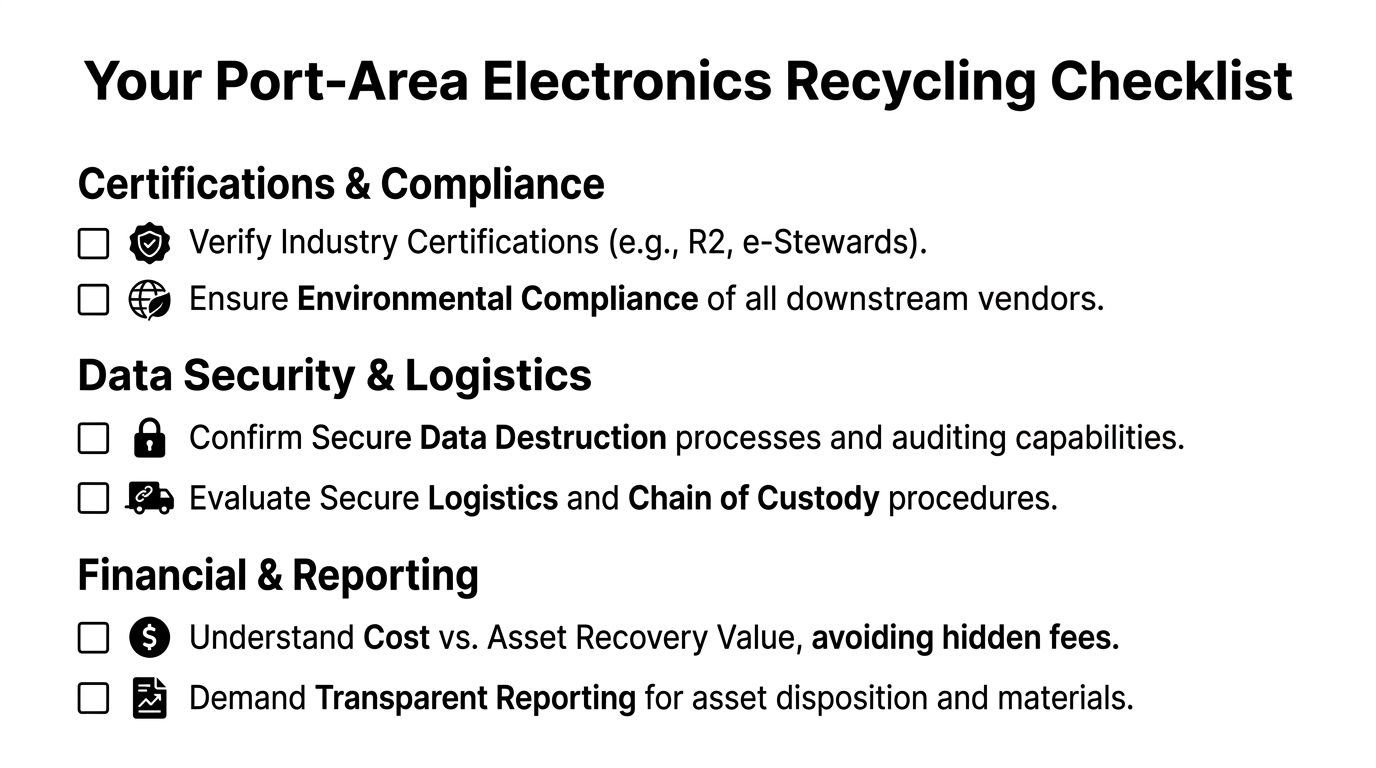
Your Port-Area Electronics Recycling Checklist
Use this list before any pickup near a Texas port, inland terminal, or ship channel facility. It is short enough for operations, but specific enough for compliance and procurement.
Before vendor selection
- Confirm acceptance rules. Verify that the destination is approved for electronics, not just metal.
- Check certifications. Ask for current documentation for the recycler’s relevant industry certifications.
- Map downstream handling. Know whether the vendor processes in-house or relies on additional downstream partners.
Before pickup day
- Build an asset list. Separate data-bearing devices, reusable hardware, non-reusable electronics, and clean metal.
- Define custody points. Record who releases the load, who signs for it, and how exceptions are escalated.
- Review site access. Port-area sites can involve stricter timing, staging, and contractor access requirements than ordinary office pickups.
During processing
- Match method to risk. Use the right data destruction method for the media and policy involved.
- Keep mixed loads separated. Do not let drives, boards, batteries, and clean steel travel as one undifferentiated stream.
- Document deviations immediately. Missing tags, surprise devices, and damaged equipment should be logged before final processing.
Before you close the project
- Collect final reporting. Make sure the recycler provides asset disposition records and data destruction documentation.
- Review financial reconciliation. Compare service fees, recovery credits, and any exception charges against the original quote.
- Archive records centrally. Store chain-of-custody and disposition documents where legal, compliance, and IT can retrieve them later.
A Texas port recycling search can be the right starting point for metal. For electronics, it should trigger a more careful question: who can move this material securely, document every step, and process it under an ITAD standard rather than a scrap assumption?
Dallas Fortworth Computer Recycling helps organizations retire technology through secure, documented IT asset disposition, data destruction, and electronics recycling workflows built for commercial and public-sector needs. If your team is planning a port-area pickup, a data center decommission, or a mixed-load electronics project in Texas, start with Dallas Fortworth Computer Recycling for a compliant path that fits enterprise requirements.