
Texas Football: An Insider’s Guide to the Lone Star State
You are likely here because texas football feels impossible to pin down from the outside. Maybe you have watched a Saturday game in Austin or College Station, heard people talk about recruiting like it's weather, or noticed that in Texas the sport begins long before college and lingers long after the final whistle.
That instinct is right.
In this state, football is not a weekend diversion. It is a pipeline, a language, a calendar, and for many towns, a public square. The same kid who plays under portable lights on a Thursday in a small district can become the center of a statewide recruiting fight by Friday night, then headline an SEC game a few years later. Fans do not experience those stages separately. They experience them as one connected system.
That is what makes texas football different. The high school game shapes local identity. College football turns those same players into symbols of institutional ambition. The business around it all (media, merchandising, travel, donor culture, and now player movement) keeps the machine running year-round.
Its More Than a Game Why Football Is a Texas Religion
On a fall evening in Texas, you can tell where the stadium is before you see it. The marching band carries across neighborhoods. Parking lots fill early. Families arrive in school colors, grandparents greet each other by first name, and kids throw footballs in strips of grass beside the entrance.
That scene repeats in big cities, farm towns, and suburbs that barely existed a generation ago. The uniforms change. The rituals do not.
Football matters here because it gives people a shared story. A town that argues all week can still sit on the same side on Friday. A university with internal politics and competing priorities can still gather around one team on Saturday. Even people who do not follow depth charts know when a rivalry game is coming.
The game becomes local identity
In Texas, football functions as civic theater. The head coach becomes a public figure. The quarterback becomes a reference point in everyday conversation. The band, cheer squad, drill team, booster club, local restaurants, and radio hosts all become part of the same ecosystem.
That is why outsiders sometimes miss the point. They look for wins and losses alone. Texans look for belonging first.
Football in Texas works because it gives people a place to gather, a reason to care, and a set of traditions they can pass down without explaining much.
Even the routines around game day matter. Tailgates, postgame breakdowns, local newspaper columns, and school-week chatter all reinforce the idea that football is part of community life, not separate from it. In places growing as fast as North Texas, where neighborhoods change quickly and people arrive from everywhere, those rituals can do some of the same work as older institutions. Even local services outside sports reflect how communities organize around shared routines, whether that is a school fundraiser or practical logistics like e-waste pickup in Frisco.
Why the obsession lasts
Texas football survives bad seasons because the attachment is not only about championships. It is about memory.
People remember where they were for a goal-line stand, a homecoming upset, or a rivalry win that changed the mood of a whole town. They remember who they watched it with. That is the engine under the obsession. The game is the event. The product is connection.
The Bedrock of Legends Inside Texas High School Football
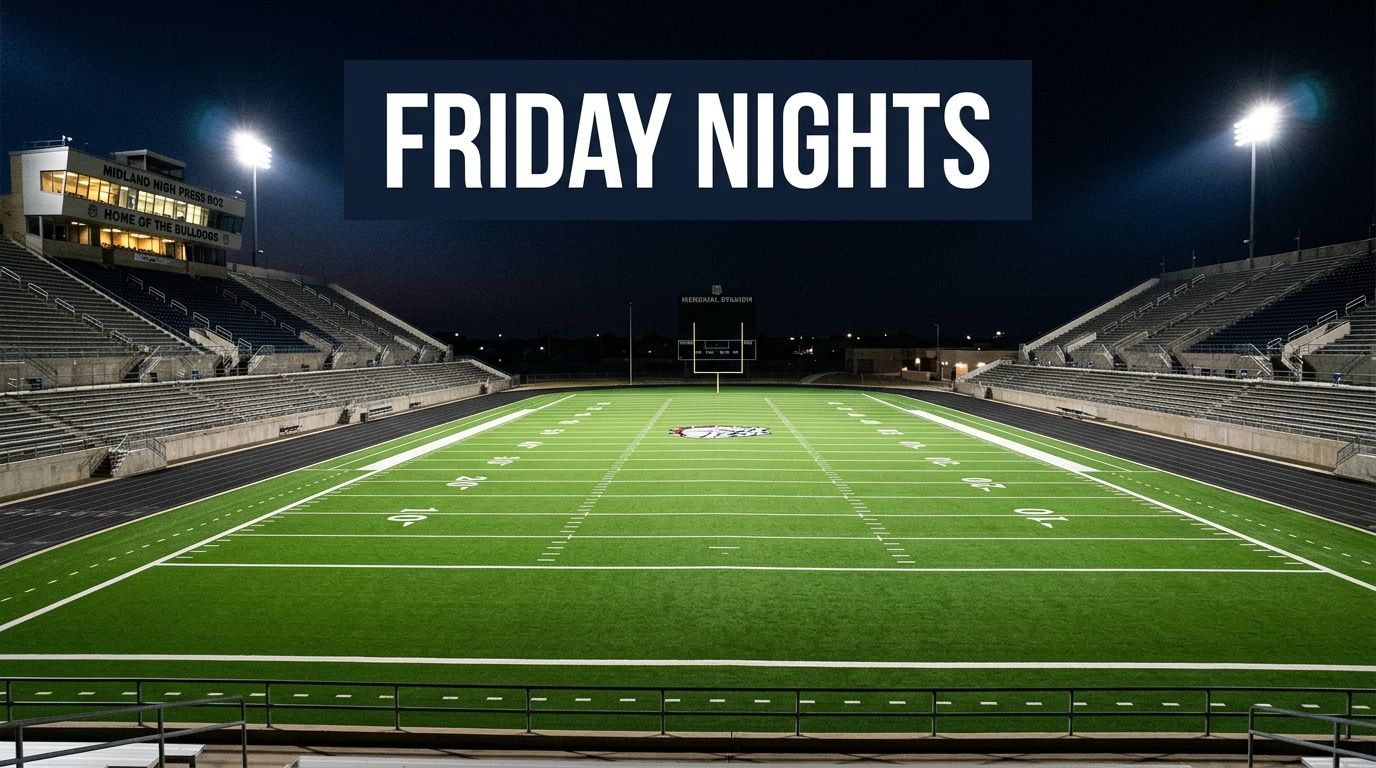
Texas high school football is where the state teaches itself what football means. If you want to understand the college game here, start with Friday night.
The structure looks simple from a distance. Schools compete by classification, communities rally around them, and top players get recruited. In practice, it is much more layered than that. Size matters. Geography matters. Local expectations matter most of all.
How the high school system works
Most fans first learn Texas football through the school classifications, commonly discussed from 1A to 6A. The shorthand tells you the scale of the school and something about the weekly environment around the team.
A bigger classification often means:
- Larger rosters with more two-way depth
- Bigger support staffs for strength training, video, and scouting
- More media attention from local outlets and recruiting services
A smaller classification means something different, but no less intense:
- Players doing more jobs on both offense and defense
- Tighter community ownership of the team
- Game nights that feel like town reunions
That distinction matters. A powerhouse in a major suburban district might look polished in the modern college style. A smaller-school contender might lean on toughness, continuity, and a quarterback who grew up in the system. Both produce players colleges want.
Why some programs keep producing talent
Programs like Allen, Katy, and Southlake Carroll have become reference points because they combine resources, coaching continuity, and clear identity. People describe these schools as talent factories, but that undersells the advantage.
Their edge comes from repetition.
Kids in those communities grow up seeing the varsity standard long before they reach it. They know the terminology. They know the expectations in the weight room. They know what a playoff run feels like because older siblings, neighbors, and former players already lived it.
Practical rule: Great high school programs do not just develop athletes. They standardize habits early.
That is the bridge to recruiting. College coaches do not only evaluate size and speed. They look for players who have handled pressure, absorbed coaching, and played inside a demanding structure. A recruit from a strong Texas program arrives on campus with a better sense of weekly preparation than fans realize.
What Friday night supports
The game itself is one part of the machine. Around many high school programs, you will find:
| Part of the ecosystem | Why it matters |
|---|---|
| Booster clubs | They support game-day operations, school spirit, and add continuity from class to class |
| Local businesses | They tie commerce to school identity through sponsorships and visible support |
| Youth feeder programs | They introduce schemes, expectations, and rivalries early |
| Community media | They keep players and coaches in public conversation all season |
That is why high school football in Texas feels oversized. It is not just one team playing one game. It is a town rehearsing what it values.
If you spend time around these programs, you learn what does not work. Chasing hype without line play holds up. Putting too much on one star player shows. Communities that expect winning but ignore infrastructure stall out. The healthiest programs invest in coaching, player development, and continuity.
For fans trying to understand the full pipeline, pay attention to where college staffs spend time, which coaches have long-standing relationships, and which schools send polished players year after year. That tells you more than a splashy highlight tape. Even off the field, communities support these large school-centered operations through local institutions and practical services, including electronics recycling across Dallas Fort Worth.
The emotional core of Friday Night Lights
What makes this level unforgettable is not only the recruiting value. It is the intimacy.
At a high school game, the players are close enough to everyday life that fans know their families, teachers know their schedules, and the whole town feels the weight of a third-and-long. That is the purest version of texas football. The later stages get richer, louder, and more commercial. They do not get more personal.
Titans of Saturday A Guide to College Football Powerhouses
On a fall Saturday in Texas, the rhythm changes by noon. High school stars from the night before are on unofficial visits, college staffs are protecting home turf, donors are watching from suites, and families are arguing over two or three games at once. That is the college layer of texas football. It takes the emotion built on Fridays and runs it through bigger budgets, harder schedules, and national stakes.
Texas sits at the center of that machine, but the state's college story is larger than one logo.
The Longhorns carry the broadest spotlight because they combine history, money, recruiting pull, and a fan base that treats national relevance as the standard. The expectations are specific. Win the line of scrimmage, develop depth, stay in the playoff race, and prove the roster can hold up over a full SEC schedule. Anything short of that gets dissected all week.
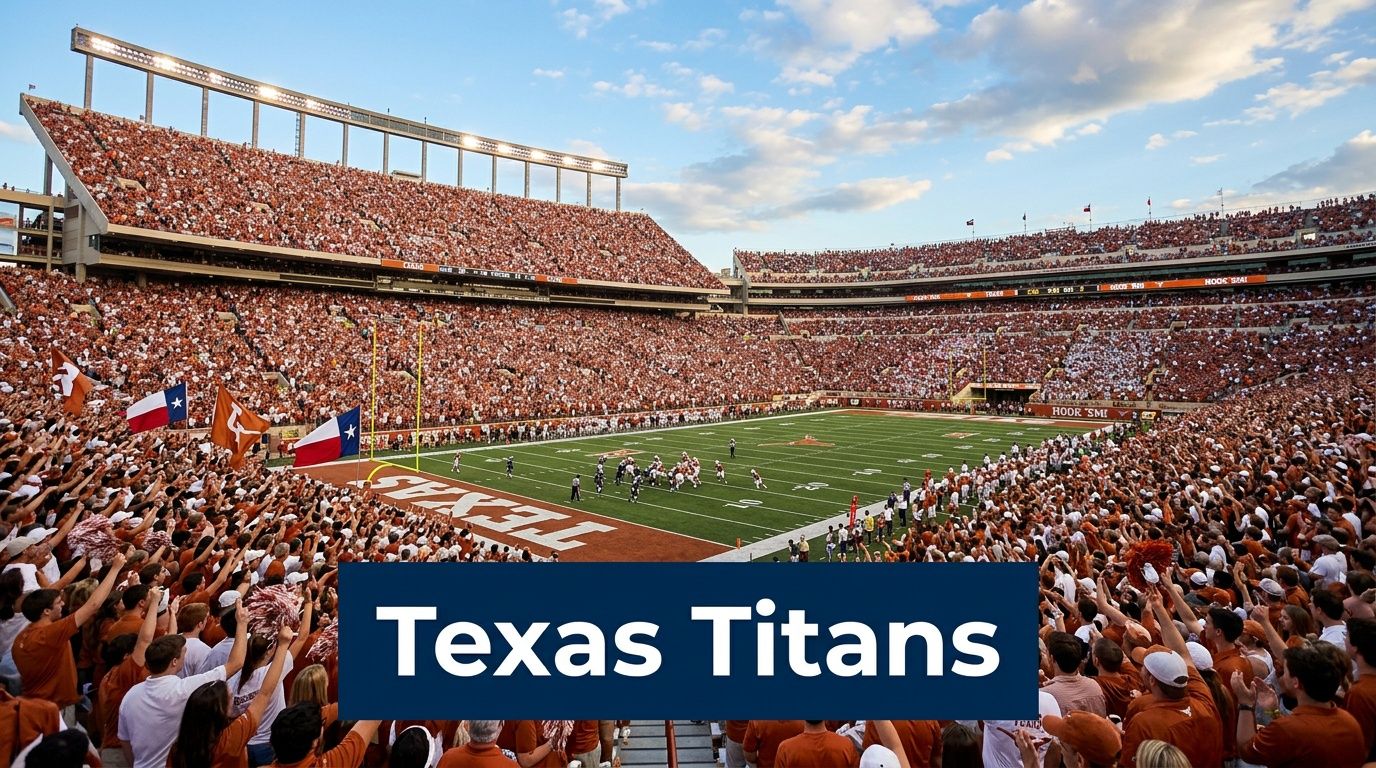
Texas A&M lives in the same pressure tier, even if the culture feels different. The Aggies run on tradition, ritual, and a strong sense of internal identity. That can be a strength because it creates buy-in. It can also tighten the walls when results stall. Either way, A&M has too much money, too much talent access, and too much pride to accept drifting through the middle.
SEC membership raised the bar for both visibility and roster construction. Fans can no longer judge a contender by a clean September record alone. They have to ask tougher questions. Can the offensive line survive repeated heavyweight matchups? Does the defensive front have enough bodies for November? Can the secondary handle tempo one week and power football the next?
This is the fundamental trade-off at this level. Star power wins headlines. Depth wins seasons.
Texas college football also makes more sense when you stop treating it as a two-team conversation. The state keeps producing meaningful programs because the pipeline is wide, the recruiting base is dense, and different regions support different football identities. Fans who care about program building can see that system up close around the Metroplex, including on game weekends in Arlington where major events and local operations overlap with practical services like secure electronics recycling in Arlington.
TCU has shown the cleanest version of efficiency. The Horned Frogs do not need the largest fan base in the state to matter. They need sharp evaluation, quarterback clarity, and a roster that understands exactly how it wants to play. When TCU is good, it looks organized before it looks flashy.
Baylor is a different case. The program has reached serious highs and taken serious hits, which makes it one of the better examples of how fragile momentum can be in this state. Coaching alignment matters there. So does institutional patience. When those pieces match, Baylor can play above its size and command national attention.
Texas Tech still carries a distinct edge because West Texas football has its own temperament. The fan base wants a team with personality, toughness, and enough offense to make anyone uncomfortable. Tech's problem is not relevance. It is consistency. The program has to turn atmosphere and identity into year-over-year substance.
Houston may be the clearest reminder that geography alone does not guarantee control of talent. The Cougars sit in one of the richest recruiting areas in the country, but they also compete in one of the most crowded sports markets in America. That creates upside and pressure at the same time. If Houston gets the coaching hire right and holds local relationships, the ceiling rises fast.
The hierarchy inside texas football is real. It changes more than outsiders assume.
Programs here hold up when they recruit Texas well without becoming closed off, match scheme to personnel, and build enough depth to absorb injuries. Programs slip when they chase headlines, force systems on the wrong roster, or expect one quarterback to cover every weakness.
Saturday power in Texas is never separate from the rest of the ecosystem. High school programs supply the talent. Colleges shape the stars. The biggest brands drive television money, recruiting traffic, and statewide attention. Put together, they form one engine, and every program in the state is trying to claim a bigger share of it.
Mark Your Calendars Key Rivalries and Season Highlights
A fair week in October, a packed parking lot before sunrise, and two fan bases arguing over barbecue, quarterbacks, and history before the gates even open. That is how the Texas football calendar announces itself. Around here, big games are not background entertainment. They set the mood for towns, campuses, households, and sports bars across the state.
That matters because the schedule is how the whole Texas football pipeline reveals itself in public. High school seniors visit campuses during rivalry weekends. College staffs protect recruiting turf while trying to win the game in front of them. Television windows, hotel rates, donor traffic, and local business all move with the same calendar. In Texas, football dates function like economic markers as much as sporting events.
The games that carry extra weight
The Red River Rivalry remains the clearest annual test of what Texas can handle under pressure. The game is old, public, and unforgiving. The University of Texas rivalry overview lists the series record and first meeting, but the bigger truth is visible every year. One afternoon in Dallas can change how fans judge a coach, how recruits talk about a program, and how the rest of the conference reads Texas.
The revived Lone Star Showdown hits a different nerve. Texas against Texas A&M is less about novelty than memory. Families split along burnt orange and maroon lines. Alumni carry old arguments into new seasons. The game pulls in the full state map, from Houston money to Hill Country tradition to small-town pride.
Then there are the rivalries that shape a season even when they do not dominate national coverage. Baylor and TCU bring decades of proximity, familiarity, and private-school edge. Texas Tech makes every visit to Lubbock feel volatile because style and setting both matter out there. Houston can turn a stable season into a stressful one if a roster has cracks.
Major Texas Football Rivalries
| Rivalry Name | Teams Involved | First Played | Trophy/Stakes |
|---|---|---|---|
| Red River Rivalry | Texas vs. Oklahoma | Early 20th century | Border-state bragging rights, recruiting momentum, conference impact |
| Lone Star Showdown | Texas vs. Texas A&M | Long-running in-state rivalry | Statewide prestige, cultural pride, alumni bragging rights |
| Revivalry | Baylor vs. TCU | Long-running in-state rivalry | Private-school supremacy in Texas, conference positioning |
| West Texas edge | Texas Tech vs. Texas | Long-running in-state rivalry | Regional pride, upset potential, fan intensity |
How the season unfolds
September tests assumptions
Early results tempt people into hard conclusions that do not hold up. September is for identifying habits. Does the offensive line pass off pressure cleanly. Does the secondary tackle in space. Does the staff trust the quarterback to win a third-and-8 throw instead of hiding him?
Good teams sharpen. Flawed teams get exposed later.
October reveals identity
By October, the conversation gets more honest. Conference games strip away soft edges. If a team cannot handle crowd noise, field position, or a one-score fourth quarter on the road, Texas fans will spot it fast.
That part of the calendar shows how tightly football is tied to ordinary life here. In North Texas, a major game weekend can affect traffic patterns, restaurant waits, hotel availability, and family schedules. People plan errands around kickoff, including practical stops like secure electronics recycling in Arlington, because football does not sit apart from the rest of the weekend. It organizes the weekend.
November rewards grown-up football
November settles the fraud debate. Depth matters more. So does health, line play, and emotional control. Young teams can still flash, but veteran teams win late because they make fewer bad decisions after six straight weeks of heavy scouting and tired legs.
Watch who stays assignment-sound, who avoids pre-snap penalties, and who can run the ball when everyone in the stadium knows it is coming. That is the part of the season that connects Friday nights to Saturday stakes. Texas produces talent everywhere, but rivalry season and the stretch run reveal which programs can turn talent into structure.
The smartest way to follow texas football is to track pressure, not rankings. Rivalries carry memory. The calendar adds consequence. In this state, the biggest games show how one football culture feeds the next, from high school dreams to college power.
The Faces of the Game Iconic Players and Legendary Coaches
Walk into a Texas living room on a fall Saturday and the conversation often turns from the scoreboard. It turns to the coach who set the standard, the back who ran with bad intentions, or the quarterback who carried a whole state's expectations without blinking. That is how football memory works here. Programs matter, but people give them shape.
Darrell Royal and the shape of authority
For the University of Texas, Darrell K Royal stands as the coach who turned winning into an expectation instead of a hope. His teams played with control, discipline, and a clear identity. In Texas, that combination carries weight because fans judge a coach on more than play design. They judge whether he fits the temperament of the place.
Royal fit it. He won big, but the larger legacy was cultural. He made Texas football feel organized and durable, the way strong programs at every level in this state try to look. High school coaches borrowed the tone. College fans borrowed the standard. That pipeline effect matters.
A legendary Texas coach has to manage public pressure. Every town has opinions. Every donor has one more. Every week brings noise. The coaches who last here are the ones who can keep a roster steady while the whole state debates the team.
The backs who carried the program’s image
Texas has always had a soft spot for punishing runners, and two names sit at the center of that tradition.
Earl Campbell won the 1977 Heisman Trophy, as recognized by the Heisman Trophy Trust’s Earl Campbell profile. He became the kind of player Texans admire on instinct. Violent runner. Reliable finisher. No wasted style.
Ricky Williams won the 1998 Heisman Trophy, according to the Heisman Trophy Trust’s Ricky Williams profile. His greatness looked a little different. More production, more buildup, more national attention. But the appeal was familiar. Texas fans respect backs who can carry an offense when everyone in the stadium knows what is coming.
That preference starts long before college. On Friday nights, fans fall for the back who can close out a game in the fourth quarter. By Saturday, those same instincts scale up. The heroes change. The taste stays the same, like the state's attachment to big, recognizable brands, whether it is a Heisman winner or a stop at Texas Roadhouse in Texas football country.
Vince Young and the performance people still replay
Every major program has historic wins. Few have a single performance that ends arguments twenty years later.
Vince Young gave Texas one. The official Rose Bowl game recap from Texas Athletics documents the Longhorns' national title win over USC, and it remains one of the clearest examples of a star meeting the moment without shrinking from it. Young did not merely produce. He made the game feel larger while it was happening.
That is why his place in Texas football goes beyond one championship. He linked recruiting hype, big-game poise, and statewide memory in one night. High school quarterbacks saw what the top of the pipeline looked like. College fans saw what Texas could be at its best.
The pressure on today’s stars
Modern quarterbacks live under harsher conditions than the legends who came before them. Every throw gets clipped, reposted, and judged in real time. The pressure starts in recruiting and does not stop after kickoff.
That is why Arch Manning matters as more than a famous surname. Texas listed his 2025 production on the school's Arch Manning player profile, and the numbers explain part of the story. The harder part to judge is how a young quarterback handles the attention that comes with leading one of the few programs in America that gets treated like a public trust.
In Texas, iconic status is never awarded at signing day. It is earned over time, under scrutiny, with everybody watching.
The Football Economy Culture Community and Commerce
By late Friday afternoon in Texas, the effect is easy to see. The cafe near the stadium adds staff. The booster club table is already set up. Local radio shifts into game coverage, and families who may disagree on everything else still end up in the same stands.
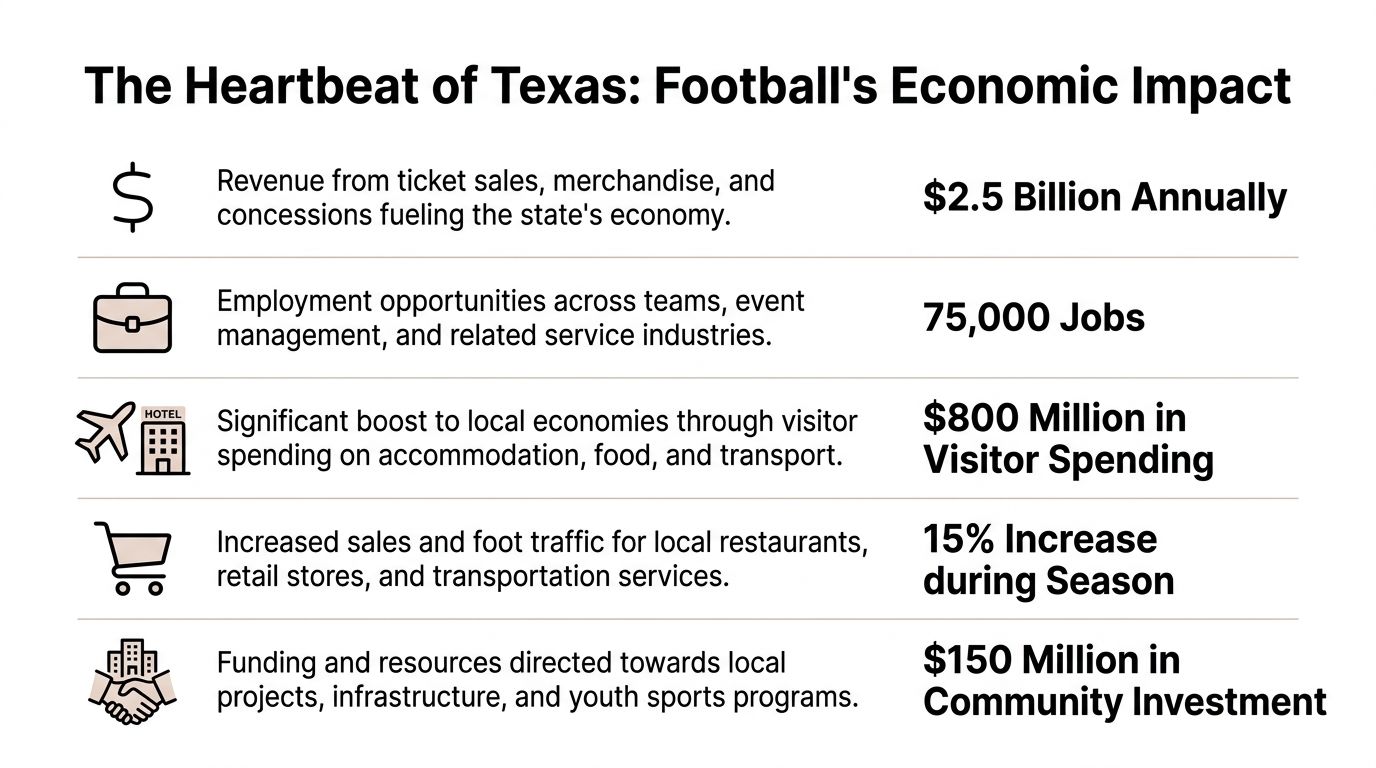
That rhythm carries from high school fields to college campuses, and it is one reason texas football works as more than entertainment. It is a weekly engine for local spending, civic identity, school visibility, and year-round conversation. In this state, the pipeline is connected. A packed high school stadium feeds college recruiting. College brands feed media money, donor interest, and business traffic. The whole system keeps circulating attention and dollars.
Community money and community ritual
Small towns and major cities express it differently, but the pattern is the same. Football weekends create predictable business for restaurants, parking lots, print shops, hotels, apparel sellers, and local media. School groups use those nights to raise money. Alumni groups turn them into reunions. City leaders know a full stadium means a busy commercial district.
College towns magnify that effect. In Austin, College Station, Lubbock, and Fort Worth, home games change traffic patterns, staffing plans, and sales expectations for an entire day. Tailgates start early, bars and restaurants fill in waves, and merchants count on visiting fans to spend before and after kickoff.
That is the visible side of the economy.
The roster is now part culture, part marketplace
The harder part sits inside the football building. Coaches are no longer managing recruiting, development, and game plans only. They have to handle transfers, donor expectations, NIL structure, and the risk that a thin position room can get thinner in one portal window.
Texas fans have learned the trade-off. Aggressive portal activity can patch a weakness fast, but constant turnover makes it tougher to build trust across an offensive line, keep leadership in the locker room, or develop depth patiently. Money can help get talent on campus. It cannot speed up cohesion.
That is why retention carries value. Veteran linemen, backup safeties who know the system, and respected captains hold a team together in October more than a headline addition in January.
What keeps the machine healthy
Programs hold up better when they do three things well.
- Keep veteran leadership in place: Experience matters most at positions where communication and trust break down slowly, then all at once.
- Match NIL spending to roster needs: Smart collectives use resources with purpose instead of chasing every recognizable name.
- Protect the local bond: Fans, donors, and businesses stay invested longer when they feel connected to the players and staff, not just the brand.
The opposite approach shows up fast on the field:
| What does not work | Why it hurts |
|---|---|
| Treating every portal cycle like an auction | Rosters get older, thinner, or less balanced in key spots |
| Paying for splash instead of fit | Talent arrives without solving the actual problem |
| Ignoring the town around the team | Programs lose goodwill that matters when results dip |
There is a broader civic layer. Football brings together school districts, chambers of commerce, restaurant owners, sponsors, churches, youth leagues, and local media in one recurring public event. Texas has always been comfortable tying big communal rituals to business relationships, including hospitality and local partnership pages such as Texas Roadhouse-related community pages.
A healthy program reflects a healthy ecosystem around it.
That is the part outsiders miss. Texas football is not a set of teams separated by age and level. It functions like one connected network, with high school passion feeding college power, and college success feeding money, attention, and ambition back into communities across the state.
Your Guide to Experiencing Texas Football Firsthand
A cool Friday night in a small Texas town and a hot Saturday afternoon in Austin can feel like two different worlds. Sit through both in the same weekend, and the whole system starts to make sense. The high school band, the booster club, the college tailgate, the donor chatter, the former players on the sideline, the little kids in jerseys copying warmups. Texas football is easiest to understand in person because every level feeds the next one.
The fastest way to get past highlights and hot takes is simple. Go to a game. If you cannot make that happen, build a routine that gives you context instead of noise.
That matters because hype seldom explains roster reality. Texas has signed highly ranked recruiting classes in recent years, but roster turnover, player development, injuries, and line depth still decide whether a season holds up in November. Smart fans track those factors before they start talking playoff paths.
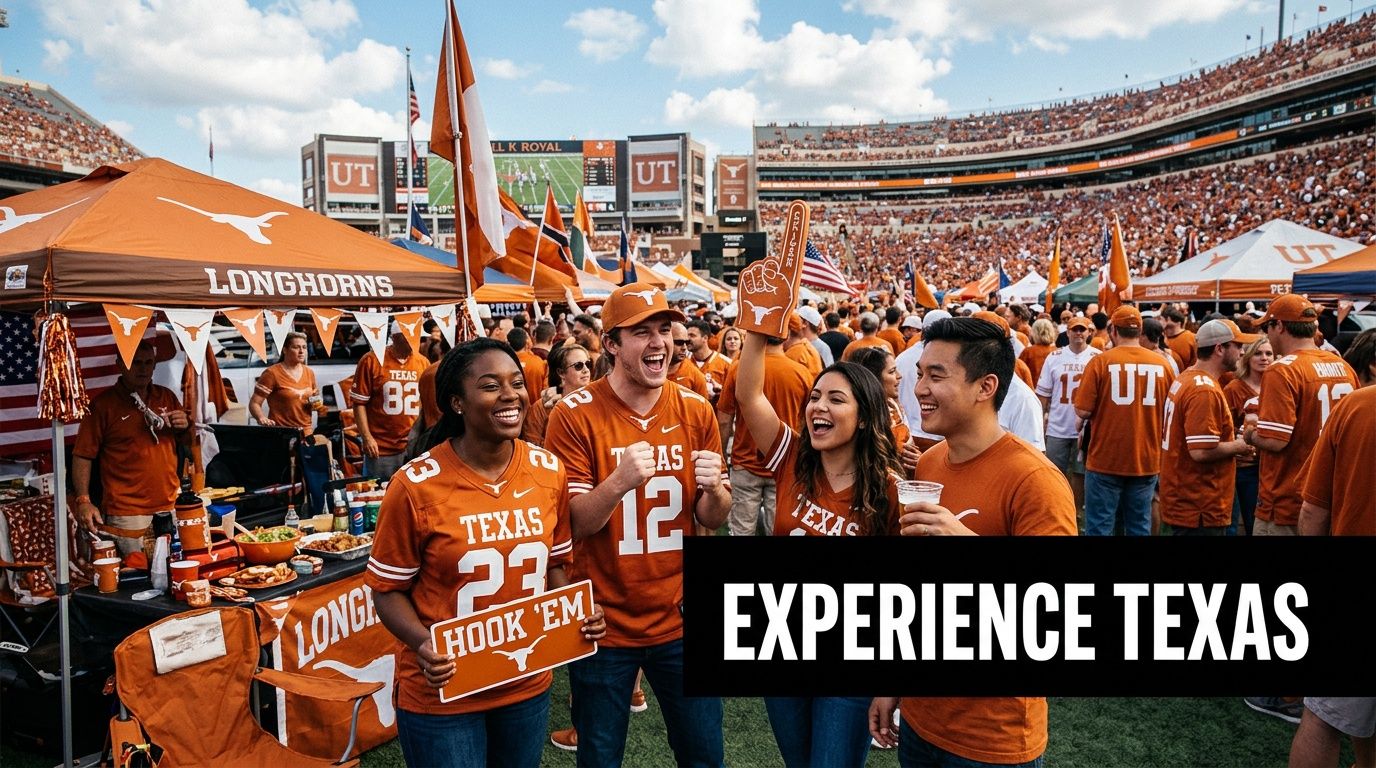
To experience the sport firsthand, start with these experiences
Go to a high school rivalry game
This is the best entry point.
Tickets are manageable, parking is easier, and you can hear the whole community around the game. Watch how early people arrive. Watch the band march in. Watch how many former players are standing along the fence talking ball. High school football in Texas shows you the roots of the culture before money and TV windows reshape it.
Pick one major college Saturday
Choose a home weekend in Austin, College Station, Fort Worth, Waco, Lubbock, or Houston. Get there early and walk outside the stadium before kickoff. The conversations tell you a lot. Serious fans are talking about left tackle play, linebacker rotations, and whether the backup corner can hold up. Casual fans are talking brand, rankings, and playoff scenarios. Both groups matter, but only one spots trouble before it shows up on the scoreboard.
Watch one road game with local fans
Road Saturdays reveal a fan base in a different way. The setting strips out some of the pageantry and leaves the habits. You learn who follows the roster week to week, who knows the coordinators' tendencies, and who only checks in when the team is ranked. That mix is part of Texas football too.
How to follow the sport without getting buried
You do not need every rumor account. You need a few reliable lanes of information and the discipline to ignore the rest.
- For recruiting: Use established outlets such as On3 and 247Sports to track commitments, flips, and portal movement.
- For team context: Read beat writers who attend practices, interview coaches and players, and travel with the team.
- For game understanding: Look for film review and postgame breakdowns that explain protection issues, coverage busts, and situational decisions.
- For perspective: Treat spring buzz, star ratings, and one big transfer as part of the story, not the whole story.
A practical game-day checklist
| Goal | Best approach |
|---|---|
| Feel the culture | Attend a high school game first, then a college home game |
| Learn the roster | Read a depth chart and injury update before kickoff |
| Judge a team accurately | Watch line play, substitutions, and discipline, not only highlights |
| Avoid hype traps | Track continuity, road performance, and how a team handles late-game situations |
One habit helps more than people realize. Build your own fall rhythm. Pick a few teams. Learn their rivalries, coaching tendencies, and roster pressure points. Trying to consume all of Texas football at once turns a great sport into background noise.
For readers in the state who spend weekends juggling errands, family plans, and kickoff times, it helps to sort out practical details early, including the Austin recycling pickup schedule and local collection rules. Saturdays are a lot better when the chores are already handled.
The best fans are not loud. They know what they are watching, why a matchup tilts one way, and which parts of a program carry from one season to the next.
Texas football opens up once you stop seeing isolated teams and start seeing the full pipeline. Friday nights shape recruiting, identity, and community pride. Saturdays turn that energy into money, exposure, and pressure at a bigger scale. That is why the obsession lasts. The whole state keeps feeding the machine.