
Find Managed Telecom Services Near Me: A Buyer’s Guide

Your branch phones drop calls at random. A circuit issue sits with one carrier, while the voice provider says the WAN is the problem. Finance wants a cleaner invoice. Operations wants fewer outages. You search managed telecom services near me because the current setup is wasting time that should be spent on actual IT planning.
That search usually starts as a support problem and turns into a sourcing problem. Once you dig in, you’re not just replacing a vendor. You’re deciding who will own carrier coordination, monitoring, change control, billing clarity, site rollouts, and the messy handoff between old infrastructure and the replacement environment.
The shift is bigger than one procurement cycle. The global telecom managed services market is projected to grow from $24.76 billion in 2024 to $66.34 billion by 2032, according to Fortune Business Insights on telecom managed services market growth. That tells you something useful as a buyer. More organizations are moving telecom operations to managed partners because internal teams often have more valuable work than chasing circuit tickets, reconciling invoices, and coordinating branch cutovers.
A local search still matters. On-site response, carrier relationships, and knowledge of regional service constraints can make or break a deployment. But “near me” shouldn’t narrow your thinking too early. It should push you to compare local presence, remote operational maturity, and lifecycle support, including what happens to the equipment you’re retiring. If you’re evaluating options alongside broader telecom solutions near me for business infrastructure planning, treat the search as the start of a full operating model review, not a quick vendor lookup.
Starting Your Search for Managed Telecom Services
A search for managed telecom services usually starts after something breaks. A branch cutover slips, invoices do not match installed services, or a carrier outage turns into a three-way blame exercise between your ISP, your voice vendor, and your internal team. By the time someone types "managed telecom services near me" into Google, the underlying problem is rarely access to circuits. It is lack of operational control.
The most common mistake I see is starting with provider names instead of the failure pattern. “We need a local telecom company” can point to very different needs. Sometimes the issue is on-site response. Sometimes it is carrier management, invoice discipline, or ownership of changes across multiple sites. In other cases, the business is about to refresh network equipment and no one has planned what happens to the routers, firewalls, handsets, and edge gear coming out of service.
That last point gets missed often. Telecom buying decisions do not end at turn-up. They also create retired assets that have to be tracked, removed, and dispositioned without creating security or compliance problems. If you are reviewing broader telecom solutions near me for business infrastructure planning, include the end-of-life process early instead of treating it as a cleanup task after migration.
What the search is really about
The environments that trigger this search tend to share the same operating issues:
- Too many service layers: primary internet from one carrier, backup from another, UC from a third party, and local field support arranged case by case.
- Unclear accountability: incidents bounce between providers because nobody owns the full service chain from carrier ticket to site restoration.
- Billing noise: invoices arrive in different formats, with weak alignment to active circuits, contract terms, or actual site usage.
- Change pressure: branch openings, relocations, Wi-Fi refreshes, cloud migrations, and voice changes stack up faster than internal teams can coordinate them.
This requires the buyer’s mindset to shift from “Who sells circuits nearby?” to “Who can run this environment with discipline, document it properly, and exit old infrastructure cleanly?”
Practical rule: Do not buy managed telecom services just to reduce the number of vendors. Buy them to create one accountable operating layer for service delivery, carrier escalation, site changes, and the retirement of replaced equipment.
Why local search still matters
Local presence matters, but not for the reason many buyers assume. A provider does not become a fit because its office is close to your headquarters. The primary advantage is whether it can dispatch at the right sites, manage regional carrier realities, support cutovers without hand-holding, and coordinate removals when old gear leaves production.
That creates a real trade-off. A smaller local provider may offer strong field coverage and faster hands-on support, but weak reporting, contract governance, or after-hours escalation. A larger managed provider may bring tighter process and better monitoring, but rely on subcontractors for site work. Neither model is automatically better. The right choice depends on whether your main risk is physical response, operational consistency, or cleanup of legacy assets after the upgrade.
Clarify whether you are trying to buy bandwidth or operational control. Answering that question truthfully simplifies the selection process.
Defining Your Actual Telecom Service Needs
Jumping straight into demos is how organizations end up overbuying features and underbuying execution. Before speaking with providers, build a working picture of your current estate, your failure points, and your future operating model.
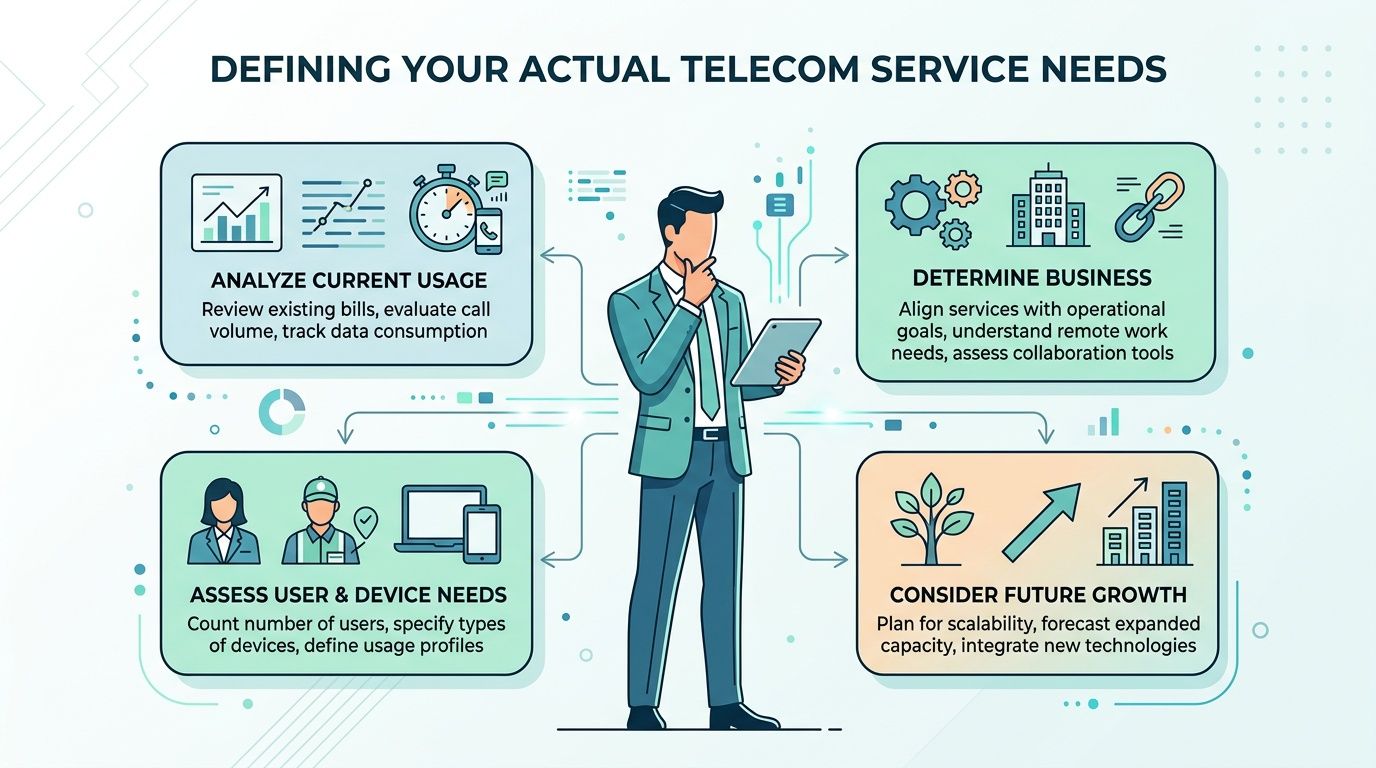
Start with a telecom inventory that finance and operations can both use
Most telecom environments are documented in fragments. Network has one list. AP has another. Branch managers keep their own notes. None of those count as a decision-grade inventory.
Build one sheet that captures:
- Active services including internet circuits, voice services, wireless lines, contact center tools, and managed Wi-Fi.
- Contract details such as provider name, renewal timing, notice periods, and any known billing disputes.
- Site dependencies that show which locations rely on each service and what breaks if that service fails.
- Hardware in use including routers, switches, firewalls, handsets, controllers, and any telecom gear sitting in racks with unclear ownership.
- Escalation reality documenting who currently opens tickets, who approves changes, and who gets blamed when outages drag on.
Many projects encounter difficulties. Self-managed telecom projects often struggle, with 71% taking longer than planned and 62% exceeding budgets, while MSP-managed projects benefit from a structured methodology, according to Innowave on telecom consulting myths and implementation outcomes.
That matters because a provider can’t fix what you haven’t scoped. If your own inventory is vague, every proposal will be padded with assumptions.
Separate symptoms from root requirements
Teams often describe issues in the language of frustration. “Support is bad.” “Calls sound terrible.” “Billing is a mess.” Useful complaints, but weak buying criteria.
Translate those into requirements:
| Current complaint | Procurement requirement |
|---|---|
| Calls fail at peak times | Clear voice quality monitoring, incident ownership, and carrier escalation workflow |
| Branch outages take too long to resolve | Defined response process, local field support options, and cutover playbooks |
| Invoices don’t match services | Billing audit discipline, inventory reconciliation, and change tracking |
| New sites take too much effort | Standardized onboarding templates and repeatable deployment process |
A lot of organizations discover they don’t need “more telecom.” They need better governance around what they already buy.
Define the future state before vendors define it for you
Write the target state in plain language. Don’t let the provider do that work for you. Your document should answer:
- Which services stay local: for example, on-site support, carrier turn-up coordination, or branch remediation.
- Which services can be centralized: monitoring, help desk intake, invoice review, reporting, and vendor management.
- Which platforms must integrate: voice, collaboration, ticketing, identity, or security tooling.
- Which sites need special handling: executive offices, clinics, warehouses, public sector locations, or shared facilities.
- What gets retired: not just contracts, but the hardware being replaced.
If your environment spans regions or includes consolidation work, it helps to compare providers against broader enterprise telecom solutions for distributed organizations, especially when local support alone won’t cover network standardization needs.
A good requirements document makes sales demos shorter, proposals cleaner, and contract negotiations tougher for the wrong vendor.
When you do this work upfront, you stop buying promises. You start buying fit.
Your Vendor Vetting and Evaluation Checklist
Once you know what you need, provider evaluation becomes much less subjective. You’re no longer judging who gave the smoothest presentation. You’re judging who can operate your environment without locking you into a brittle stack, a vague SLA, or a billing model that turns ugly after month six.
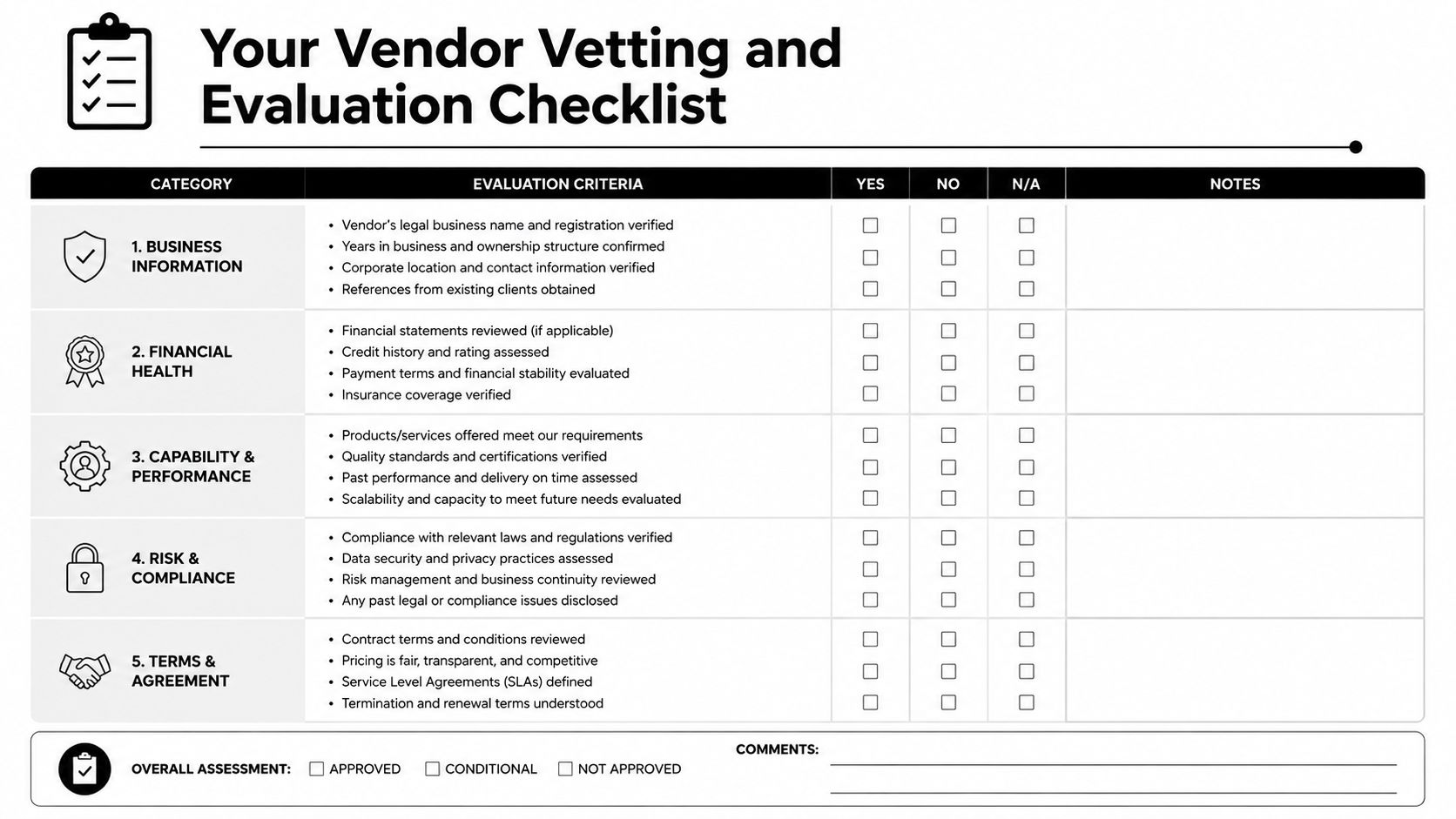
Technical capability matters more than product breadth
Some providers look impressive because they resell everything. Voice, internet, wireless, SD-WAN, contact center, managed Wi-Fi. That catalog isn’t the point. The question is whether they can support a mixed estate without hiding behind vendor boundaries.
One of the biggest risks is lock-in. Seventy-five percent of MSPs rely on vendor-specific management systems, which can limit flexibility and increase long-term cost exposure, according to Broadband Breakfast on managed service provider Wi-Fi and platform challenges.
That stat should change how you vet any “single pane of glass” pitch.
What to verify in the technical review
- Multi-vendor support: Ask whether the provider can operate mixed environments or whether they tend to force standardization around their preferred manufacturer.
- Monitoring depth: You want service monitoring, fault visibility, ticket correlation, and clean escalation ownership, not just a portal with green lights.
- Configuration discipline: Find out how they document changes, approve maintenance windows, and handle rollback if a cutover fails.
- Carrier management: The provider should own carrier pressure, not merely forward you a ticket number.
- Integration capability: Check whether they can fit into your ticketing, identity, reporting, and security workflows.
A provider with weaker branding but stronger operational habits often outperforms a flashy reseller with a narrow tooling stack.
Read the commercial model like an operator, not a purchaser
Plenty of telecom contracts look manageable until service changes start. Then every MACD event, site add, disconnect request, or billing dispute becomes a separate mini-negotiation.
Evaluate the business terms with the same rigor you’d apply to technical fit.
Commercial signals worth paying attention to
| Area | What good looks like | What usually causes trouble |
|---|---|---|
| Pricing structure | Clear separation of recurring charges, one-time costs, and optional field work | Bundled pricing with vague “as needed” service language |
| Billing controls | Inventory-linked billing and dispute workflow | Invoices that can’t be reconciled to live services |
| Contract flexibility | Clear service schedules and defined exit terms | Long commitments with unclear offboarding obligations |
| SLA language | Specific response and escalation definitions | Marketing language masquerading as enforceable commitments |
Many teams often overlook hidden cost drivers. If a provider can’t explain when charges start, when they stop, and how disputes are handled, the proposal isn’t ready.
Buyer test: If finance, infrastructure, and operations each read the contract and come away with different interpretations, the wording is too loose.
Local support is more than truck rolls
The “near me” part of the search still has value, but buyers often define it too narrowly. Local doesn’t just mean an office nearby. It means practical support logistics.
Review these points closely:
- On-site response model: Do they have their own field resources, local subcontractors, or a best-effort dispatch process?
- Escalation path: Can you reach a named account team and an operations lead, or only a generic support queue?
- Regional carrier familiarity: Local knowledge helps when serviceability, construction coordination, or branch-specific carrier issues become blockers.
- Project governance: Ask who runs cutover calls, documents milestones, and handles exception management.
If you’re comparing regional options, it can help to review the broader range of local telecom companies serving business environments and then narrow your shortlist based on service ownership, not just proximity.
Red flags that usually show up early
A weak provider often tells on itself before the contract stage. Watch for these patterns:
- They answer architecture questions with brand names. That usually means the solution is tied to preferred resale relationships, not your environment.
- They can’t show a change process. If implementation discipline isn’t visible during sales, it won’t appear later.
- They avoid discussing offboarding. Vendors who hate talking about exits usually make exits painful.
- They separate service from accountability. If they say, “That’s the carrier’s responsibility,” too often, they’re not offering managed service. They’re offering managed forwarding.
Strong vetting saves more than money. It prevents operational drift after the honeymoon period ends.
Asking the Right Questions to Uncover the Truth
A polished proposal won’t tell you how a provider behaves during an outage, a failed cutover, or a billing dispute. Direct questions will. This part of the process works best when you stop asking broad prompts like “How do you handle support?” and start forcing specifics.

Ask for process, not promises
You’re trying to uncover how the provider runs work. That means every question should pull toward workflow, ownership, and evidence.
Use questions like these in live calls and in your RFI or RFP:
- Incident ownership: When a voice issue could be caused by LAN, WAN, handset, or carrier routing, who owns triage until root cause is identified?
- Escalation discipline: What does your escalation ladder look like during a branch outage, and who has authority to pull in carriers or field technicians?
- Root cause review: After a major incident, what written analysis do you provide, and how do you track repeat issues?
- Change governance: Who approves production changes, and how are maintenance windows documented and communicated?
- Billing accountability: If our invoice doesn’t match active services, what’s the dispute process from ticket open to credit resolution?
- Field support model: For sites outside your home market, do you use employees, subcontractors, or carrier dispatch?
These questions work because they’re hard to answer with generic language.
Make providers show their operating habits
A strong provider should be able to walk you through examples without hand-waving. Ask to see redacted artifacts where appropriate:
| Ask for this | Why it matters |
|---|---|
| Sample onboarding plan | Shows whether they run deployments with structure |
| Example escalation matrix | Reveals whether support is real or improvised |
| Redacted incident report | Demonstrates root cause discipline |
| Billing review sample | Indicates whether finance issues are operationalized |
| Service review template | Shows how they manage accountability over time |
“Show me the document” is usually a better buyer question than “Can you do this?”
If they claim mature operations but can’t produce examples, assume the process depends on a few experienced people rather than a repeatable system.
Build your RFP for comparability
Many RFPs fail because they invite storytelling. Providers answer in different formats, making comparisons messy. Force consistency.
Use a response structure that requires:
- Direct yes or no answers for capability questions.
- Named dependencies where a function relies on a third party or carrier.
- Defined assumptions for pricing, onboarding, and site scope.
- Exceptions list showing what’s out of scope.
- Operational ownership statement for support, provisioning, invoicing, and decommissioning coordination.
If your footprint includes branch complexity or secondary markets, compare answers against practical telecom services in Houston and similar regional service models to see whether the provider’s “local support” claim really scales beyond one metro area.
A vague answer in procurement becomes a painful surprise in operations. Push until the provider either gives you specifics or reveals that they can’t.
Negotiating Contracts and Planning for Onboarding
Once you’ve identified the best-fit provider, don’t relax. Telecom contracts often look settled because pricing is visible, while the expensive risks sit in support language, implementation assumptions, and termination mechanics.
The local market affects this more than many buyers realize. MSP coverage is uneven across the U.S. The Midwest accounts for 72.7% of MSP service coverage, while Texas represents 4.1% and New York 4.4%, according to Infrascale’s U.S. MSP coverage statistics. In practical terms, some markets have plenty of local options, while others have fewer credible providers competing for the same accounts.
Negotiate the clauses that shape operations
Monthly price matters. The clauses below matter more once the service is live.
Focus hard on:
- SLA definitions: Make sure support response, escalation, and service restoration terms are specific enough to enforce.
- Implementation assumptions: If the provider has assumed clean circuits, accessible MDF/IDF spaces, or carrier-ready sites, get those assumptions documented.
- Exit rights: You need a clean path for transition assistance, credential handoff, configuration return, and service inventory export.
- Billing start and stop rules: Spell out exactly when recurring charges begin, how disconnects are processed, and how disputed charges are credited.
- Change controls: MACDs, relocations, after-hours work, and emergency support should not live in a gray zone.
If a provider resists clarifying these points, that’s not a legal nuisance. It’s an operational warning.
Use onboarding to test the relationship early
The first ninety days usually tell you whether you bought a true managed service or just a better sales team. Good onboarding is deliberate and visible.
Look for a plan that includes:
| Onboarding area | What you want to see |
|---|---|
| Governance | Named stakeholders, meeting cadence, and escalation map |
| Discovery | Verified inventory, contract review, and carrier baseline |
| Transition | Milestones for ticket handoff, monitoring setup, and reporting |
| Site work | Branch-by-branch cutover sequence and dependency tracking |
| Documentation | Current-state and future-state records with ownership defined |
The onboarding plan should reduce ambiguity, not produce more of it.
A provider serving a thin local market may try to rush contracting because they know options are limited. Don’t reward that behavior. Scarcity should make you more careful, not less. If local field presence is weak, negotiate stronger remote support accountability and tighter milestone governance before signature.
Closing the Loop with Telecom Asset Disposition
A telecom modernization project isn’t finished when the new circuits are live or the new voice platform is stable. It’s finished when the old equipment is out of your environment, data risks are addressed, and disposal is documented well enough for audit, security review, and internal asset reconciliation.
That’s the part many managed telecom providers barely address.
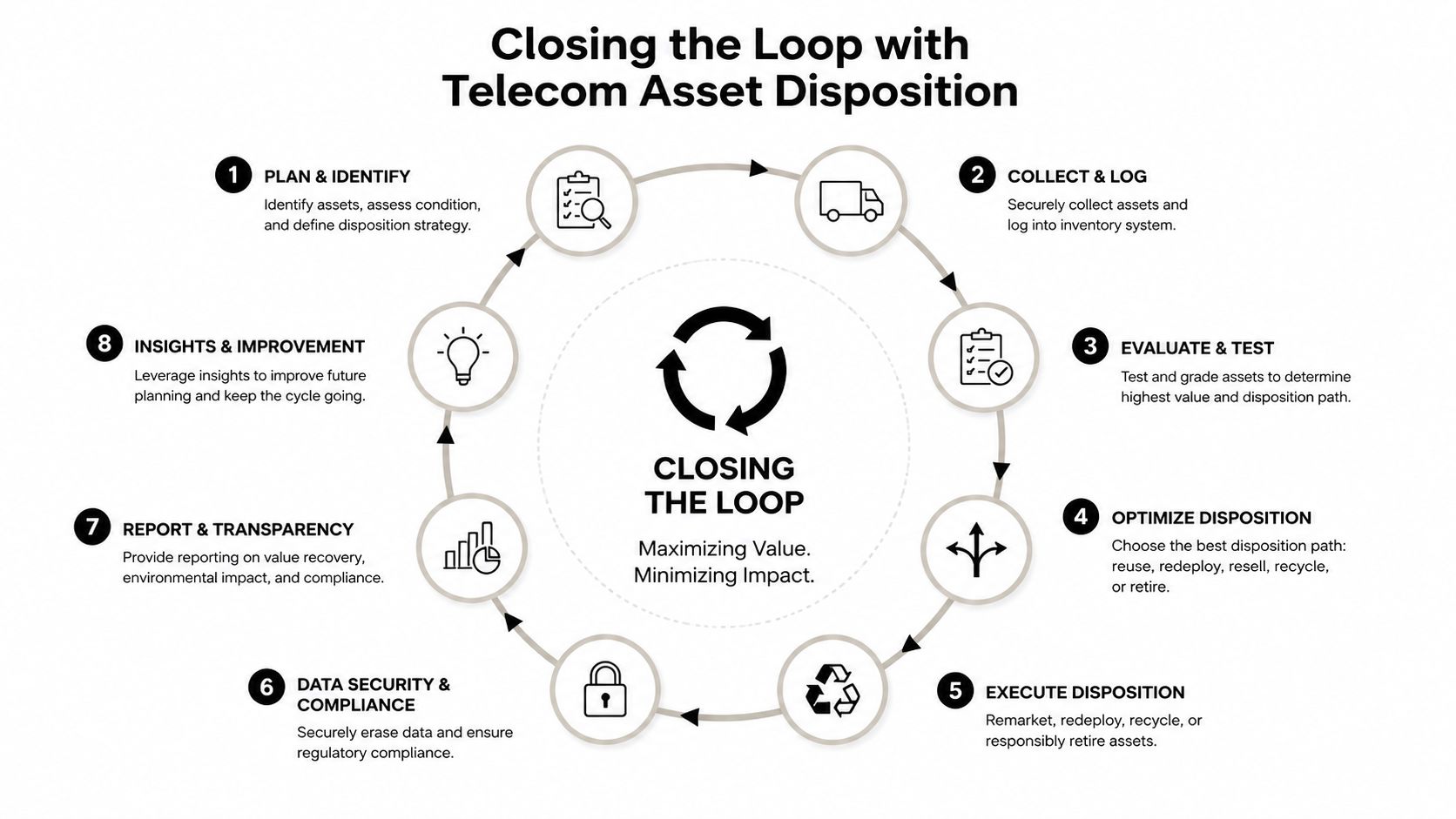
There’s a real gap in the market. Managed telecom providers focus on network optimization but rarely provide integrated services for secure, compliant retirement of replaced hardware, as noted by Managed Telecom Services on provider scope and lifecycle gaps. For IT leaders, that means the project can look complete while racks still hold old routers, switches, voice gear, and branch equipment with unresolved data and chain-of-custody risk.
Why this gets missed
Telecom teams often center the project around activation. Procurement focuses on contract terms. Infrastructure focuses on cutover. Nobody owns the retired hardware unless someone names it directly.
That creates predictable problems:
- Old gear gets stockpiled in closets, racks, and storage rooms.
- Asset records drift because disconnected equipment isn’t formally processed.
- Data-bearing devices stay untracked after decommissioning.
- Compliance documentation never materializes because disposal wasn’t scoped.
A generic recycler doesn’t solve that. You need a process that matches enterprise risk controls.
What a sound disposition plan includes
Treat telecom asset disposition as part of the implementation workstream, not an afterthought at project close.
A solid plan includes:
- Asset identification tied to the migration or replacement scope.
- Segregation of reusable and retired equipment so nothing accidentally returns to service without validation.
- Secure handling for data-bearing devices with documented destruction workflows where required.
- Chain-of-custody records from pickup through processing.
- Audit-ready reporting that procurement, security, and finance can all use.
- Responsible recycling and remarketing pathways appropriate to the equipment condition.
If your team needs a baseline for the process itself, it helps to review what IT asset disposition involves in regulated and enterprise environments before finalizing your telecom rollout plan.
Retiring old telecom gear is not cleanup work. It’s a security, compliance, and asset-control function.
The organizations that handle this well build disposition into the original project checklist. The ones that don’t usually discover the gap later, when a storage room fills up or an audit asks for records nobody collected.
A managed telecom initiative should leave you with more control than you started with. That includes the final step. New service in. Old infrastructure out. Documented, secure, and complete.
If your team is replacing telecom infrastructure and needs a reliable path for the equipment coming out, Dallas Fortworth Computer Recycling can help close that final gap. They support organizations nationwide with secure, compliant IT asset disposition, data destruction, and decommissioning workflows that fit enterprise procurement, infrastructure, healthcare, government, and distributed branch environments.