
Your Guide to Arlington IT Asset Recovery
Smart Arlington IT asset recovery isn't just about getting rid of old equipment. It’s about turning retired technology from a major liability into a strategic asset—a process that focuses on security, compliance, and recovering financial value from everything you’re retiring.
Building Your Arlington IT Asset Recovery Framework
For any Arlington-based organization, it’s time to stop thinking about retired technology as "disposal." This isn't just cleanup. It's a strategic process for locking down your security, staying compliant, and clawing back financial value from equipment that’s reached the end of its useful life. Done right, a proper framework turns a storeroom of aging gear from a potential risk into a real asset.
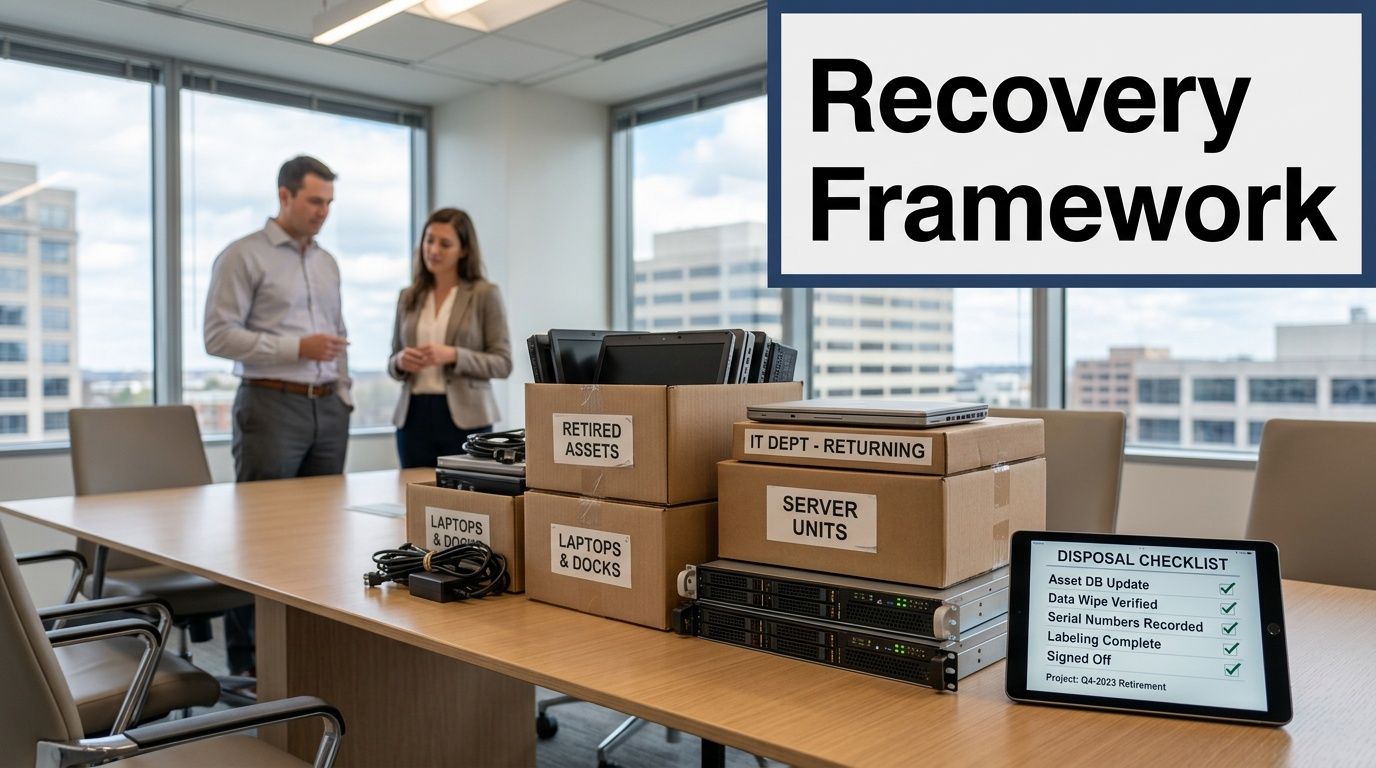
Here's a secret from the field: a successful recovery project is won or lost months before a single truck shows up. It starts with meticulous on-the-ground planning that transforms potential chaos into perfect order. Think of it as a large-scale liquidation—every single piece, from a data center server rack down to a user’s old keyboard, must be accounted for and staged.
This prep work establishes a clear "flow" for the entire project. It creates a coordinated order that makes it easy for both your team and your ITAD partner to locate, audit, and process items without a hitch.
The Pillars Of A Modern ITAD Program
So what does a modern, effective program actually look like? It's built on a few core components, each one designed to address a specific business need, from mitigating risk to maximizing financial return. Understanding these helps you spot the gaps in your own process.
To give you a clearer picture, here’s a breakdown of what every plan needs to include.
Key Pillars of a Modern IT Asset Recovery Plan
| Component | Primary Objective | Key Action |
|---|---|---|
| Comprehensive Inventory | Gain full visibility and control over all retired assets. | Conduct a detailed audit of all hardware, including serial numbers and specs. |
| Certified Data Destruction | Eliminate the risk of data breaches from retired media. | Implement documented, verifiable data wiping and physical destruction. |
| Responsible Recycling | Ensure environmental compliance and support sustainability goals. | Partner with a certified e-waste recycler to process non-remarketable assets. |
| Value Recovery Strategy | Maximize financial returns from functional equipment. | Identify and segment assets for resale through remarketing channels. |
These four components are the bedrock of a program that doesn't just dispose of hardware but actively manages it as part of a larger business strategy.
The groundwork laid during initial planning directly translates to the dollars realized and the risks mitigated. Preparation dictates performance, turning a complex logistical challenge into a manageable, value-driven project.
How Does Your Current Process Stack Up?
With these pillars in mind, take a hard look at your own organization's readiness. A quick self-assessment can expose some glaring vulnerabilities or opportunities you're missing. How does your company currently handle these tasks? If you're looking for more advanced strategies, our guide on IT asset management best practices offers a deeper dive into building a more structured program.
The ultimate goal is to shift from a reactive, "get it out of here" mindset to a proactive, value-focused one.
This might feel overwhelming, especially for large companies with thousands of assets. A project liquidating over 22,000 lots of equipment, for example, demands an unflinching ability to manage complexity. Every single item needs to be accounted for, described accurately, and handled professionally to ensure nothing gets lost in the shuffle.
This is precisely why a systematic approach is non-negotiable. It’s not just about making a list; it’s about strategically presenting your assets in a way that builds buyer confidence and drives up your return. Your framework for Arlington IT asset recovery must be designed to handle this complexity from day one, ensuring every asset—no matter how small—achieves its maximum potential while eliminating every last bit of risk.
Conducting Your Pre-Recovery Inventory and Risk Audit
Before you can map out an Arlington IT asset recovery plan, you need to know exactly what you’re working with. A vague guess of "a few hundred laptops and some servers" simply won't do. A thorough internal audit is the foundation of the entire process, allowing you to get accurate quotes, manage risk, and make sure no device gets left behind.
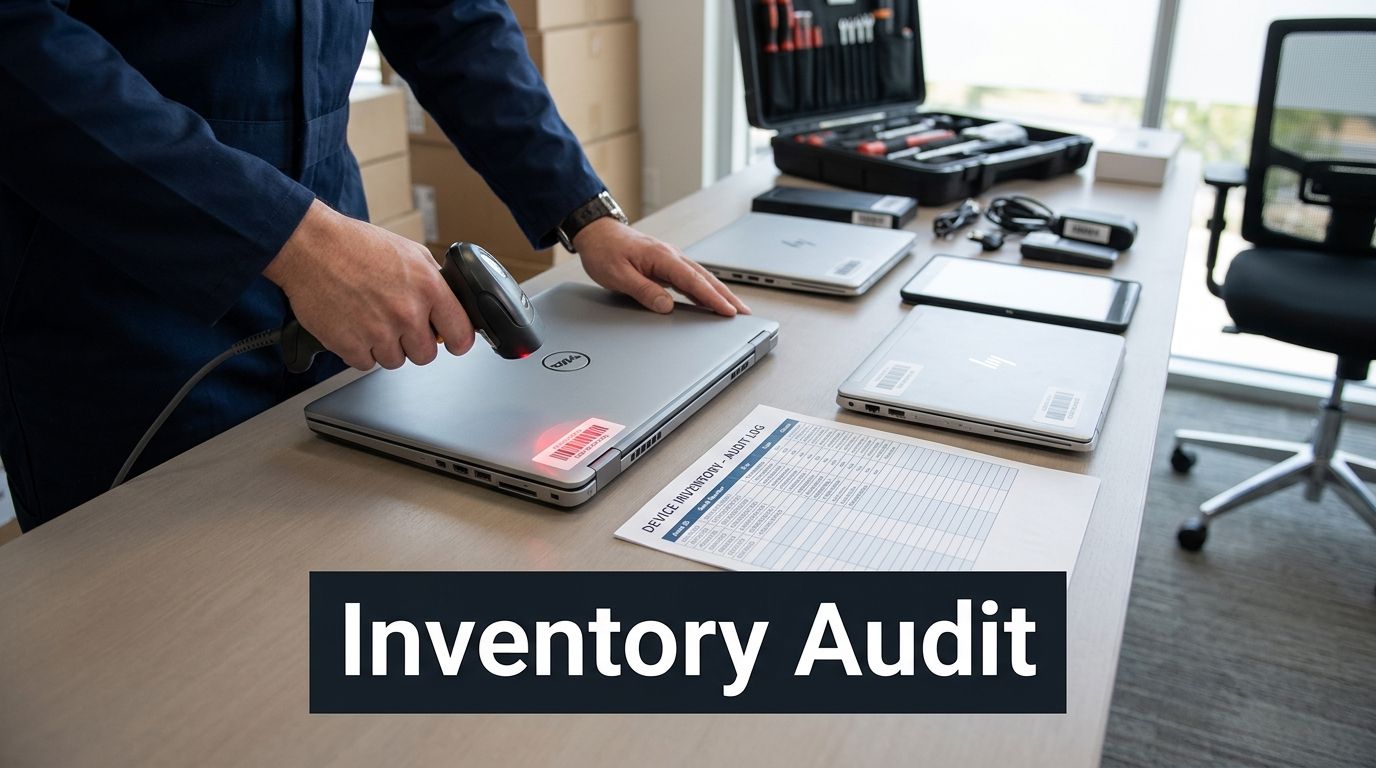
Think of this as creating a "recovery-ready" manifest. This isn’t just about counting heads; it's a strategic catalog that will guide the logistics, security protocols, and financial return of your project. The goal is to turn a closet full of retired equipment into an organized, documented inventory.
Cataloging Your IT Assets
Your first job is to account for every piece of hardware slated for retirement. This process needs to be methodical. Go department by department, check every storage closet, and sweep through the server room.
For each asset, you need to capture a few key data points. A simple spreadsheet can work, but dedicated software is often better. From our experience, you should track:
- Asset Type: (e.g., Laptop, Desktop, Server, Monitor, Network Switch)
- Brand and Model: (e.g., Dell Latitude 7420, HP ProLiant DL380)
- Serial Number or Asset Tag: This is non-negotiable for creating a verifiable chain of custody.
- Physical Condition: (e.g., Excellent, Good, Fair, Damaged, Non-functional)
- Physical Location: (e.g., Building A, 3rd Floor, Storage Closet 3B)
This data is the backbone of your recovery project. Without accurate serial numbers, for instance, you can't get the serialized Certificates of Data Destruction needed to prove compliance. If you need help finding the right tool for the job, check out our guide on the best IT asset management software on the market in 2026.
A detailed and accurate inventory is your single most powerful negotiation tool. When you can provide a potential ITAD partner with a precise manifest, you eliminate guesswork and receive quotes that reflect the true value and scope of your project.
Assessing Risk and Value Potential
Once you have a complete list, it's time to layer in risk and value classifications. This is where your manifest becomes a true strategic document, as every asset carries a different level of risk and potential for resale.
Start by classifying the data sensitivity of each device. A server that held customer records poses a much higher risk than a monitor. We recommend a simple system:
- High-Risk: Contains PII, PHI, financial data, or intellectual property (e.g., servers, SANs, employee laptops).
- Low-Risk: Has no storage media or sensitive data (e.g., monitors, keyboards, peripherals).
This classification directly impacts your data destruction requirements. High-risk assets demand on-site shredding or NAID AAA certified data wiping, while low-risk items can move straight to recycling or remarketing.
Next, assess the potential for value recovery based on the age, condition, and specs of your equipment. A three-year-old high-performance laptop has significant remarketing potential, whereas a ten-year-old desktop is likely headed for responsible recycling. This step helps you and your ITAD partner build an effective remarketing strategy from the start.
Even local government operations understand the importance of this. For example, budget pressures during the pandemic forced the City of Arlington's IT Department to freeze key technology projects, saving $1.1 million. Events like these show how critical it is to have an efficient recovery strategy that pulls maximum value from retired assets—a core service we provide as a nationwide disposition partner. You can see the city's complete Arlington 2024 Recovery Plan on treasury.gov. This audit puts you in control, turning a logistical headache into a well-managed, value-driven initiative.
How to Vet and Select Your Arlington ITAD Partner
Choosing your partner for Arlington IT asset recovery is the most critical decision you'll make in this process. This isn't just about finding a low-cost pickup service; it's about finding a secure, transparent vendor to protect your company from significant financial and legal blowback.
The wrong choice can lead directly to data breaches, environmental fines, and a total loss of your assets' recoverable value. The right partner, on the other hand, acts as a true extension of your IT team, making sure every device is handled with documented precision and accountability.
Start with Non-Negotiable Certifications
Before you waste time requesting quotes or reviewing service lists, your first step is to verify a potential vendor's certifications. These aren't just fancy logos for a website—they are hard-earned credentials proving the vendor submits to rigorous, third-party audits for security and environmental compliance.
You should consider two certifications as mandatory requirements:
- R2v3 (Responsible Recycling): This is the premier global standard for electronics recycling. It's your guarantee that a vendor follows strict environmental and safety protocols and that their downstream partners are also certified. An R2v3-certified provider ensures your e-waste never sees a landfill.
- NAID AAA: This is the gold standard for secure data destruction. It verifies a company’s procedures for sanitizing or physically destroying data on hard drives and other media are secure and auditable. A partner with this certification gives you a defensible process against data breach claims.
A vendor lacking both R2v3 and NAID AAA certifications should be an immediate disqualification. The risk of a compliance failure or data breach is simply too great to justify any perceived cost savings.
Beyond Certifications: The Critical Questions to Ask
Once you've shortlisted vendors with the right credentials, it’s time to dig into their actual processes. Their answers to these questions will tell you everything you need to know about their service quality and commitment to transparency. Don't settle for vague responses; press for specifics.
Here’s what you need to ask your potential Arlington ITAD partner:
- Can you show me a sample serialized chain-of-custody report? This document should track every single asset—by serial number—from the moment it leaves your building to its final disposition, whether it's resold, recycled, or destroyed.
- How do you handle data destruction, and what proof will I get? They should offer multiple destruction methods (like wiping, degaussing, and shredding) and advise on the best fit for your assets. Most importantly, insist on a serialized Certificate of Data Destruction that links each drive's serial number to the specific destruction method and date.
- What is your process for value recovery and remarketing? A quality partner has a clear, transparent system for testing, grading, and selling functional equipment. Ask how they set asset values and what percentage of the final sale price your organization will receive.
- Do you carry pollution liability and errors and omissions insurance? General business insurance isn't enough. They need specialized coverage that protects you if an environmental incident or a data breach happens on their watch. Ask to see the certificate of insurance.
Exploring various IT asset disposition companies can give you a better sense of the services and standards available. This research is invaluable for benchmarking potential partners against the best in the industry.
Scenario: The Tale of Two Partners
To really see what's at stake, let's look at a common scenario. An Arlington-based company needs to dispose of 200 laptops.
- Company A goes with an uncertified recycler who gave them a low, flat-rate pickup fee. They get a simple invoice saying the job is done. Six months later, an old company laptop pops up for sale online, complete with sensitive internal files.
- Company B chooses a certified ITAD vendor. They get a detailed quote, secure on-site packing, and a GPS-tracked truck. Two weeks after pickup, they receive a full settlement report, a Certificate of Data Destruction for all 200 hard drives, and a check for their portion of the remarketed laptops.
The difference couldn't be starker. Company A saved a bit of money upfront but walked straight into a massive liability. Company B invested in a secure, documented process that not only protected their data but also generated a positive financial return. Your choice of partner will directly determine which of these outcomes you experience.
Once you’ve chosen your vendor, it’s time to move from planning to execution. This is where the rubber meets the road for your Arlington IT asset recovery project. A successful recovery hinges on maintaining a flawless chain of custody and ensuring every piece of data is completely and verifiably destroyed.
It all starts the moment your ITAD partner shows up. This isn’t just a moving job; their team should arrive with a clear, documented plan. They should be professionally packing, palletizing, and, most importantly, scanning the serial number of every single asset before it gets loaded onto their truck.
This on-site inventory scan is your first checkpoint in a secure chain of custody. The manifest they build on-site must line up perfectly with your own internal list. If there are any discrepancies, they need to be sorted out right then and there—before your assets ever leave the building.
From Your Loading Dock to Their Facility
Secure transport is absolutely non-negotiable. Your ITAD partner must use sealed, dedicated trucks—often with GPS tracking—to move equipment from your Arlington offices to their processing facility. This is crucial for preventing any unauthorized stops or access while your assets are on the road.
When the truck arrives at the ITAD facility, the equipment is unloaded into a secure, access-controlled area. Here, every serial number is scanned and verified a second time against the original manifest. This dual verification is critical for creating a defensible audit trail that proves everything arrived as expected.
This simple flowchart shows how the vetting process directly impacts the security of the actual recovery.
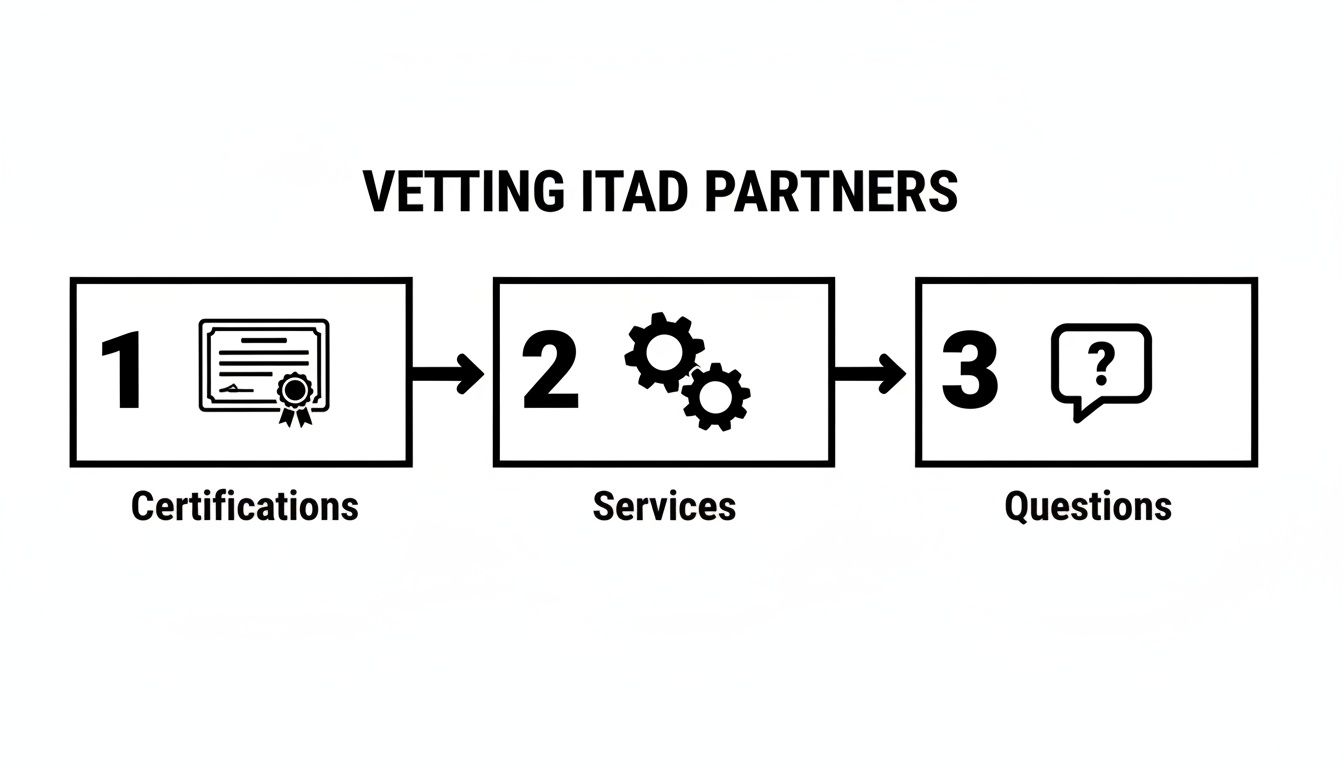
As you can see, a secure process starts long before pickup day. The right certifications and services are the foundation for an execution you can actually trust.
The Core of Security: Certified Data Destruction
With your assets accounted for at the secure facility, the most sensitive work begins: data destruction. We’ve all seen it—people think hitting 'delete' or reformatting a drive is enough. It isn’t. Proper data security demands certified, irreversible methods that make data recovery impossible.
A good partner will offer several options and guide you to the right choice based on the asset type, data sensitivity, and your compliance needs.
- Data Wiping: Using specialized software to overwrite a drive with random data, typically to NIST 800-88 standards. This is perfect for newer, working drives that can be resold, as it sanitizes them completely while preserving their value.
- Degaussing: This method uses a powerful magnetic field to instantly scramble the magnetic platters inside a hard drive, rendering it unreadable. It’s quick and effective but also destroys the drive.
- Physical Shredding: For the highest level of security, nothing provides more peace of mind than physical destruction. A commercial shredder grinds hard drives, SSDs, and other media into tiny, worthless fragments.
For businesses in regulated fields like healthcare or finance, a hybrid approach is common. For example, you might wipe laptops destined for resale but shred the old server drives that held sensitive customer PII. To dig deeper into these methods, you can review our https://dallasfortworthcomputerrecycling.com/arlington-secure-data-destruction/.
The ultimate proof of compliance is not a promise; it's a document. For every single data-bearing device, you must receive a serialized Certificate of Data Destruction. This document links the drive's serial number to the date and method of destruction, creating the auditable evidence you need to satisfy any compliance check.
This level of documented security is particularly vital for public-sector organizations. We know from experience that government and defense agencies require an incredibly high standard of IT asset recovery, often handling massive volumes of end-of-life tech. Since 2012, our firm has helped B2B clients meet these exacting demands, including the stringent NSA standards required by many state, local, and federal agencies. By demanding meticulous execution and documentation, you transform a potential liability into a clear security win.
Maximizing ROI and Ensuring Final Compliance
The job of Arlington IT asset recovery isn't truly done once the truck leaves your loading dock. This next phase is where a strategic ITAD partnership really proves its worth, focusing on two critical outcomes: recovering financial value from your retired hardware and cementing your company's compliance with a solid audit trail.
Many businesses treat this as an afterthought, but it's a massive missed opportunity. Properly remarketed assets can inject new revenue back into your IT budget, while diligent reporting is your best defense against future liability. This is how you close the loop on the IT asset lifecycle.
Turning Retired Hardware Into Revenue
Don't assume every retired asset is destined for the recycling bin. You'd be surprised how much equipment still holds significant value on the secondary market. A professional ITAD partner will have a transparent and effective process for testing, grading, and reselling these assets to maximize your financial return.
The process should be clear and auditable:
- Testing and Grading: At the secure facility, each device is tested for functionality. A technician assesses its cosmetic condition and component performance, assigning a grade (e.g., A, B, C, or D).
- Market-Based Valuation: Using that grade and current market data for the specific model, your partner determines its fair resale value based on real-world demand.
- Strategic Resale: The partner then uses their established sales channels—from online marketplaces to wholesale networks—to sell the equipment for the best possible price.
This systematic approach is what separates professional ITAD from a simple pickup service. It creates a transparent revenue-sharing model where everyone is motivated to achieve the highest return.
The most crucial part of this process is the final settlement report. This document must detail the original asset list, what was resold, the final sale price for each item, the partner's fee, and your net payment. If a vendor can't provide this level of detail, you're flying blind.
Responsible Recycling and Environmental Reporting
For assets that are too old, damaged, or obsolete for resale, the focus shifts to environmental responsibility. This is about more than just keeping e-waste out of a landfill; it's about ensuring every component is processed in a compliant and sustainable way.
Your partner, especially one with an R2v3 certification, is required to follow a strict hierarchy for reuse and recycling. They will dismantle end-of-life equipment to recover commodity materials like steel, plastic, aluminum, and precious metals.
Just like a Certificate of Data Destruction, you should also receive a Certificate of Recycling. This document confirms that your assets were processed according to all environmental regulations. Some partners can even provide detailed environmental impact reports, showing things like:
- Pounds of e-waste diverted from landfills
- Greenhouse gas emissions avoided
- Energy saved by using recycled vs. virgin materials
This data is incredibly valuable for your company's corporate social responsibility (CSR) reporting and demonstrates a real commitment to sustainability.
Assembling Your Audit-Proof Compliance File
The final step is to gather all your documentation into a single, comprehensive compliance file for the project. In the event of an audit or a regulatory inquiry, this file is your definitive proof that you followed a secure, compliant process from start to finish.
At a minimum, your file should contain:
- The initial asset inventory you created
- The signed quote and statement of work from your ITAD partner
- The serialized chain-of-custody report from pickup
- The serialized Certificate of Data Destruction
- The Certificate of Recycling
- The final settlement report detailing all financial transactions
By meticulously collecting these documents, you create an unassailable record of due diligence. You have proof that every asset was tracked, all data was destroyed, and all hardware was handled responsibly. This file closes the book on your retired IT assets, protecting your organization and freeing you up to focus on the next technology refresh. To get an idea of what individual components might be worth, you might be interested in our article on where to sell computer parts.
Common Arlington IT Asset Recovery Questions Answered
If you're overseeing an IT asset recovery project in Arlington, you've probably got some tough questions. It’s a project with serious security, compliance, and financial implications. We get it.
Here are the direct answers to the most critical questions we hear from IT and finance leaders across the DFW area. These aren't just textbook definitions—they're based on what works right here in our local market.
What Is the Average Cost for IT Asset Recovery in Arlington?
This is always the first question, but there's no simple price tag. It's better to think of the cost as a net financial outcome, not a flat fee.
Several variables will move the needle on your final cost:
- Asset Mix: A pallet of uniform, late-model laptops is a much different project than a mixed lot of old servers, specialized peripherals, and desktops spread across multiple floors.
- Service Requirements: On-site services, like physical hard drive shredding, naturally have higher labor and logistical costs than off-site data wiping.
- Logistical Effort: The complexity of the pickup itself matters. Is everything staged on a loading dock, or do we need to remove equipment from offices across a high-rise building?
The biggest factor, however, is value recovery. If your retired equipment still has resale value, a good ITAD partner can generate revenue by remarketing it. Often, this revenue is enough to cover all the service fees, and sometimes, it can even lead to a net payment back to your company.
The only way to get a real number is with a detailed quote. A trustworthy partner will break down all service fees and provide a transparent, realistic estimate of the resale value you can expect from your specific assets.
How Do I Ensure My Company's Data Is Securely Destroyed?
This is non-negotiable, and a verbal promise just won't cut it. To truly guarantee your data is gone for good, you need to rely on certified processes and demand proof.
First, look for a partner with NAID AAA certification. This isn't just a logo for their website; it's a rigorous, ongoing audit that verifies a vendor's security protocols, employee background checks, and operational integrity meet the highest industry standards for data destruction.
Next, you need to demand a serialized Certificate of Data Destruction. This is your auditable proof. It should be a detailed report that links the unique serial number of every single hard drive or SSD to:
- The exact date of destruction
- The method used (e.g., wipe, degauss, or shred)
- A clear confirmation that the data is unrecoverable
Without that serialized certificate, you have a critical gap in your compliance and no definitive way to prove you met your legal obligations in the event of a future audit or breach investigation.
Are There Specific Environmental Regulations for Electronics Disposal in Texas?
Yes, absolutely. In Texas, the Texas Commission on Environmental Quality (TCEQ) sets the rules for how electronics are recycled and disposed of. These regulations are designed to keep hazardous materials like lead, mercury, and cadmium out of our local landfills and groundwater.
Trying to navigate these requirements on your own is a headache waiting to happen. The most straightforward way to ensure you're fully compliant with both state (TCEQ) and federal (EPA) standards is to work with an R2v3 (Responsible Recycling) certified partner.
The R2v3 certification is your assurance that your e-waste is handled in an environmentally sound and secure manner. Certified recyclers are audited to ensure they follow a strict "reuse, recover, dispose" hierarchy and that no hazardous materials are improperly exported or sent to landfills.
For your own peace of mind and due diligence, always get a Certificate of Recycling from your vendor. This document confirms that your non-functional assets were processed in full accordance with environmental laws, officially closing the loop on your responsibility.
When you're ready to implement a secure, compliant, and value-driven process for your retired technology, Dallas Fortworth Computer Recycling is here to help. With nationwide service and deep expertise in the Arlington market, we provide the documented assurance your organization needs. Learn more about our B2B IT asset disposition services.