
IT equipment recycling Arlington: A 2026 Guide for Businesses
For IT leaders in Arlington, managing technology disposal is a critical business function. It’s a strategic process that touches on data security, environmental compliance, and financial management—far more than just clearing out old hardware.
Why Smart IT Recycling in Arlington Is Non-Negotiable
When your Arlington organization retires old technology, what happens next is more than a simple cleanup task. Improper disposal of those servers, laptops, and network gear opens your company to serious risks, turning a routine equipment refresh into a potential liability nightmare.
Think about a single discarded company laptop that wasn't properly wiped. If that device ends up in the wrong hands with sensitive customer data or proprietary information still on it, the fallout can be severe. We’re talking about steep financial penalties, legal action, and lasting damage to your brand's reputation. This isn't a hypothetical—it's a real-world risk that IT leaders must actively manage.
The True Cost of Negligence
Ignoring a formal process for IT equipment disposal introduces threats from multiple angles. The risk goes beyond just a data breach. State and federal environmental regulations have strict rules on how electronic waste (e-waste) must be handled.
The improper disposal of electronics, which often contain hazardous materials like lead and mercury, can lead to significant fines and legal repercussions. A certified recycling partner ensures you remain compliant and environmentally responsible.
A disorganized approach also means you are likely leaving money on the table. Many retired assets, particularly enterprise-grade servers and networking equipment, still have residual value. Without a structured IT Asset Disposition (ITAD) plan, you lose the opportunity to recover that value through remarketing, which can offset or even cover the entire cost of the project.
Creating Your Initial ITAD Plan
A formal ITAD plan is your roadmap for secure and efficient equipment retirement. It doesn't need to be complex to be effective. The first phase is all about understanding what you have and the risks tied to it. Start by identifying every asset slated for disposal, from data center hardware to individual employee workstations. You can find more information about the overall advantages by exploring the benefits of e-waste recycling in our detailed guide.
This initial inventory is a crucial first step for any business getting serious about IT equipment recycling in Arlington. It sets the foundation for everything that follows, including choosing the right vendor and ensuring every piece of data is properly destroyed.
The table below outlines the essential first steps for building your plan.
Initial IT Asset Disposition Checklist for Arlington Businesses
| Phase | Key Action | Why It Matters |
|---|---|---|
| Inventory | Create a basic list of devices to be recycled. | Establishes the scope of the project and helps you get accurate quotes. |
| Data Assessment | Identify which devices contain sensitive information. | Prioritizes assets that require certified data destruction. |
| Stakeholder ID | Determine who needs to be involved (IT, Finance, Legal). | Ensures all departments are aligned on security and compliance needs. |
Completing this quick checklist before you even contact a vendor will make the entire process smoother, more secure, and more cost-effective for your organization.
Executing Your Secure IT Asset Disposition Plan
Once you’ve identified which assets are ready for retirement, it’s time to put the plan into motion. This is where you move from inventory spreadsheets to a real-world logistics project. For organizations needing IT equipment recycling in Arlington, a successful execution phase hinges on detailed tracking, smart categorization, and smooth coordination with your chosen ITAD partner.
The first step is building a detailed manifest of every item slated for disposal. This isn't just a quick count of desktops. For true accountability, you need to document specifics for each asset: serial numbers, internal asset tags, and the make and model. This level of detail is essential for maintaining a secure chain of custody from the moment that equipment leaves your office.
Categorizing Assets for Maximum Value and Compliance
Not all retired equipment is the same, and it shouldn't be treated that way. Sorting your assets into clear categories directly impacts your project's bottom line and environmental compliance.
Your inventory will typically fall into one of three main groups:
- Assets for Resale: Newer, higher-value equipment like recent-model servers, networking gear, or enterprise-grade laptops often have a second life. A professional ITAD partner can test, refurbish, and sell these items, generating revenue to offset your recycling costs.
- Assets for Reuse or Donation: Some equipment might not meet your company's performance needs anymore but is still perfectly functional. These devices are ideal candidates for donation to local nonprofits or schools, supporting the community and extending the hardware's life.
- Assets for Recycling: This category is for the old, obsolete, or broken equipment with no resale value. These items must be responsibly dismantled and recycled according to strict environmental standards to recover raw materials.
Properly sorting your assets ensures you aren’t shredding valuable equipment that could have generated a return. For Arlington businesses, this strategic step can turn a disposal project from a cost center into a value-recovery opportunity. You can learn more about this process in our guide on what IT asset disposition entails.
The Logistics of a Professional Pickup
With your inventory sorted, the next step is scheduling the physical pickup. A professional ITAD provider handles all the logistics, making the process efficient and keeping disruption to your daily operations at a minimum. This is a far cry from just piling old computers onto a pallet and hoping for the best.
The process starts by coordinating a pickup time that works for your team. The vendor’s logistics crew arrives with everything needed—pallets, security cages, and shrink wrap—to safely pack and prepare your assets for transport. They should work quickly and professionally, usually in a designated staging area you’ve cleared ahead of time.
This handoff is a critical part of effective IT equipment recycling in Arlington, transferring assets securely from your control to the vendor's.
This visual breaks down the core workflow of a well-managed ITAD plan into its three essential actions.
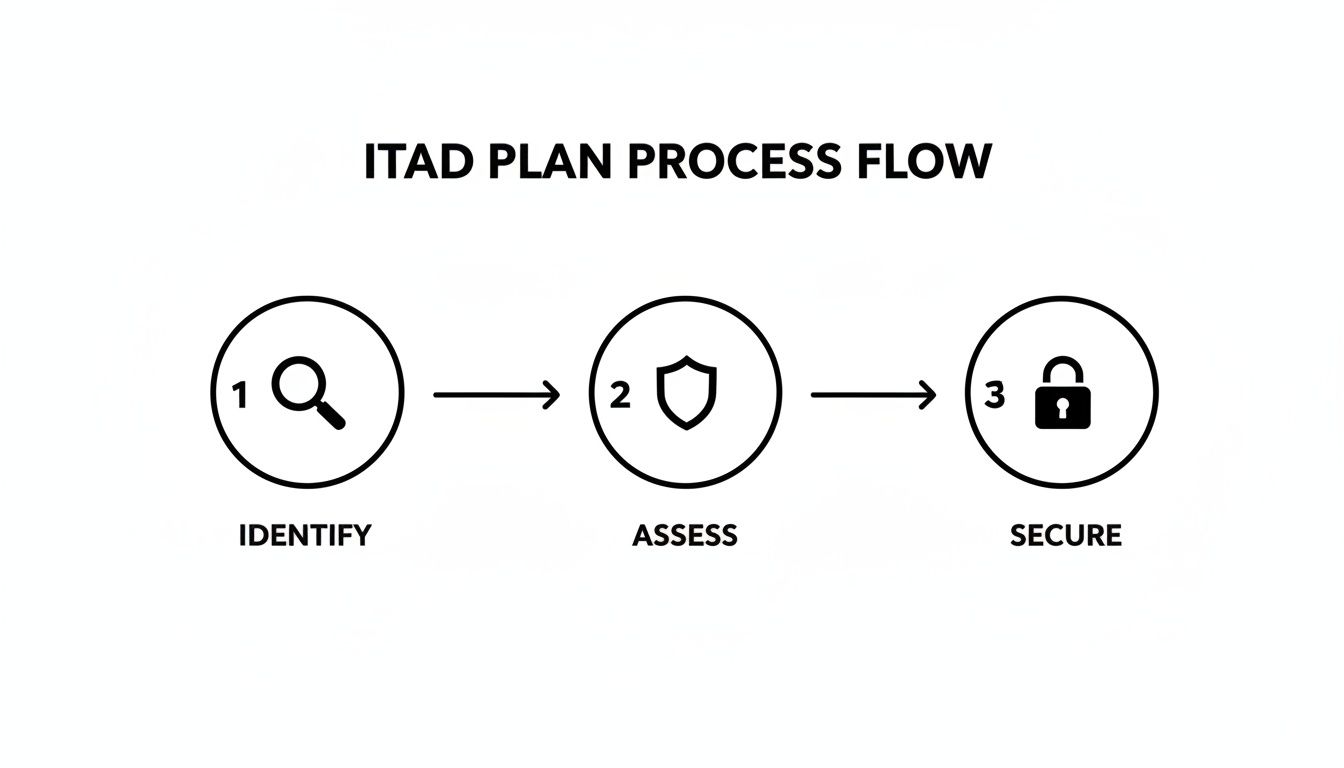
As the diagram shows, every secure disposition project begins with identifying assets, moves to assessing their data risk, and ends with securing them for transport and processing.
During the pickup, each pallet of equipment is typically inventoried or scanned, shrink-wrapped for security, and labeled before being loaded onto a locked truck. This methodical approach ensures nothing gets lost in transit.
A key sign of a professional service is a seamless pickup. They should handle the heavy lifting and logistical planning, freeing up your IT team to focus on their core responsibilities.
Once loaded, your assets are transported directly to the vendor's secure processing facility. This is where the crucial work of data destruction and responsible recycling begins. Your initial inventory list becomes the foundation for the final reporting you'll receive, including Certificates of Data Destruction and recycling reports. This documentation closes the loop, giving your organization the auditable proof of compliance it needs.
Data Destruction and Secure Chain of Custody
When your Arlington organization decides to recycle old IT equipment, the conversation quickly shifts from hardware logistics to data security. Simply powering down a device doesn't secure it. The confidential information—client records, financial data, and internal strategy—that lives on those hard drives and servers remains a major liability until it’s permanently destroyed.
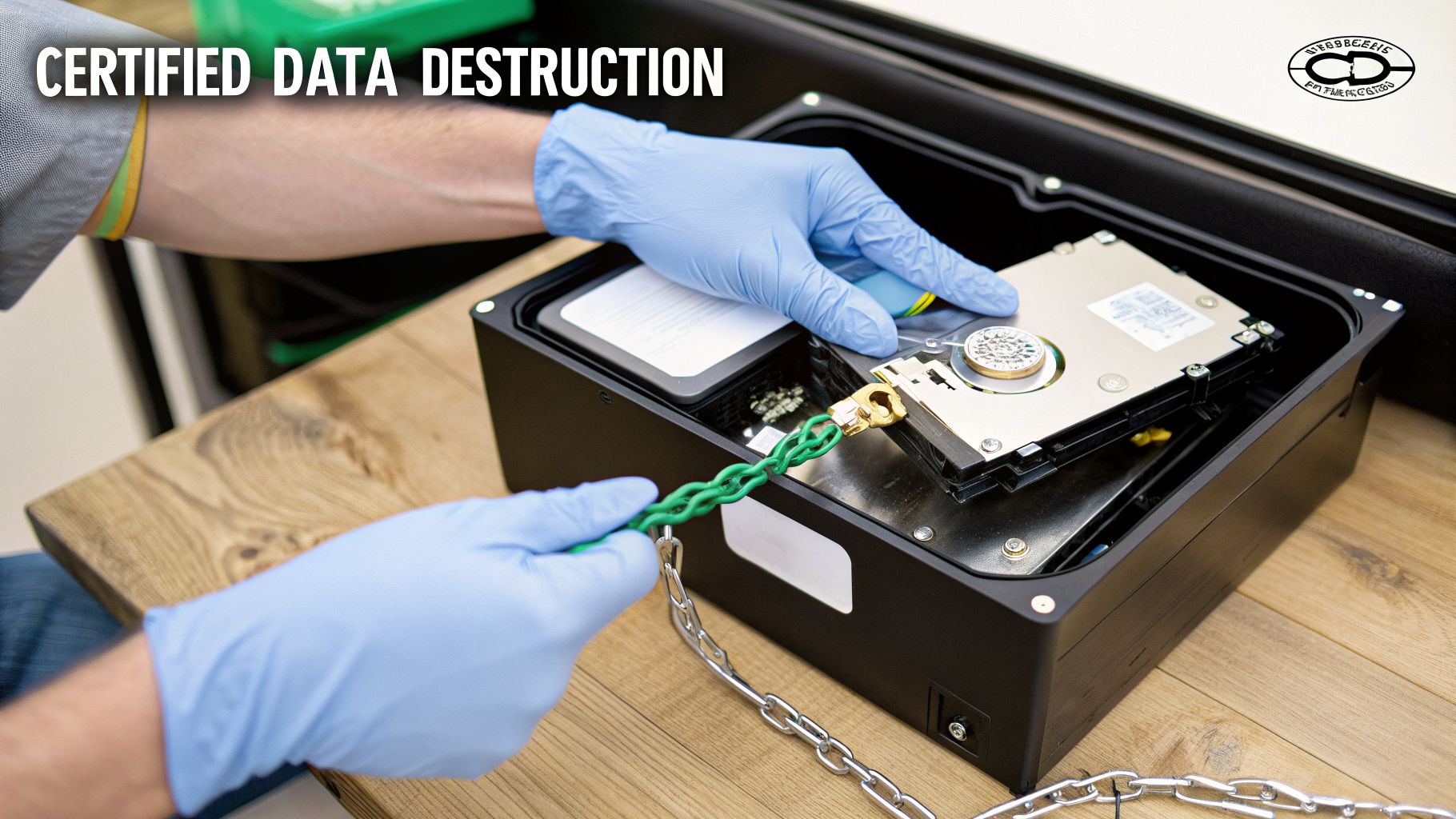
This is why certified data destruction is the most critical part of the entire IT asset disposition process. It’s not enough to just delete files. You need a verifiable, auditable method that proves your data is gone for good.
Understanding Data Destruction Methods
Professional ITAD partners use several industry-approved methods to destroy data, and the right one depends on your internal policies, data sensitivity, and compliance needs under regulations like HIPAA, FACTA, or GLBA.
The three primary methods are:
- Data Wiping (Sanitization): A software-based process that overwrites all data on a storage device. The main advantage here is that the hardware remains functional and can be reused or resold, maximizing its value.
- Degaussing: This method uses a powerful magnet to scramble the magnetic domains on traditional hard disk drives (HDDs) and magnetic tapes. Degaussing instantly renders the drive inoperable.
- Physical Shredding: For the highest security level, nothing beats physical destruction. Industrial shredders grind hard drives, solid-state drives (SSDs), and other media into tiny fragments, making data recovery impossible.
Shredding ensures that even a determined effort can't piece the data back together from the scrap.
Matching the Method to the Media
The type of storage media in your equipment dictates the most effective destruction method. What works on an old spinning hard drive is useless on a modern SSD.
Let's imagine an Arlington-based healthcare provider retiring a mix of equipment. They have older servers with HDDs full of patient records, laptops with SSDs used by their admin team, and a box of old backup tapes. A one-size-fits-all approach just won't cut it.
| Media Type | Appropriate Destruction Method(s) | Why It Works |
|---|---|---|
| HDDs (Hard Disk Drives) | Wiping, Degaussing, or Shredding | All three are effective. Wiping allows for reuse, while degaussing and shredding provide total destruction for highly sensitive data. |
| SSDs (Solid-State Drives) | Wiping or Shredding | SSDs use flash memory chips and are immune to degaussing. Secure wiping or physical shredding is required. |
| Magnetic Tapes | Degaussing or Shredding | Older media like tapes are easily destroyed by the powerful magnetic fields of a degausser. Shredding is also a final, secure option. |
For this healthcare provider, the solution has to be multi-pronged. The server HDDs with patient data demand physical shredding to meet HIPAA’s strict rules. The newer laptop SSDs can be securely wiped to NIST 800-88 standards, which allows the hardware to be resold. Finally, the old backup tapes can be efficiently destroyed through degaussing.
This tailored strategy ensures full compliance without needlessly destroying valuable assets.
The Importance of a Secure Chain of Custody
Even the best destruction methods are only as reliable as the process behind them. This is where the chain of custody becomes essential. It’s the unbroken, documented trail that tracks your assets from the moment they leave your facility until they are completely destroyed.
A secure chain of custody is your proof that every device was handled according to protocol, with no gaps where a data breach could occur. It transforms the promise of security into a documented reality.
A strong chain of custody is built on several key elements:
- Serialized Inventory: It all starts with the detailed inventory you created, which your vendor reconciles at pickup.
- Secure Logistics: Assets must be transported in locked, GPS-tracked vehicles by vetted personnel directly to a secure facility.
- Controlled Access: The processing facility should have 24/7 surveillance, restricted access zones, and strict visitor policies.
- Documented Destruction: The process concludes with a Certificate of Data Destruction.
This certificate is the cornerstone of your compliance and risk management. It's more than a receipt; it’s a legal document proving you met your due diligence. A proper certificate lists the serial number of every single drive that was wiped, degaussed, or shredded, linking a specific destruction method to each unique asset.
This level of detail is non-negotiable for any organization serious about data protection. You can learn more by reading our guide on what a Certificate of Destruction for hard drives truly means for your business's security. It provides the auditable evidence you need to satisfy auditors and regulators, closing the loop on your retired IT assets securely and definitively.
Navigating Costs and Local Arlington Regulations
Budgeting for IT asset disposition is a top concern for any Arlington business. It’s easy to look at the process as just another line item expense, but with a smart approach, you can keep costs down and sometimes even generate a return. Knowing what drives the price, along with local regulations, is the key to a cost-effective and compliant IT recycling program.
The truth is, IT equipment recycling in Arlington is never a one-size-fits-all service with a flat rate. The final cost always comes down to a mix of logistics, the security measures you need, and the value left in your retired hardware. A successful project means finding the right balance to protect both your budget and your business.
Decoding the Cost Structure
The quote you get from an ITAD provider will depend on a few key variables. The biggest factors are the type and amount of equipment you have, the level of data destruction required, and the logistics of the pickup itself.
For instance, a major data center decommissioning with hundreds of servers will naturally have a different cost profile than a simple office cleanout of 50 desktops.
Here are the main cost drivers you’ll see:
- Logistics and Transportation: The distance from your Arlington facility to the processing center, plus the labor needed to pack and load everything, factors in. A ground-floor pickup is always simpler and more cost-effective than a multi-story office cleanout.
- Data Destruction Services: Certified data destruction is a critical, value-added service. On-site shredding, where a mobile shred truck comes to your business, usually costs more but gives you immediate, visual confirmation. NIST-compliant data wiping also carries an associated service fee.
- Labor and Processing: This covers the hands-on work of sorting, testing, dismantling, and properly recycling all the different components.
Understanding these elements helps you have a more productive conversation with potential vendors and set a realistic budget for your project.
The Impact of Value Recovery
The best tool for offsetting your costs is value recovery, which is just the process of remarketing your old equipment. Many retired IT assets, particularly enterprise-grade hardware less than five years old, still have plenty of life and value in them. A professional ITAD partner can test, refurbish, and sell this equipment for you.
Your ITAD project shouldn't be just a cost center. By strategically remarketing viable assets, many businesses find they can cover the entire cost of recycling and data destruction, sometimes even generating a net positive return.
Picture an engineering firm in Arlington recycling 100 high-performance workstations. Maybe 30 are truly obsolete, but the other 70 are recent-enough models. A certified partner can securely wipe the data from all 100 units, responsibly recycle the 30 older ones, and sell the 70 newer workstations. The revenue from that sale is then shared back with your company, drastically cutting the project's overall cost. That's the difference between simple disposal and smart asset management.
Staying Compliant with Arlington and Texas Regulations
Beyond the budget, complying with local and state environmental laws is non-negotiable. Both Texas and the City of Arlington have specific rules for disposing of electronic waste to keep hazardous materials out of our landfills.
These regulations are in place to protect the local environment from toxic substances found in electronics, like lead, mercury, and cadmium. Getting this wrong can lead to serious fines and real damage to your company's reputation. As you can see in our guide to enterprise IT equipment recycling in Texas, navigating the rules for a larger organization can get complicated.
Working with a certified electronics recycler is the most straightforward way to guarantee compliance. A qualified vendor must provide:
- Industry Certifications: Always look for R2v3 or e-Stewards certifications. These credentials are proof that the vendor meets the highest industry standards for environmental safety and data security.
- Downstream Accountability: A certified partner will give you a transparent chain of custody, showing you exactly where all materials end up after they leave their facility. This ensures your e-waste isn’t illegally exported or dumped.
- Auditable Documentation: You should always receive Certificates of Recycling and Certificates of Data Destruction. These documents are your official proof of responsible and compliant disposal.
Ultimately, navigating the costs and rules of IT equipment recycling in Arlington comes down to choosing a partner who operates with transparency. A reputable vendor will provide a clear quote, explain opportunities for value recovery, and have the certified processes you need to keep your organization secure and compliant.
Choosing the Right IT Recycling Partner in Arlington
When it comes to your company’s retired technology, selecting the right partner for IT equipment recycling in Arlington is the single most important decision you'll make. This isn't just about hauling away old computers; it's about protecting your business from data breaches, environmental fines, and reputational damage.
The difference between a certified IT Asset Disposition (ITAD) professional and a basic scrap hauler is massive. One bad decision here can have serious consequences. An uncertified vendor could mishandle a server hard drive, leading to a data breach, or illegally dump e-waste, putting your organization directly in the crosshairs of regulators. A partnership with a vetted, certified provider is your best defense against these liabilities.

The Power of Industry Certifications
As you start evaluating potential vendors, certifications should be your first checkpoint. They are the clearest, most reliable indicator of a recycler’s commitment to security, safety, and responsible environmental practices. In our industry, the two gold standards are R2v3 and e-Stewards.
These aren't just logos they put on a website. They represent a grueling, ongoing audit process that proves a vendor’s operations meet the highest standards.
R2v3 (Responsible Recycling): This certification covers a wide range of critical areas, from worker health and safety to data security and environmental accountability. A key requirement is that an R2v3-certified recycler must track all materials through their downstream partners, ensuring nothing ends up in a landfill.
e-Stewards: Often seen as the most rigorous standard, e-Stewards places a heavy emphasis on preventing the export of hazardous electronic waste to developing nations and mandates the highest level of data security protocols.
A vendor holding these certifications has already done the hard work of proving they can protect your company. If a potential partner can’t show you their current certificates, that’s a major red flag. To understand why this matters so much, you can learn more about what it means to be an R2 certified electronics recycler and how it shields your business from risk.
Beyond Certifications Security and Service Capabilities
While certifications are the foundation, you also need to look at a vendor's specific service capabilities. A true partner does more than just pick up your old gear; they provide a complete, secure, and seamless process from start to finish.
The right partner doesn’t just pick up your old equipment. They provide end-to-end risk management, from on-site security protocols to auditable final documentation that proves your compliance.
Key service capabilities to look for include:
On-Site Services: Does the vendor offer services at your facility? This is critical for maximum security, including on-site hard drive shredding or professional packing and palletizing to guarantee a safe and orderly pickup.
Logistics Network: A vendor with a robust logistics network can handle pickups not just in Arlington but across the state or even nationwide. This is essential for any company with multiple offices or a remote workforce.
Comprehensive Insurance: Your partner must carry sufficient liability insurance, specifically including policies for data breach and pollution. This coverage acts as a final backstop, protecting your business if something unexpected happens.
Vetting Your Vendor A Practical Checklist
Before you commit to a partnership, it's wise to run through a final evaluation. A professional and trustworthy vendor should have no problem providing clear answers and documentation for every item on this list.
ITAD Vendor Evaluation Checklist
| Evaluation Criteria | What to Look For | Red Flags to Avoid |
|---|---|---|
| Certifications | Current R2v3 or e-Stewards certification. | Vague answers, expired certificates, or no certifications at all. |
| Data Security | Offers certified data destruction to NIST 800-88 standards. | No Certificate of Data Destruction offered or an inability to explain their process. |
| Transparency | Provides a clear chain of custody and downstream tracking reports. | Unwillingness to share details about where materials go after processing. |
| Financial Stability | An established business with a proven track record and local references. | A new company with no history or a pattern of changing business names. |
| Service Scope | The ability to handle all your equipment types and logistical needs. | Limited services that don't cover all your assets or locations. |
Choosing your partner for IT equipment recycling in Arlington is a decision that protects your company’s future. By prioritizing certifications, robust security protocols, and proven service capabilities, you can confidently select a vendor that acts as a true extension of your IT team.
Common Questions About IT Recycling in Arlington
As Arlington businesses prepare for an IT recycling project, a few key questions always come up. Getting clear answers on equipment eligibility, data security, and documentation is essential for a smooth, compliant, and secure process.
A professional ITAD vendor should handle nearly every piece of technology your business uses, not just the obvious desktops and laptops.
What Types of IT Equipment Can We Recycle in Arlington?
We provide comprehensive business computer recycling for a wide range of IT and electronic equipment used by organizations in Arlington.
This includes everything from large data center hardware like servers and networking gear to everyday office equipment. We regularly handle pickups for printers, monitors, phones, and peripherals. We can even manage specialized items from medical or lab environments.
Before any pickup, we recommend providing a general inventory list. This allows our team to arrive fully prepared and give you the most accurate service quote.
Is Our Company Data Truly Secure During Recycling?
Yes, but only when you work with a certified and vetted provider. As specialists in IT equipment recycling in Arlington, we've built security and compliance into every step of our process.
True data security isn't just a promise; it's a documented process. From locked trucks and secure facilities to audited destruction methods, every action is designed to protect your information and prove compliance.
Our process uses GPS-tracked vehicles for transport, 24/7 surveillance at our secure facilities, and fully background-checked employees. Most importantly, we use certified data destruction methods that meet or exceed NIST 800-88 standards, guaranteeing your data is permanently unrecoverable.
How Much Does IT Equipment Recycling Cost?
The final cost can vary, and in many cases, it can be significantly offset. Some projects may have charges based on weight or item count, while others qualify for free pickups if they contain a large volume of high-value equipment suitable for resale.
Several key factors influence the final pricing:
- Transportation: The logistics and labor required for an on-site pickup at your Arlington facility.
- Service Level: On-site data shredding, for example, is a premium service compared to off-site destruction.
- Value Recovery: The potential resale value of newer equipment can dramatically reduce or even eliminate your costs.
Always insist on a detailed quote that breaks down all potential charges and credits. Complete transparency is the hallmark of a trustworthy ITAD partner.
What Is a Certificate of Data Destruction?
A Certificate of Data Destruction is your official, legally defensible audit record. It provides formal confirmation that all data on your retired devices has been permanently destroyed according to industry standards.
This document is absolutely critical for proving compliance with data privacy regulations like HIPAA, FACTA, and GLBA. It details the serial numbers of the sanitized devices, creating a clear paper trail that protects your business from future liability.
Ready to manage your IT asset disposition with confidence? Dallas Fortworth Computer Recycling offers secure, certified, and nationwide services tailored to your organization's needs. Get a free quote and ensure your IT equipment recycling is handled the right way.