
Your Guide to Compliant Arlington E-Waste Recycling
For Arlington businesses, handling old IT equipment has moved from a simple clean-out task to a critical process involving security, compliance, and corporate responsibility. Professional e-waste recycling isn't just about disposal; it's a secure, documented method for managing retired IT assets through a certified vendor.
This approach is essential for protecting your company’s sensitive data, ensuring you comply with Texas environmental laws, and keeping hazardous materials out of our local landfills.
Why E-Waste Recycling Is Critical for Arlington Businesses

Not long ago, getting rid of old office computers was an afterthought. Today, it’s a core business function with serious legal and financial consequences. For organizations here in Arlington and across the wider Dallas-Fort Worth metroplex, a formal IT Asset Disposition (ITAD) plan is no longer optional—it's a necessity.
The pressure comes from a few key areas. First, you have strict state regulations from the Texas Commission on Environmental Quality (TCEQ), which classifies electronics as a special waste stream. A simple mistake, like putting old monitors in a commercial dumpster, can lead to significant fines.
Then there’s the constant threat of a data breach. Every retired server, laptop, and hard drive holds a history of your company's sensitive information. Without certified data destruction, that data is just waiting for the wrong person to find it.
Beyond Compliance to Corporate Responsibility
Beyond the risks, there’s a growing expectation for corporate sustainability. Your customers, partners, and even employees want to see a real commitment to environmental stewardship. A transparent and responsible Arlington e-waste recycling program is a powerful way to build that trust.
This isn’t just about avoiding penalties. It's about building a resilient and reputable brand. Proper electronics recycling helps you achieve several key goals at once:
- Mitigates Data Breach Risks by ensuring all data is permanently destroyed according to certified, auditable standards.
- Ensures Regulatory Compliance with all Texas and federal environmental laws, backed by a documented audit trail.
- Supports Sustainability Goals by diverting hazardous materials from landfills and recovering valuable, reusable resources.
The positive impact is clear. In Arlington, Texas, e-waste recycling initiatives have boosted the city's overall recycling rate by 13 percent, saving an estimated 40,000 cubic yards of landfill space.
To give you a clear overview, here’s a summary of the critical factors your Arlington business needs to address.
Key Factors for Arlington Business E-Waste Recycling
| Factor | Key Action Required | Primary Benefit |
|---|---|---|
| Regulatory Compliance | Adhere to TCEQ and EPA rules for special electronic waste. | Avoid fines and legal penalties. |
| Data Security | Implement certified data destruction for all storage devices. | Prevent costly data breaches and protect your reputation. |
| Vendor Certification | Partner with a recycler holding R2 or e-Stewards certification. | Guarantees secure, ethical, and environmentally sound processing. |
| Chain of Custody | Require detailed documentation tracking assets from pickup to final disposition. | Provides a defensible audit trail for compliance and internal controls. |
| Environmental Impact | Ensure the vendor prioritizes reuse and resource recovery over landfilling. | Supports your company's sustainability and ESG goals. |
Addressing these factors turns a potential liability into a streamlined, secure operation that strengthens your business.
Partnering for a Secure Process
This is where a certified ITAD partner becomes so important. A professional service transforms a complex, high-risk task into a secure and documented process. Instead of your IT team spending hours wiping drives and managing logistics, you can rely on experts to handle everything from secure pickup to final certification. You can learn more about the benefits of e-waste recycling in our detailed guide.
By working with a vendor that understands the specific demands of Arlington e-waste recycling, you ensure your retired technology is managed securely, ethically, and in full compliance with the law. This frees up your internal resources to focus on your core business, knowing your assets and data are protected.
Navigating Texas E-Waste Regulations

Trying to make sense of the legal maze around electronics disposal is a common headache for business leaders. The good news is that your obligations are much more straightforward than they first appear. For businesses in Texas, the key is knowing that e-waste isn't just another category of trash—it’s a regulated class of waste with very specific handling requirements.
The main authority you need to know is the Texas Commission on Environmental Quality (TCEQ). The TCEQ enforces rules under the Texas Health and Safety Code, which is the foundation of your compliance duties. This code draws a sharp line between how households and businesses must manage old electronics. While residential programs offer convenient drop-off points, businesses are held to a much higher standard.
That’s because common electronic components—like circuit boards, batteries, and old CRT monitors—are loaded with hazardous materials like lead, mercury, and cadmium. When these devices end up in a landfill, they can leach these toxic substances into the soil and groundwater. The TCEQ’s rules exist to prevent exactly that.
Your Responsibility as the Generator
As a business, your organization is considered the "generator" of its e-waste. That means you are legally responsible for its proper management from the moment you decide to dispose of it until its final, documented destruction. This responsibility doesn't just end when the equipment leaves your building.
Think about this real-world scenario: an office manager in Arlington hires a general junk hauler to clear out a storage room full of old computers and printers. The hauler, who isn’t certified for e-waste, simply dumps the entire load in a commercial dumpster. When it’s discovered, the fallout is immediate.
- The business, as the generator, faces TCEQ fines for improper disposal.
- If any of those hard drives contained customer or employee data, the company is now facing a data breach lawsuit.
- The company’s reputation takes a hit from both the environmental violation and the massive security failure.
This is exactly why documented proof of proper disposal from a certified partner is your best protection. A professional Arlington e-waste recycling service provides a clear chain of custody and Certificates of Destruction, giving you an auditable trail that proves you did your due diligence.
Key Texas Codes and What They Mean for You
The specific statutes can be dense, but their message for businesses is clear. Texas generates more electronic waste than almost any other state, and businesses must navigate a complex set of regulations to avoid stiff penalties. Under Texas Health and Safety Code Chapter 361, the TCEQ classifies many electronic components as hazardous waste. On top of that, the Computer Equipment Recycling Program (SB 510) requires manufacturers to offer free recycling to consumers, but businesses retain the primary responsibility for their own IT disposal.
Your legal obligation is to ensure that electronic waste is managed in a way that is protective of human health and the environment. This means partnering with a vendor who can provide documented, compliant recycling and data destruction.
This regulatory framework gets even stricter for certain industries with their own data privacy rules. For example, a healthcare provider in Arlington must also comply with HIPAA. A data breach from an improperly discarded computer could lead to crippling fines that go far beyond what the TCEQ would impose. If your organization handles protected health information (PHI), you can learn more about HIPAA-compliant electronics recycling in Texas to ensure you meet every requirement.
Ultimately, these regulations aren't just about avoiding fines. They provide a clear roadmap for responsible corporate citizenship, protecting both your business and the North Texas community.
Choosing Your Certified E-Waste Recycling Partner
Picking the right partner for your Arlington e-waste recycling is the most important decision you'll make in the entire IT asset disposition (ITAD) process. This single choice directly affects your company’s data security, legal compliance, and environmental reputation. This isn't about finding the cheapest junk hauler; it's about finding a certified specialist who minimizes your risk.
A true partner does more than just pick up old equipment. They deliver a documented, auditable service that shields you from liability. That means you need to go beyond a basic checklist and ask the tough questions that separate a legitimate recycler from a potential disaster.
Look for R2v3 or E-Stewards Certifications
The first filter for any potential vendor is their certifications. In the world of electronics recycling, two standards are the gold standard for security and responsible practices: R2v3 (Responsible Recycling) and e-Stewards. These aren't just logos on a website—they represent a commitment backed by rigorous, ongoing third-party audits.
An R2v3-certified recycler, for instance, is held accountable for:
- Data Security: They must follow strict protocols for data sanitization and destruction, ensuring your sensitive information is permanently and verifiably destroyed.
- Environmental Protection: They are prohibited from illegally exporting hazardous e-waste and must ensure all materials are processed in an environmentally sound manner.
- Worker Safety: The certification requires safe working conditions for every employee handling and processing electronic assets.
A vendor without one of these certifications is a major red flag. It means they operate without any independent oversight, leaving you to simply hope they are handling your data and hazardous materials properly. Hope is not a compliance strategy.
Working with an uncertified provider for your Arlington e-waste recycling puts your business directly in the line of fire. If your equipment ends up in a landfill or is improperly exported, your company is still legally responsible for the consequences. You can take a closer look at what being an R2 certified electronics recycler means for your business's protection.
Understand the Chain of Custody
After confirming certifications, the next critical concept to grasp is chain of custody. This is the unbroken, documented trail that tracks your IT assets from the moment they leave your facility to their final disposition—whether that's resale, refurbishment, or recycling.
A weak or broken chain of custody is a massive liability. Imagine you hand over 50 laptops for recycling, but the final report only accounts for 48. Where did the other two go? Do they still have company data on them? Without a clear paper trail, you have no way of knowing and no proof of due diligence if a data breach occurs.
A top-tier partner provides a detailed chain of custody through thorough documentation. Here’s what that looks like in practice:
- Serialized Inventory: An itemized list is created before pickup, capturing serial numbers and asset tags for every single device.
- Secure Logistics: The equipment is moved in sealed, GPS-tracked vehicles operated by background-checked personnel.
- Auditable Reporting: You receive a Certificate of Destruction and a Certificate of Recycling that itemize every asset and confirm its compliant processing.
This meticulous documentation is your best defense in an audit. It proves you took every required step to protect your data and comply with TCEQ regulations.
What Best-in-Class Service Involves
A premier Arlington e-waste recycling partner provides an end-to-end solution that makes security and compliance effortless on your end. They should offer a range of certified data destruction methods, letting you choose the right level of security for your needs—from software wiping that meets NIST 800-88 standards to physical shredding for the most sensitive hard drives.
They also conduct downstream auditing. This means they verify that their own partners who process raw materials (like plastics and metals) also follow strict environmental and security standards. This ensures your commitment to sustainability is upheld through the entire recycling ecosystem.
Finally, they provide transparent reporting and clear communication, making the entire process seamless and giving you complete peace of mind.
How to Prepare Your IT Assets for Disposal
Once you’ve chosen a certified recycling partner, the focus shifts back to your own team. Getting your IT assets ready for disposal is much more than just stacking old equipment in a storage room; it’s a critical internal process that protects your data and guarantees a smooth, auditable pickup. This is where your IT department's attention to detail becomes essential for a successful Arlington e-waste recycling project.
Your first order of business is to build a precise inventory of every single asset headed for disposal. This isn't just a quick headcount. This list is the foundation of your entire chain of custody, making any future audit simple and defensible. A vague entry like "50 old computers" simply won't cut it and creates a serious compliance risk.
For total accountability, your asset list must include specific identifiers for each item. Be sure to document the following:
- Asset Type (e.g., Laptop, Desktop, Server, Monitor)
- Manufacturer and Model (e.g., Dell Latitude 7420)
- Serial Number (the unique manufacturer ID)
- Internal Asset Tag Number (your company's unique tracking number)
This level of detail ensures that the documentation you get back from your vendor—like the Certificate of Destruction—can be tied directly to your internal records. It's how you close the loop on every asset.
Securing Your Data Before It Leaves the Building
With your inventory locked down, you’ve reached the most crucial step: ensuring all sensitive data is properly handled before any equipment leaves your facility. Your company's data is by far your most valuable and vulnerable asset. Simply deleting files or formatting a drive is not enough, as data can often be recovered with surprising ease.
The data destruction method you choose will depend on your security policies, the type of media, and whether the assets have any resale value. This is a core part of your vendor's service, and your selection process should have confirmed they can meet your needs.
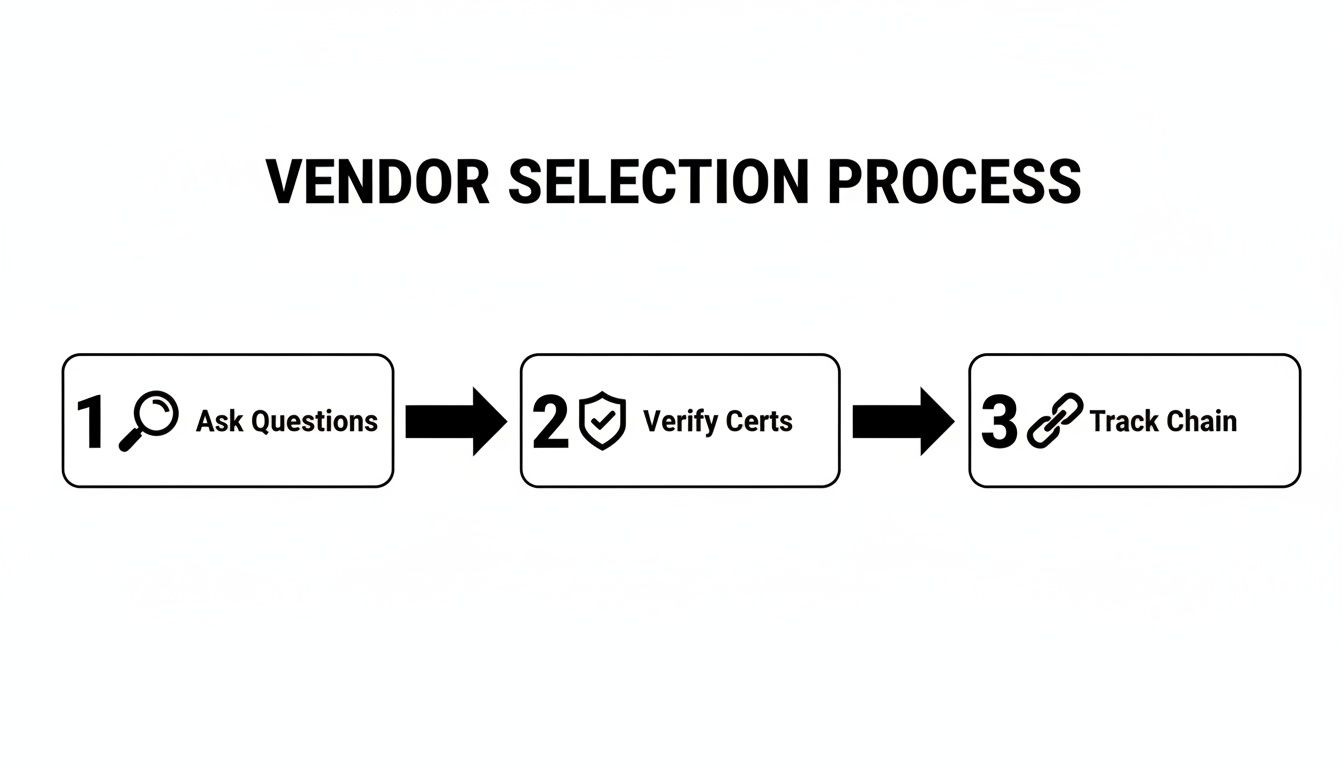
As the process shows, verifying certifications and tracking the chain of custody are non-negotiable steps. They are your guarantee that both data and physical materials are handled securely from start to finish.
A professional partner can perform certified data destruction either on-site at your Arlington office or at their own secure facility. There are two primary approaches, each serving a different purpose.
Comparing Data Destruction Methods
Deciding between software wiping and physical shredding comes down to balancing security needs with potential value recovery. This table breaks down the two main certified methods to help you choose the right service for your assets.
| Method | Security Level | Best For | Considerations |
| :— | :— | :— |
| Software Wiping (NIST 800-88) | High | Reusable assets (newer laptops, servers) where you want to recover residual value. | A methodical, verifiable process that overwrites all data sectors, rendering data unrecoverable. |
| Physical Shredding | Highest | End-of-life or damaged hard drives, SSDs, and other media with highly sensitive data. | The device is physically destroyed, making data recovery impossible and eliminating any potential for reuse. |
Choosing the right method ensures you meet your security obligations effectively.
For assets that might be refurbished and resold, software wiping that follows the NIST 800-88 "Purge" or "Clear" standards is the go-to method. This approach allows your organization to recoup value from your equipment while still receiving a full Certificate of Destruction. For more on the technical details, our guide explains how to completely wipe a hard drive the right way.
When you need absolute certainty, physical shredding is the final answer. It’s the best choice for devices holding top-secret IP, classified data, or for drives that are too damaged to be wiped. This process reduces the media to tiny, unrecognizable fragments.
Pro Tip: Never assume a device is "broken" and therefore safe. A laptop that won't turn on might have a perfectly functional hard drive inside. All devices with data storage must undergo certified destruction, regardless of their operational status.
The Final Step: Staging for Pickup
With your inventory complete and a data destruction plan in place, the last piece of the puzzle is preparing for the physical pickup. To keep the process efficient and secure, consolidate all the inventoried equipment into a single, easily accessible location, like a loading dock or a designated storage room.
Try to keep the assets organized. If you can, palletize monitors, stack desktops neatly, and group laptops together. This not only makes the pickup faster for your vendor but also minimizes the risk of items being damaged or missed during collection. A clean, organized staging area sends a clear signal that you’re serious about a professional and secure process.
Managing Logistics, Documentation, and Costs
You’ve vetted your vendors and scheduled the pickup. Now comes the part where everything gets real—the logistics, the paperwork, and the final costs. Getting this stage right is what separates a one-off cleanout from a truly compliant, repeatable process for your Arlington e-waste recycling program.
A professional ITAD partner doesn't just show up whenever. They'll coordinate with you to find a pickup time that causes the least disruption, whether that’s early in the morning, during a slow afternoon, or at a specific loading dock you designate. This is a coordinated effort, not a random junk removal.
Your only job should be to have the inventoried gear staged and ready. Their team handles the rest, using background-checked drivers and secure, GPS-tracked vehicles to get your assets off-site safely.
The Documentation That Protects Your Business
Once the equipment is on the truck, the documentation trail begins. This isn’t just busywork; this paperwork is your legal proof of compliance. It’s your shield against potential fines or accusations of a data breach down the road.
Without a solid audit trail, your company is left completely exposed.
Your recycling partner is required to provide two critical documents:
- Certificate of Destruction (COD): This is the legal document confirming your data-bearing devices were properly sanitized or destroyed, usually to NIST 800-88 standards. It must list the serial numbers of the destroyed assets, tying directly back to your inventory list.
- Certificate of Recycling (COR): This certificate verifies that all your other electronics and the raw materials from the destroyed devices were handled in an environmentally sound way, meeting R2v3 or e-Stewards standards and keeping everything out of landfills.
Think of these certificates as your get-out-of-jail-free cards. If the TCEQ or a data privacy regulator ever comes knocking, these documents are indisputable proof you did your due diligence. If you're new to this, it's a good idea to read our guide on the Certificate of Destruction for hard drives to fully grasp its importance.
Breaking Down the Costs of E-Waste Recycling
The cost is often what surprises Arlington businesses the most—in a good way. Professional, compliant e-waste recycling is far more affordable than most people think. In many situations, it can be free or even put money back into your budget. It all comes down to the volume and resale value of your equipment.
Here are the most common scenarios:
- Free Pickup and Recycling: If you have a decent amount of equipment, like from an office refresh or clearing out a server closet, most ITAD partners will handle the pickup and recycling at no cost. The value they recover from the raw materials typically covers their expenses.
- Revenue Sharing: Got newer gear with resale value? Think recent-generation laptops, servers, or networking equipment. A partner might offer a revenue-sharing agreement where they refurbish and sell the assets, then give you a cut of the profits.
- Per-Pound or Per-Item Fees: Fees usually only come into play for very small pickups or for items that are expensive to process and have little to no commodity value, like old CRT monitors.
It's a common myth that proper e-waste disposal is always a major expense. For a typical B2B client in Arlington with a decent amount of standard office electronics, the service is frequently provided at no cost.
Always get a custom quote. When you provide your inventory list to a certified vendor, they can give you a clear, upfront breakdown of any costs or potential revenue. This lets you manage your Arlington e-waste recycling as a predictable and budget-friendly part of your IT operations.
Common Questions About E-Waste Recycling in Arlington
Even with a solid plan, navigating the specifics of IT asset disposition can bring up a lot of questions. For businesses focused on Arlington e-waste recycling, getting clear, direct answers is key to moving forward with confidence. We’ve compiled the questions we hear most often from Arlington businesses to help you keep your e-waste program secure, compliant, and on track.
Think of this as a quick-reference guide to address the most common hurdles in the process.
What Types of Electronics Can My Business Recycle?
Many businesses assume e-waste recycling is just for old computers and monitors. In reality, a professional ITAD partner is equipped to handle a comprehensive range of business equipment, allowing you to clear out all your retired technology in one secure, organized process.
Of course, this includes all the standard office electronics:
- Desktop computers and all-in-ones
- Laptops, tablets, and mobile devices
- Monitors of all types (LCD, LED, and older CRTs)
- Printers, scanners, and multifunction devices
- Keyboards, mice, and other peripherals
Beyond the basics, a certified vendor can manage more specialized corporate assets. This includes entire data center inventories like server racks, blade servers, network switches, and uninterruptible power supplies (UPS). It also covers telecommunications gear, audiovisual equipment, and even sensitive laboratory electronics.
Prohibited items are generally non-electronic hazardous waste or large appliances like refrigerators, which require a different recycling stream. Always confirm with your vendor beforehand—they’ll provide a detailed list of accepted materials so there are no surprises on pickup day.
How Do I Know My Company Data Is Actually Secure?
This is the most critical question, and the answer comes down to certified proof. Your company’s data is only secure if you partner with a recycler who provides a Certificate of Destruction (COD) for every single data-bearing device. This document is your non-negotiable proof of compliance and security.
Reputable vendors handling Arlington e-waste recycling follow strict data sanitization protocols, primarily the NIST 800-88 standard. This is achieved through two primary methods:
- Software Wiping: Using specialized software to overwrite a hard drive multiple times, permanently erasing the data so it is completely unrecoverable. This is often used for newer drives that have resale value.
- Physical Shredding: The hard drive or solid-state drive is run through an industrial shredder that reduces it to tiny, unreconstructable metal fragments.
The entire process, from your office to final disposition, is meticulously documented. Your Certificate of Destruction will list the serial numbers of the specific assets that were destroyed, creating a clear, auditable trail that proves your data was handled securely and compliantly.
Never work with a provider who can’t offer this level of documented assurance. A verbal promise or a basic invoice is not enough to protect your business from the legal and financial consequences of a data breach.
What Does E-Waste Recycling Typically Cost a Business in Arlington?
The cost structure for business e-waste recycling is often a pleasant surprise for many organizations. The final price depends on the volume of your equipment and its potential resale value. For most B2B clients in the Arlington area, the service is frequently provided at no charge.
Here’s a breakdown of how it works:
- Valuable Assets (Potential for Revenue Share): If you have newer IT assets with remaining market value—like recent-generation laptops, enterprise servers, or networking gear—an ITAD partner can often provide the service for free. In some cases, they may even offer a revenue-sharing return after the equipment is refurbished and sold.
- No-Value Assets (Free Pickup): For large quantities of standard office electronics with little to no resale value, the service is still often free of charge. The recycler covers their costs by recovering value from the raw commodity materials (copper, aluminum, steel) after processing.
- Cost-Incurring Items: Charges typically only apply for very small pickups where logistics costs are prohibitive, or for specific items that are expensive and difficult to recycle, such as old CRT monitors.
Requesting a custom quote is always the best approach. An accurate inventory list allows a vendor to give you a clear, upfront assessment of any potential costs or revenue returns.
What Paperwork Should I Get After My E-Waste Is Picked Up?
After your equipment is collected, it is essential that you receive and retain specific documents to create an official audit trail. This paperwork is your legal proof that you complied with Texas environmental regulations and all applicable data privacy laws.
At a minimum, you must receive these two key documents:
- A Certificate of Destruction (COD): This certifies that all data on your hard drives and other storage media was securely destroyed according to industry standards.
- A Certificate of Recycling (COR): This confirms that the physical electronics were processed in an environmentally responsible manner, adhering to R2 or e-Stewards guidelines.
Along with these certificates, you should also receive a detailed asset report that matches the inventory collected from your facility. Together, these documents provide a closed-loop accounting of every asset, from your door to its final disposition.
When you need a reliable partner for secure, compliant IT asset disposition, Dallas Fortworth Computer Recycling provides the expertise and documentation your organization needs. With over a decade of experience, we offer certified data destruction and responsible electronics recycling for businesses across Arlington and nationwide. To get a quote and schedule your pickup, visit us at https://dallasfortworthcomputerrecycling.com.