
A Guide to Arlington Technology Recycling for Businesses
For any IT manager in Arlington, dealing with outdated technology is a high-stakes balancing act. You have to guarantee absolute data security while also making sure you’re following a tangled web of environmental regulations. Simply throwing old gear away isn’t just sloppy—it’s a massive business risk. A formal IT Asset Disposition (ITAD) plan isn't a "nice-to-have" anymore; it's a fundamental part of modern operations.
The Modern Challenge of Business E-Waste in Arlington
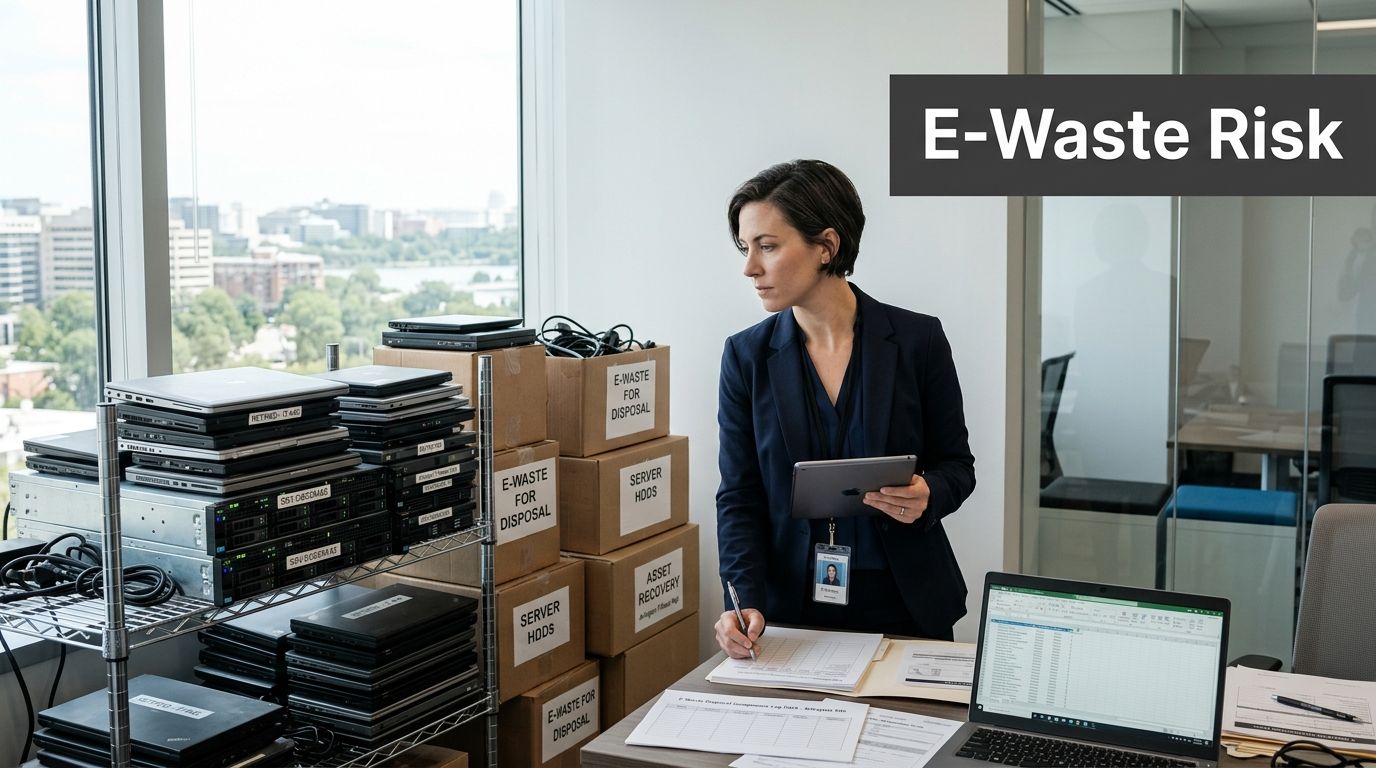
The days of shoving old computers and servers into a forgotten storage closet are long gone. Every single piece of retired hardware is a potential data breach and an environmental liability waiting to happen. For businesses here in Arlington, technology recycling has shifted from a low-priority chore to a critical risk management function. One misstep can lead to steep fines, a damaged reputation, and your most sensitive information falling into the wrong hands.
This isn’t just about following local rules. The regulations are a complex web of federal laws, industry-specific mandates like HIPAA for healthcare, and ever-tightening data privacy laws. A casual approach to disposal can quickly land your company in hot water, which is why a professional partner for Arlington technology recycling is essential.
Beyond the Dumpster: Data Security and Compliance
For any IT or procurement manager, the number one concern is the data still living on those retired assets. A single hard drive from a decommissioned server or an old company laptop can hold a goldmine of confidential information—customer lists, financial reports, or your proprietary intellectual property.
A professional IT Asset Disposition (ITAD) strategy is not a cost center; it is a vital risk management function. It protects your company's data, reputation, and bottom line by ensuring secure and compliant handling of every retired asset.
This is where technical standards like NIST 800-88 become non-negotiable. These guidelines from the National Institute of Standards and Technology are the industry playbook for media sanitization. They define three core methods for making sure your data is gone for good:
- Clear: This involves overwriting data using software. It’s a solid option for assets with a low-risk profile that might be reused internally.
- Purge: This goes a step further, using methods like degaussing for magnetic hard drives or cryptographic erasure to make data recovery practically impossible.
- Destroy: The most absolute method. The media is physically shredded, disintegrated, or incinerated, leaving nothing behind to recover.
Your recycling partner must do more than just offer these services. They need to provide a Certificate of Data Destruction. This document is your official, auditable proof that your data was permanently eliminated, protecting your business from any future claims of liability. Getting this right also means understanding the environmental impact of electronic waste and choosing a partner who addresses it head-on.
Navigating the Landscape of Vendor Certifications
Choosing a vendor for your Arlington technology recycling needs is about more than finding the lowest bidder. The certifications a vendor holds are your best indicator of their commitment to security, environmental stewardship, and ethical operations.
To help you vet potential partners, this table breaks down the most important standards in the ITAD industry.
Essential ITAD Compliance and Certification Standards
| Standard/Regulation | What It Covers | Why It Is Critical for Your Business |
|---|---|---|
| R2v3 | The R2 (Responsible Recycling) v3 standard sets strict requirements for environmental protection, data security, and worker health and safety. It follows a "reuse, recover, dispose" hierarchy to maximize the life of electronics. | An R2-certified recycler is audited to ensure they aren't just dumping your assets. It guarantees a secure, transparent process and responsible management of all materials, which protects your brand reputation. |
| e-Stewards | Known for having the most stringent global standards, e-Stewards certification includes a complete ban on exporting hazardous e-waste to developing countries. It was created by the Basel Action Network to stop environmental injustice. | This certification gives you peace of mind that your old equipment won’t end up causing health and environmental crises overseas. It's the highest bar for corporate social responsibility in e-waste. |
| NIST 800-88 | Not a certification, but a U.S. government guideline for media sanitization. It defines the Clear, Purge, and Destroy methods for data destruction, providing a framework for eliminating information from media. | Adherence to NIST 800-88 ensures your vendor uses recognized, defensible methods for data destruction. This is crucial for creating an auditable trail and proving you met your data security obligations. |
| NAID AAA | The National Association for Information Destruction (NAID) offers a AAA certification for secure data destruction operations. It verifies compliance through surprise audits of security protocols, employee screening, and the chain-of-custody process. | If data security is your absolute top priority, a NAID AAA certified partner provides the ultimate assurance. It confirms their entire operation, from pickup to destruction, is built to withstand intense security scrutiny. |
A certified partner ensures your company is part of the solution, not the problem.
The sheer volume of electronics being recycled shows why these standards are so critical. In fact, the Arlington-based Consumer Technology Association (CTA) recently reported a record-breaking 700 million pounds of consumer electronics recycled in a single year. That's a staggering figure, equal to preventing roughly 175 million laptops from ending up in landfills. This national momentum toward responsible e-waste management is exactly what should be guiding your own asset disposition strategy.
Building Your Internal IT Asset Disposition Plan
Thinking about recycling your old tech? The real work starts long before a truck ever shows up for pickup. It begins with a clear, documented internal plan for what we in the industry call IT Asset Disposition (ITAD). This is your playbook for retiring technology securely and responsibly, and frankly, it's the only way to avoid chaos.
Without a solid plan, getting rid of old equipment turns into a major risk. A structured approach ensures every device is accounted for, all sensitive data is properly handled, and you stay compliant from start to finish. It all kicks off with a thorough audit of the gear you're looking to retire.
Start with a Comprehensive Asset Audit
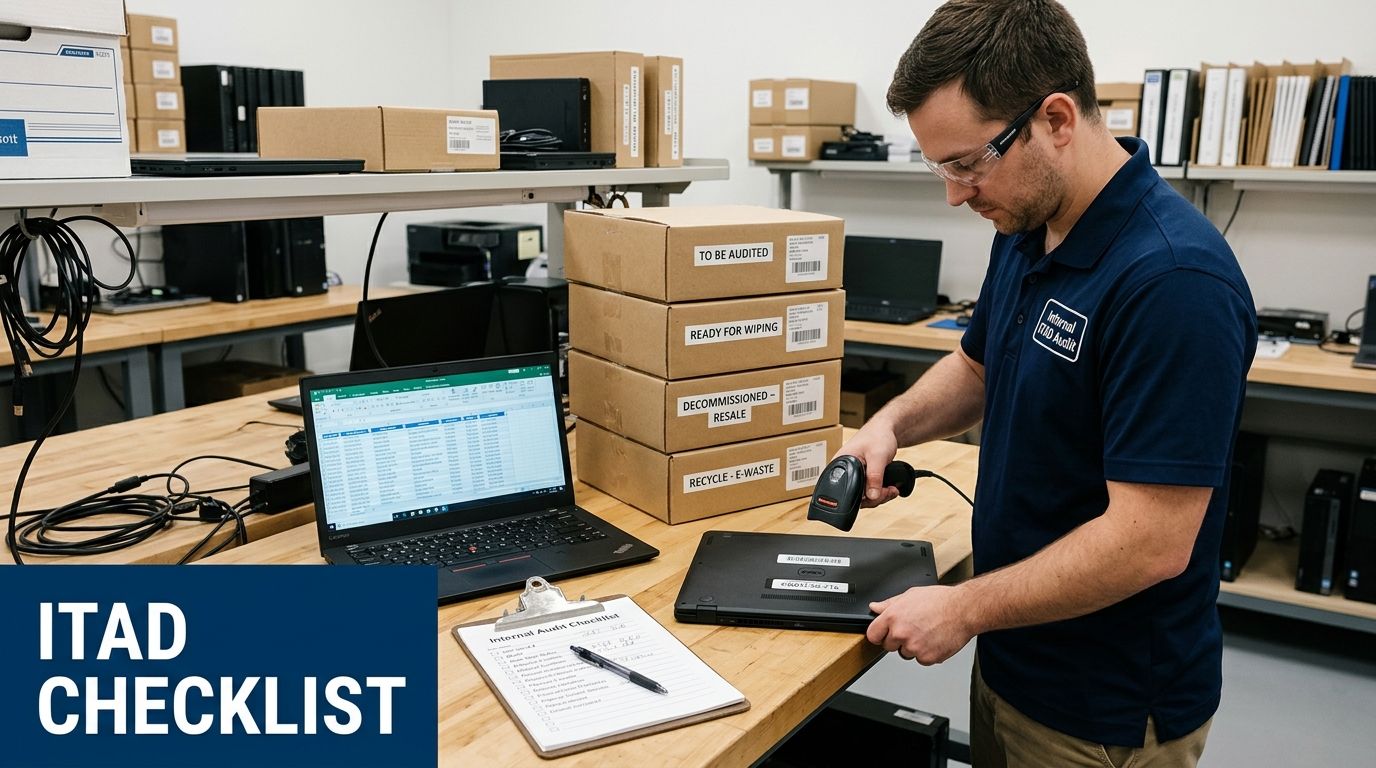
First things first: you need a detailed inventory of every single asset. This isn't just about counting laptops. It's about knowing exactly what you have, where it is, and what kind of data risk it carries. Think of it as a final census for your outgoing technology.
Your team needs a consistent checklist to capture the critical details for each piece of equipment. This ensures nothing gets missed, whether you're clearing out an entire data center or just processing a single laptop from a former employee.
A good inventory list should capture:
- Asset Type: (e.g., laptop, server, monitor, networking switch)
- Brand and Model: (e.g., Dell Latitude 7420, Cisco Catalyst 9300)
- Serial Number: The unique identifier for precise tracking.
- Asset Tag: Your company’s internal tracking number.
- Data-Bearing Status: Does it contain a hard drive, SSD, or other storage media? This is critical.
- Physical Condition: (e.g., functional, minor damage, non-working)
This level of detail is what separates a pile of old electronics from a manageable, auditable inventory. It sets the stage for everything that follows. If you're new to this, you can learn more about what an IT asset disposition process entails in our detailed guide.
Classify Assets and Map Out the Risks
With your inventory in hand, it's time to start classifying. Not all assets are created equal, and they shouldn't be treated that way. A five-year-old monitor has a completely different risk profile and value than a two-year-old server that processed sensitive customer data.
Group your assets into logical categories. This makes decision-making much, much easier.
Disposition Categories
- Resale/Remarketing: Newer, functional equipment that still has market value.
- Donation: Working gear that might not have high resale value but could be a huge help to a local nonprofit.
- Recycling: Broken, obsolete, or zero-value assets that require responsible materials recovery.
- Secure Destruction: Any asset with highly sensitive data that must be physically destroyed, no matter its condition.
For IT managers, the absolute most critical part of this stage is assessing data sensitivity. A laptop used by a C-suite executive requires a far more stringent data destruction protocol than a conference room display monitor. This risk assessment directly informs the security requirements you'll need from your Arlington technology recycling partner.
This classification process isn't just about security; it’s also smart business. Identifying assets for resale can generate revenue that helps offset the costs of recycling everything else.
Get Your Internal Stakeholders on Board
An ITAD plan can't live in a silo. You need support from across the organization—especially from finance, legal, and facilities. Getting their buy-in early is the secret to a smooth, headache-free process.
When you talk to them, frame it as a business case that speaks their language.
- For Finance: Talk about the potential for value recovery from resold assets and the massive cost avoidance of a data breach fine.
- For Legal: Emphasize risk mitigation. They’ll care about certified data destruction and a documented chain of custody that will stand up to scrutiny.
- For Facilities: Coordinate the logistics. Discuss storage, staging areas, and pickup scheduling to keep operational disruptions to a minimum.
Presenting a comprehensive plan like this shows you're aligned with the broader push for responsible corporate citizenship. Just look at the local trends—Arlington County's recycling rate grew from 40.3% in 2007 to 52.4% by 2021, driven largely by businesses like yours. A structured plan for Arlington technology recycling isn't just good governance; it's what's expected.
How to Vet Your Arlington Technology Recycling Partner
Choosing the right vendor is a critical decision in your entire IT Asset Disposition process. This choice directly impacts your data security, environmental compliance, and even your brand’s reputation. Simply picking the cheapest option or the first company in a search result is a gamble you can't afford to take. A true Arlington technology recycling partner does more than just haul away old equipment; they deliver a secure, transparent, and fully auditable service that protects your organization from risk.
This means you have to look beyond surface-level promises. You need to dig into the specifics of their certifications, their security processes, and how they report back to you. Asking the right questions is the only way to tell the difference between a basic scrap hauler and a professional ITAD partner.
Verifying Certifications Beyond the Logo
Any potential partner will have logos for certifications like R2v3 or e-Stewards on their website, but your due diligence can't end there. You must independently verify that their certification is active, valid, and applies to the specific facility that will actually process your assets.
Here’s exactly how to do it:
- For R2v3: Go to the SERI (Sustainable Electronics Recycling International) website and use their official directory to look up the company. Confirm their status is "Certified" and not "Suspended" or "Expired."
- For e-Stewards: Use the directory on the official e-Stewards website. This certification holds vendors to the highest standards, including a complete ban on exporting hazardous e-waste.
A major red flag is any vendor who makes this verification difficult or is vague about their certification status. Transparency is non-negotiable. If you want to dive deeper into these standards, you can learn more about what it means to be an R2v3 certified electronics recycler and why it’s so important for your business.
Critical Questions to Ask Potential Vendors
Once you’ve confirmed their certifications are legitimate, it’s time to grill them on their process. The detail and confidence in their answers will reveal everything about their operational security and professionalism.
Don't be shy about getting specific. Prepare a list of questions that go beyond a simple "What do you recycle?"
Key Questions for Your RFP or Interview:
- Chain of Custody: "Can you walk me through your entire chain of custody process, from pickup at our Arlington office to final disposition?" A solid answer will detail secure, GPS-tracked transport, locked containers, and documented handoffs at every stage.
- Data Destruction: "What data destruction methods do you use, and how do you verify success for each device?" They should be able to clearly explain their process for wiping, degaussing, and shredding in line with NIST 800-88 standards.
- Reporting: "Can I see a sample of your serial-number-level reporting?" Ask for a sample Certificate of Data Destruction and Certificate of Recycling. The report must be detailed enough to itemize every single asset you handed over.
- Downstream Vendors: "How do you audit your downstream vendors?" A responsible recycler vets every partner they send materials to for tasks like smelting or refining, and they should have the documentation to prove it.
- Employee Security: "What are your protocols for employee background checks and security training?" The people handling your assets are a critical part of the security chain.
A vendor’s hesitation or inability to provide detailed, confident answers to these questions is a clear warning sign. The best partners welcome this level of scrutiny because they have robust, defensible processes and are proud to show them off.
Local Specialist vs. National Provider
Finally, you need to consider the scale of your project. For an Arlington business, the choice often boils down to a local recycler versus a large provider with a national footprint.
Local-Only Arlington Recyclers
- Pros: Often provide more personalized service and have a deep understanding of Arlington-specific regulations. They can be very responsive for quick, smaller-scale pickups.
- Cons: May lack the infrastructure for large, multi-location projects. Their downstream vendor network might not be as extensive or rigorously audited as a larger company’s.
National ITAD Providers
- Pros: Ideal for companies with offices beyond Arlington. They offer standardized processes, uniform reporting, and consolidated billing. They typically have highly audited security protocols and extensive value recovery networks.
- Cons: The service can feel less personal. They may have minimum volume requirements to schedule a pickup.
For a mid-sized Arlington company managing a single-site refresh, a specialized local partner could be a perfect fit. However, for an enterprise with offices in Arlington, Dallas, and beyond, a national provider offers the consistency and scale that a local-only vendor simply cannot match. Your choice should align with both your immediate project and your company’s future ITAD needs.
Ensuring Data Destruction and an Unbroken Chain of Custody
Your responsibility for sensitive corporate data doesn’t end when a device is unplugged. The moment retired assets leave your facility, the focus must shift to irrefutable data destruction and a perfect, unbroken chain of custody. This isn’t just about compliance; it's about protecting your organization from the immense financial and reputational damage of a data breach.
A professional recycling partner should offer solutions aligned with NIST 800-88 standards, which define the industry-accepted methods for data sanitization. It's crucial to understand these methods to match the right process to the right asset, especially when it comes to hard disk drives (HDDs) versus solid-state drives (SSDs).
This flowchart details the essential steps for vetting a recycling partner in Arlington, from verifying certifications to confirming logistics and data security protocols.
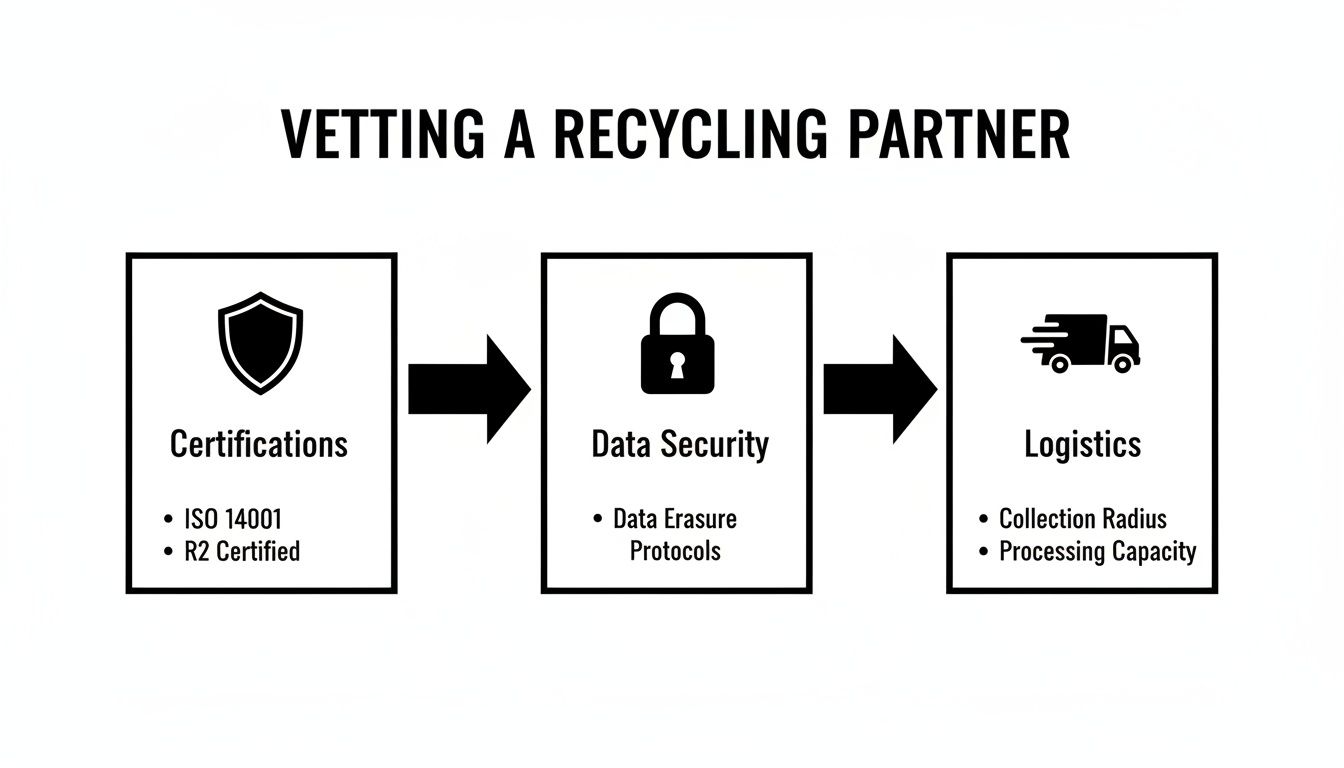
As the chart shows, data security is the technical heart of any responsible ITAD program. It sits squarely between verifying a vendor's credentials and their ability to handle the physical pickup and transport.
Aligning Destruction Methods With Your Assets
Not all data destruction is created equal, and a one-size-fits-all approach is a common mistake that can leave data exposed. The type of storage media dictates the most effective method.
Data Wiping (Clearing): This software-based method overwrites every sector of a drive, making the original information unrecoverable by standard tools. It’s a great option for functional HDDs and SSDs slated for reuse or resale, but it requires careful verification to ensure the wipe is 100% complete.
Degaussing (Purging): Using a powerful magnet, degaussing destroys the magnetic field on traditional HDDs, rendering them permanently inoperable. However, this method is completely ineffective on SSDs, which use flash memory chips that are immune to magnetic fields.
Physical Shredding (Destroying): This is the ultimate solution for end-of-life media or drives containing highly sensitive information. The device is physically pulverized into tiny fragments, making data recovery impossible. It is the only guaranteed method for both HDDs and SSDs.
For an organization handling HIPAA records or sensitive financial data, physical shredding is often the only acceptable endpoint. For less-sensitive assets destined for resale, a certified wipe is more appropriate.
The proof is everything. A handshake agreement or a simple invoice won’t protect you in an audit. Your vendor must provide a legally defensible audit trail proving every single data-bearing device was handled securely and sanitized completely.
This level of documentation is central to any sound risk management strategy and should be a top consideration when evaluating a partner for Arlington technology recycling. The local commitment is clear; Arlington County's own Zero Waste plan targets a 90% landfill diversion rate by 2038, a significant jump from 52.4% in 2021. You can read more about the county's goals on ARLnow.com. For businesses, this underscores the need for partners who provide documented, responsible processing.
The Certificate of Data Destruction: Your Audit Trail
The linchpin of your audit trail is the Certificate of Data Destruction. This document is your official proof that you fulfilled your due diligence. Without it, you have no way to defend your company in the event of a breach investigation.
A valid certificate is more than a piece of paper; it's a detailed, itemized report. When vetting a partner, demand to see a sample and ensure it includes these four critical elements:
- Unique Serial Numbers: Every hard drive, server, and laptop must be listed by its unique serial number.
- Destruction Method: The certificate must specify if the device was wiped, degaussed, or physically shredded.
- Date of Destruction: The exact date the sanitization was completed.
- Authorized Signatures: Signatures from the vendor confirming the process was finished according to established standards.
This serial-number-level tracking is non-negotiable. It closes the loop on your chain of custody, from your facility to final disposition. To see exactly what this document should contain, review our guide on the essentials of a Certificate of Destruction for hard drives. It’s this level of detail that provides peace of mind that your company's data is truly gone for good.
Managing Logistics and Unlocking Asset Value
With a solid internal plan and a vetted partner, it's time to move your Arlington technology recycling strategy from paper to practice. This is all about execution—managing the real-world logistics of pickup and, just as importantly, recovering value from your retired assets.
A smooth pickup is about more than just clearing out old equipment; it's about minimizing disruption to your daily operations. The key to a hassle-free process is getting your assets staged properly before the truck arrives. Consolidate all inventoried equipment in a secure, accessible area, ideally near a loading dock. Keeping it separate from your active IT infrastructure is critical to prevent anything from being removed by mistake.
For larger projects, proper palletizing is a must. This means securely shrink-wrapping assets onto pallets, which makes loading faster and safer while protecting the equipment during transport. A well-organized staging area shows your ITAD partner you’re prepared and helps the entire process run like clockwork.
Maximizing Your Return Through Asset Remarketing
One of the most valuable parts of a smart ITAD strategy is the financial return you can get from your old gear. Through a process called value recovery or asset remarketing, many retired IT assets—especially those less than five years old—still hold significant value on the secondary market.
A professional partner will have a transparent process for this:
- Testing and Auditing: Each asset is tested to determine its functionality and cosmetic condition.
- Certified Data Erasure: All data is securely wiped according to NIST 800-88 standards. This is non-negotiable before any resale.
- Refurbishment: Minor repairs or upgrades can be performed to boost the asset's market value.
- Resale: The refurbished equipment is then sold through established channels to buyers looking for quality used technology.
The revenue generated from these sales is shared back with your company. For many of our clients, these returns significantly offset—or even exceed—the costs of recycling and data destruction. To get a better sense of what has value, check out our guide on where to sell computer parts and equipment.
Donation Programs and Corporate Social Responsibility
Beyond a direct financial return, donating functional equipment is a powerful way to support the Arlington community and strengthen your company’s Corporate Social Responsibility (CSR) profile. Many local nonprofits, schools, and charities operate on tight budgets and can put your retired laptops, desktops, and monitors to excellent use.
Your recycling partner can often facilitate these donations for you. They handle the certified data wiping, confirm the equipment is clean and working, and manage the logistics of getting it to the recipient organization. In return, your business can often receive a tax deduction while building positive brand recognition for giving back.
Case Study in Action: A large healthcare client here in the Arlington area was decommissioning a specialized diagnostic lab. They had dozens of high-value, proprietary medical devices that couldn't be resold on the open market due to compliance rules. Instead of just shredding them, their ITAD partner identified a university research hospital that could legally use the equipment for non-clinical studies. The partner managed the secure data sanitization, documented the transfer, and helped the client turn a complex disposal project into a valuable donation, furthering medical research and reinforcing the client's commitment to community health.
This strategic approach transforms what could be a logistical headache into a win on multiple fronts. You ensure compliance, recover value, and create a positive community impact—all from the same set of retired assets.
Finding Your Trusted Partner in E-Waste Management
We've covered the essentials for building a secure and compliant program for your company's outdated technology. With a solid plan in place, the final piece of the puzzle is selecting the right partner to execute it. This isn't just about finding someone with a truck; it's about finding a provider that delivers confidence and protects your organization.
For businesses looking for reliable Arlington technology recycling, this means partnering with an organization that has a proven, local track record. Experience matters. A company with a decade or more in the ITAD industry—like our 13 years of dedicated service—has seen it all and understands the specific challenges businesses face.
From Logistics to Long-Term Partnership
Certification is the cornerstone of trust in this industry. When a potential partner holds an R2v3 certification, it’s not just a logo for their website. It’s your guarantee that they adhere to the highest global standards for environmental responsibility and data security, from the moment your equipment leaves your Arlington office.
This level of service should cover everything from secure data destruction and remarketing for value recovery to managing the complex logistics of specialized equipment.
The right ITAD partner doesn't just solve a one-time disposal problem. They become an extension of your team, providing the expertise and infrastructure needed to manage the entire lifecycle of your IT assets securely and sustainably.
As a nationwide provider, Dallas Fort Worth Computer Recycling combines deep local expertise with the logistical capability to serve businesses across the country. We handle a routine office laptop refresh with the same documented precision as a full data center decommissioning. This is critical for Arlington businesses looking for a reliable, long-term ITAD relationship.
Ultimately, the goal is to make secure and compliant Arlington technology recycling a seamless part of your operations. With the right team handling the complexities of data security, logistics, and compliance, your organization can focus on its core mission, confident that its retired assets are in expert hands.
Ready to build a reliable, long-term ITAD partnership? Connect with our team today to discuss your organization's specific needs.
Frequently Asked Questions About Technology Recycling
Even the most thorough IT asset disposition plan can leave a few questions on the table. We work with IT managers and procurement teams across Arlington every day, and a few key questions come up time and again. Here are the answers you need.
What Types Of Business Electronics Can Be Recycled?
Just about every piece of technology in your office is recyclable. This goes beyond the obvious desktops, laptops, and monitors to include all your networking gear, servers, printers, and peripherals.
A professional Arlington technology recycling partner should also be equipped to handle more specialized assets. This includes enterprise data center hardware, medical and lab equipment, and other complex electronics that require specific processing and data security protocols.
How Can I Be Sure My Company’s Data Is Secure?
True data security comes from working with a certified partner who provides an unbroken, fully documented chain of custody. Your vendor should be using secure, GPS-tracked vehicles for transport and data destruction methods that align with NIST 800-88 standards.
The entire process must end with a Certificate of Data Destruction. This document itemizes every single device by serial number and serves as your non-negotiable proof of compliance. It’s the audit trail that protects your company from future liability.
What Is Value Recovery And How Does It Work?
Value recovery is simply the process of getting a financial return on your retired IT assets. Equipment that still holds some market value—usually devices less than five years old—can be securely wiped, tested, and refurbished for resale.
The revenue generated from those sales is then shared back with you. This return can dramatically lower the net cost of recycling your older, non-functional equipment, sometimes covering the entire project cost and turning a line-item expense into a revenue source.
At Dallas Fort Worth Computer Recycling, we provide the certified, secure, and auditable services Arlington businesses need. Contact us today to ensure your IT assets are managed responsibly.