
Telecom Equipment Liquidation Houston A Strategic Guide

A lot of Houston IT teams hit the same point at once. The migration is done, the carrier cutover has happened, or the data center refresh is finally approved. What's left behind is the hard part: racks of decommissioned routers, switches, PBX hardware, optics, line cards, storage components, and telecom gear that can't just sit in a cage indefinitely.
That backlog creates two problems at the same time. One is financial. Some of that equipment still has resale value, especially in a market like Houston. The other is operational and legal. If the wrong asset leaves the building without verified sanitization, proper chain-of-custody, or complete reconciliation, the liquidation project stops being a cleanup task and starts becoming a liability event.
Houston makes the decision more urgent. The region has a large concentration of enterprise infrastructure, data center activity, telecom operations, and industrial IT environments. That creates a real secondary market for networking gear, but it also means buyers are selective and audit expectations are high. If you're handling telecom equipment liquidation Houston operations for a data center, hospital system, campus network, municipality, or energy company, speed matters, but documentation matters more.
Your Guide to Telecom Asset Retirement in Houston
At 6:30 p.m., the migration window closes, the carrier confirms cutover, and the old telecom row is suddenly your problem. The gear still has value, but the bigger question is whether your team can move it out of the facility with clean records, verified data handling, and a paper trail that will hold up in an audit.
That is the part many liquidation guides miss. Price matters, but enterprise and public-sector teams in Houston also have to account for disposal requirements tied to customer data, regulated workloads, and internal retention rules. The FTC's Disposal Rule and NIST media sanitization guidance shape how retired telecom hardware should be handled when devices, modules, or attached media may contain sensitive information. A fast pickup with weak documentation can create a larger loss than a weak resale result.
Houston has the scale to support an active resale channel for telecom and network equipment. CBRE's North America Data Center Trends places Houston among established data center markets, which helps sustain demand for selected enterprise gear, spares, optics, and infrastructure components. It also means buyers are disciplined. They discount incomplete lots, undocumented assets, and anything with uncertain chain-of-custody.
Retirement projects that go well usually start the same way. The owner defines what must be reconciled, what must be sanitized, what can be remarketed, and what requires downstream disposition records. That sounds administrative. It is also how teams avoid write-offs, security exceptions, and disputes with procurement after the equipment leaves the building.
If your organization is also retiring servers, endpoints, and mixed electronics outside the telecom stack, a broader Houston computer recycling program for cross-department IT disposal can help standardize policy and reporting.
Ask a harder question at the start. Can this lot leave the site with resale value preserved and every compliance obligation documented?
The Pre-Liquidation Playbook Audit and Valuation
A liquidation project usually gets priced twice. First on paper, when buyers review your inventory. Then again after pickup, when missing modules, unreadable serials, undocumented damage, or surprise data-bearing components show up in inspection. The gap between those two numbers is where recovery gets lost and disputes start.
The control point is the Master Asset List. If that file is weak, every downstream step gets weaker with it. Finance cannot reconcile the retirement. Security cannot confirm what required sanitization. The buyer protects their margin by lowering the offer.

Build the asset list before you request pricing
For telecom equipment liquidation Houston projects, the asset list needs enough detail for a buyer to sort resale units from scrap without filling in blanks on your behalf. Guesswork lowers offers. It also creates chain-of-custody and reconciliation problems later.
Include at minimum:
- Manufacturer and model. Cisco, Juniper, Nokia, Huawei, and PBX platforms move through different secondary channels.
- Serial number. This is the anchor for reconciliation, title transfer, and exception handling.
- Your internal asset tag. Audit and finance teams usually need both records tied together.
- Configuration details. Capture supervisor modules, power supplies, optics, line cards, transceivers, and rail kits.
- Functional state. Note whether the unit was pull-tested, powered on, was working at deinstall, or remains unverified.
- Physical condition. Bent rack ears, cracked bezels, corrosion, damaged ports, and fan faults affect resale.
- Location. Rack, room, cage, floor, and site.
- Data-bearing status. Flag embedded storage, removable flash, SSDs, HDDs, and management modules that need sanitization or removal.
Large Houston decommissions often involve multiple rooms, multiple technicians, and multiple spreadsheets. That is where inventory quality breaks down. Use a naming convention before the first rack is touched, and use one system of record. If your process still depends on disconnected files, review IT asset management software options for stronger lifecycle control.
Condition drives value more than expected
Age matters. Demand matters. Condition and completeness often decide whether equipment is sold as a marketable asset or priced for parts.
That distinction gets expensive fast.
A current or recently retired enterprise router with complete modules, visible serials, clean photos, and known working status will usually draw better attention than gear with unknown provenance. A chassis missing cards or power supplies may still have value, but buyers price uncertainty aggressively because they are taking on testing time, parts sourcing, and resale risk. In Houston's active secondary market, disciplined buyers do not pay top-tier numbers for incomplete records.
Original purchase price rarely helps. Buyers focus on current demand, support status, configuration, firmware relevance, cosmetic condition, and how much labor it will take to resell the unit.
Practical rule: If your audit record does not show the exact configuration, the buyer will not price it as complete.
Use the right valuation lens
Telecom gear should not all be valued the same way. In practice, three methods matter.
| Valuation method | Best use case | What it means in practice |
|---|---|---|
| Fair Market Value | Current, in-demand gear with active secondary demand | Best for equipment that can be remarketed as a working unit or tested component |
| Orderly Liquidation Value | Larger projects sold over a defined timeline | Assumes controlled sale conditions and realistic buyer demand |
| Scrap Value | End-of-life, damaged, obsolete, or unsupported hardware | Based on commodity recovery, not equipment utility |
Use the wrong method and the project gets distorted. I see this often with mixed telecom lots. A few desirable routers or optics lead internal stakeholders to assign resale expectations to everything else, including unsupported PBX shelves, damaged chassis, and low-demand transmission gear. The result is delayed approval, pricing disputes, and write-downs after settlement.
A better approach is to separate the lot early. Keep marketable equipment, parts-only candidates, and scrap streams distinct in the audit. That gives buyers less room to discount the whole project because of the weakest assets in the room.
Audit evidence should survive procurement, finance, and legal review
The audit package is not just a pricing tool. It is part of your documentation trail. If a serial number is disputed, a module goes missing, or an asset later turns up on an exception list, your records need to show what was present, what condition it was in, and how it was classified before pickup.
A defensible file usually includes:
- Lot-level overview photos
- Close-ups of serial plates and asset tags
- Photos or notes showing missing components
- Functional status records
- A version-controlled master list with date and owner
For public-sector teams, healthcare organizations, financial institutions, and any enterprise with formal retention and disposal controls, this paperwork has another job. It supports the compliance record that follows the asset through sanitization, transfer, resale, recycling, or destruction. If that handoff is weak, value recovery stops being the only concern. Liability becomes part of the transaction.
Navigating Houston's Compliance and Data Security Maze
Most liquidation failures don't begin with bad pricing. They begin with the sentence, “It's just network gear.”
That assumption is wrong often enough to create real exposure. Routers, switches, PBX systems, unified communications platforms, firewalls, and storage-adjacent telecom devices can all retain information you don't want leaving the building without verification. Configuration data, credentials, call records, logs, cached files, management backups, and residual data on removable or embedded media are exactly the sort of details that get overlooked when a team treats liquidation as surplus removal instead of controlled disposition.
Disposal standards define what reasonable looks like
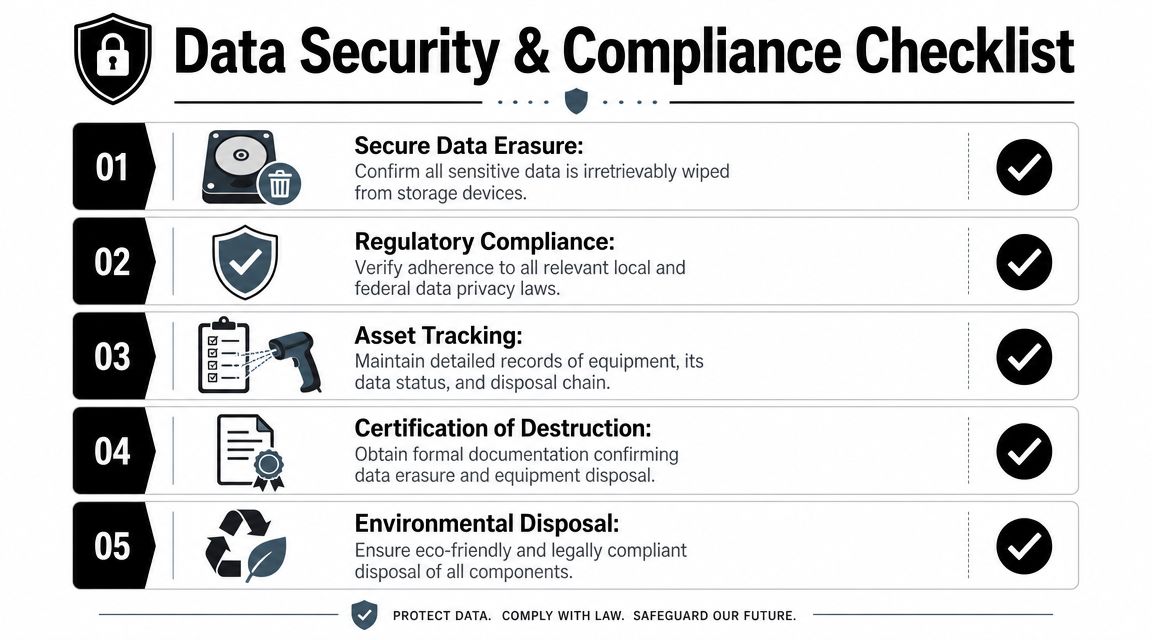
For enterprise and public-sector teams, the standard isn't “we removed the gear.” The standard is whether you took reasonable measures to prevent unauthorized access to sensitive information.
The FTC's Disposal Rule and NIST media sanitization guidance are part of that baseline. The compliance side is financially material too. The global average cost of a data breach reached $4.88 million in 2024, which is why strong documentation isn't administrative overhead. It's risk control, as noted in guidance on disposal rule and sanitization expectations.
NIST thinking is useful because it separates sanitization into different actions. In practical terms:
- Clearing is appropriate when media remains in a controlled environment and the risk profile is lower.
- Purging is stronger and more appropriate when assets leave your direct control.
- Destroying is the right choice when reuse isn't appropriate or the media can't be sanitized to the required standard.
You don't need to turn every project into a legal memo. But you do need to match the sanitization method to the asset, the data type, and the organization's risk posture.
A certificate should answer the auditor's next question
A weak Certificate of Data Destruction is little more than a receipt. A strong one supports audit, legal review, and internal reconciliation.
It should identify:
- Which assets were sanitized or destroyed
- How the sanitization was performed
- When and where the work occurred
- Who handled the assets
- Which serial numbers or unique identifiers were covered
- Whether the result was wipe, purge, or physical destruction
- The final downstream outcome if the device was recycled after media destruction
If your organization handles healthcare, financial, public-sector, or other regulated data, incomplete destruction records create headaches fast. Teams with protected data should align telecom disposition policies with broader HIPAA-compliant electronics recycling practices in Texas, even when the equipment category looks “network-only” on paper.
Don't accept “all drives wiped” as a final statement. Ask which drives, by serial number, with what method, and where that record is stored.
Chain-of-custody is where good intentions fail
Many projects maintain adequate sanitization plans but suffer from poor handoff discipline. That is a dangerous combination. If a pallet sits unsecured in a loading area, if serials are not reconciled during pickup, or if mixed assets move without clear labeling, your paper process may look stronger than the actual one.
A workable chain-of-custody process includes these controls:
- Sealed or controlled staging before pickup
- Count verification at handoff
- Signed transfer records
- Vehicle and personnel documentation
- Receiving confirmation at the processor or downstream site
- Exception reporting for missing, substituted, or damaged assets
Environmental compliance matters too
Telecom equipment retirement also intersects with environmental handling obligations. Boards, batteries, power systems, mixed metals, and legacy components can't be treated like general office trash. A compliant liquidation partner should be able to explain downstream handling, not just loading and pickup.
For Houston teams, that's especially important in multi-asset decommissions where telecom equipment is mixed with servers, storage, UPS components, and general e-waste. The biggest compliance mistakes often happen at the edges of the lot, not in the center of it.
Choosing Your Houston Telecom Liquidation Partner
A buyer can offer a strong number and still be the wrong partner. For telecom equipment liquidation Houston projects, the wrong partner usually reveals itself in the details: vague intake procedures, thin reporting, limited technical understanding, weak downstream transparency, or contracts that protect the vendor more than the client.
Many organizations lose control at this stage. Procurement focuses on price and pickup date. Security wants sanitization. Operations wants the room cleared. Finance wants asset recovery. Legal wants proof. The vendor that can satisfy all five groups is the one worth shortlisting.
What qualified partners do differently
Industry data indicates that 60 to 70% of telecom equipment failures during liquidation stem from inadequate initial condition assessment and missing technical documentation. The same source notes that structured assessment protocols with a qualified partner improve outcomes by 40 to 50% and recover 15 to 25% additional value, according to telecom loss assessment and liquidation analysis.
That finding tracks with what experienced ITAD teams see in the field. Telecom gear isn't generic desktop surplus. It has dependencies, removable components, licensing questions, interconnection context, and data-bearing edge cases. The vendor has to understand all of that before the truck arrives.
When you vet partners, ask them to explain their process with specifics. Not “we provide full service.” Ask how they identify transceivers separately from chassis, how they handle embedded storage in network appliances, how they reconcile exceptions, and what the client receives after processing.
Certifications and controls matter more than a polished pitch
A serious vendor should be comfortable discussing certifications, facility controls, and insurance without hesitation. If the answers are vague, keep looking.
Key areas to review:
- Recycling and disposition certifications. Ask whether the vendor maintains recognized certifications and what scope they cover. If certification quality is part of your procurement criteria, review what an R2 certified electronics recycler is expected to document and control.
- Insurance coverage. Ask about general liability, pollution liability, and data-related coverage.
- Physical security. Find out how assets are staged, monitored, processed, and restricted.
- Downstream transparency. Know where resale, recycling, and destruction occur.
- Reporting quality. Sample reports should show serial-level reconciliation, not just pallet counts.
A vendor who can't show you their exception-handling process probably doesn't have one.
Review the contract like a risk document
The contract is where marketing language disappears. Read it like your security officer and general counsel will read it later.
Look for clarity on:
- Title transfer timing
- Responsibility for data-bearing assets
- Indemnification language
- Dispute process for count or condition differences
- Settlement timing and pricing adjustments
- Downstream handling rights
- Audit support and record retention
A vague statement that the vendor will “manage assets responsibly” isn't enough. You need defined obligations.
Vendor Selection Checklist for Telecom Liquidation
Use a scorecard. It slows down emotional decisions and creates a record of why you selected one partner over another.
| Criteria | What to Look For | Vendor A Score (1-5) | Vendor B Score (1-5) |
|---|---|---|---|
| Asset intake discipline | Serial-level inventory, exception logging, photographic intake | ||
| Telecom technical knowledge | Familiarity with routers, switches, optics, PBX, transmission gear | ||
| Data destruction process | Clear sanitization methods, certificates, serial traceability | ||
| Chain-of-custody | Signed transfers, sealed loads, receiving confirmation | ||
| Reporting quality | Reconciliation reports, settlement detail, downstream records | ||
| Certifications | Current, relevant certifications with defined scope | ||
| Insurance | Adequate liability and environmental coverage | ||
| Facility security | Controlled access, monitored processing, secure staging | ||
| Environmental transparency | Named downstreams or documented disposition channels | ||
| Contract clarity | Defined obligations, exceptions, audit support, indemnities |
Red flags worth treating seriously
Some warning signs don't need much interpretation.
- They price from a rough verbal list only. Telecom lots need detail.
- They don't ask about media or sanitization. That's not a small omission.
- They combine resale and scrap reporting in one vague summary. You lose visibility fast.
- They resist site visits or process reviews. Mature operators don't hide the basics.
- They promise top dollar before seeing the inventory. That number often changes later.
Selecting a partner is less about finding someone who can remove equipment and more about finding someone whose process still holds up after procurement, security, and finance each ask for proof.
Pricing Strategies to Maximize Your Financial Recovery
The biggest pricing mistake in telecom liquidation is treating the lot as one thing. It isn't. A retired telecom room usually contains several different value streams mixed together: marketable hardware, reusable subcomponents, low-demand legacy equipment, scrap, and devices that should be destroyed for compliance reasons.
If you blend all of it into one pickup request, the high-value pieces get buried under the low-value ones. Buyers protect themselves by assuming uncertainty.

New standards change old equipment value fast
Enterprise hardware resale is being reshaped by demand for newer network standards. 400G Ethernet revenue reached about $1.9 billion in 2024 and is growing, which is one reason older 1G and 10G legacy assets are depreciating faster, according to market context on Houston-area electronics liquidation.
That doesn't mean older equipment is unsellable. It means timing matters more than many teams think. If you know certain platforms are already slipping out of buyer preference, delaying liquidation usually doesn't help. Holding legacy gear in storage can turn a recoverable asset into a recycling candidate while still costing you space, labor, and internal tracking time.
Separate the pieces buyers actually want
A lot of networking value sits in parts, not complete systems. In many projects, the line cards, optics, transceivers, supervisor modules, and power supplies deserve separate attention from the chassis.
That changes the conversation from “What will you pay for this rack?” to “Which components are worth remarketing, and which should move straight to recycling?”
Useful pricing disciplines include:
- Break out optics and transceivers instead of leaving them undocumented in installed positions.
- Identify complete systems with all expected modules and rails.
- Tag incomplete or damaged chassis separately so they don't drag down the better assets.
- Group by platform family and generation so the buyer can value with less uncertainty.
If you have a lot of removable parts, it helps to understand where to sell computer parts and components in channels that recognize component-level value rather than pricing everything as bulk surplus.
The more precisely you sort the lot, the less margin the buyer has to reserve for uncertainty.
Choose the right sale structure
Not every project should be an outright purchase. The right structure depends on your timeline, risk tolerance, and reporting needs.
| Sale structure | Best fit | Main trade-off |
|---|---|---|
| Outright purchase | Fast room clearance and immediate transfer | Usually simpler, but may price more conservatively |
| Consignment | Higher-potential recovery on selected equipment | Slower settlement and more reporting dependency |
| Hybrid | Mixed lots with obvious resale and obvious scrap | More administration, but better segmentation |
A practical strategy often works best. Put current, in-demand gear into a tighter resale path. Move low-demand legacy hardware quickly. Destroy anything that creates unnecessary data or compliance exposure.
Timing is part of valuation
Teams often ask whether they should wait for a better price. Usually the better question is whether the equipment is becoming harder to sell.
If a platform is drifting away from active enterprise demand, delay can work against you. If a module set is still desirable but tied up in an aging chassis, separating it sooner may preserve more value. In Houston, where telecom and data center equipment moves regularly, buyers compare your lot to other available supply. A clear, current, well-segmented lot usually performs better than a stale one.
Executing the Liquidation A Project Management Plan
A good telecom liquidation plan fails at the loading dock more often than in the conference room. Execution is where timing, access, security, and documentation all collide.
That's especially true in Houston. Urban office towers, shared loading areas, colocation facilities, energy campuses, and tightly managed data centers all have constraints. Freight windows are limited. Building rules change by site. Elevator access, dock reservations, pallet staging, and escort requirements can all reshape the removal day.

Build the schedule around control points
Large-scale telecom retirement volume is rising. The FCC's Rip and Replace activity involves removing millions of units from U.S. networks, and in 2025 that decommissioning flow was projected to contribute 15 to 20% of all carrier-grade telecom equipment entering secondary markets, according to reporting on Rip and Replace market impact. More volume means logistics discipline matters.
A simple project structure works well:
- Freeze the asset list once internal review is complete.
- Confirm sanitization status for each data-bearing device.
- Schedule pickup windows with building management and security.
- Stage equipment by lot so serial checks happen faster.
- Execute handoff controls on pickup day.
- Reconcile receiving reports against the master list.
- Review settlement and certificates before closing the project.
What to do before pickup day
Preparation usually determines whether pickup is smooth or chaotic.
Use this short checklist:
- Clear paths of travel. Confirm pallet jack and dolly access from room to dock.
- Pre-stage by disposition path. Keep resale, recycle, and destruction lots separated.
- Label mixed telecom assets clearly. Routers, PBX gear, storage shelves, and loose modules shouldn't be piled together.
- Coordinate with facilities. Reserve elevators, docks, badges, and after-hours access if needed.
- Assign one internal owner. One person should approve exceptions on the spot.
What happens on the day of removal
Pickup day should feel procedural, not improvisational. Your internal lead should have the final inventory, the approved vendor contact list, building access details, and authority to stop the load if the process drifts.
A clean removal sequence usually looks like this:
| Phase | Internal team responsibility | Vendor responsibility |
|---|---|---|
| Arrival | Verify crew access and site rules | Check in, present documentation, follow escort rules |
| Staging review | Confirm lot boundaries and exceptions | Match visible assets to pickup records |
| Loading | Witness count verification and release approval | Pack, palletize, label, and load securely |
| Transfer | Sign only after count review | Provide signed transfer documents |
| Post-departure | Log departure and retain copies | Deliver receiving confirmation and follow-up reporting |
If the lot changes during loading, stop and document the change before the truck leaves.
After the truck leaves
The project isn't done when the room is empty. You still need the administrative closeout.
Final closeout should include:
- Serial-level reconciliation
- Certificates for sanitized or destroyed media
- Settlement support
- Exception reports
- Final disposition records
That package is what turns a physical removal into a completed retirement event. Without it, the room may be empty, but the risk hasn't fully left the building.
Conclusion From Tactical Disposal to Strategic Retirement
Telecom equipment liquidation Houston projects go wrong when teams treat them as a surplus cleanup exercise. They go right when teams treat them as a controlled retirement process.
The repeatable pattern is straightforward. Audit the assets carefully. Handle compliance and data destruction as core requirements. Select a partner based on controls, not promises. Price the lot based on actual marketability. Execute the logistics with project-level discipline. That framework protects value and keeps the organization out of avoidable trouble.
The practical shift is this: retired telecom gear isn't just old hardware. It's a mix of recoverable value, potential residual data, regulated disposal obligations, and audit exposure. Once you see it that way, the process gets clearer. You stop asking for a pickup and start demanding evidence.
The best outcomes usually come from long-term discipline, not one-off cleanup efforts. Build a standard internal playbook, use the same inventory logic each time, keep certificate requirements consistent, and evaluate liquidation partners as strategic risk vendors rather than commodity haulers.
That's how IT leaders turn disposal into something more useful. Not just removal. Controlled retirement that stands up to finance, security, and compliance scrutiny.
If your team needs a B2B partner for secure, documented IT asset retirement, Dallas Fortworth Computer Recycling supports organizations nationwide with certified data destruction, electronics recycling, data center decommissioning, and audit-friendly chain-of-custody processes. They work with enterprise, healthcare, government, and other regulated environments that can't afford loose documentation or uncertain downstream handling.