
Recycling in Austin Texas: Your Business E-Waste Guide

Your Austin office just finished a refresh. The old rack gear is off production. Laptops are stacked in a conference room. A few network switches still have asset tags on them, and someone from operations is asking whether facilities can just add everything to the building recycling stream.
That is usually the moment the search starts for recycling in austin texas. It is also the moment many businesses realize the public information they find does not answer commercial e-waste questions. The city publishes a lot about curbside carts, residential drop-off options, and household sorting rules. An IT director dealing with retired storage arrays, encrypted laptops, medical devices, or end-of-life desktops needs something else entirely.
For businesses, electronics recycling is not a bin problem. It is a risk management process. You need data destruction, asset tracking, chain of custody, downstream accountability, and documentation that will still make sense months later during an audit, insurance review, procurement check, or legal hold discussion.
Austin has serious sustainability goals. That helps create pressure to divert material from landfill. But public recycling infrastructure and enterprise IT asset disposition are not the same system. If you treat them as interchangeable, you create avoidable exposure.
The Austin E-Waste Challenge for Businesses
A common scenario looks like this. An Austin-based IT manager decommissions a small server room, retires a batch of user devices, and wants to move fast because the office needs the floor space back.
The search results look promising at first. Austin is known for recycling programs and a strong zero-waste posture. Then the details get messy. Most of what appears online is built around household service, not business equipment. The rules focus on curbside collection, resident drop-off eligibility, and what belongs in a blue cart.
That mismatch causes delays.
What the business has
Commercial e-waste rarely arrives as a neat pile of consumer electronics. It shows up as mixed asset classes with different handling requirements:
- Data-bearing devices such as laptops, desktops, servers, tablets, backup appliances, and external drives
- Infrastructure hardware including switches, firewalls, UPS units, KVM gear, rack accessories, and cabling
- Regulated or sensitive equipment such as healthcare IT, lab devices, and systems tied to internal compliance controls
- Low-value miscellaneous loads like keyboards, docks, dead monitors, printers, and damaged accessories
A facilities-oriented recycling answer does not solve for any of that.
Why confusion creates real exposure
The risk is not only environmental. It is operational and legal.
If assets leave the building without serialization, approved sanitization, and custody records, IT loses visibility. If a recycler cannot show what happened downstream, procurement and legal inherit the problem. If someone assumes a residential drop-off style option is acceptable for commercial material, the organization may end up with rejected loads, undocumented disposal, or unmanaged data-bearing media.
Practical takeaway: The moment retired electronics include storage media, business records, or regulated equipment, stop treating the project like general recycling and start treating it like controlled disposition.
Austin businesses need a different playbook from residents. The city’s public recycling identity is clear. But for organizations, the workable path is a private, documented, enterprise-grade process.
Austin's Two Worlds of Recycling Residential vs Commercial
A common Austin scenario looks like this. Facilities has a solid recycling program for paper, cardboard, and break-room waste. Then IT decommissions 200 laptops, a few racks of network gear, and a stack of failed drives. The city resources your team finds first are built for residents, not for serialized corporate assets with data exposure and audit requirements.

The residential system is visible. Business disposal is a separate process.
Austin has a well-known residential recycling program with broad curbside reach and established diversion goals, as noted earlier. That public infrastructure is useful for households. It does not function as an enterprise IT disposition channel.
The gap becomes clear on the city side. The Austin Recycle and Reuse Drop-off Center page excludes businesses from dropping off hazardous waste and points commercial users to separate arrangements. For an IT director, that matters because retired electronics rarely fit a simple public drop-off model once the load includes storage media, batteries, or equipment that needs documented downstream handling.
Why the distinction matters for IT
Residential recycling is built for convenience and standard material streams. Commercial e-waste handling is built around control.
Those are different operating models.
A city program can help a resident get rid of old household items. A business retiring endpoints, servers, phones, and infrastructure gear needs pickup scheduling, asset tracking, data sanitization, and disposition records that will stand up in a legal, audit, or procurement review. Healthcare groups and other regulated organizations usually need an even tighter process, especially when devices may contain protected data. That is why many Austin organizations rely on a HIPAA-compliant electronics recycling process in Texas instead of trying to force business assets into public recycling channels.
What belongs in each stream
| Stream | Best fit | Where it breaks down |
|---|---|---|
| Residential recycling and drop-off | Household materials, resident convenience, routine curbside items | Business electronics, chain-of-custody controls, palletized pickups, audit documentation |
| Commercial ITAD and e-waste services | Data-bearing devices, office and data center pickups, decommissioning, reporting, downstream vendor accountability | One-off household disposal needs |
The practical line Austin businesses should draw
Use building recycling for office commodities. Route retired IT assets through a documented business process.
That means laptops, desktops, servers, drives, phones, firewalls, switches, and similar equipment should be separated from general recycling as soon as they leave service. The trade-off is simple. Public-facing recycling options may look cheaper or faster at first, but they do not address custody, data destruction, or load-level documentation. A qualified commercial partner closes that gap and gives your team a process that works for volume, compliance, and internal sign-off.
Navigating Austin's E-Waste Compliance Environment
A common failure point in Austin looks like this: facilities clears a storage room, a building recycling vendor takes the load, and IT finds out later that laptops, switches, and loose drives left the site with no serial-level record and no destruction documentation. The building may still be in good standing on general recycling. The IT team is not.
Austin’s policy environment matters because it shapes how buildings handle ordinary waste, but business electronics sit in a different control category. Public-facing goals around diversion and recycling do not create a compliant process for retired IT assets. For Austin businesses, that gap is the issue to solve.
What the URO covers, and what it does not
Austin’s Universal Recycling Ordinance requires recycling access for businesses and multifamily properties, supports single-stream recycling, and tracks diversion activity through the city’s ReTRAC Annual Diversion Plan process. Businesses also need to size service appropriately using the city’s capacity calculator, as outlined in the URO Technical Guide.
That structure helps with office paper, cardboard, bottles, cans, and similar commodities. It does not set the controls an IT director needs for retired endpoints, network gear, servers, or storage media.
Single-stream service is built for convenience. IT disposition is built for accountability. Those are different operating models.
Where Austin organizations get exposed
The recurring mistake is treating building recycling compliance as if it also covers e-waste compliance for business assets.
For enterprise electronics, key requirements often sit outside the building program:
- Data sanitization that matches the media type and business risk
- Asset reconciliation by serial number, asset tag, or owner department
- Chain of custody from pickup through processing
- Downstream accountability for reuse, parts harvesting, and final recycling
- Reporting that can stand up to internal audit, procurement review, and customer questionnaires
Here, public service gaps become obvious. Austin’s recycling rules can support diversion goals for a property. They do not provide the documentation, custody controls, or data destruction evidence a business needs once devices leave service.
How to turn city policy into an internal control process
Austin’s Zero Waste goals are broad. IT disposition should be specific, documented, and tied to ownership.
Start by separating regulated IT assets from facility recycling streams at the moment of retirement. Do not let office cleanouts, moves, or lease-exit projects blur the line. Once business electronics are mixed into a general recycling load, inventory accuracy usually drops first. Documentation problems follow.
Next, set the disposal standard before pickup is scheduled. If systems handled healthcare data, employee records, legal files, financial data, or security infrastructure, require sanitization aligned with NIST 800-88 and document the method by asset type. Teams that need a closer look at regulated disposal expectations can review this guidance on HIPAA-compliant electronics recycling in Texas.
Then confirm the recycler’s qualifications in writing. A vendor with R2-certified electronics recycling capabilities is better positioned to support documented downstream controls and consistent processing discipline than a generic junk hauler or building recycling vendor.
What to lock down before anything leaves the site
Set these internal requirements before the truck arrives:
- IT approves the asset list, media handling method, and release scope.
- Facilities or operations controls dock access, staging, timing, and pallet flow.
- Procurement, legal, or compliance confirms the statement of work, certificates, and reporting obligations.
That alignment prevents the problems Austin teams see during rushed cleanouts and office closures. Missing labels. Unverified drive handling. Incomplete pickup records. Once equipment is gone, those gaps are hard to repair.
Key takeaway: Austin’s recycling rules help buildings manage diversion. Business e-waste compliance depends on documented custody, verified data destruction, and vendor controls that public recycling programs do not provide.
Must-Have Credentials for Your E-Recycling Partner
Vendor choice is the control point that matters most. Once equipment leaves your custody, your process is only as strong as the recycler’s discipline.
If you are evaluating partners for recycling in austin texas, do not start with marketing language. Start with credentials, methods, and evidence.

Data destruction is essential
Enterprise e-waste disposal should specify NIST 800-88 data destruction and ensure the chosen vendor uses certified facilities that aim for high material recovery rates, aligning with Austin’s zero-waste goals and standards often referenced alongside the EU WEEE Directive, according to Waste Dive’s reporting on Austin’s zero-waste plan.
The key issue is not whether a vendor says it “wipes drives.” The issue is whether the method matches the asset and risk level.
Know the difference between methods
- Logical wiping: Appropriate for some devices intended for reuse, provided the process is documented and verified.
- Degaussing: Useful in narrower circumstances. It is not a universal answer for modern media types.
- Physical destruction: Often required for failed media, highly sensitive assets, or devices that cannot be sanitized reliably by software.
A mature partner will not force every device into the same method. They will classify the media and apply the right control.
Environmental certifications matter
Certifications are not paperwork theater. They indicate whether the recycler has a disciplined management system for safety, environmental handling, and downstream accountability.
Look for a provider that can support recognized standards such as R2 and **RIOS. If your team wants a benchmark for what to ask during evaluation, this overview of an R2-certified electronics recycler is a useful reference point.
The documents you should demand
Do not settle for vague summaries.
A business-grade e-recycling partner should be able to produce:
- Chain-of-custody records from pickup through processing
- Serialized inventory reporting when the project scope requires it
- Certificates of destruction for data-bearing assets or media
- Certificates of recycling or equivalent downstream disposition records
- Clear exception handling for damaged, unlabeled, or nonconforming items
Red flags during vendor review
Some warning signs show up early.
| Red flag | Why it matters |
|---|---|
| Vendor talks only about “green disposal” | That ignores data and compliance risk |
| No clear answer on NIST 800-88 | Sanitization process may be weak or inconsistent |
| No chain-of-custody detail | You may lose traceability after pickup |
| No downstream explanation | Environmental liability becomes harder to assess |
| One generic certificate for everything | Audit defense becomes weak |
Tip: Ask a simple question: “Show me what documentation I receive for a pallet of serialized laptops, failed drives, and mixed network gear.” Strong vendors answer with forms, workflows, and sample outputs. Weak vendors answer with slogans.
Your Step-by-Step IT Asset Disposition Workflow
A reliable ITAD workflow removes guesswork. It gives IT, facilities, and compliance the same operating model every time equipment is retired.
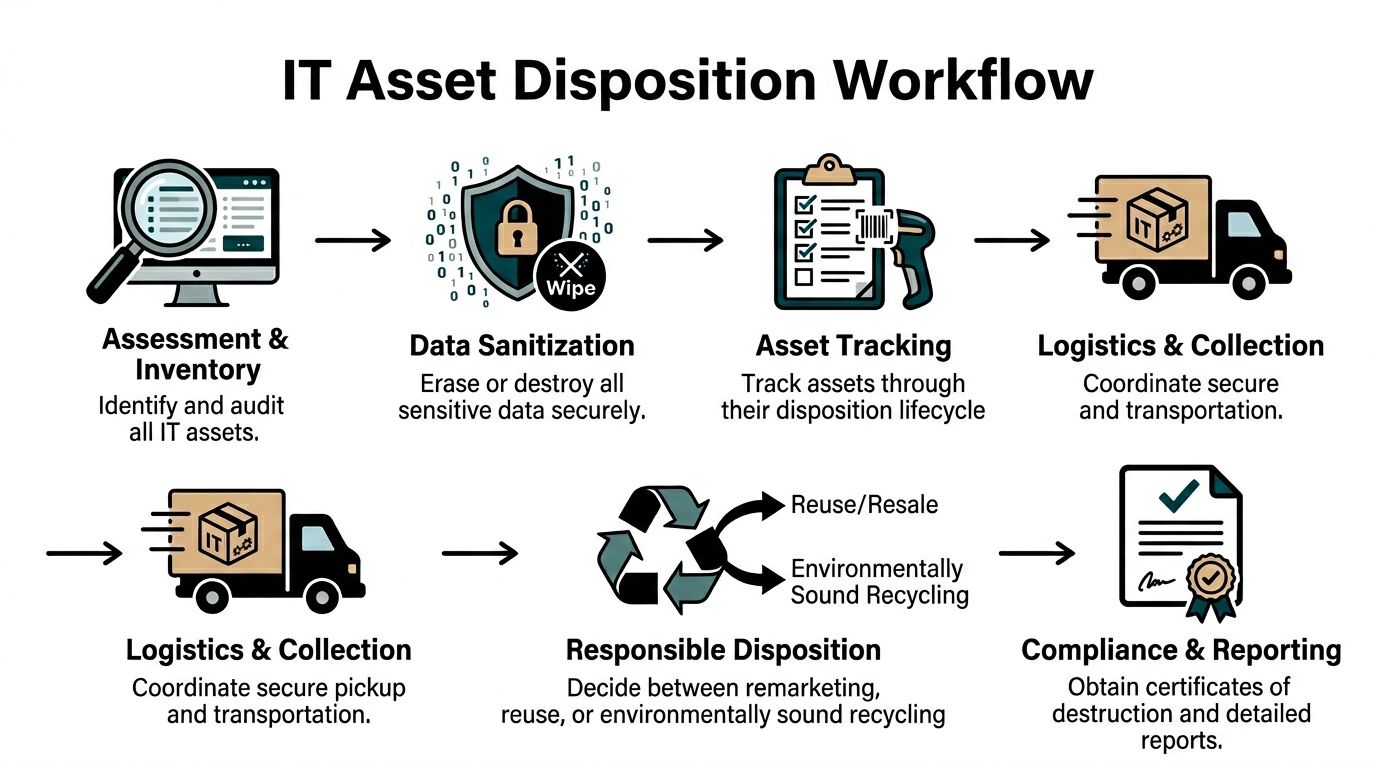
Stage one assessment and inventory
Start before anything is unplugged from its final location.
Build a working inventory that separates data-bearing, non-data-bearing, reusable, damaged, and regulated items. Pull serials where practical. Capture asset tags if your CMDB or endpoint platform uses them. Flag devices with unknown drive status.
This is also where you isolate exceptions. A dead laptop with a swollen battery should not move the same way as a working desktop intended for remarketing.
Stage two vendor selection and scope control
Choose the recycler before the equipment pile grows.
Write the scope in operational language, not generic recycling language. State whether the project includes onsite packing, rack removal, palletization, serialized scanning, media shredding, redeployment triage, or remarketing. If your team needs a foundational definition of process scope, this overview of what IT asset disposition is is useful for internal alignment.
Questions that tighten scope
- Will the vendor scan serials at pickup, at processing, or both?
- Which media will be wiped, and which will be physically destroyed?
- How are mixed loads handled if non-listed items appear on the dock?
- What is the timeline for final reporting?
Stage three secure logistics and pickup
Logistics is where many otherwise good projects go sideways.
Use a staging plan. Assign one internal owner on pickup day. Make sure pallets or gaylords are labeled by category if the project has mixed asset classes. If your site has loading dock restrictions, freight elevator windows, security escorts, or badging rules, communicate them early.
Practical tip: Do not let assets sit in an unsecured hallway or common receiving area waiting for the truck. Retirement projects often fail at the handoff, not the processing stage.
Stage four processing and data destruction
Once equipment reaches the processor, the workflow should become more controlled, not less.
A competent processor reconciles the inbound load, identifies media, applies the approved sanitization method, and routes equipment into reuse, parts harvesting, or recycling. Reuse should be intentional and documented. So should destruction.
What “responsible disposition” looks like
Some assets still have value and can be prepared for secondary use. Others are obsolete, damaged, or too risky to remarket. The processor should make that decision through policy, not improvisation.
A useful internal rule is simple:
- Devices with value and clean data status move toward reuse.
- Failed or sensitive media moves toward destruction.
- Commodity scrap moves toward certified recycling.
Stage five reporting and certification
This closes the loop. Without it, the job is not finished.
Final reporting should reconcile what was received, what happened to it, and what proof your team can retain. At minimum, that usually means destruction evidence for media, disposition records for the load, and documentation suitable for audit files or procurement review.
Common workflow failures
The pattern is predictable:
- Assets are collected without inventory discipline.
- Pickup is scheduled before scope is agreed.
- Mixed materials are handed over with no exception process.
- Reporting is requested after the fact.
- Internal teams cannot reconstruct what left the site.
That failure pattern is avoidable if the workflow is standardized and repeated every quarter, every office refresh, and every decommission event.
Planning for Logistics and Costs in Austin
A common Austin scenario looks like this. IT finishes a refresh across two offices, facilities wants the old equipment out by Friday, and security asks for proof that every drive was handled correctly. City recycling programs do not solve that problem. Businesses need scheduled collection, chain of custody, media controls, and reporting that stands up to audit review.
Public recycling in Austin is built for residential material streams, as noted earlier, not for enterprise loads with serialized laptops, failed drives, network gear, and restricted site access. That gap affects both logistics and cost. If your team treats an ITAD project like a standard recycling pickup, the quote will be wrong and the risk will sit with you.

What drives logistics complexity
Scope drives the plan.
A small office pickup may be straightforward if assets are boxed, inventoried, and staged at a dock. A hospital satellite office, law firm, or data center is different. Access windows may be tight. Equipment may be spread across floors. Drives may need separate handling. Removal may need to happen after hours so operations stay intact.
For Austin organizations, a business-focused service such as electronic disposal in Austin usually matches the actual work better than any resident-facing option. The vendor should be able to handle loading, transport, serialized intake, exception items, and final documentation without asking your staff to build that process on the fly.
What affects the final quote
ITAD pricing is usually based on scope, labor, risk, and recovery value.
Higher-value assets can offset part of the service cost if they are suitable for reuse and clear for resale. Low-value scrap, broken monitors, mixed peripherals, and heavily damaged equipment do not create the same offset. Data-bearing devices also change the cost structure quickly because sanitization, destruction, and reporting add handling steps that scrap-only jobs do not require.
Common cost drivers
- Asset mix: Laptops, servers, switches, monitors, printers, batteries, and loose drives do not move through the same process.
- Condition and resale potential: Working business-class hardware can reduce net cost. Obsolete or damaged equipment usually cannot.
- Packaging and staging: Palletized, labeled loads are faster and cheaper to process than loose equipment collected from multiple rooms.
- Data handling requirements: Serialized drive tracking, on-site shredding, or detailed wipe records increase labor and documentation time.
- Site constraints: Freight elevators, dock restrictions, security badging, parking limits, and narrow pickup windows affect crew size and truck time.
- Reporting depth: A basic weight ticket is not the same deliverable as full asset reconciliation with destruction records.
How to budget without surprises
Start with an internal intake sheet before you ask for pricing. That one step prevents a large share of change orders and quote revisions.
| Budget input | Why it matters |
|---|---|
| Asset list by category | Sets expected labor, truck space, and disposition path |
| Number of data-bearing items | Defines wipe, shred, and chain-of-custody requirements |
| Pickup location details | Affects route planning, access, and crew time |
| Packaging status | Changes loading speed and onsite labor needs |
| Required documentation | Determines reconciliation and certificate scope |
A per-pound recycling price is not enough for business e-waste in Austin. IT directors need to know what controls are included, what exceptions trigger added charges, and what documentation arrives at closeout. The lowest quote often excludes the work your compliance team assumes is standard.
Recycling Resources for Austin Nonprofits and Government
Nonprofits and government agencies face the same e-waste risks as private companies, but the decision pressure looks different. Budget limits are tighter. Procurement rules are stricter. Internal approvals take longer.
Austin’s recycling systems also operate under real financial pressure. The city’s recycling collection costs $11,305,945 annually, according to the analysis of Austin’s recycling programs. That helps explain why specialized private programs and partnerships matter for organizations that cannot rely on municipal systems to absorb commercial e-waste complexity.
For nonprofits
Many nonprofits hold equipment longer than private firms. By the time devices are retired, the asset mix often includes both reusable hardware and true scrap.
That creates an opportunity if the recycling partner can separate the two responsibly. Reuse value from workable equipment can sometimes help offset service costs. For budget-conscious organizations, that is often the only practical path to compliant disposition.
What nonprofits should ask for
- A reuse-first screening process for viable devices
- Clear documentation for donated, remarketed, or recycled assets
- Pickup options that do not require internal warehouse capacity
- Simple intake support for lean teams without dedicated ITAD staff
For government and public-sector buyers
Public-sector organizations need more than a recycling promise. They need a procurement-ready scope.
RFPs and bid documents should require the vendor to define media sanitization standards, chain-of-custody procedures, documentation outputs, and downstream controls. If the project includes regulated data, those requirements should be explicit and contractual.
A better model than ad hoc disposal
Nonprofits and government departments both benefit from the same operating principle. Treat e-waste as a managed service, not a cleanup event.
That approach supports sustainability goals, protects sensitive information, and avoids pushing difficult material into public channels that were not designed for it.
Tip: For cost-sensitive organizations, the best partner is often the one that can combine reuse, recycling, pickup logistics, and audit documentation in one scope of work. Fragmented vendors usually create more admin burden than they remove.
Austin Business E-Recycling Frequently Asked Questions
Can my business use Austin’s public drop-off resources for old computers
Do not assume yes. Public guidance is centered on residents, and official city information excludes businesses from dropping off hazardous waste at the Recycle and Reuse Drop-off Center. For commercial electronics, confirm eligibility and use a business-grade process instead of relying on resident-facing channels.
Can my business be fined for improper e-waste disposal in Austin
This should be treated as a compliance risk, not a technicality. The more immediate problem is often broader than fines. Improper handling can expose your organization to data loss, contract violations, internal audit findings, and environmental liability questions. A documented ITAD process is the practical defense.
What is the difference between a recycler and an ITAD partner
A recycler focuses on material recovery. An IT asset disposition partner manages the full retirement process for technology assets.
That usually includes inventory control, secure logistics, media sanitization, disposition decisions, and final documentation. If your retired equipment includes drives, corporate devices, or infrastructure hardware, you need the second category.
What documentation should I keep for an audit
Keep everything that proves control from handoff to final outcome.
Core records to retain
- Pickup records
- Asset lists or serialized inventories
- Certificates of destruction for media
- Recycling or disposition certificates
- Any exception reports for damaged, missing, or unscannable items
If your team needs to understand why destruction records matter, this guide to a certificate of destruction for hard drives is a useful reference.
How should we handle remote employee equipment in the Austin area
Do not let remote devices become informal disposal projects. The cleanest approach is to use a controlled return workflow with approved packaging, tracked shipping or managed pickup, and the same sanitization and reporting standards used for office assets.
The worst option is telling employees to “recycle locally” with no chain of custody. That breaks visibility immediately.
Should we wipe drives ourselves before pickup
Sometimes yes, but only if your internal process is mature and documented. Many organizations choose to keep devices intact and require vendor-side sanitization or destruction because that creates a single accountable record.
The key is consistency. A half-internal, half-informal process usually produces gaps in proof.
Can we mix office recycling and e-waste in one sustainability program
You can manage them under one sustainability umbrella, but not through one handling stream. Office paper, cardboard, and containers belong in your building recycling process. IT assets should move through a dedicated disposition workflow with security and reporting controls.
What should I do first if I have a pile of retired equipment right now
Start with containment and inventory.
Move the equipment into a controlled area. Separate data-bearing devices from peripherals. Estimate volume. Identify any regulated or high-sensitivity systems. Then engage a qualified ITAD partner and define pickup, sanitization, and reporting requirements before anything leaves the building.
How often should we review our process
At least whenever one of these changes: your compliance obligations, your equipment profile, your office footprint, or your chosen vendor. In practice, most organizations benefit from reviewing the workflow after each major refresh or decommission event and tightening the process based on what slowed the last one down.
If your team needs a secure, business-focused partner for IT asset disposition, Dallas Fortworth Computer Recycling provides nationwide service for organizations that need compliant electronics recycling, certified data destruction, and audit-ready reporting for office refreshes, data center projects, healthcare equipment, and public-sector technology retirement.