
Arlington Office Electronics Recycling A Practical How To Guide
Managing old office technology in Arlington isn't just about clearing out a storage closet—it's a critical business function tied directly to your company's security, compliance, and financial health. For IT directors and facilities teams, a proper Arlington office electronics recycling strategy transforms a major logistical headache into a streamlined, secure process.
Why Secure E-Waste Recycling Is a Critical Business Function
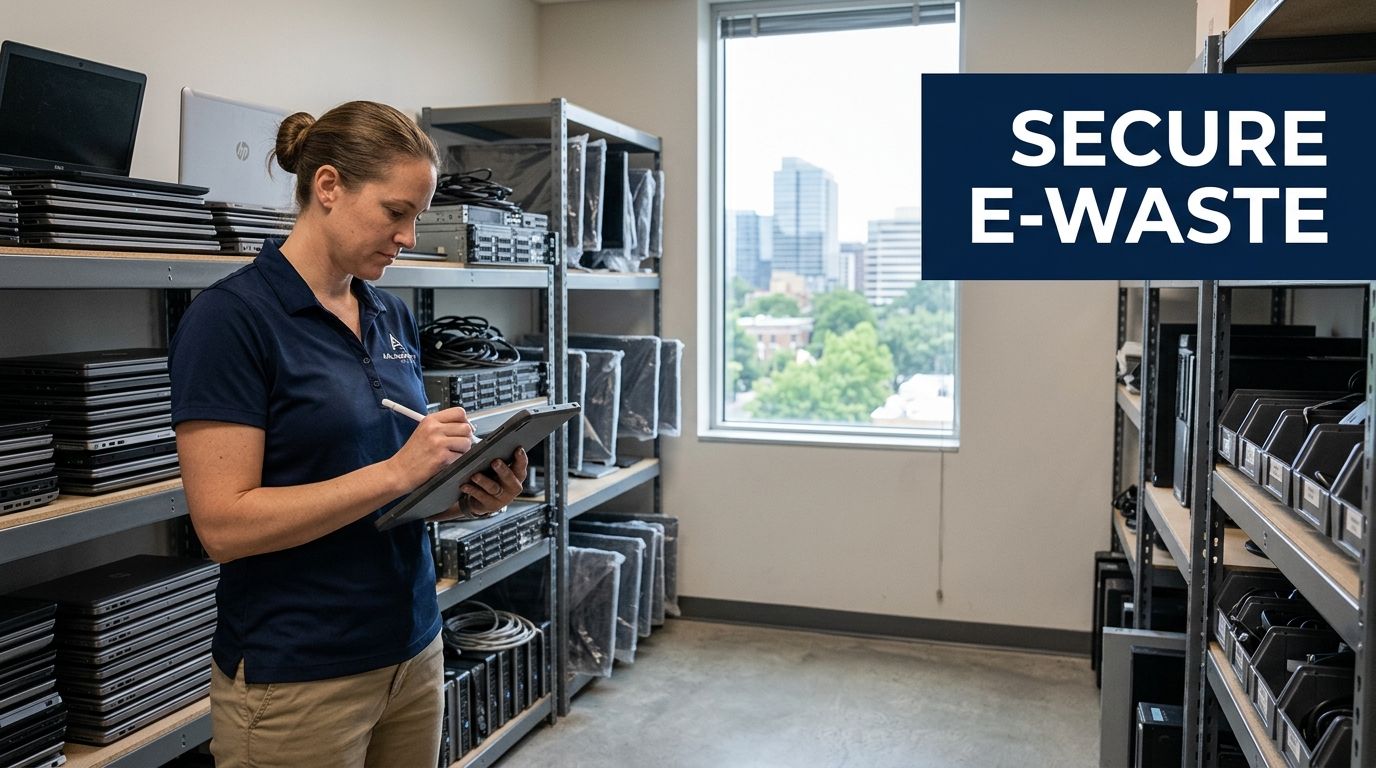
In a dynamic business center like Arlington, Texas, the sheer volume of retired devices from local startups and Fortune 500 headquarters creates significant risk. Thinking of old electronics as just "junk" is a costly mistake. Each retired server, laptop, and smartphone is a potential liability if not handled correctly.
The consequences of improper disposal are severe. Unsecured hard drives can lead to devastating data breaches, while incorrect handling of e-waste can result in heavy fines for non-compliance with environmental regulations. This isn't just about being "green"; it's a core component of modern risk management.
The Scale of E-Waste in Arlington
The amount of electronic waste generated locally is staggering. Tarrant County, where Arlington is a key economic hub, generates over 1.2 million tons of municipal solid waste annually, with electronics making up a fast-growing portion.
This translates to an estimated 24,000 to 60,000 tons of e-waste per year, much of it originating from office environments. A mid-size company with 500 employees might retire 200-300 devices annually. For IT directors, failing to manage this outflow is not an option, especially when a single data breach can cost a company an average of $4.88 million.
Key Takeaway: A proactive electronics recycling plan is non-negotiable. It moves the process from a reactive, chaotic cleanout to a strategic, documented procedure that protects your company's reputation and bottom line.
Beyond Disposal: A Strategic Approach
Viewing e-waste management as a strategic function changes the entire conversation. Instead of asking, "How do we get rid of this stuff?" the question becomes, "How can we securely and efficiently retire these assets while mitigating risk and recovering value?"
A professional partner helps you answer this by:
- Ensuring every device's data is irretrievably destroyed according to standards like NIST 800-88.
- Providing a documented chain of custody from your office to the final processing facility.
- Maximizing the value of reusable components through certified remarketing channels.
- Guaranteeing compliance with all federal, state, and local disposal regulations.
This proactive approach turns a compliance chore into a streamlined, secure, and sometimes even revenue-positive activity. Before diving into the specifics of planning, it's helpful to understand the wider positive impacts, which you can explore by reading about the benefits of e-waste recycling. This guide will provide the step-by-step actions needed to implement such a program in your Arlington office.
First, Build a Clear IT Asset Disposal Inventory
Before a single server or laptop leaves your Arlington office, you need to know exactly what you have. This isn't just about making a list; it's about building a detailed inventory that will drive every decision, from security and logistics to your final project cost.
I’ve seen it happen time and again: companies underestimate this step. A big office cleanout can easily involve hundreds of assets. Without a clear plan, data-bearing devices get missed, and valuable equipment gets tossed in with the scrap. The goal here is to transform that pile of old electronics into a structured, actionable inventory.
Cataloging Your Retiring Assets
Your first move is to create a master list. The details are what really matter. This inventory needs to be specific enough to guide decisions about data destruction and potential resale value down the line.
You can use a spreadsheet, but an existing IT Asset Management (ITAM) system is even better. For teams that need a more robust solution, it's worth exploring the best IT asset management software to automate a lot of this work.
For each and every asset, make sure you capture these key details:
- Asset Type: (e.g., Laptop, Desktop, Server, Monitor, Printer, Network Switch)
- Manufacturer and Model: (e.g., Dell Latitude 7420, HP LaserJet Pro M404)
- Serial Number: This is non-negotiable. It’s essential for chain-of-custody tracking.
- Internal Asset Tag: Your own internal tracking number.
- Physical Location: (e.g., Storage Closet B, Data Center Rack 42U)
- Condition: Be honest. Is it Working, Damaged, or completely Non-Functional?
- Data-Bearing Status: A simple Yes/No flag is critical for identifying devices that need data destruction.
A pro tip: Use barcode scanners to capture serial numbers and asset tags. This drastically cuts down on the manual data entry errors that always seem to pop up during these projects.
A detailed inventory is your single source of truth. It allows your recycling partner to provide an accurate quote, plan for the right data destruction methods, and create a precise chain-of-custody manifest before a single item leaves your facility.
Sorting for Reuse vs. Recycling
With your master list complete, the next job is to sort your assets. Not everything is destined for the shredder. How you categorize your equipment has a direct impact on your budget and your company's environmental goals.
As a rule of thumb, we separate items into three main buckets:
- Remarketing/Reuse: This is for your newer, functional equipment—think laptops, servers, and monitors that are less than five years old. These items still have market value and can often generate a financial return for your company.
- Donation: This category is perfect for functional but older gear that doesn’t meet your corporate standards anymore. Local Arlington-area nonprofits or schools can often put these devices to good use.
- Recycling/Destruction: This is the end of the line. It’s for anything obsolete, broken, or non-functional. It also includes any device that absolutely must be physically destroyed to meet security or compliance policies.
This sorting process is a cornerstone of a smart Arlington office electronics recycling program. By physically separating or clearly tagging these groups, you make the logistics for your recycling partner much simpler. It ensures valuable assets aren't destroyed by mistake and that true e-waste is handled responsibly.
Once your inventory is squared away, you’ve arrived at the most critical part of any Arlington office electronics recycling project: data security. For any IT leader or facilities manager, this isn't just a box to check—it’s your responsibility to protect the company, your clients, and your team. A single hard drive that falls through the cracks can cause a world of trouble.
This is where certified data destruction comes in. We’re not talking about simply hitting "delete." We’re talking about a formal, audited process for making data completely unrecoverable, governed by strict industry and federal standards like NIST 800-88.
Choosing the Right Data Destruction Method
The right method for destroying data depends entirely on the media type, your company's security policies, and any compliance rules you're bound by. A financial firm here in Arlington will have very different requirements than a local manufacturing plant, and the approach needs to reflect that.
We typically rely on three professional methods:
- Software-Based Wiping: Using specialized software, we overwrite a drive with random data, often in multiple passes. This is perfect for newer, functional hard drives (HDDs and SSDs) that you might want to reuse or resell, as it keeps the hardware intact.
- Degaussing: This process uses an incredibly powerful magnetic field to instantly scramble the data on magnetic media like older hard drives and backup tapes. It renders the drive unusable, so it’s only for assets headed straight for recycling.
- Physical Shredding: For the highest level of security, nothing beats physical destruction. We feed devices into industrial shredders that tear them into tiny, unrecognizable pieces. This method is irreversible and is the gold standard for top-secret data or the strictest compliance mandates.
To help you start thinking about which path your assets will take, this chart outlines the basic decision-making process.
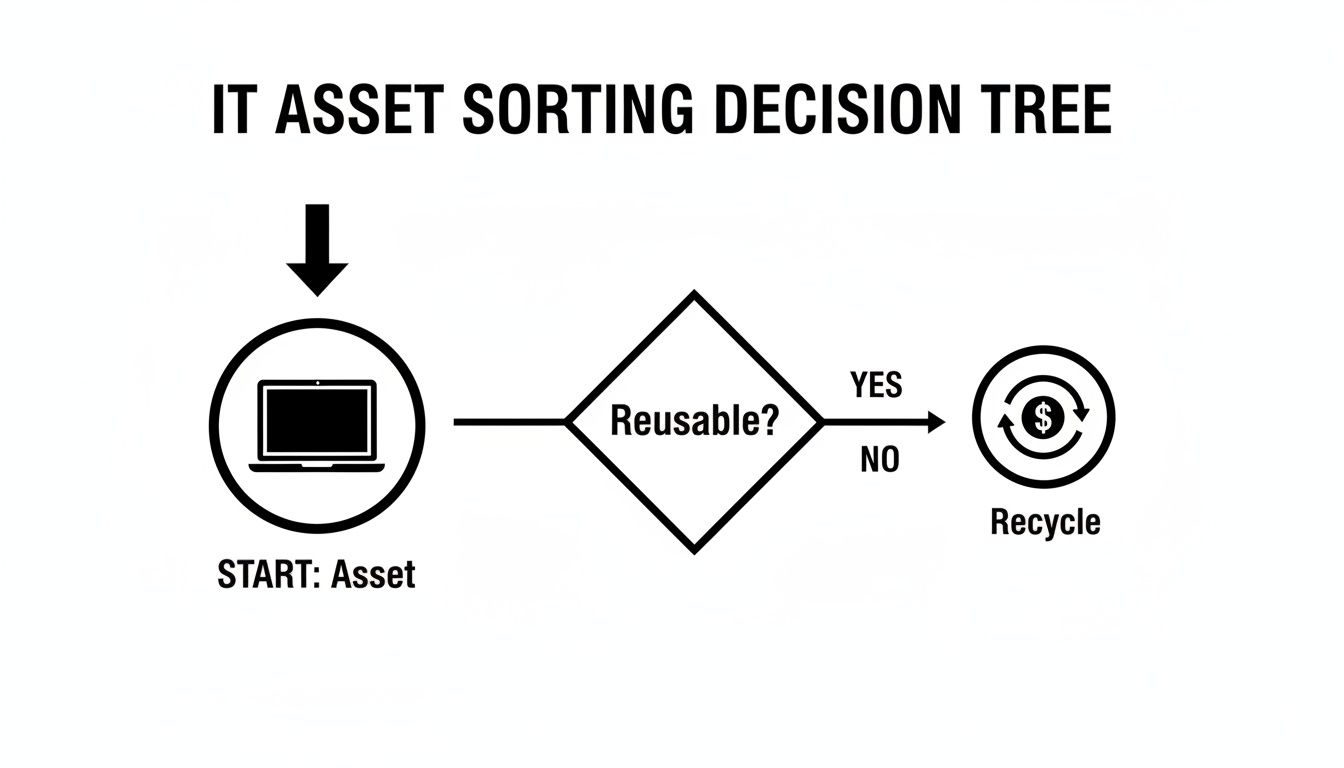
Sorting your gear is the first step. From there, we can determine the right data destruction method for each and every device.
Data Destruction Methods Comparison
Choosing between wiping, degaussing, and shredding can be confusing. This table breaks down the core differences to help you align a method with your specific asset types and security needs.
| Method | Description | Best For | Compliance Standard |
|---|---|---|---|
| Software Wiping | Overwrites drive with random data, preserving the hardware. | Functional HDDs & SSDs intended for reuse or remarketing. | NIST 800-88 Purge |
| Degaussing | Powerful magnetic field destroys data on magnetic media, rendering it inoperable. | End-of-life HDDs & magnetic tapes not suitable for reuse. | NIST 800-88 Purge |
| Physical Shredding | Industrial shredder grinds devices into small, irrecoverable fragments. | All media types requiring the highest level of security; damaged or non-functional drives. | NIST 800-88 Destroy |
Ultimately, the goal is to match the sanitization level to the data's sensitivity and the asset's next step, whether that's a new life or responsible recycling.
Understanding Key Security Certifications
When you partner with an electronics recycler, their certifications are your proof of quality and security. The two most important credentials to look for are NAID AAA Certification and adherence to NIST 800-88 guidelines. These aren't just fancy logos; they represent a commitment to a secure, documented process.
For businesses in Arlington, working with a NAID AAA Certified provider is especially important. Given that a reported 70% of data breaches stem from lost or stolen devices, this certification provides a crucial layer of assurance. It verifies everything from employee background checks to access controls and a documented chain of custody.
Expert Insight: Think of a Certificate of Data Destruction as your legal safe harbor. This single document serves as irrefutable proof that you performed your due diligence. It lists the serial numbers of the destroyed devices and certifies the date and method of destruction, creating an essential audit trail for compliance.
Your Final Proof of Compliance
Once the data destruction is complete, you should always receive a Certificate of Data Destruction. This isn't just a receipt—it's a legally binding record confirming every single data-bearing device you handed over has been properly sanitized or destroyed according to an agreed-upon standard.
This certificate should list every asset by its serial number and confirm its final disposition. For any IT manager, this documentation is gold. It closes the loop on your asset management and serves as concrete proof of compliance with regulations like HIPAA, SOX, or GDPR. Without it, you leave your organization exposed.
To see how this fits into our overall process, you can learn more about our secure data destruction process in Arlington.
Coordinating Logistics and Scheduling Your Pickup
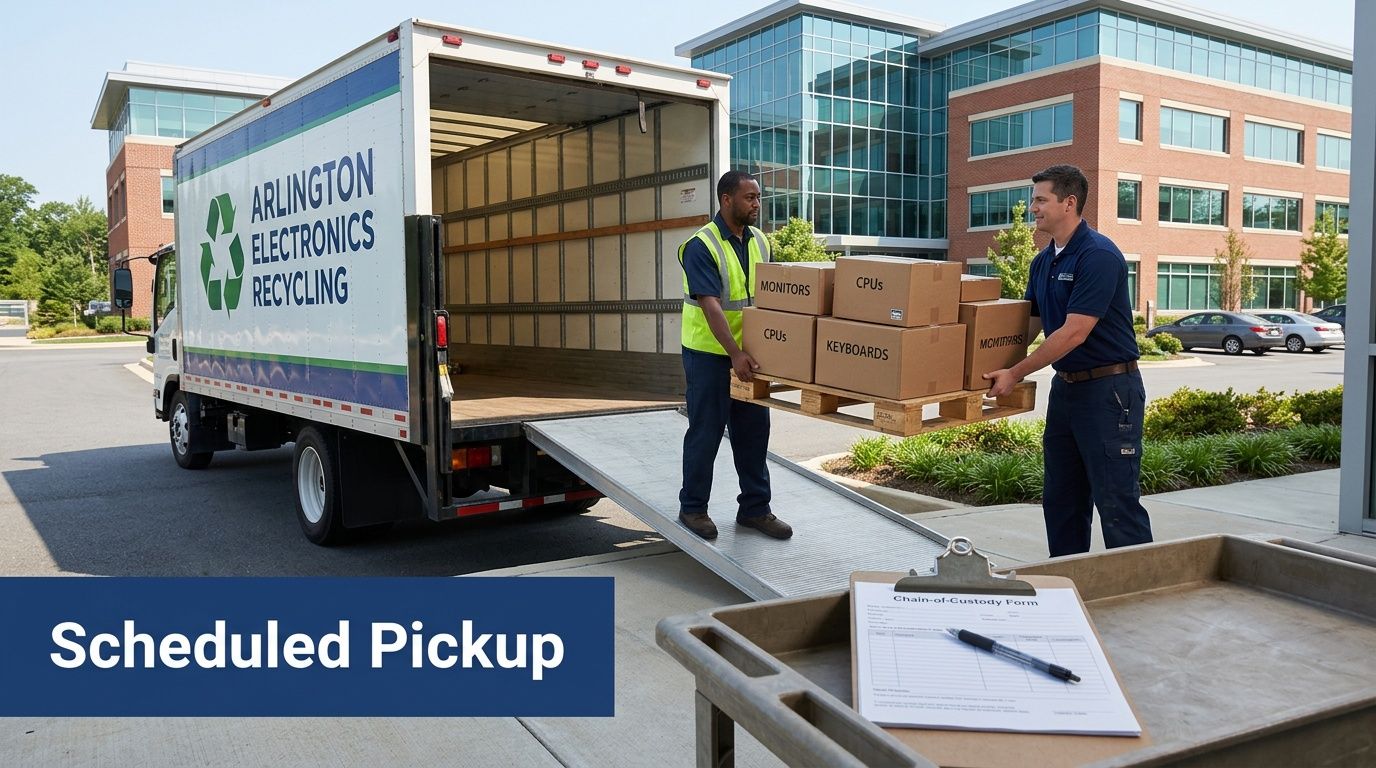
Once your assets are inventoried and the data is secure, the final step is getting the equipment out of your building. Moving hundreds—or even thousands—of pounds of old electronics without disrupting your business can feel like a major undertaking. But with good preparation and clear communication, it can be a smooth and straightforward process.
A seamless pickup doesn't happen by accident; it's the result of careful planning. This is especially true in the diverse commercial spaces across Arlington, from large corporate campuses to downtown high-rises. Our goal is to make the physical removal of your equipment a non-event for your team.
Preparing Your Equipment for Pickup
Before the truck arrives, a few simple prep steps will make the entire process faster and more secure. Think of it as staging your equipment for a clean handoff. This preparation prevents last-minute scrambling and ensures nothing gets missed.
While we'll provide specific instructions for your project, here is a general checklist to guide your team:
- Consolidate in One Area: Move all designated electronics to a single, accessible location. A ground-floor storage room or an area near a loading dock is perfect.
- Palette and Shrink-Wrap: For large jobs, stack equipment securely on pallets and shrink-wrap it. This is standard procedure for data center cleanouts and big office moves. It keeps assets protected and makes loading much quicker.
- Label Everything Clearly: Put labels on pallets or equipment groups that say "For E-Waste Recycling" and include your company name. This simple step prevents any active equipment from being removed by mistake.
Consolidating your assets also gives you a final chance to visually check everything against your inventory list, making sure the physical count matches the paperwork.
Navigating Common Logistical Hurdles
Every office has its own unique challenges. A partner experienced in Arlington office electronics recycling will know how to anticipate these issues and plan for them.
For example, a pickup from a downtown Arlington high-rise involves more than just pulling up a truck. We often need to coordinate with building management to reserve the loading dock, secure freight elevator access, and schedule the work for off-peak hours. I've personally managed projects where we worked on a Saturday just to avoid disrupting other tenants—that kind of flexibility is crucial.
Another common scenario is a large-scale data center decommissioning. This means removing heavy, sensitive servers and networking gear, which requires a crew with specialized dollies, server lifts, and the experience to move through tight spaces without causing damage.
Key Insight: Treat your recycling partner’s logistics team as a resource. A professional provider will always ask about building access, elevator availability, and security protocols in advance. This proactive approach is what separates a smooth pickup from a chaotic one.
The Importance of Chain-of-Custody Documentation
The moment our team arrives at your facility, the chain of custody begins. This is the formal, documented trail that tracks your assets from your office to their final disposition, and it's the foundation of a secure, compliant recycling program.
The process starts when our driver verifies the asset count or number of pallets against the pickup order. When they sign for the equipment, the responsibility for those assets officially transfers to us. A serialized manifest is created, and that document follows your equipment through transport, intake at our secure facility, and final processing.
This unbroken, auditable trail gives you complete transparency. It's your proof that what left your building is exactly what was received and processed, whether through data destruction, remarketing, or recycling. Ultimately, it’s your proof of due diligence.
For organizations managing a high volume of retiring assets, our team can help you design the most efficient process. You can learn more about how we manage pickups by checking out our guide on scheduling a computer recycling pickup in Arlington.
A smart Arlington office electronics recycling program is more than just a disposal task; it’s a strategic opportunity to recover value from retired assets and reinforce your company’s environmental commitments. Many IT leaders see old tech as a simple cost center, but a well-managed IT Asset Disposition (ITAD) program can deliver significant financial returns.
This approach transforms the process from merely getting rid of old equipment to strategically recovering value, strengthening your environmental credentials, and supporting the Arlington community.
Generating Revenue from Retired Tech
Not all retired electronics are waste. A surprising amount of your office equipment, especially items under five years old, still holds considerable resale value. Laptops, servers, networking gear, and even high-end monitors can often be refurbished and sold on secondary markets.
Through a professional remarketing program, businesses frequently recover 20-30% of an asset’s original purchase price. For an office upgrading a hundred high-spec laptops, this can mean tens of thousands of dollars returned directly to your IT budget. A qualified ITAD partner handles everything from cosmetic refurbishment and testing to secure resale, ensuring you get maximum value without the logistical burden. If you're curious about the market for individual components, our guide on where to sell computer parts offers more detail.
Defining True Environmental Responsibility
In the electronics recycling industry, terms like "green" and "sustainable" are common. However, a truly responsible program is defined by concrete certifications and policies that guarantee ethical and environmentally sound practices.
Two critical indicators of a top-tier recycling partner are:
- A "Zero-Landfill" Policy: This is a firm commitment that no part of your electronic waste will end up in a landfill. All materials are either recycled into raw commodities or properly processed.
- R2v3 Certification: The "Responsible Recycling" standard is the premier certification for the electronics recycling industry. An R2v3-certified provider has passed rigorous third-party audits covering data security, environmental health and safety, and the downstream tracking of all materials.
Choosing an R2v3-certified partner for your Arlington office electronics recycling provides assurance that your equipment is handled in a way that protects both the environment and your brand’s reputation.
Key Takeaway: The economic and environmental ROI of Arlington office electronics recycling shines through recovery statistics. Globally, while e-waste volumes hit 62 million metric tons, recycling in hubs like Arlington recovers precious metals worth billions. Locally, certified partners often refurbish up to 40% of office electronics for resale, returning significant value to businesses and ensuring that 100% of non-functional gear is diverted from landfills. Learn more about the latest e-waste statistics and their impact.
Fueling Corporate Social Responsibility Goals
Your surplus technology can be a powerful asset for community good. Functional equipment that no longer meets your corporate standards can be a lifeline for local nonprofits, schools, and community centers operating on tight budgets. A structured donation program does more than clear out a storage closet; it builds goodwill and demonstrates a tangible commitment to corporate social responsibility (CSR).
By partnering with an ITAD provider that facilitates these donations, you turn retired tech into a valuable resource that strengthens the Arlington community.
Examples of Donation Impact:
- Local Nonprofits: Donated desktops and laptops can help a nonprofit expand its administrative capacity or provide essential job training services.
- Educational Institutions: Schools and after-school programs can use your retired tablets and computers to create digital literacy workshops for students.
- Community Centers: Your old printers and monitors can help a community center set up a public computer lab for residents to use for job searches and accessing services.
This approach not only aligns with environmental goals by extending the life of electronics but also creates a positive story your company can proudly share.
Your Partner for Secure Arlington Electronics Recycling
Finding the right partner is the single most important decision you'll make in your electronics recycling project. As we've covered, proper Arlington office electronics recycling isn't just about hauling away old equipment—it’s a critical part of your company's risk management and compliance strategy.
Working with a single, dedicated partner for IT asset disposition means you have one team accountable for the entire process. Instead of managing separate vendors for pickup, data destruction, and reporting, you get a unified solution that guarantees a secure, unbroken chain of custody from your office to the final disposition.
Choosing the right partner means you're not just hiring a hauling service; you're engaging a specialist dedicated to protecting your data, maximizing asset value, and ensuring every device is handled responsibly.
This guide gives you the blueprint for a secure and compliant project. With over 13 years of experience serving businesses across the nation and right here in North Texas, Dallas Fort Worth Computer Recycling is ready to put this plan into action for your organization.
Frequently Asked Questions About Office E-Waste Recycling
Even with a solid plan, you're bound to have a few questions when it's time to clear out old office electronics. We get it. To give you some clarity, we've gathered the most common questions we hear from Arlington businesses.
Our goal is to answer your questions upfront so you can move forward with confidence.
What Types of Electronics Do You Accept?
This is always the first question, and the answer is simple: if it plugs into a wall or has a circuit board, we can almost certainly handle it. We work with a huge range of office electronics, from everyday IT gear to more specialized equipment.
Our business e-recycling services cover:
- IT Hardware: Desktops, laptops, servers, and all the peripherals that go with them like keyboards, mice, and monitors.
- Networking Gear: Routers, switches, hubs, and entire server racks.
- Office Equipment: Printers, copiers, scanners, and fax machines.
- Miscellaneous Electronics: Office phones, projectors, and every type of cable you can imagine.
If you have an unusual item and aren't sure, just ask us. It's always better to confirm than to assume, especially with large or specialized pieces of equipment.
Is My Small Business Too Small for Your Services?
Absolutely not. We have the logistics to manage massive data center decommissioning projects, but we work with small and mid-sized businesses across Arlington every single day.
A local law firm with a dozen laptops needs the same level of data security and compliance as a Fortune 500 company. The risks of a data breach don't care about the size of your business. No project is "too small" when secure data handling is on the line.
How Much Does Arlington Office Electronics Recycling Cost?
The cost of Arlington office electronics recycling really depends on the project. We look at the types and volume of equipment, the logistics involved, and the level of data destruction you require. Certain items, like old CRT monitors, do have a recycling fee because of the hazardous materials inside.
Key Insight: Many projects end up being cost-neutral, and some even generate a return. If you have newer equipment with resale value, the revenue recovered from remarketing can often offset or even exceed the service fees.
What Guarantees Do I Have That My Data Is Secure?
Your guarantee is built on our certified process and the official documentation you receive. We are NAID AAA Certified for data destruction. This isn't just a label; it means our facility, our employees, and our entire process are subject to rigorous, unannounced third-party audits to ensure we meet the highest security standards.
When the job is done, you get a Certificate of Data Destruction. This legally defensible document lists every single serialized asset and confirms the exact method and date of destruction. It's your official audit trail and the ultimate proof that your sensitive data is gone for good.
Ready to make sure your old electronics are handled securely, compliantly, and responsibly? Contact Dallas Fortworth Computer Recycling to schedule a consultation and get a clear, actionable plan for your business.